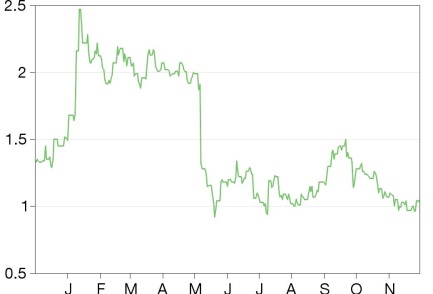
Alexza reported total debt on 30 September 2015 of $67.7m, which includes the $45m private placement debt financing secured in March 2014 (bearing interest at 12.25% pa), as well as a discounted amount of the $25m that was drawn from the Teva note facility. Given $11.3m cash and equivalents, we determine Q315 net debt of $56.4m.
Alexza’s cash burn rate (operating cash flow plus net capex) in Q315 was $7.5m but we expect it to decrease given the suspension in Adasuve manufacturing and other headcount cuts described above. We project a cash burn rate of c $5.7m in both Q415 and Q116. We expect Alexza’s current cash resources, and remaining amounts available under the Ferrer Note, should be sufficient for the company to meet its cash needs into Q216, or through its planned strategic review process. This process can lead to cash infusions to better fund the AZ-002 and AZ-007 programs, as well as new potential US Adasuve license relationships.
In our model, we assume the company will find and secure a new manufacturing partner before Adasuve reshipments are required (which we anticipate to begin in H217). We also believe that Teva will not require or request repayment of the $25m Teva note until 2018 (the original projected repayment date prior to their decision to return US Adasuve rights to Alexza), although this is not assured, and if Teva requires repayment or an equity for debt swap, current shareholders could be subject to significant dilution.
Subject to interest from would-be collaborators or partners, the ongoing strategic review can potentially provide an opportunity for the company and investors to realize upside to the current market value by partnering, selling, or out-licensing aspects from the firm’s pipeline (Adasuve, AZ-002, AZ-007, etc), or even by merging with another company. However, until further clarity, continue to value Alexza as an independent entity pursuing all the above-mentioned current pipeline projects, using our relative net present value (rNPV) approach.
Our base case projects that Alexza will raise $35m in 2016 and in 2017 via debt to pursue its R&D programs, and that Alexza will start a Phase II MOTN awakening study for AZ-007 in H216 (this pushes back our potential AZ-007 launch timing forecast from 2019 to 2020). While our model projects that the upcoming financings will be in the form of long-term debt, the firm could also issue equity capital to meet its funding obligations. We do not include the potential of upfront payments from additional Adasuve territory licensing deals or from possible Staccato technology transactions.
Exhibit 3: Alexza Pharmaceuticals rNPV assumptions
Product |
Indication |
rNPV (US$m) |
rNPV/
share
(US$) |
Probability
of success (%) |
Estimated
launch year |
Estimated peak US market share (%) |
Current market value (US$m) globally |
Estimated
max US royalty rate (%) |
Estimated peak WW sales (US$m) |
Adasuve revenue and milestones |
Agitation |
131.2 |
6.52 |
100 |
2013 |
12.5 |
1,100 |
20 |
279 in 2022 |
AZ-002 revenue and milestones |
Acute repetitive seizures |
14.8 |
0.74 |
25 |
2018 |
20 |
470 |
25 |
86 in 2023 |
AZ-007 revenue and milestones |
Middle of night awakening |
32.7 |
1.62 |
20 |
2020 |
5 |
9,400 |
20 |
484 in 2025 |
COGS and Adasuve contingency costs |
|
(40.8) |
(2.03) |
|
|
|
|
|
|
R&D expenses |
|
(18.9) |
(0.94) |
|
|
|
|
|
|
SG&A expenses |
|
(36.0) |
(1.79) |
|
|
|
|
|
|
Net Capex, NWC and taxes |
|
(5.6) |
(0.28) |
|
|
|
|
|
|
Total pipeline rNPV |
|
77.3 |
3.84 |
|
|
|
|
|
|
Net debt (Q315) |
|
56.4 |
2.80 |
|
|
|
|
|
|
Total equity value |
|
20.9 |
1.04 |
|
|
|
|
|
|
FD shares outstanding (m) |
|
20.1 |
|
|
|
|
|
|
|
Source: Edison Investment Research
Given our reduced Adasuve market share and sales growth assumptions, our Adasuve-derived revenue (including milestones) contribution to our rNPV has declined to $131.2m, from $220.7m, previously. This effect is offset by a significant reduction in our forecasts for Adasuve COGS and contingency cost component (from $128.0m, to $40.8m), which anticipates significant cost-savings to Alexza through:
■
its transfer of product manufacturing responsibilities to a third party; and
■
our assumption that the framework for a new US licensing agreement with a new pharma marketer will reduce Alexza’s overall responsibility for product supply and manufacturing and providing other support functions (ie under the old Teva agreement, Alexza was still responsible for supply and manufacturing, and many post-marketing regulatory activities).
Altogether, we assume Alexza will retain a strong interest in Adasuve revenue, but will be able to significantly reduce its cost commitment. Our new rNPV valuation is $77.3m (from $77.7m, previously). After removing $56.4m Q315 net debt, we derive an equity valuation of $20.9m, or $1.04 per share fully diluted.
Exhibit 4: Financial summary
|
|
US$000s |
2013 |
2014 |
2015e |
2016e |
2017e |
Year-end 31 December |
|
|
US GAAP |
US GAAP |
US GAAP |
US GAAP |
US GAAP |
PROFIT & LOSS |
|
|
|
|
|
|
|
Revenue |
|
|
47,839 |
5,561 |
4,903 |
2,200 |
7,203 |
Cost of Sales |
|
|
(11,209) |
(15,925) |
(14,354) |
0 |
(5,200) |
Gross Profit |
|
|
36,630 |
(10,364) |
(9,451) |
2,200 |
2,003 |
General & Administrative |
|
|
(12,492) |
(9,951) |
(9,778) |
(5,600) |
(6,138) |
Research & Development |
|
|
(19,082) |
(13,748) |
(11,898) |
(14,085) |
(15,798) |
EBITDA |
|
|
5,056 |
(34,063) |
(31,127) |
(17,485) |
(19,933) |
Operating Profit (before except.and Allegro payouts) |
1,770 |
(37,456) |
(33,956) |
(19,345) |
(21,500) |
Intangible Amortization |
|
|
0 |
0 |
0 |
0 |
0 |
Exceptionals |
|
|
(29,587) |
8,413 |
19,100 |
0 |
0 |
Other including payouts to Symphony Allegro |
|
(10,326) |
(251) |
(868) |
0 |
(1,721) |
Operating Profit |
|
|
(38,143) |
(29,294) |
(15,724) |
(19,345) |
(23,221) |
Net Interest |
|
|
(1,472) |
(7,438) |
(7,966) |
(8,986) |
(12,233) |
Profit Before Tax (norm) |
|
|
(10,028) |
(45,145) |
(42,790) |
(28,332) |
(35,455) |
Profit Before Tax (FRS 3) |
|
|
(39,615) |
(36,732) |
(23,690) |
(28,332) |
(35,455) |
Tax |
|
|
0 |
0 |
0 |
0 |
0 |
Profit After Tax (norm) |
|
|
(10,028) |
(45,145) |
(42,790) |
(28,332) |
(35,455) |
Profit After Tax (FRS 3) |
|
|
(39,615) |
(36,732) |
(23,690) |
(28,332) |
(35,455) |
|
|
|
|
|
|
|
|
Average Number of Shares Outstanding (m) |
|
16.7 |
17.8 |
19.7 |
20.0 |
20.3 |
EPS - normalized (US$) |
|
|
(0.60) |
(2.54) |
(2.17) |
(1.42) |
(1.74) |
EPS - normalized and fully diluted (US$) |
|
(0.60) |
(2.54) |
(2.14) |
(1.40) |
(1.71) |
EPS - (IFRS) (US$) |
|
|
(2.38) |
(2.07) |
(1.20) |
(1.42) |
(1.74) |
Dividend per share ($) |
|
|
0.0 |
0.0 |
0.0 |
0.0 |
0.0 |
|
|
|
|
|
|
|
|
BALANCE SHEET |
|
|
|
|
|
|
|
Fixed Assets |
|
|
16,159 |
19,775 |
12,503 |
10,919 |
9,642 |
Intangible Assets |
|
|
0 |
0 |
0 |
0 |
0 |
Tangible Assets |
|
|
16,159 |
17,018 |
12,503 |
10,919 |
9,642 |
Investments (new ABCP Notes) |
|
|
0 |
2,757 |
0 |
0 |
0 |
Current Assets |
|
|
30,913 |
41,785 |
7,116 |
13,281 |
14,472 |
Short-term investments |
|
|
8,578 |
19,574 |
0 |
0 |
0 |
Debtors |
|
|
0 |
0 |
0 |
0 |
0 |
Cash |
|
|
17,306 |
15,200 |
5,583 |
12,014 |
12,729 |
Other |
|
|
5,029 |
7,011 |
1,533 |
1,266 |
1,743 |
Current Liabilities |
|
|
(14,898) |
(11,517) |
(12,108) |
(11,858) |
(11,858) |
Creditors |
|
|
(14,118) |
(11,517) |
(9,194) |
(8,944) |
(8,944) |
Short term borrowings |
|
|
(780) |
0 |
(2,914) |
(2,914) |
(2,914) |
Long Term Liabilities |
|
|
(56,149) |
(101,696) |
(81,758) |
(114,558) |
(149,558) |
Long term borrowings |
|
|
(10,859) |
(63,767) |
(64,774) |
(99,774) |
(134,774) |
Other long term liabilities |
|
|
(45,290) |
(37,929) |
(16,984) |
(14,784) |
(14,784) |
Net Assets |
|
|
(23,975) |
(51,653) |
(74,247) |
(102,217) |
(137,302) |
|
|
|
|
|
|
|
|
CASH FLOW |
|
|
|
|
|
|
|
Operating Cash Flow |
|
|
(9,453) |
(34,312) |
(26,730) |
(19,306) |
(21,762) |
Net Interest |
|
|
(1,472) |
(7,438) |
(7,966) |
(8,986) |
(12,233) |
Tax |
|
|
0 |
0 |
0 |
0 |
0 |
Capex |
|
|
(1,768) |
(2,363) |
(263) |
(276) |
(290) |
Acquisitions/disposals |
|
|
0 |
0 |
0 |
0 |
0 |
Financing |
|
|
6,583 |
5,878 |
175 |
0 |
0 |
Dividends |
|
|
0 |
0 |
0 |
0 |
0 |
Other |
|
|
0 |
0 |
0 |
0 |
0 |
Net Cash Flow |
|
|
(6,110) |
(38,235) |
(34,784) |
(28,568) |
(34,285) |
Opening net debt/(cash) |
|
|
(16,305) |
(14,245) |
26,236 |
62,105 |
90,674 |
HP finance leases initiated |
|
|
0 |
0 |
0 |
0 |
0 |
Other |
|
|
4,050 |
(2,246) |
(1,085) |
(0) |
0 |
Closing net debt/(cash) |
|
|
(14,245) |
26,236 |
62,105 |
90,674 |
124,959 |
Source: Alexza accounts, Edison Investment Research. Note: We assume $35m debt financing in 2016, and $35m in 2017.
Edison, the investment intelligence firm, is the future of investor interaction with corporates. Our team of over 100 analysts and investment professionals work with leading companies, fund managers and investment banks worldwide to support their capital markets activity. We provide services to more than 400 retained corporate and investor clients from our offices in London, New York, Frankfurt, Sydney and Wellington. Edison is authorised and regulated by the Financial Conduct Authority (www.fsa.gov.uk/register/firmBasicDetails.do?sid=181584). Edison Investment Research (NZ) Limited (Edison NZ) is the New Zealand subsidiary of Edison. Edison NZ is registered on the New Zealand Financial Service Providers Register (FSP number 247505) and is registered to provide wholesale and/or generic financial adviser services only. Edison Investment Research Inc (Edison US) is the US subsidiary of Edison and is regulated by the Securities and Exchange Commission. Edison Investment Research Limited (Edison Aus) [46085869] is the Australian subsidiary of Edison and is not regulated by the Australian Securities and Investment Commission. Edison Germany is a branch entity of Edison Investment Research Limited [4794244]. www.edisongroup.com DISCLAIMER
Copyright 2015 Edison Investment Research Limited. All rights reserved. This report has been commissioned by Alexza Pharmaceuticals and prepared and issued by Edison for publication globally. All information used in the publication of this report has been compiled from publicly available sources that are believed to be reliable, however we do not guarantee the accuracy or completeness of this report. Opinions contained in this report represent those of the research department of Edison at the time of publication. The securities described in the Investment Research may not be eligible for sale in all jurisdictions or to certain categories of investors. This research is issued in Australia by Edison Aus and any access to it, is intended only for "wholesale clients" within the meaning of the Australian Corporations Act. The Investment Research is distributed in the United States by Edison US to major US institutional investors only. Edison US is registered as an investment adviser with the Securities and Exchange Commission. Edison US relies upon the "publishers' exclusion" from the definition of investment adviser under Section 202(a)(11) of the Investment Advisers Act of 1940 and corresponding state securities laws. As such, Edison does not offer or provide personalised advice. We publish information about companies in which we believe our readers may be interested and this information reflects our sincere opinions. The information that we provide or that is derived from our website is not intended to be, and should not be construed in any manner whatsoever as, personalised advice. Also, our website and the information provided by us should not be construed by any subscriber or prospective subscriber as Edison’s solicitation to effect, or attempt to effect, any transaction in a security. The research in this document is intended for New Zealand resident professional financial advisers or brokers (for use in their roles as financial advisers or brokers) and habitual investors who are “wholesale clients” for the purpose of the Financial Advisers Act 2008 (FAA) (as described in sections 5(c) (1)(a), (b) and (c) of the FAA). This is not a solicitation or inducement to buy, sell, subscribe, or underwrite any securities mentioned or in the topic of this document. This document is provided for information purposes only and should not be construed as an offer or solicitation for investment in any securities mentioned or in the topic of this document. A marketing communication under FCA Rules, this document has not been prepared in accordance with the legal requirements designed to promote the independence of investment research and is not subject to any prohibition on dealing ahead of the dissemination of investment research. Edison has a restrictive policy relating to personal dealing. Edison Group does not conduct any investment business and, accordingly, does not itself hold any positions in the securities mentioned in this report. However, the respective directors, officers, employees and contractors of Edison may have a position in any or related securities mentioned in this report. Edison or its affiliates may perform services or solicit business from any of the companies mentioned in this report. The value of securities mentioned in this report can fall as well as rise and are subject to large and sudden swings. In addition it may be difficult or not possible to buy, sell or obtain accurate information about the value of securities mentioned in this report. Past performance is not necessarily a guide to future performance. Forward-looking information or statements in this report contain information that is based on assumptions, forecasts of future results, estimates of amounts not yet determinable, and therefore involve known and unknown risks, uncertainties and other factors which may cause the actual results, performance or achievements of their subject matter to be materially different from current expectations. For the purpose of the FAA, the content of this report is of a general nature, is intended as a source of general information only and is not intended to constitute a recommendation or opinion in relation to acquiring or disposing (including refraining from acquiring or disposing) of securities. The distribution of this document is not a “personalised service” and, to the extent that it contains any financial advice, is intended only as a “class service” provided by Edison within the meaning of the FAA (ie without taking into account the particular financial situation or goals of any person). As such, it should not be relied upon in making an investment decision. To the maximum extent permitted by law, Edison, its affiliates and contractors, and their respective directors, officers and employees will not be liable for any loss or damage arising as a result of reliance being placed on any of the information contained in this report and do not guarantee the returns on investments in the products discussed in this publication. FTSE International Limited (“FTSE”) © FTSE 2015. “FTSE®” is a trade mark of the London Stock Exchange Group companies and is used by FTSE International Limited under license. All rights in the FTSE indices and/or FTSE ratings vest in FTSE and/or its licensors. Neither FTSE nor its licensors accept any liability for any errors or omissions in the FTSE indices and/or FTSE ratings or underlying data. No further distribution of FTSE Data is permitted without FTSE’s express written consent. |
Frankfurt +49 (0)69 78 8076 960 Schumannstrasse 34b 60325 Frankfurt Germany |
London +44 (0)20 3077 5700 280 High Holborn London, WC1V 7EE United Kingdom |
New York +1 646 653 7026 245 Park Avenue, 39th Floor 10167, New York US |
Sydney +61 (0)2 9258 1161 Level 25, Aurora Place 88 Phillip St, Sydney NSW 2000, Australia |
Wellington +64 (0)48 948 555 Level 15, 171 Featherston St Wellington 6011 New Zealand |
Frankfurt +49 (0)69 78 8076 960 Schumannstrasse 34b 60325 Frankfurt Germany |
London +44 (0)20 3077 5700 280 High Holborn London, WC1V 7EE United Kingdom |
New York +1 646 653 7026 245 Park Avenue, 39th Floor 10167, New York US |
Sydney +61 (0)2 9258 1161 Level 25, Aurora Place 88 Phillip St, Sydney NSW 2000, Australia |
Wellington +64 (0)48 948 555 Level 15, 171 Featherston St Wellington 6011 New Zealand |
|