Last close As at 05/08/2026
EUR277.40
— 0.00 (0.00%)
Market capitalisation
—
Research: TMT
Esker reported FY23 results in line with our expectations. Revenue grew 12% (14% constant currency) while inflationary effects and sales commissions on bookings outperformance in H223 resulted in operating profit declining 16% y-o-y. The high level of contracts signed towards the end of FY23 provide good support for revenue growth in FY24 and FY25 and measures taken by management to improve productivity should drive margin expansion over our forecast period back into the company’s target range of 12–15%.
Esker |
Targeting margin recovery in FY24 |
FY23 results, |
Software and comp services |
1 May 2024 |
Share price performance
Business description
Next events
Analyst
Esker is a research client of Edison Investment Research Limited |
|||||||||||||||||||||||||||||||||||||||||||||||||||
Esker reported FY23 results in line with our expectations. Revenue grew 12% (14% constant currency) while inflationary effects and sales commissions on bookings outperformance in H223 resulted in operating profit declining 16% y-o-y. The high level of contracts signed towards the end of FY23 provide good support for revenue growth in FY24 and FY25 and measures taken by management to improve productivity should drive margin expansion over our forecast period back into the company’s target range of 12–15%.
Year end |
Revenue (€m) |
PBT* |
EPS* |
DPS |
P/E |
Yield |
12/22 |
159.0 |
23.4 |
3.04 |
0.75 |
57.4 |
0.4 |
12/23 |
178.6 |
19.8 |
2.47 |
0.64 |
70.7 |
0.4 |
12/24e |
200.0 |
25.9 |
3.20 |
0.83 |
54.7 |
0.5 |
12/25e |
227.7 |
31.9 |
3.89 |
1.00 |
45.0 |
0.6 |
Note: *PBT and EPS (fully diluted) are normalised, excluding amortisation of acquired intangibles, exceptional items and share-based payments.
FY23 results in line; FY24 focus on productivity
Esker reported FY23 results in line with our forecasts, which were updated in January post the revenue update. FY23 operating margin, down 3.4pp to 10.0%, was affected by the inflationary environment and outperformance by the sales team. The former should moderate in FY24 and the latter is a positive indicator of future revenue growth. Q124 revenue grew 12% y-o-y. Management noted that it had slowed the pace of hiring during FY23 and would continue to hire at a more modest rate during FY24. With guidance for FY24 unchanged (constant currency revenue growth of 12–14%, operating margin 12–13%), our FY24 forecasts are materially unchanged and we introduce FY25 forecasts for 13.8% revenue growth and 13.3% operating margin.
Strong bookings intake drives future growth
Esker grew bookings 23% in FY23, with intake backend loaded towards the last four months of the year as companies in France prepared for upcoming regulation around e-invoicing. Moving into FY24, the company expects bookings growth to accelerate in the US and for demand in France to remain strong; Q124 bookings were 37% higher year-on-year. Factoring in the time it takes to implement software, the company should start to see the benefits of H223 bookings from mid-FY24.
Valuation: Small discount to US SaaS peers
Based on EV/sales and P/E ratios, the stock continues to trade at a premium to French software peers (CY P/E c 22x). We believe this is due to Esker’s high level of recurring revenue, history of and potential for double-digit profitable growth and strong balance sheet, and it trades at a small discount to US SaaS peers (CY P/E c 60x). Potential triggers for upgrades include improving traffic volumes, successful implementation of recent contract wins, evidence of margin growth and continued strength in new business wins. With net cash of €46.0m at the end of Q124, the company is wellfunded to make bolt-on acquisitions or buy back shares.
Review of FY23 results
The table below summarises Esker’s FY23 results.
Exhibit 1: FY23 results highlights
€m |
FY22a |
FY23e |
FY23a |
Difference |
y-o-y |
Revenues |
159.0 |
178.6 |
178.6 |
0.0% |
12.3% |
EBITDA |
31.8 |
29.7 |
29.6 |
(0.4%) |
(7.0%) |
EBITDA margin |
20.0% |
16.6% |
16.6% |
(0.1%) |
(3.4%) |
Normalised EBIT |
21.7 |
18.3 |
18.2 |
(0.5%) |
(16.1%) |
Normalised EBIT margin |
13.6% |
10.2% |
10.2% |
(0.1%) |
(3.4%) |
Reported EBIT |
21.4 |
18.0 |
17.9 |
(0.5%) |
(16.3%) |
Reported EBIT margin |
13.5% |
10.1% |
10.0% |
(0.1%) |
(3.4%) |
Normalised PBT |
23.4 |
19.7 |
19.8 |
0.5% |
(15.5%) |
Normalised net income |
18.3 |
15.0 |
15.0 |
0.2% |
(18.0%) |
Reported net income |
17.9 |
14.8 |
14.9 |
0.6% |
(16.8%) |
Normalised diluted EPS (€) |
3.04 |
2.46 |
2.47 |
0.6% |
(18.8%) |
Reported basic EPS (€) |
3.04 |
2.51 |
2.53 |
1.0% |
(16.7%) |
Reported diluted EPS (€) |
2.97 |
2.42 |
2.45 |
1.0% |
(17.6%) |
Net cash |
32.6 |
39.8 |
42.8 |
7.3% |
31.3% |
DPS (€) |
0.75 |
0.80 |
0.64* |
(20.0%) |
(14.7%) |
Source: Esker, Edison Investment Research. Note: *Estimate. Will not be proposed until AGM in June.
The company reported FY23 revenue in January so this was as expected, with reported revenue 12% higher year-on-year and constant currency (cc) growth of 14%. SaaS revenue increased 17% cc, to make up 82% of total revenue, implementation services revenue increased 12% cc and legacy products revenue declined 49% cc to make up only 2% of group revenue.
All other measures were broadly in line with our forecasts, other than net cash, which was €3m higher than expected due to a higher working capital inflow, and increased 31% y-o-y. We have reduced our dividend forecast for FY23 as the company confirmed that it would adhere to its policy of paying out 25% of earnings, even if this means the dividend will decline year-on-year.
The company provided some additional data to explain why the operating margin declined 3.4pp compared to FY22. The table below shows a reconciliation of operating income from FY22 to FY23.
Exhibit 2: Reconciliation of operating profit FY22 to FY23
€m |
|
FY22 operating income |
21.4 |
Revenue growth |
19.6 |
Sales commissions |
(3.5) |
Headcount growth |
(6.8) |
Salary increase |
(4.8) |
Tax accrual on free shares |
(2.4) |
Full year of Market Dojo |
(0.5) |
FX impact |
(0.7) |
Increase in travel spend |
(1.9) |
Increase in platform costs, eg Azure, software |
(2.8) |
Other income |
0.5 |
FY23 operating income |
17.9 |
FY22 operating income |
Revenue growth |
Sales commissions |
Headcount growth |
Salary increase |
Tax accrual on free shares |
Full year of Market Dojo |
FX impact |
Increase in travel spend |
Increase in platform costs, eg Azure, software |
Other income |
FY23 operating income |
€m |
21.4 |
19.6 |
(3.5) |
(6.8) |
(4.8) |
(2.4) |
(0.5) |
(0.7) |
(1.9) |
(2.8) |
0.5 |
17.9 |
Source: Esker
As had already been flagged in both October 2023 and January, the large increase in bookings in France towards the end of 2023 resulted in a larger than expected accrual for sales commissions in H223. While this has a short-term impact on profitability (as under French GAAP it has to be expensed immediately), winning a higher level of new business than expected is a positive for medium-term growth. It typically takes six to nine months from contract signing to software being implemented, so the revenue benefit from the new business will only start to become evident from mid-FY24.
The company was affected by higher inflation in the geographies in which it operates, feeding through into higher salaries (also a tool for staff retention) and higher costs for travel and platform maintenance. It has consumer price index (CPI)-related price increases factored into customer contracts, but this takes time to feed through into revenue and the French index tends to lag other countries. The company slowed the pace of hiring during the year, as demonstrated in the chart below. In FY24, management noted that it intended to increase net headcount by c 30 employees, which is significantly lower than in FY23 and FY22.
|
Exhibit 3: Changes to headcount on a half-yearly basis |
|
|
Source: Esker |
Bookings growth
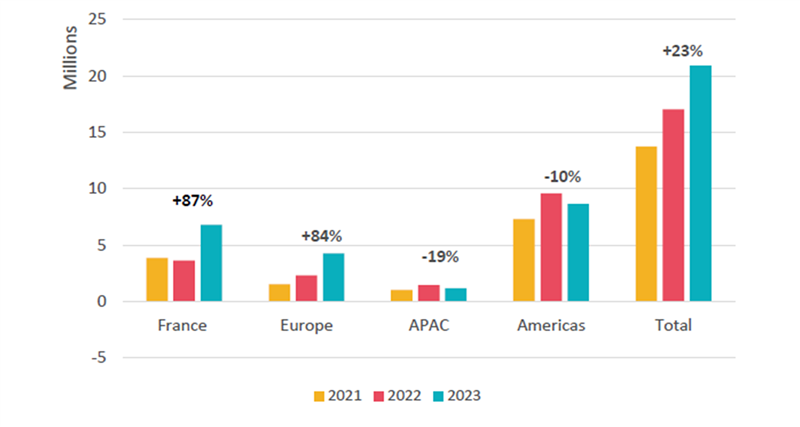
The company provided details on the split of bookings by geography (Exhibit 4) and on a half-yearly basis (Exhibit 5). As a reminder, bookings consist of the minimum average annual amount of subscription revenue (annual recurring revenue – ARR). Contracts are typically signed for three to five years and transaction revenue is also payable per document processed but not included in the bookings measure.
Bookings in France increased 87% in FY23, with the majority of the increase in H223. Bookings in the rest of Europe increased 84% y-o-y, with a similar level of bookings in H123 and H223. Bookings declined 28% in Asia-Pacific due to economic weakness in China. In the US, bookings declined 10%, reflecting the rebuild of the sales pipeline during FY23 after very strong conversion in FY22. For FY24, the company expects stronger growth in the US, and France is expected to remain strong due to government regulation around e-invoicing. Regulation is being introduced in other countries (Malaysia this year, Germany next year) that could stimulate further demand.
|
Exhibit 4: Bookings by region, FY21–23 |
Exhibit 5: Bookings by half-year FY22–23 |
|
|
|
Source: Esker |
Source: Esker |
|
Exhibit 4: Bookings by region, FY21–23 |
|
|
Source: Esker |
|
Exhibit 5: Bookings by half-year FY22–23 |
|
|
Source: Esker |
Q124 revenue update
On 16 April, the company disclosed Q124 revenue as per Exhibit 6.
Exhibit 6: Q124 revenue by type and bookings
€m |
Q124 |
Q123 |
y-o-y reported |
y-o-y constant currency |
Revenue |
||||
SaaS |
39.6 |
35.4 |
12% |
12% |
Implementation services |
7.7 |
6.3 |
22% |
22% |
Legacy products |
0.4 |
1.1 |
-64% |
-64% |
Total |
47.7 |
42.8 |
12% |
12% |
ARR bookings |
6.0 |
4.1 |
44% |
37% |
Source: Esker
SaaS revenue increased 12% y-o-y, with revenue from transaction volumes flat and subscription revenue up 29% y-o-y, reflecting implementation of orders signed in 2023. The company noted that within transaction volumes, fax and mail volumes declined year-on-year. In some cases, customers are switching from physical to electronic mail or from faxes to electronic mail. Overall, the installed base of fax or mail-only based customers is not growing so these volumes will make up a decreasing proportion of total transaction volumes. Implementation services revenue increased 22% y-o-y as the company worked hard to implement contracts signed last year. Management noted that roughly half of contracts are implemented by partners. Legacy product revenues fell sharply as the company stopped supporting certain legacy products as it was not cost effective to do so.
Q124 ARR bookings of €6.0m were 37% higher year-on-year in constant currency and were the second highest recorded. Orders from France increased 29% y-o-y, Asia-Pacific 83% and the Americas 73%, whereas the rest of Europe declined 18% due to a large contract signed in Germany in Q123. The company sold two deals comprising seven modules through its partnership with Commerce Bank in the US.
The company is close to being officially registered as an e-invoicing operation in France (PDP – plateforme de dématérialisation partenaire) and is starting to see positive momentum in Malaysia, where e-invoicing regulations will take effect later this year.
Outlook and changes to forecasts
Management maintained its FY24 guidance for constant currency revenue growth of 12–14% with an operating margin in the range 12–13%. This takes into account investment to be able to deliver the high level of contracts that were signed in FY23. We have made minor changes to our FY24 forecasts, reflecting the FY23 cost base, Q124 revenue update, higher interest income and a lower contribution from the joint venture with Quadient. We introduce FY25 forecasts, where we expect revenue growth to accelerate and the reported operating margin to expand to 13.3%.
Exhibit 7: Changes to forecasts
€m |
FY24e old |
FY24e new |
change |
y-o-y |
FY25e new |
y-o-y |
Revenues |
201.6 |
200.0 |
(0.8%) |
12.0% |
227.7 |
13.8% |
EBITDA |
37.1 |
38.0 |
2.3% |
28.3% |
45.2 |
19.1% |
EBITDA margin |
18.4% |
19.0% |
0.6% |
2.4% |
19.9% |
0.9% |
Normalised EBIT |
24.4 |
24.2 |
(0.6%) |
33.2% |
30.5 |
25.8% |
Normalised EBIT margin |
12.1% |
12.1% |
0.0% |
1.9% |
13.4% |
1.3% |
Reported EBIT |
24.1 |
24.0 |
(0.6%) |
33.7% |
30.2 |
26.1% |
Reported EBIT margin |
12.0% |
12.0% |
0.0% |
1.9% |
13.3% |
1.3% |
Normalised PBT |
25.9 |
25.9 |
(0.1%) |
30.7% |
31.9 |
23.4% |
Normalised net income |
19.7 |
19.7 |
(0.1%) |
31.0% |
24.3 |
23.4% |
Reported net income |
19.5 |
19.5 |
(0.1%) |
31.0% |
24.1 |
23.7% |
Normalised diluted EPS (€) |
3.18 |
3.20 |
0.7% |
29.4% |
3.89 |
21.5% |
Reported basic EPS (€) |
3.25 |
3.27 |
0.7% |
29.3% |
3.98 |
21.6% |
Reported diluted EPS (€) |
3.14 |
3.17 |
0.7% |
29.4% |
3.85 |
21.7% |
Net cash |
46.5 |
51.7 |
11.1% |
20.9% |
63.4 |
22.7% |
DPS (€) |
0.85 |
0.83 |
(2.4%) |
29.7% |
1.00 |
20.5% |
Source: Edison Investment Research
Exhibit 8: Financial summary
€'m |
2019 |
2020 |
2021 |
2022 |
2023 |
2024e |
2025e |
||
Year end 31 December |
French GAAP |
French GAAP |
French GAAP |
French GAAP |
French GAAP |
French GAAP |
French GAAP |
||
PROFIT & LOSS |
|||||||||
Revenue |
|
|
104.2 |
112.3 |
133.6 |
159.0 |
178.6 |
200.0 |
227.7 |
EBITDA |
|
|
20.1 |
21.9 |
25.7 |
31.8 |
29.6 |
38.0 |
45.2 |
Normalised Operating Profit |
|
|
12.8 |
14.0 |
16.8 |
21.7 |
18.2 |
24.2 |
30.5 |
Amortisation of acquired intangibles |
(0.4) |
(0.4) |
(0.3) |
(0.3) |
(0.3) |
(0.3) |
(0.3) |
||
Exceptionals and other income |
(0.1) |
0.0 |
0.0 |
0.0 |
0.0 |
0.0 |
0.0 |
||
Operating Profit |
12.4 |
13.6 |
16.6 |
21.4 |
17.9 |
24.0 |
30.2 |
||
Net Interest |
0.3 |
(0.1) |
0.2 |
0.3 |
0.6 |
0.7 |
0.5 |
||
Associates & joint ventures |
0.5 |
0.5 |
1.0 |
1.5 |
1.1 |
1.0 |
1.0 |
||
Exceptionals |
0.0 |
0.5 |
0.4 |
(0.3) |
0.1 |
0.0 |
0.0 |
||
Profit Before Tax (norm) |
|
|
13.6 |
14.5 |
18.0 |
23.4 |
19.8 |
25.9 |
31.9 |
Profit Before Tax (FRS 3) |
|
|
13.1 |
14.5 |
18.2 |
22.9 |
19.6 |
25.6 |
31.7 |
Tax |
(3.4) |
(3.0) |
(3.9) |
(5.0) |
(4.8) |
(6.1) |
(7.6) |
||
Profit After Tax (norm) |
10.1 |
11.5 |
14.2 |
18.3 |
15.0 |
19.7 |
24.3 |
||
Profit After Tax (FRS 3) |
9.7 |
11.6 |
14.3 |
17.9 |
14.9 |
19.5 |
24.1 |
||
Ave. No. of Shares Outstanding (m) |
5.4 |
5.7 |
5.8 |
5.9 |
5.9 |
5.9 |
6.0 |
||
EPS - normalised (€) |
|
|
1.86 |
2.03 |
2.42 |
3.11 |
2.56 |
3.31 |
4.01 |
EPS - normalised fully diluted (€) |
|
|
1.79 |
1.99 |
2.37 |
3.04 |
2.47 |
3.20 |
3.89 |
EPS - (GAAP) (€) |
|
|
1.80 |
2.04 |
2.44 |
3.04 |
2.53 |
3.27 |
3.98 |
Dividend per share (€) |
0.33 |
0.50 |
0.60 |
0.75 |
0.64 |
0.83 |
1.00 |
||
Gross margin (%) |
N/A |
N/A |
N/A |
N/A |
N/A |
N/A |
N/A |
||
EBITDA Margin (%) |
19.2 |
19.5 |
19.2 |
20.0 |
16.6 |
19.0 |
19.9 |
||
Normalised Operating Margin (%) |
12.3 |
12.5 |
12.6 |
13.6 |
10.2 |
12.1 |
13.4 |
||
BALANCE SHEET |
|||||||||
Fixed Assets |
|
|
47.2 |
49.0 |
57.2 |
71.7 |
75.9 |
80.4 |
84.9 |
Intangible Assets |
29.3 |
30.8 |
33.6 |
47.7 |
51.4 |
54.9 |
58.4 |
||
Tangible Assets |
10.4 |
10.0 |
9.9 |
9.0 |
8.7 |
8.7 |
8.7 |
||
Other |
7.4 |
8.2 |
13.7 |
15.0 |
15.9 |
16.9 |
17.9 |
||
Current Assets |
|
|
52.0 |
72.9 |
71.5 |
90.7 |
96.4 |
109.2 |
126.1 |
Stocks |
0.2 |
0.3 |
0.3 |
0.5 |
0.3 |
0.3 |
0.3 |
||
Debtors |
30.0 |
31.4 |
35.5 |
46.2 |
46.2 |
52.1 |
59.3 |
||
Cash |
21.4 |
40.4 |
35.0 |
42.9 |
48.8 |
55.7 |
65.4 |
||
Other |
0.5 |
0.8 |
0.7 |
1.1 |
1.1 |
1.1 |
1.1 |
||
Current Liabilities |
|
|
(34.3) |
(50.2) |
(45.9) |
(45.6) |
(49.8) |
(52.5) |
(56.1) |
Creditors |
(34.3) |
(38.7) |
(44.7) |
(45.6) |
(49.8) |
(52.5) |
(56.1) |
||
Short term borrowings |
0.0 |
(11.5) |
(1.2) |
0.0 |
0.0 |
0.0 |
0.0 |
||
Long Term Liabilities |
|
|
(8.3) |
(6.3) |
(2.5) |
(18.1) |
(14.2) |
(12.2) |
(10.2) |
Long term borrowings |
(6.5) |
(3.6) |
0.0 |
(15.0) |
(10.9) |
(8.9) |
(6.9) |
||
Other long term liabilities |
(1.8) |
(2.7) |
(2.5) |
(3.1) |
(3.2) |
(3.2) |
(3.2) |
||
Net Assets |
|
|
56.6 |
65.4 |
80.4 |
98.6 |
108.4 |
124.9 |
144.7 |
CASH FLOW |
|||||||||
Operating Cash Flow |
|
|
20.3 |
24.4 |
28.8 |
22.9 |
36.4 |
35.9 |
42.6 |
Net Interest |
0.4 |
(0.0) |
0.3 |
0.2 |
(0.0) |
0.7 |
0.5 |
||
Tax |
(3.3) |
(0.9) |
(3.4) |
(4.5) |
(4.9) |
(6.1) |
(7.6) |
||
Capex |
(11.0) |
(10.2) |
(11.1) |
(14.7) |
(16.0) |
(17.5) |
(18.5) |
||
Acquisitions/disposals |
(0.5) |
(0.5) |
(5.9) |
(7.5) |
(1.1) |
0.0 |
0.0 |
||
Financing |
1.4 |
0.0 |
2.8 |
1.1 |
0.3 |
0.0 |
0.0 |
||
Dividends |
(2.2) |
(1.9) |
(2.9) |
(3.6) |
(4.5) |
(4.0) |
(5.2) |
||
Net Cash Flow |
5.0 |
11.0 |
8.5 |
(6.0) |
10.2 |
8.9 |
11.7 |
||
Opening net debt/(cash) |
|
|
(16.6) |
(21.0) |
(30.3) |
(38.6) |
(32.6) |
(42.8) |
(51.7) |
HP finance leases initiated |
0.0 |
0.0 |
0.0 |
0.0 |
0.0 |
0.0 |
0.0 |
||
Other |
(0.6) |
(1.7) |
(0.2) |
(0.1) |
(0.0) |
(0.0) |
0.0 |
||
Closing net debt/(cash) |
|
|
(21.0) |
(30.3) |
(38.6) |
(32.6) |
(42.8) |
(51.7) |
(63.4) |
Source: Esker, Edison Investment Research
|
|
Research: Consumer
Notwithstanding its sector ‘sweet spot’ (a healthy, customisable product at a competitive price), Tortilla Mexican Grill (Tortilla) has taken the opportunity of a change in management to refine its strategy to address challenges since its successful IPO in 2021 as well as expedite growth. Significant benefit is expected from a new delivery structure to mitigate commission charges in an important part of the business (c 30% of sales), from enhanced marketing to tackle surprisingly low brand awareness and from an initial director of food to bolster menu development. With a new FY24 target of self-funded roll-out (down from 12 to eight), franchising will drive expansion as capital light and has been so successful to date. A near-doubling in H223 pre-IFRS 16 adjusted EBITDA, if from a low base, is testament to Tortilla’s recovering financials and initiatives already in place.