Achillion Pharmaceuticals
Written by
Achillion Pharmaceuticals |
Moving ahead with Factor-D in rare diseases |
Pipeline update |
Pharma & biotech |
30 March 2016 |
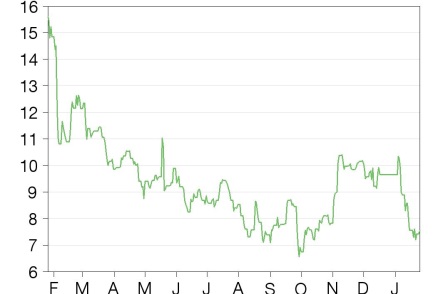
Share price performance
Business description
Next events
Analysts
|
||||||||||||||||||||||||||||||||||||||||||||||||||||
Thanks to its strong balance sheet following the out-licensing deal with Janssen in May 2015, Achillion appears to be well positioned to see its home-grown Factor-D program at least through the mid-stages of a clinical development program. Janssen’s equity purchase has helped to provide the financial muster needed for the company to invest in its early-stage small molecule therapeutics research platform, with its complement Factor D program at the forefront and on the verge of clinical testing.
Year end |
Revenue ($m) |
PBT* |
EPS* |
DPS |
P/E |
Yield |
12/13 |
0.0 |
(53.0) |
(51.4) |
0.0 |
N/A |
N/A |
12/14 |
0.0 |
(61.7) |
(56.5) |
0.0 |
N/A |
N/A |
12/15e |
67.0 |
(17.1) |
(12.7) |
0.0 |
N/A |
N/A |
12/16e |
0.0 |
(58.7) |
(40.3) |
0.0 |
N/A |
N/A |
Note: *PBT and EPS are normalised and fully diluted, excluding amortisation of acquired intangibles, exceptional items and share-based payments.
Factor-D regulatory pathway taking shape
Achillion has filed a lead drug candidate in its Factor D program, ACH-4471, with FDA approval for development in paroxysmal nocturnal hemoglobinuria (PNH), also spelling out its aim to begin Phase I/IIa testing in PNH and another undisclosed rare disease later this year. Initiated in-house, the Factor-D program was highlighted in a symposium in early December at the American Society for Hematology (ASH) when the value of Factor-D as a validated and druggable target was outlined. Management has indicated that further Factor-D drug candidates will be put forward with alternative attributes enabling the targeting of additional indications, such as compounds allowing ocular administration in eye disease.
Janssen targets early 2017 for Phase III in HCV
Through its partner Janssen, Achillion is developing a triple-regimen short-duration, highly effective, pan-genotypic Hepatitis C (HCV) treatment with promise to be best in class. Janssen aims to initiate Phase III development in the early part of 2017. Two trials are underway with a once-daily combination of Achillion’s odalasvir (ACH-3102), Janssen’s simeprevir (approved and previously marketed as Olysio) and Janssen’s ALS-335: a Phase I drug interaction study in healthy volunteers and a Phase IIa trial in ~60 patients with treatment-naïve genotype 1 HCV with treatment durations of eight, six, or four weeks. The Phase II primary endpoint is safety and secondary endpoints pharmacokinetics, SVR and viral resistance.
Valuation: Marginal change to $2.26bn from $2.27bn
Our valuation moves to $2.26bn ($16.5/share from $16.7) due to a change in estimated cash. We do not yet include Achillion’s Factor D program in our valuation but will do so on the start of Phase I trials in Q116. Despite the recent share price weakness, the company’s significant cash cushion coupled with the anticipated positive newsflow related to the progress of the HCV development program and the clinical start of the Factor-D trials should provide support for the shares over the coming year.
Factor-D inhibitor ACH-4471 poised for trials in man
The Factor D program, which targets complement-mediated diseases, was initiated in house through Achillion’s own research platform as a therapeutic target holding promise in a variety of ultra-rare diseases and serious conditions. A validated and druggable target, Factor D’s low plasma concentration enhances the target value, which is amenable to potent inhibition by small molecules. The company held a symposium on its complement Factor D program on 6 December at the ASH, at which time expert speakers2 presented on complement immune-biology, and relative risks of infection associated with immune modulation of the complement system. Achillion’s chief medical officer, David Apelian (M.D., Ph.D.), profiled the company’s lead small-molecule Factor D inhibitor compound ACH-4471 just before the company filing an IND regulatory package for the drug.
Dr. Scott Barnum, PhD., Professor of Microbiology at the University of Alabama and Peter Densen, M.D. Professor of Internal Medicines at the University of Iowa.
Achillion is initially focusing its research on the orally dosed ACH-4471 in PNH, a disease caused by the deficiency of complement-regulated proteins CD55 and CD59. The only approved treatment for PNH is Alexion’s Soliris, or eculizumab, (2014 sales $2.2bn), which has significant limitations including intravenous administration, a black box warning of serious meningococcal infections, while ~25% of patients have suboptimal response3 to the treatment due to partial protection. Achillion aims to provide consistent and potent inhibition of complement for all PNH patients. A Phase I single and multi-ascending dose study is planned in healthy volunteers for initial investigation of safety and pharmacokinetics and will begin in the coming weeks once the company receives a green light on its regulatory submission. A Phase Ib/IIa proof of concept trial is also planned in 2016 in multiple ascending doses (seven to 14 days) in treatment-naïve PNH patients whereby a marker of hemolysis – lactate dehydrogenase (LDH) – will be used to establish efficacy. The oral ACH-4471 compound will also begin Phase I trials in one other yet to be disclosed ultra-rare disease in H216. Achillion reports its overall portfolio of Factor D inhibitors looks to be potent and highly specific with early safety assessments, including repeat-dose toxicity studies, supporting clinical development. Research is ongoing with distinct new chemical entities (NCEs) in indications with varied patient population sizes, including dry age-related macular degeneration (AMD), chronic obstructive pulmonary disease, myasthenia gravis and atypical haemolytic uremic syndrome (aHUS). Additional compounds undergoing evaluation are capable of alternative routes of administration including ocular and inhalation.
Suboptimal response of current C5 targeted therapies due to mutations that prevent binding of eculizumab to C5 and symptomatic extravascular hemolysis due to accumulation of C3 fragments on PNH red cells. Risitano AM. Blood 2009; Nishimura J, et al. N Engl J Med 2014.
Exhibit 1: Select complement-mediated diseases
Disease |
Characteristics |
Epidemiology (prevalent population US/EU-5) |
Current treatment (approved and/or supportive care) |
PNH 1,4 |
Acquired: rare form of hemolytic anemia |
8,000-10,000 |
Eculizumab RBC transfusion |
aHUS1-3 |
Commonly genetic: thrombocytopenia |
2,000-3,000 |
Eculizumab RBC transfusion |
Myasthenia gravis 5,6 |
Autoimmune: neuromuscular junction (NMJ) destruction and muscle weakness |
80,000-100,000 |
Cholinesterase inhibitors, steroids, immunosuppression |
Dry AMD (geographic atrophy, GA) 1,3,7-10 |
Complex and multifactorial; loss or atrophy of retinal pigment epithelium |
2,000,000-3,000,000 |
No treatments (prophylactic only) |
Source: Achillion
Two clinical studies underway by Janssen in Hep-C
Achillion, through its partner Janssen, is moving forward with the development and commercialization of a short-duration, highly effective, pan-genotypic Hep-C treatment, aiming to initiate Phase III development in the early part of next year. The link up with Janssen has increased the odds of marketing the first triple combination – NS5A, NS3 and nucleotide polymerase – and best-in-class Hep-C treatment serving to firm up Achillion’s positioning in Hep-C by adding multiple options for combination (see Exhibit 2 below), enabling many shots on goal. Janssen brings two additional Hep-C candidates for inclusion in the potential triple regimen: NS5B polymerase inhibitor ALS-335 and the already approved NS3/4A protease inhibitor (PI), Olysio or simeprevir, both of which are included in trials currently underway. Notably, both milestones and royalties will be paid on any regimen containing any one Achillion compound.
The following studies have been initiated by Janssen since its acquisition in mid-2015 of the worldwide licensing rights to three Hep-C drugs in the Achillion portfolio4:
Agreement included the right to NS5A inhibitor ACH-3102, nuc ACH-3422 and Achillion’s protease inhibitor sovaprevir.
■
A Phase 1 drug-drug interaction study in healthy volunteers with a triple DAA (direct acting antiviral) regimen assessing the combination of Achillion’s odalasvir (ACH-3102) with Jansenn’s simeprevir, and ALS-335.
■
Dosing of patients in a Phase IIa ~60 patient clinical trial for treatment-naïve genotype 1 chronic HCV with a once-daily combination of odalasvir (ACH-3102), simeprevir, and ALS-335 with randomized treatment durations of eight, six, or four weeks. The study’s primary endpoint is safety, while secondarily the trial will study pharmacokinetics, SVR and viral resistance.
As indicated by the companies, Olysio’s status as a currently marketed PI could allow for an accelerated time to commercialisation for the triple regimen (and Olysio is therefore being pursued as a component in the mix). Olysio was previously heavily prescribed with Gilead’s Sovaldi before Gilead’s launch of Harvoni (Ledipasvir/Sofosbuvir NS5B polymerase inhibitor) in late 2015.
In the meantime in H215 Achillion also announced positive confirmatory results in a second cohort of its Phase II proxy study evaluating its own NS5A inhibitor, odalasvir (ACH-3102) and Gilead’s sofosbuvir for genotype 1 HCV. The company reported 100% SVR12 (HCV undetectable after 12 weeks) in the second cohort of patients treated for just six weeks, which followed on to previously announced SVR24 in two earlier cohorts receiving eight and six weeks of therapy.
Exhibit 2: Hep-C triple regimens NS5A+nuc+PI
Achillion and competitor triple combination regimens |
|||
NS5A inhibitor |
NS5B polymerase inhibitor (nuc) |
NS3/4A protease inhibitor |
|
Achillion with Janssen |
ACH-3102 (A) |
ACH-3422 (A) ALS-335 (J) |
Sovaprevir (A) Olysio/Simeprevir (J) |
Gilead |
Ledipasvir GS-5816 |
Sofosbuvir |
GS-9857 |
Merck |
MK-8408 |
MK-3682 |
Grazoprevir |
Source: Achillion Pharmaceuticals
.
Valuation
Our valuation changes only slightly to $2.26bn from $2.27bn ($16.5/share from $16.7 or $16.0/share from $16.1 on a diluted basis) with the subtle difference related to cash spend and actual cash inflow from the deal with Jannsen. We do not yet include Achillion’s Factor D program in our valuation but will do so on the start of Phase I trials, expected in Q116. Based on our current assumptions and estimates, Factor D could potentially add some $125m to our risk-adjusted valuation of the company assuming peak sales of $2bn for products in PNH, probability of success of 12% and a WACC of 12.5%.
As announced by the companies, Janssen will wholly fund all development and commercialisation costs related to HCV, while Achillion is eligible to receive up to $905m in development, regulatory and commercial milestone-based payments.
Exhibit 3: Achillion valuation
Product |
Main indication |
Status |
Prob. of success |
Launch year |
Peak sales ($m) |
Patent protection |
Royalty |
rNPV |
All oral combo |
US, HCV |
Phase II |
60% |
2018 |
$1,766 |
2032 |
12%-24% |
$572 |
All oral combo |
EU Big-5, HCV |
Phase II |
60% |
2018 |
$1,074 |
2032 |
12%-24% |
$347 |
All oral combo |
Japan, HCV |
Phase II |
60% |
2018 |
$1,158 |
2032 |
12%-24% |
$328 |
Milestone payments |
$558 |
|||||||
Total |
|
|
|
|
|
|
|
$1,806 |
Cash end FY15e ($m) |
$450.8 |
|||||||
Total firm value ($m) |
$2,257 |
|||||||
Total basic shares (m) |
137 |
|||||||
Value per basic share ($) |
$16.5 |
|||||||
Stock options(3/2015, m) |
8.4 |
|||||||
Total diluted number of shares |
144.9 |
|||||||
Diluted value per share ($) |
|
|
|
|
|
|
$16.0 |
|
Source: Edison Investment Research
Financials
Last November Achillion announced third-quarter and nine-month 2015 results also providing updated financial guidance. In Q315 (ending September 2015), the company reported net income of $26.3m supported by revenue of $33.8m stemming from a portion of the premium paid by JJDC (Janssen) as part of its equity purchase. This compared with a loss of $15.7m in Q314. R&D expenses of $12.0m in Q315 were roughly on par with that of the $12.1m spent in Q314 as increased costs related to the complement inhibitor program were offset by decreasing costs of HCV studies. The increase in G&A expenses in Q315 ($4.9m) vs. Q314 ($3.7m) related primarily to consulting and legal fees associated with the licensing deal with Janssen. Achillion’s financial guidance for the full year 2015 has been revised as follows: R&D of $60-65m (ex stock compensation), G&A $24-25m (ex stock compensation), a net loss of $18-20m, and operating cash burn of $60-65m (ex revenue related to Janssen).
Our forecasts have been adjusted to reflect the premium stock payment from JJDC as well as higher than anticipated R&D expenses in 2015 which partly reflects the timing of R&D expenses taken on by Janssen. Per terms of the collaboration, JJDC will be taking over all R&D related to the licensed compounds from Achillion moving forward. All in all, we expect FY15 revenue of $67m, EBITDA loss of $19m and normalised PBT loss of $17m. In FY16, we now see EBITDA and normalised PBT loss of $70m (from $60m) and $59m (from $48m) respectively.
Achillion has a strong balance sheet with estimated cash and cash equivalents of $451.2m at end FY15, which we expect will be sufficient to fund operations through to profitability when significant royalty payments from Janssen are forecast to begin feeding through. We currently model first sales of a potential triple Hep-C regimen in 2018.
Exhibit 4: Financial summary
($000) |
2011 |
2012 |
2013 |
2014 |
2015e |
2016e |
||
Year end 31 December |
IFRS |
IFRS |
IFRS |
IFRS |
IFRS |
IFRS |
||
PROFIT & LOSS |
||||||||
Revenue |
|
|
247 |
2,607 |
0 |
0 |
67,000 |
0 |
Cost of Sales |
0 |
0 |
0 |
0 |
0 |
0 |
||
Gross Profit |
247 |
2,607 |
0 |
0 |
67,000 |
0 |
||
EBITDA |
|
|
(41,031) |
(42,953) |
(53,157) |
(61,664) |
(19,321) |
(70,246) |
Operating Profit (before amort. and except.) |
(41,358) |
(43,361) |
(53,556) |
(62,153) |
(20,000) |
(70,975) |
||
Intangible Amortisation |
0 |
0 |
0 |
0 |
0 |
0 |
||
Exceptionals |
0 |
0 |
0 |
0 |
0 |
0 |
||
Stock options |
(2,989) |
(3,932) |
(5,920) |
(7,273) |
(10,000) |
(10,000) |
||
Operating Profit |
(44,347) |
(47,293) |
(59,476) |
(69,426) |
(30,000) |
(80,975) |
||
Net Interest |
141 |
166 |
529 |
418 |
2,945 |
12,250 |
||
Profit Before Tax (norm) |
|
|
(44,206) |
(43,195) |
(53,027) |
(61,735) |
(17,055) |
(58,725) |
Profit Before Tax (FRS 3) |
|
|
(44,206) |
(47,127) |
(58,947) |
(69,008) |
(27,055) |
(68,725) |
Tax |
0 |
0 |
0 |
0 |
0 |
0 |
||
Profit After Tax (norm) |
(41,217) |
(43,195) |
(53,027) |
(61,735) |
(17,055) |
(58,725) |
||
Profit After Tax (FRS 3) |
(44,206) |
(47,127) |
(58,947) |
(69,008) |
(27,055) |
(68,725) |
||
Average Number of Shares Outstanding (m) |
64.25 |
73.97 |
93.98 |
98.37 |
125.49 |
136.54 |
||
EPS - normalised (c) |
|
|
(64.2) |
(58.4) |
(56.4) |
(62.8) |
(13.6) |
(43.0) |
EPS - normalised and fully diluted (c) |
|
(64.2) |
(58.4) |
(51.4) |
(56.5) |
(12.7) |
(40.3) |
|
EPS - (IFRS) (c) |
|
|
(68.8) |
(63.7) |
(62.7) |
(70.2) |
(21.6) |
(50.3) |
Dividend per share (c) |
0.0 |
0.0 |
0.0 |
0.0 |
0.0 |
0.0 |
||
Gross Margin (%) |
100.0 |
100.0 |
N/A |
N/A |
N/A |
N/A |
||
EBITDA Margin (%) |
N/A |
N/A |
N/A |
N/A |
N/A |
N/A |
||
Operating Margin (before GW and except.) (%) |
N/A |
N/A |
N/A |
N/A |
N/A |
N/A |
||
BALANCE SHEET |
||||||||
Fixed Assets |
|
|
1,009 |
1,503 |
1,344 |
1,780 |
2,089 |
2,354 |
Intangible Assets |
0 |
0 |
0 |
0 |
0 |
0 |
||
Tangible Assets |
994 |
1,247 |
1,265 |
1,726 |
1,994 |
2,259 |
||
Restricted cash |
152 |
152 |
152 |
152 |
152 |
152 |
||
Investments |
15 |
256 |
79 |
54 |
95 |
95 |
||
Current Assets |
|
|
81,469 |
79,875 |
160,921 |
154,875 |
453,796 |
399,943 |
Inventory |
0 |
0 |
0 |
0 |
0 |
0 |
||
Accounts recievable, net |
103 |
277 |
480 |
95 |
400 |
450 |
||
Cash and cash equivalents |
79,943 |
77,418 |
157,989 |
152,879 |
451,195 |
397,293 |
||
Other |
1,423 |
2,180 |
2,452 |
1,901 |
2,201 |
2,200 |
||
Current Liabilities |
|
|
(8,944) |
(9,136) |
(9,403) |
(13,059) |
(18,120) |
(18,245) |
Creditors |
(8,803) |
(8,786) |
(9,112) |
(12,864) |
(17,900) |
(18,050) |
||
Short term borrowings |
(141) |
(350) |
(291) |
(195) |
(220) |
(195) |
||
Long Term Liabilities |
|
|
(229) |
(347) |
(56) |
(279) |
(290) |
(285) |
Long term borrowings |
(229) |
(347) |
(56) |
(279) |
(290) |
(285) |
||
Other long term liabilities |
0 |
0 |
0 |
0 |
0 |
0 |
||
Net Assets |
|
|
73,305 |
71,895 |
152,806 |
143,317 |
437,475 |
383,767 |
CASH FLOW |
||||||||
Operating Cash Flow |
|
|
(36,268) |
(46,700) |
(54,165) |
(55,942) |
(6,446) |
(70,645) |
Net Interest |
132 |
166 |
529 |
418 |
2,945 |
12,250 |
||
Tax |
0 |
0 |
0 |
0 |
0 |
0 |
||
Capex |
(732) |
(656) |
(408) |
(947) |
(947) |
(994) |
||
Acquisitions/disposals |
0 |
0 |
0 |
0 |
0 |
0 |
||
Financing |
61,663 |
44,235 |
133,951 |
52,264 |
301,837 |
4,750 |
||
Net Cash Flow |
24,795 |
(2,955) |
79,907 |
(4,207) |
297,389 |
(54,639) |
||
Opening net debt/(cash) |
|
|
(55,035) |
(79,725) |
(76,873) |
(157,794) |
(152,557) |
(450,837) |
HP finance leases initiated |
0 |
0 |
0 |
0 |
0 |
0 |
||
Other |
(105) |
103 |
1,014 |
(1,030) |
891 |
767 |
||
Closing net debt/(cash) |
|
|
(79,725) |
(76,873) |
(157,794) |
(152,557) |
(450,837) |
(396,965) |
Source: Edison Investment Research
|