Last close As at 05/08/2026
GBP3.13
▲ −4.00 (−1.26%)
Market capitalisation
GBP2,914m
Research: Investment Companies
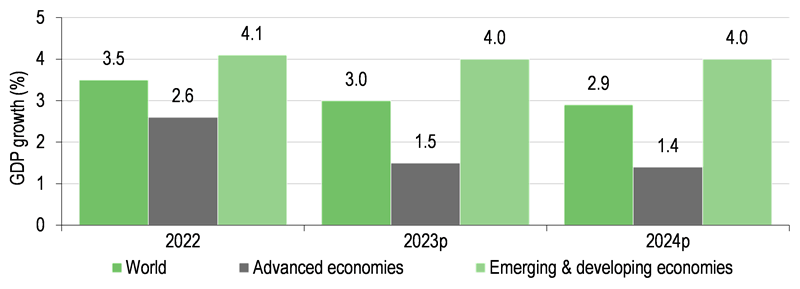
Templeton Emerging Markets Investment Trust’s (TEMIT’s) co-managers Chetan Sehgal (lead manager) and Andrew Ness consider that the case for emerging markets is not well understood. Hence, they believe that the regions remain under-owned, undervalued and under-appreciated, which provides an interesting opportunity for global investors. There are several powerful trends supporting the superior economic growth prospects of emerging markets versus those in developed regions, including demographics, urbanisation, higher consumption and technological innovation. Emerging markets also remain relatively attractively valued. TEMIT’s performance versus the MSCI Emerging Markets Index troughed in April 2022 and is in a steadily improving trend. The trust’s results tend to be better when investors focus on company fundamentals, which drive equity returns over the long term, rather than considering near-term macroeconomic events.
Templeton Emerging Markets IT |
Under-owned, undervalued & under-appreciated |
Investment trusts |
13 December 2023 |
Analyst
|
|||||||||||||||||||||||||||||||||||||||||||||||||||||||||||||||||||||||||||||||||||||||||||||||||||||||||||||||||||||||||
Templeton Emerging Markets Investment Trust’s (TEMIT’s) co-managers Chetan Sehgal (lead manager) and Andrew Ness consider that the case for emerging markets is not well understood. Hence, they believe that the regions remain under-owned, undervalued and under-appreciated, which provides an interesting opportunity for global investors. There are several powerful trends supporting the superior economic growth prospects of emerging markets versus those in developed regions, including demographics, urbanisation, higher consumption and technological innovation. Emerging markets also remain relatively attractively valued. TEMIT’s performance versus the MSCI Emerging Markets Index troughed in April 2022 and is in a steadily improving trend. The trust’s results tend to be better when investors focus on company fundamentals, which drive equity returns over the long term, rather than considering near-term macroeconomic events.
|
Higher growth potential in emerging markets |
|
|
Source: International Monetary Fund World Economic Outlook October 2023 data, Edison Investment Research. Note: p is projected. |
Why consider TEMIT?
Looking at a range of TEMIT’s quality, growth and valuation factors, the trust could be considered as a ‘quality value’ fund. This ties in with the managers’ approach of seeking companies with sustainable earnings growth potential that are trading at a discount to their intrinsic values. When required, they can draw on the resources of Franklin Templeton’s large, locally based emerging markets investment team.
TEMIT’s portfolio is actively managed, and bottom-up stock selection means that industry and geographic allocations are differentiated from those of the benchmark. The trust’s largest overweight sector is technology, while its largest underweights are consumer staples and utilities, which are both defensive. This suggests that the trust should be well positioned for an economic recovery.
As a result of economic uncertainty and macroeconomic events in recent years, investor risk aversion is elevated. This is reflected in TEMIT’s double-digit 13.3% discount, which is wider than the trust’s historical averages. There is significant scope for TEMIT to be afforded a higher valuation if investors become more interested in the positive growth and valuation attributes of emerging markets and/or the trust’s relative performance continues to improve.
TEMIT: Broad EM exposure from a well-resourced team
When required, TEMIT’s managers can draw on the deep resources of Franklin Templeton, which is the sixth-largest independent asset manager in the world with more than £1tn of assets under management. The company has been investing in emerging markets for more than 35 years and its emerging markets team of 75+ investment professionals research more than 700 securities. Franklin Templeton views its local presence in 13 emerging market countries as a competitive advantage in terms of building relationships and gaining valuable insights.
TEMIT’s managers seek to capitalise on long-term structural opportunities by identifying companies with sustainable earnings power that are trading at a discount to their intrinsic worth. ESG analysis is an integral part of the investment process.
Looking over the long term, from the date of TEMIT’s launch in June 1989 to end H124 (30 September 2023), the trust’s NAV total return of +3,832.7% is substantially higher than the benchmark’s +1,698.1% total return.
Why emerging markets?
Four important trends in emerging markets contribute to their above-average economic growth potential: favourable demographics, the continued shift towards urbanisation, higher consumption helped by a rising middle class and technological innovation.
Emerging market institutions have made policy improvements. Despite shocks within the US and European banking sectors earlier in 2023, emerging markets’ banking systems have generally been more resilient. This is due to a more conservative approach in response to prior periods of stress such as the 1997–98 Asian financial crisis. Historically, emerging markets were sources of commodities and inexpensive manufacturing. This has shifted to higher demand for premium products and increased technology penetration in the regions. In terms of innovation, some emerging market technology companies have leapfrogged over their developed market peers to become global leaders, such as Taiwan Semiconductor Manufacturing Company, which is the world's largest contract manufacturer of semiconductor chips.
Data from Franklin Templeton show that from January 2008 to December 2022, average annualised rolling five-year total returns in emerging markets were 7.3%. The largest contributor at 5.4% was earnings growth, with dividends contributing 2.7% and higher valuations 0.6%. The combined 8.7% was partially offset by a 1.4% drag from currency movements.
|
Exhibit 1: Market performance and valuation |
|
Performance of indices in £ (last five years) |
Valuation of MSCI indices (at 30 November 2023) |
|
|
|
Source: Refinitiv, MSCI, Edison Investment Research |
|
In terms of performance over the last five years (Exhibit 1, left-hand side), both emerging markets and the UK have woefully lagged the performance of the world market. However, a large part of this is due to the outperformance of the US, which dominates global indices (70% of the MSCI World Index). The shares of large-cap US technology companies have performed particularly well, although there is no guarantee that this will continue. A shift in investor preferences towards markets/sectors that have lagged in recent years could be beneficial for the performance of emerging market stocks.
Emerging market shares continue to look very attractively valued versus their global peers (Exhibit 1, right-hand side). On a forward P/E basis at the end of October 2023, the MSCI Emerging Market Index was around 30% less expensive than the MSCI World Index and offered a higher dividend yield.
TEMIT versus the MSCI Emerging Markets Index
Comparing TEMIT with the benchmark in Exhibit 2, in terms of quality attributes it generates better returns and a has higher net margin, but a modestly lower operating margin than the MSCI Emerging Markets Index. Looking at forward EPS estimates, the trust has a lower growth profile, but is more attractively valued on multiple metrics, while offering a modestly higher dividend yield. Taken in aggregate, TEMIT could be considered as a ‘quality value fund’, which has potential to perform well in a variety of market environments, although it is likely to struggle in a market led by highly valued growth stocks or deep-value cyclical names.
Exhibit 2: Portfolio versus the benchmark (at 31 October 2023)
TEMIT’s portfolio |
Benchmark |
|
Quality |
||
Return on assets (%) |
9.6 |
8.5 |
Return on equity (%) |
19.5 |
17.8 |
Return on invested capital (%) |
14.3 |
13.4 |
Operating margin (%) |
19.6 |
20.5 |
Net margin (%) |
19.9 |
17.5 |
Net debt to equity (ex-banks, x) |
0.8 |
20.3 |
Growth |
||
Last 3-year sales growth (%) |
17.6 |
18.7 |
Last 3-year EPS growth (%) |
22.6 |
17.4 |
Estimated 3–5-year EPS growth (%) |
11.3 |
14.9 |
Valuation |
||
12-month trailing P/E (x) |
10.0 |
11.8 |
Price-to-cash flow (x) |
5.1 |
6.0 |
Price-to-book (x) |
1.3 |
1.5 |
Dividend yield (%) |
3.3 |
3.1 |
Source: TEMIT
Current portfolio breakdown
TEMIT offers investors a broad and differentiated emerging markets exposure. At 30 September 2023, 34 distinct names representing 21% of the portfolio were not held by its major peers. Also, the fund had 30 names that are not represented in its benchmark and made up 17% of the fund.
Exhibit 3: Top 10 holdings (at 31 October 2023)
Company |
Country |
Sector |
Portfolio weight % |
|
31 Oct 2023 |
31 Oct 2022* |
|||
Taiwan Semiconductor Manufacturing Co |
Taiwan |
Semiconductors & semi equip |
10.5 |
9.6 |
Samsung Electronics |
South Korea |
Technology hardware & equip |
5.6 |
6.6 |
ICICI Bank |
India |
Banks |
5.5 |
7.0 |
Alibaba Group Holding |
China |
Retailing |
5.0 |
4.4 |
Petroleo Brasileiro (Petrobras) |
Brazil |
Energy |
3.2 |
3.0 |
Naver Corporation |
South Korea |
Media & entertainment |
3.1 |
2.9 |
Tencent Holdings |
China |
Media & entertainment |
3.0 |
3.2 |
Samsung Life Insurance |
South Korea |
Insurance |
2.8 |
N/A |
Prosus |
China |
Retailing |
2.7 |
N/A |
LG Corporation |
South Korea |
Capital goods |
2.5 |
2.9 |
Top 10 (% of portfolio) |
43.9 |
46.1 |
||
Source: TEMIT, Edison Investment Research. Note: *N/A where not in October 2022 top 10.
At end-October 2023, TEMIT’s top 10 holdings, across a range of countries and sectors, made up 43.9% of the portfolio, which was a lower concentration compared with 46.1% 12 months earlier; eight positions were common to both periods.
The trust has exposure across the market cap spectrum. At end-October 2023, the portfolio was broken down as follows: market cap above $50bn (44.9%); $25–50bn (8.4%); $10–25bn (16.4%); $5–10bn (15.5%); $2–5bn (6.4%) and less than $2bn (8.4%).
There is a new position in the fund: Hypera (formerly known as Hypermarcas) is a leading Brazilian pharmaceutical company that sells prescription, generic and over-the-counter medicines as well as consumer health products. Brazil’s ageing population is a positive growth driver for its pharma industry. Hypera has a portfolio of well-known brands and a good record of new product launches, along with robust cash generation and a strong balance sheet.
TEMIT’s sector and geographic weightings are a result of bottom-up stock selection. As shown in Exhibit 5, over the 12 months to the end of October 2023, the largest changes in the trust’s sector exposure were higher weightings in industrials (+3.8pp) and healthcare (+2.5pp), with lower allocations to financials (-2.4pp) and materials (-2.1pp). In terms of active positioning versus the benchmark, IT remained the largest overweight (+5.8pp), while the largest underweight was consumer staples (-3.4pp).
|
Exhibit 4: TEMIT’s sector weights versus the benchmark (at end-October 2023) |
|
|
Source: TEMIT, Edison Investment Research. Note: Excludes other net assets. |
Exhibit 5: Portfolio sector changes and active weights versus benchmark (% unless stated)
Portfolio |
Portfolio |
Change |
Active weight |
|
Information technology |
26.4 |
28.2 |
(1.8) |
5.8 |
Financials |
25.2 |
27.6 |
(2.4) |
2.7 |
Consumer discretionary |
12.1 |
12.5 |
(0.4) |
(1.5) |
Communication services |
9.2 |
8.0 |
1.2 |
(0.2) |
Industrials |
8.4 |
4.6 |
3.8 |
2.0 |
Materials |
6.2 |
8.3 |
(2.1) |
(1.6) |
Healthcare |
4.4 |
1.9 |
2.5 |
0.4 |
Energy |
3.5 |
3.4 |
0.1 |
(1.8) |
Consumer staples |
2.9 |
3.7 |
(0.8) |
(3.4) |
Utilities |
0.5 |
0.0 |
0.5 |
(2.1) |
Real estate |
0.4 |
0.4 |
0.0 |
(1.3) |
Other net assets |
0.7 |
1.4 |
(0.7) |
0.7 |
100.0 |
100.0 |
Source: TEMIT, Edison Investment Research. Note: Numbers subject to rounding.
Looking at TEMIT’s geographic breakdown in Exhibit 7, the largest country weighting is China, although the fund has an underweight position versus the benchmark (-4.3pp). Over the 12 months to the end of October 2023, the largest changes are a higher weighting to China (+2.0pp) and a lower allocation to Brazil (-2.1pp). The largest active weights are an above-index allocation to South Korea (+8.2pp) and below-index allocation to ‘the rest of the world’ (-9.4pp).
|
Exhibit 6: TEMIT’s geographic weights versus the benchmark (at end-October 2023) |
|
|
Source: TEMIT, Edison Investment Research. Note: Excludes net other assets. |
Exhibit 7: Portfolio geographic changes and active weights vs benchmark (% unless stated)
Portfolio |
Portfolio |
Change |
Active weight |
|
China |
25.6 |
23.6 |
2.0 |
(4.3) |
South Korea |
20.0 |
19.6 |
0.4 |
8.2 |
Taiwan |
14.9 |
14.3 |
0.6 |
(0.2) |
India |
13.0 |
13.5 |
(0.5) |
(2.9) |
Brazil |
9.4 |
11.5 |
(2.1) |
4.0 |
US |
3.3 |
4.2 |
(0.9) |
3.3 |
Thailand |
2.5 |
2.7 |
(0.2) |
0.6 |
Rest of the world |
10.6 |
9.2 |
1.4 |
(9.4) |
Other net assets |
0.7 |
1.4 |
(0.7) |
0.7 |
100.0 |
100.0 |
Source: TEMIT, Edison Investment Research. Note: Numbers subject to rounding.
Performance: Building on a positive relative record
TEMIT is a member of the AIC Global Emerging Markets sector. In Exhibit 8, we exclude the specialist funds to enable a more relevant comparison. TEMIT is the largest of the selected peers by a considerable margin. Its NAV total return is above average over the last 12 months, ranking third out of five funds and broadly in line over the last decade, ranking third out of four funds.
Exhibit 8: Selected emerging markets peer group at 12 December 2023*
% unless stated |
Market cap (£m) |
NAV TR |
NAV TR |
NAV TR |
NAV TR |
Discount (cum fair) |
Ongoing charge |
Perf. |
Net gearing |
Dividend yield |
Templeton Emerging Mkts Inv Trust |
1,659.2 |
5.3 |
(15.5) |
20.6 |
74.3 |
(13.5) |
1.0 |
No |
100 |
3.4 |
Fidelity Emerging Markets |
537.7 |
1.3 |
(27.2) |
(1.1) |
34.8 |
(11.4) |
0.8 |
No |
100 |
2.7 |
JPMorgan Emerging Markets Inv Tr |
1,163.9 |
(0.6) |
(12.7) |
28.6 |
109.0 |
(10.1) |
0.9 |
No |
103 |
1.6 |
JPMorgan Global Emerging Mkts Inc |
360.5 |
5.4 |
1.1 |
31.6 |
81.6 |
(12.5) |
0.9 |
No |
109 |
4.3 |
Mobius Investment Trust |
151.8 |
12.6 |
30.0 |
49.2 |
|
(8.9) |
1.5 |
No |
100 |
0.9 |
Average (5 funds) |
774.6 |
4.8 |
(4.8) |
25.8 |
74.9 |
(11.3) |
1.0 |
102 |
2.6 |
|
TEMIT rank in peer group |
1 |
3 |
4 |
4 |
3 |
5 |
4 |
3= |
2 |
Source: Morningstar, Edison Investment Research. Note: *Performance at 12 December 2023 based on ex-par NAVs. TR, total return. Net gearing is total assets less cash and equivalents as a percentage of net assets.
TEMIT’s managers consider the trust’s closest peers are Fidelity Emerging Markets and JPMorgan Emerging Markets Investment Trust. Comparing their NAV total returns, TEMIT ranks first over the last 12 months and second over the last three, five and 10 years. The managers suggest that Franklin Templeton’s large and globally diversified emerging markets equity team is able to identify local opportunities that may be overlooked by its peers.
Most of the funds in the selected peer group are currently trading on double-digit discounts during a period of heightened investor risk aversion; TEMIT’s discount is the widest. The trust has an average ongoing charge, and in line with its peers no performance fee is payable. TEMIT is one of three funds that is currently ungeared. The trust has an above-average dividend yield, ranking second and is 0.8pp above the mean.
Exhibit 9: Five-year discrete performance data
12 months ending |
Share price |
NAV |
MSCI Emerging |
MSCI World |
CBOE UK All Companies (%) |
30/11/19 |
15.1 |
14.1 |
6.2 |
13.6 |
11.3 |
30/11/20 |
18.3 |
16.4 |
15.1 |
11.5 |
(11.2) |
30/11/21 |
(0.8) |
0.4 |
4.0 |
23.4 |
17.1 |
30/11/22 |
(13.2) |
(10.9) |
(7.9) |
(0.5) |
7.9 |
30/11/23 |
3.1 |
3.3 |
(1.6) |
6.8 |
1.5 |
Source: Refinitiv. Note: All % on a total return basis in pounds sterling.
|
Exhibit 10: Investment trust performance to 30 November 2023 |
|
Price, NAV and benchmark total return performance, one-year rebased |
Price, NAV and benchmark total return performance (%) |
|
|
|
Source: Refinitiv, Edison Investment Research. Note: Three-, five- and 10-year performance figures annualised. |
|
TEMIT’s relative returns are shown in Exhibit 11. It is ahead of its benchmark over the last one, five and 10 years in both NAV and share price terms. The trust’s relative performance is steadily improving, having troughed in April 2022.
Over the last year, positive contributors to TEMIT’s relative performance include: Posco Holdings (South Korea, steel maker); Taiwan Semiconductor Manufacturing Company (Taiwan, semiconductor manufacturer); and Petrobras (Brazil, oil producer). Conversely, positions that have detracted from the trust’s performance include: Guangzhou Tinci Materials Technology Company (China, cosmetic materials manufacturer); non-index name Genpact (India, professional services provider); and Branco Bradesco (Brazil, bank).
Exhibit 11: Share price and NAV total return performance, relative to indices (%)
|
One month |
Three months |
Six months |
One year |
Three years |
Five years |
10 years |
Price relative to MSCI Emerging Markets |
0.1 |
(0.4) |
1.0 |
4.7 |
(5.9) |
4.8 |
1.5 |
NAV relative to MSCI Emerging Markets |
0.3 |
0.0 |
0.8 |
4.9 |
(2.1) |
6.3 |
3.5 |
Price relative to MSCI World |
(1.2) |
(1.0) |
(2.7) |
(3.5) |
(32.4) |
(27.3) |
(44.5) |
NAV relative to MSCI World |
(0.9) |
(0.5) |
(3.0) |
(3.3) |
(29.6) |
(26.3) |
(43.4) |
Price relative to CBOE UK All Companies |
0.9 |
0.3 |
2.2 |
1.6 |
(30.8) |
(4.6) |
2.5 |
NAV relative to CBOE UK All Companies |
1.2 |
0.8 |
1.9 |
1.8 |
(28.0) |
(3.3) |
4.6 |
Source: Refinitiv, Edison Investment Research. Note: Data to end-November 2023. Geometric calculation.
TEMIT’s upside/downside capture
Exhibit 12 shows TEMIT’s upside/downside capture over the last 10 years. Its upside capture of 110% is the same as its downside capture, which suggests that the fund will modestly outperform its benchmark in months when emerging market share prices rally and underperform to a similar degree during months of emerging market share price weakness.
|
Exhibit 12: TEMIT’s upside/downside capture |
|
|
Source: Refinitiv, Edison Investment Research. Note: Cumulative upside/downside capture calculated as the geometric average NAV total return (TR) of the fund during months with positive/negative reference index TRs, divided by the geometric average reference index TR during these months. A 100% upside/downside indicates that the fund's TR was in line with the reference index’s during months with positive/negative returns. Data points for the initial 12 months have been omitted in the exhibit due to the limited number of observations used to calculate the cumulative upside/downside capture ratios. |
|
|
Research: Consumer
Elior’s turnround is gathering pace with a near doubling of target recurring annual EBITDA synergies (€56m vs €30m) by 2026 following its April 2023 integration with Derichebourg (DMS). Also, with deleveraging the priority, net debt/EBITDA is expected by management to fall from 5.4x in FY23 to 4x in the current year and below 3x in FY26. Current momentum in terms of pricing, cost control, cross-selling and voluntary contract exits as well as an easing of inflationary pressures look to justify this confidence, with FY24 guidance of c 2.5% adjusted EBITA margin (up from normalised 1.9%) and organic revenue growth of 4–5% (focus on profit, not volume). Consensus FY24e EV/EBITDA of 5.9x reflects the early stage of recovery and lower guidance for H223 rather than potential upside from a turnround.