Last close As at 05/08/2026
CHF12.26
▲ 0.44 (3.72%)
Market capitalisation
CHF256m
Research: Healthcare
Newron has announced positive 12-month data from its Phase II extension trial (study 015) assessing evenamide in 161 patients with treatment-resistant schizophrenia (TRS). The results demonstrate desirable safety and tolerability, as well as durable efficacy of evenamide, showing statistically significant improvements (p-value <0.001) in all key efficacy measures (PANSS, CGI-S and LOF) versus baseline. We believe the results are favourable for Newron’s TRS programme and bolster the company’s plans to launch a potentially pivotal Phase III trial, which management expects to commence in Q224. We note that the company is also gearing up to share results from the Phase III trial (study 008A) for patients with poorly managed schizophrenia in March 2024, which could represent another significant catalyst for investor attention.
Written by
Newron Pharmaceuticals |
TRS data green-lights evenamide Phase III plans |
Clinical update |
Pharma and biotech |
5 January 2024 |
Share price performance
Business description
Next events
Analysts
Newron Pharmaceuticals is a research client of Edison Investment Research Limited |
|||||||||||||||||||||||||||||||||||||||||||||||||||
Newron has announced positive 12-month data from its Phase II extension trial (study 015) assessing evenamide in 161 patients with treatment-resistant schizophrenia (TRS). The results demonstrate desirable safety and tolerability, as well as durable efficacy of evenamide, showing statistically significant improvements (p-value <0.001) in all key efficacy measures (PANSS, CGI-S and LOF) versus baseline. We believe the results are favourable for Newron’s TRS programme and bolster the company’s plans to launch a potentially pivotal Phase III trial, which management expects to commence in Q224. We note that the company is also gearing up to share results from the Phase III trial (study 008A) for patients with poorly managed schizophrenia in March 2024, which could represent another significant catalyst for investor attention.
Year end |
Revenue |
PBT* |
EPS* |
DPS |
P/E |
Yield |
12/21 |
5.76 |
(14.12) |
(0.79) |
0.0 |
N/A |
N/A |
12/22 |
6.09 |
(16.99) |
(0.95) |
0.0 |
N/A |
N/A |
12/23e |
8.95 |
(14.62) |
(0.82) |
0.0 |
N/A |
N/A |
12/24e |
6.85 |
(22.27) |
(1.25) |
0.0 |
N/A |
N/A |
Note: *PBT and EPS are normalised, excluding amortisation of acquired intangibles, exceptional items and share-based payments.
12-month data validates evenamide potential in TRS
The 12-month data from study 015 builds on the robust interim data package evaluating evenamide as an adjuvant treatment for TRS, with statistically significant improvements observed across PANSS, CGI-S and LOF measures (p-value <0.001: paired t-test) versus baseline. Overall, over 70% of patients experienced a clinically meaningful reduction in condition severity and 25% achieved remission, the first demonstration of which in TRS, to our knowledge. The drug continued to be well-tolerated, with few treatment-emergent adverse dropouts, consistent with prior interim data. The next major milestone for Newron in TRS will be the initiation of the potentially pivotal Phase III trial (study 003), which we expect within Q224.
Upcoming study 008A results: Another key catalyst
The Phase III study 008A is investigating evenamide as a twice-daily treatment (30mg bid) for poorly managed schizophrenia patients already receiving antipsychotics, but not classed as having TRS. This is a potentially pivotal randomised, double-blind, placebo-controlled trial assessing efficacy, safety and tolerability. In December 2023, Newron announced that it had completed patient enrolment (n=290), covering sites in Europe, Asia and Latin America. Management has confirmed the results for this study will be shared in March 2024, potentially representing another significant catalyst for the company, in our view.
Valuation: Maintained at CHF137.4m or CHF7.7/share
We maintain our valuation for Newron at CHF137.4m or CHF7.7 per share. With study 015 now complete and the Phase III trial design in TRS finalised, the development trajectory in TRS is advancing and we plan to revisit our model assumptions once the company begins the potential pivotal trial, guided for Q224.
12-month data supportive of upcoming Phase III trial
Study 014/015 is an open-label, rater-blinded, multi-centre (India, Italy, Sri Lanka) Phase II clinical trial to evaluate long-term safety, tolerability, as well as efficacy, of evenamide (7.5mg, 15mg and 30mg bid) in TRS patients as an add-on treatment (to any single antipsychotic drug excluding clozapine, the last approved drug for TRS in 1989). Study 014 refers to the initial six weeks of treatment and study 015 includes the extension up to 12 months, which is now also complete.
While the prior interim readout (October 2023) disclosed full six-month data, this latest clinical development encompasses 12-month data for the full patient cohort. 161 patients were initially randomised, 153 completed the initial six weeks and 144 agreed to enter the extension study. 132 patients completed treatment up to six months of follow-up and 121 completed 12 months (Exhibit 1). The observed attrition (c 25% in total) was attributed to withdrawal of consent (14.3%), not rolling over into extension study (5.6%), lost to follow-up (3.1%) and adverse dropouts (1.9%).
|
Exhibit 1: Patient disposition by study and duration |
|
|
Source: Newron – Conference call (4 January 2024) |
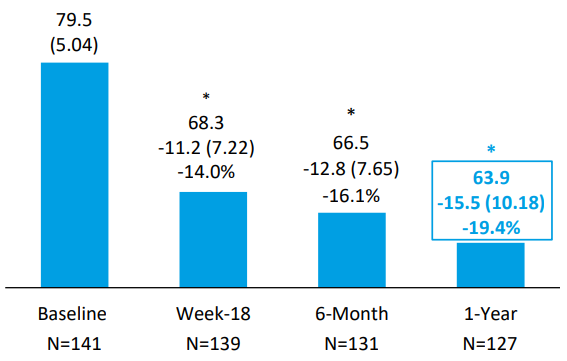
After 12 months of follow up, there was a statistically significant improvement in Positive and Negative Syndrome Scale (PANSS) mean percentage change from baseline (p-value <0.001: paired t-test, OC/LOCF). These results reflect continued benefit from staying on the treatment, with improvements observed through from six weeks, and six months, to the 12-month follow-up (Exhibit 2).
Further, it was found that c 40% of patients showed a clinically meaningful response based on PANSS measures at 12 months, defined as showing an improvement from baseline of ≥20% (Exhibit 3). This is particularly notable, given that all patients were on therapeutic doses of antipsychotics prior to the study, and hence, the improvements reflect the positive benefit of evenamide. Moreover, the data demonstrated that a significant majority (90%) of patients who initially responded to the treatment at the six-week timepoint (ie considered PANSS responders, approximately 45% of the patients) maintained their positive response after 12 months of treatment.
|
Exhibit 2: PANSS mean percentage change from baseline (SD in brackets) |
Exhibit 3: PANSS responder analysis (PANSS responder defined as showing a total improvement from baseline of ≥20%) |
|
|
|
Source: Newron – Conference call (4 January 2024); Note: *p-value vs baseline < 0.001, paired t-test, OC. |
Source: Newron – Conference call (4 January 2024)
|
|
Exhibit 2: PANSS mean percentage change from baseline (SD in brackets) |
|
|
Source: Newron – Conference call (4 January 2024); Note: *p-value vs baseline < 0.001, paired t-test, OC. |
|
Exhibit 3: PANSS responder analysis (PANSS responder defined as showing a total improvement from baseline of ≥20%) |
|
|
Source: Newron – Conference call (4 January 2024)
|
Condition severity was also evaluated by Clinical Global Impressions (CGI) measures, and this also showed statistically significant improvements (Exhibit 4) versus baseline. The data showed a reduction in severity of the condition in over 70% of patients. Additionally, Level of Functioning (LOF) was measured, which also showed a statistically significant benefit, with over 60% of patients showing an improvement at the 12-month follow-up (Exhibit 5).
|
Exhibit 4: CGI-S mean percentage change from baseline (SD in brackets) |
Exhibit 5: LOF mean percentage change from baseline (SD in brackets) |
|
|
|
Source: Newron – Conference call (4 January 2024); Note: *p-value vs baseline < 0.001, paired t-test, OC. |
|
Exhibit 4: CGI-S mean percentage change from baseline (SD in brackets) |
|
|
Source: Newron – Conference call (4 January 2024); Note: *p-value vs baseline < 0.001, paired t-test, OC. |
|
Exhibit 5: LOF mean percentage change from baseline (SD in brackets) |
|
|
Source: Newron – Conference call (4 January 2024); Note: *p-value vs baseline < 0.001, paired t-test, OC. |
Collectively, these results are highly encouraging, in our view, consistent with prior interim readouts at earlier follow-ups for this clinical trial. For example, 12-month data were reported for the first 100 patients in May 2023, and the results showed a comparable trend. This included a 47% PANSS responder rate, slightly higher than the now reported 40% rate for the full patient population, but this should not undermine the encouraging results of the total data set, in our view. Importantly, for the full population, over 70% of the patients experienced a clinically meaningful reduction in schizophrenia severity, and it was concluded from the efficacy data that c 50% of patients no longer met the protocol severity criteria for a diagnosis of treatment resistance at 12 months. This comes as a notable improvement, given that this figure stood at c 40% at six months and c 26% at six weeks. These data demonstrate the effectiveness of evenamide to overcome a treatment-resistant diagnosis, offering sustained benefit over the study duration. Additionally, 25% of all patients were described as achieving ‘remission’, which we note has not yet been observed in TRS patients to our knowledge, raising the expectation for an efficacious treatment strategy for this sub-population (see below). In terms of safety, it was found that the use of evenamide in combination with antipsychotics was well-tolerated, with a low incidence of treatment-emergent adverse dropouts. Further, there were no instances of patient relapses throughout the 12-month treatment period. The results are therefore promising, in our view, that evenamide can be used in addition to antipsychotics without any risk of drug-drug interaction or additional toxicity, making it a potentially effective treatment option in TRS.
Remission in TRS
Historically, remission in schizophrenia has been investigated by Lieberman et al. in 1993 and by Andreasen et al. in 2005, which have sought definitions based on precise measures of what would consist remission of the condition (including PANSS and CGI). Newron describes remission as a level of symptomatology that does not interfere with an individual’s behaviour and is also below that required for a diagnosis of schizophrenia. Such symptom improvements should persist for a significant time period in order for remission to be reached. Remission would represent the highest level of improvements that can be obtained in a patient with schizophrenia.
Newron believes that remission in TRS patients has not been described before. However, its analysis of the most recent data from study 014/015 suggests that a notable portion of evenamide treated patients have met the criteria for remission, with 27.6% of patients meeting the definition of Lieberman et al. (which had a maintenance requirement of eight weeks) and 25% meeting the definition of Andreasen et al. (maintenance requirement of 24 weeks).
Next up in TRS: A potentially pivotal Phase III trial
Based on the encouraging results to date, Newron has now disclosed the proposed study design for the planned subsequent Phase III trial. This will involve a larger population which, according to management, will include over 510 patients randomised (1:1:1) to receive either evenamide (15mg bid), evenamide (30mg bid) or placebo. We highlight that while the results from study 014/015 were encouraging, this was an open-label trial, which may be viewed as subject to biases in patient assessment. Accordingly, the Phase III TRS trial is designed to be double-blinded, as this is more likely to meet the requirements for regulatory approval, and it was noted that there will not be an opportunity for re-randomisation throughout the treatment duration. The pivotal study endpoints will be assessed at 12 weeks, with PANSS total change from baseline as the primary efficacy measure and CGI-S change from baseline as the key secondary measure. A second endpoint will be assessed at 26 weeks with PANSS total change from baseline as the maintenance efficacy measure, and a third (long-term) endpoint assessed at 52 weeks, also with the PANSS total change from baseline as the long-term efficacy measure. An open-label extension study will be conducted after one year, with patients from the initial portion of the Phase III study moving onto the extension arm as they complete treatment. We believe that the initiation of this trial, which we expect will launch in Q224, will represent a key milestone for Newron and will mark an important step for the clinical development of evenamide in TRS. We note that while management is confident that the design of this Phase III trial should be sufficient for regulatory approval (provided the data are positive), the company is currently in various discussions with potential partners, and we expect that an update on this front, when available, will provide guidance on eventual plans for the submission of a new drug application in either TRS or poorly managed schizophrenia, potentially dependent on the outcome of study 008A.
Recap: Understanding the assessment parameters
As discussed in our prior update note corresponding to six-month data for study 014/015, Newron is using the following efficacy scales to assess the effectiveness of evenamide:
■
Positive and Negative Syndrome Scale (PANSS), which is the primary efficacy indicator in study 014/015.
•
The PANSS is a 30-item scale that was developed to provide a balanced representation of positive (seven items) and negative (seven items) symptoms of schizophrenia, and understand their relationship to one another, as well as to general symptoms of psychopathology (16 items). The PANSS is intended to be a brief interview (c one hour), and to ensure standardisation, interviewers must be trained to a sufficient level of reliability.
■
Clinical Global Impressions (CGI).
•
The CGI scales are established rating tools that can be used for all psychiatric disorders, not limited to schizophrenia. The CGI are intended to provide an overall clinician-determined summary assessment (c 10 minutes) based on an overall view (observations and reported symptoms) of the global functioning of a patient population across a treatment period.
■
Strauss-Carpenter Level of Functioning (LOF).
•
The LOF scale uses a semi-structured interview (c 20 minutes) focused on quality of life across four domains: social contacts, work, symptomatology and function.
Near term: Study 008A results could be a key catalyst
Beyond TRS, Newron is developing evenamide for the treatment of poorly managed schizophrenia in patients already receiving antipsychotics, but who are not classed as having TRS. The potentially pivotal Phase III trial (study 008A) is a randomised, double-blind, placebo-controlled study to assess the safety, efficacy and tolerability of evenamide following a four-week 30mg bid treatment regimen (n=290). The recent announcement that patient recruitment has been completed serves as a positive indicator that the trial is progressing as anticipated. Top-line results are expected to be shared in March 2024, and could be the next most significant catalyst for investor attention, provided the data are positive.
Financials and valuation
We assessed Newron’s H123 financial performance in our recent note. Newron had a cash position of €7.7m at end-H123, plus €9.4m in other current financial and liquid assets. Based on our forecasted operating cash burn and estimated loan repayments to the European Investment Bank of €17.5m (including €10m in July 2024 and €7.5m in November 2024), we estimate a cash runway into Q324, consistent with the most recent management guidance. Assuming a positive readout from study 008A (guidance for readout in March 2024), we expect Newron will pursue a partnership deal for evenamide in schizophrenia, of which any payment from such a deal may extend our estimated cash runway further. In the absence of a partnership deal for evenamide in schizophrenia, we continue to expect that the company would need to raise additional capital of €30m in H224, which we have modelled as illustrative debt. We model that a licensing transaction will be realised by the end of FY24 and assuming our €30m funding forecast requirement is met, the company would no longer require further capital for evenamide to reach commercialisation and for the company to reach operating profitability. If the €30m projected funding is realised through an equity issue instead of debt (and at the 4 January 2024 closing trading price of CHF6.14 per share), Newron would have to issue 4.5m shares, resulting in our per share valuation reducing to CHF7.3 per share from CHF7.7 currently (shares outstanding would increase from 17.8m to 22.5m).
We maintain our valuation for Newron at CHF137.4m or CHF7.7 per share. Our valuation is based on a risk-adjusted net present value (rNPV) calculation for Xadago in Parkinson’s disease and evenamide in schizophrenia (Exhibit 6). We plan to revisit our assumptions to fully reflect the most recent data and once Newron launches the potentially pivotal Phase III clinical study in TRS, which it expects to start in Q224.
Exhibit 6: Newron valuation breakdown
Product |
Indication |
Launch |
Probability |
rNPV (CHFm) |
NPV/share (CHF/share) |
Xadago |
Parkinson’s disease |
2015 |
100% |
34.0 |
1.9 |
Evenamide |
Schizophrenia |
2025 |
60% |
252.2 |
14.1 |
Total direct product value |
|
|
|
286.3 |
16.0 |
|
|||||
Direct costs to 2033 less tax |
(120.5) |
(6.8) |
|||
Cash at end-June 2023 |
16.5 |
0.9 |
|||
Loans (fair value June 2023) |
(44.8) |
(2.5) |
|||
Valuation |
|
|
|
137.4 |
7.7 |
Source: Edison Investment Research
Exhibit 7: Financial summary
Accounts: IFRS; year end 31 December; €000s |
|
|
2021 |
2022 |
2023e |
2024e |
PROFIT & LOSS |
|
|
|
|
|
|
Total revenues |
|
|
5,762 |
6,094 |
8,947 |
6,847 |
Cost of sales |
|
|
0 |
0 |
0 |
0 |
Gross profit |
|
|
5,762 |
6,094 |
8,947 |
6,847 |
Total operating expenses |
|
|
(18,119) |
(19,396) |
(20,881) |
(26,043) |
Research and development expenses |
|
|
(10,725) |
(12,005) |
(13,434) |
(18,521) |
SG&A |
|
|
(7,394) |
(7,391) |
(7,448) |
(7,522) |
EBITDA (normalized) |
|
|
(11,386) |
(12,620) |
(11,747) |
(19,078) |
Operating income (reported) |
|
|
(12,357) |
(13,302) |
(11,935) |
(19,196) |
Finance income/(expense) |
|
|
(2,527) |
(4,170) |
(2,681) |
(3,070) |
Exceptionals and adjustments |
|
|
0 |
0 |
0 |
0 |
Profit before tax (reported) |
|
|
(14,884) |
(17,472) |
(14,615) |
(22,266) |
Profit before tax (normalised) |
|
|
(14,122) |
(16,992) |
(14,615) |
(22,266) |
Income tax expense (includes exceptionals) |
|
|
(17) |
(21,000) |
0 |
0 |
Net income (reported) |
|
|
(14,901) |
(17,493) |
(14,615) |
(22,266) |
Net income (normalised) |
|
|
(14,139) |
(17,013) |
(14,615) |
(22,266) |
Basic average number of shares, m |
|
|
17,845.0 |
17,845.0 |
17,845.0 |
17,845.0 |
Basic EPS (€) |
|
|
(0.84) |
(0.98) |
(0.82) |
(1.25) |
Adjusted EPS (€) |
|
|
(0.79) |
(0.95) |
(0.82) |
(1.25) |
BALANCE SHEET |
|
|
|
|
|
|
Property, Plant and Equipment |
|
|
87 |
72 |
72 |
72 |
Right of use assets (leases) |
|
|
490 |
455 |
285 |
186 |
Intangible Assets |
|
|
2 |
0 |
0 |
0 |
Non-current receivables (Tax credits) |
|
|
10,480 |
8,175 |
5,774 |
3,087 |
Total non-current assets |
|
|
11,059 |
8,702 |
6,131 |
3,345 |
Cash and equivalents |
|
|
25,019 |
13,424 |
10,908 |
4,313 |
Current financial assets |
|
|
9,575 |
9,350 |
0 |
0 |
Inventories |
|
|
0 |
0 |
0 |
0 |
Trade Accounts Receivable |
|
|
4,833 |
5,719 |
5,276 |
5,498 |
Total current assets |
|
|
39,427 |
28,493 |
16,184 |
9,810 |
Trade Accounts Payable |
|
|
3,504 |
4,869 |
4,605 |
5,211 |
Other Current Liabilities |
|
|
150 |
172 |
172 |
172 |
Total current liabilities |
|
|
3,654 |
5,041 |
4,777 |
5,383 |
Long-term Debt |
|
|
42,542 |
45,165 |
32,756 |
57,665 |
Leasing Obligations |
|
|
389 |
325 |
325 |
325 |
Share based liabilities |
|
|
213 |
220 |
220 |
220 |
Long-term Provisions |
|
|
581 |
474 |
474 |
474 |
Total non-current liabilities |
|
|
43,725 |
46,184 |
33,775 |
58,684 |
Equity attributable to company |
|
|
3,107 |
(14,030) |
(28,645) |
(50,911) |
CASH FLOW STATEMENT |
|
|
||||
Pre-tax profit |
|
|
(14,884) |
(17,472) |
(14,615) |
(22,266) |
Net Financial Income |
|
|
(792) |
(1,183) |
0 |
0 |
Depreciation and amortisation |
|
|
209 |
202 |
188 |
118 |
Share based payments |
|
|
762 |
480 |
0 |
0 |
Other adjustments |
|
|
3,524 |
4,996 |
2,401 |
2,687 |
Movements in working capital |
|
|
(264) |
1,885 |
179 |
384 |
Cash from operations (CFO) |
|
|
(11,445) |
(11,092) |
(11,848) |
(19,077) |
Capex |
|
|
(20) |
(18) |
(18) |
(18) |
Acquisitions & disposals net |
|
|
0 |
0 |
0 |
0 |
Other investing activities |
|
|
8,440 |
(299) |
9,350 |
0 |
Cash used in investing activities (CFIA) |
|
|
8,420 |
(317) |
9,332 |
(18) |
Loans received |
|
|
15,000 |
0 |
0 |
0 |
Illustrative debt |
|
|
0 |
0 |
0 |
30,000 |
Loan repayments |
|
|
0 |
0 |
0 |
0 |
Equity issued |
|
|
0 |
0 |
0 |
0 |
Other Financing Cash Flows (leases) |
|
|
(169) |
(186) |
0 |
0 |
Cash from financing activities (CFF) |
|
|
14,831 |
(186) |
0 |
30,000 |
Cash and equivalents at beginning of period |
|
|
13,213 |
25,019 |
13,424 |
10,908 |
Increase/(decrease) in cash and equivalents |
|
|
11,806 |
(11,595) |
(2,516) |
10,905 |
Effect of FX on cash and equivalents |
|
|
0 |
0 |
0 |
0 |
Cash and equivalents at end of period |
|
|
25,019 |
13,424 |
10,908 |
21,813 |
Net (debt)/cash (including liquid resources) |
|
|
(7,948) |
(22,391) |
(21,848) |
(35,852) |
Source: Company reports, Edison Investment Research
|
|
Research: Healthcare
Sequana Medical announced that the American Medical Association has issued six new Category III Current Procedural Terminology (CPT III) codes for the alfapump system. The issue of these codes augments the existing ICD-10 procedure codes and is expected to assist healthcare professionals and insurers in identifying specific procedures related to the alfapump system for reimbursement. This may broaden and facilitate the future US utilisation and reimbursement for the alfapump for the treatment of recurrent and refractory ascites (RRA) on regulatory approval. Sequana had submitted a Premarket Approval application to the US FDA on 27 December for the alfapump device and we remain confident that there is a high likelihood of a positive regulatory approval decision in H224, given the robust efficacy data from the POSEIDON North American pivotal study.