Last close As at 11/08/2026
—
— 0.00 (0.00%)
Market capitalisation
—
Research: Real Estate
Noratis is a hybrid between a property company that owns residential assets and a residential asset developer. Noratis has been operating in Germany’s non-core cities since 2011, and exploits the opportunities in this market segment while mitigating typical developer’s risks through targeting a constant cash inflow from rental income. Noratis acquires existing residential blocks, aims to modernise them with minimal disruption to the rental income stream and, within 12 to 36 months, aims to sell the building as a whole or unit-by-unit. Noratis has raised gross funds of €17.25m, which should enable it to boost its asset base, generate economies of scale and therefore mitigate risks for investors further, widening the gap between recurring rental yields and operating costs.
Written by
Ralf Goenemba
Noratis |
The real estate optimisers
Real estate |
Scale research report - Initiation
30 June 2017 |
Share details
Business description
Bull
Bear
Analyst
|
||||||||||||||||||||||||||||||
Noratis is a hybrid between a property company that owns residential assets and a residential asset developer. Noratis has been operating in Germany’s non-core cities since 2011, and exploits the opportunities in this market segment while mitigating typical developer’s risks through targeting a constant cash inflow from rental income. Noratis acquires existing residential blocks, aims to modernise them with minimal disruption to the rental income stream and, within 12 to 36 months, aims to sell the building as a whole or unit-by-unit. Noratis has raised gross funds of €17.25m, which should enable it to boost its asset base, generate economies of scale and therefore mitigate risks for investors further, widening the gap between recurring rental yields and operating costs.
Differentiated offer generates safer income
Noratis appears to have a differentiated profile in the German market: combining the stability of rental income streams with the benefits of development gains. Noratis develops existing residential assets, leading to a re-positioning of the asset. Higher like-for-like rents are then targeted at more affluent tenants, hence improving the rental income level and stability, and boosting the asset’s rental multiples at point of sale, leading to potential exit gains.
Noratis mitigates typical asset holder risks
Noratis is neither a long-term residential asset holder, nor a pure new asset developer. Noratis selects rent yielding assets with improvement potential with the intention to sell the asset typically after a one- to three-year ‘optimisation’ programme, including tenant restructuring and vacancy reduction. Historically, funds from disposal have been partly distributed and partly re-invested. The IPO proceeds will be invested with the objective of achieving and sustaining a portfolio size to generate sufficient yields to cover operating and optimisation costs for ongoing projects. Cash returns from asset sales can then wholly benefit investors.
Valuation: Bringing it together
The IPO raised gross funds of €17.25m through the issue of 920k shares at €18.75. At the IPO price, Noratis trades at 9x 2016 historic earnings, substantially below the peer group of 12.75x.
|
Historical financials
Source: Noratis accounts. Note: EPS and DPS based on 2m shares. |
Edison Investment Research provides qualitative research coverage on companies in the Deutsche Börse Scale segment in accordance with section 36 subsection 3 of the General Terms and Conditions of Deutsche Börse AG for the Regulated Unofficial Market (Freiverkehr) on Frankfurter Wertpapierbörse (as of 1 March 2017). Two to three research reports will be produced per year. Research reports do not contain Edison analyst financial forecasts.
Company description: Optimise before disposal
Noratis is a niche player in the German residential real estate segment. It specialises in acquiring low- to medium-end residential assets, preferably in non-core areas. Noratis has been operating since 2011 and by 2016 had a portfolio of approximately 1,000 units. Noratis only acquires assets with enhancement potential achievable within a one- to three-year timeframe. During that period, it invests in the asset while, crucially, simultaneously earning rental income. Rather than emptying a block, it improves the external appearance of the building and only refurbishes vacant apartments. In turn, this attracts more affluent tenants and changes the tenant mix of the block over time. Better tenant mix implies less asset management costs and therefore potentially attracts a different set of financial investors in the disposal process. The rental income stream and a development/optimisation period that is slightly longer than that of pure developers (typically 12-24 months) helps mitigate the disposal risk for Noratis.
Noratis listed on the Scale segment of Deutsche Börse on 30 June, raising €17.25m (gross) through a placing of 920,000 shares at €18.75/share. According to management, the funds raised will primarily be used to acquire new assets, predominantly in the vicinity of Germany’s densely populated areas, aiming to significantly increase the asset base from 65,000 square metres (end of March 2017).
Noratis is located in Eschborn, near Frankfurt, from where it manages its activities nationwide. It currently has 25 employees, covering all aspects of its business, ie due diligence, purchase process, modernisation control, asset management and the disposal process.
Noratis’s current rental income producing portfolio consists of approximately 1,100 units (including secured acquisitions in H117), of which 595 units are earmarked for private sale. The current asset base is approximately 75,000sqm.
Noratis’s business combines that of a real estate asset holder and a real estate developer. The key difference lies in the structure of multi-year cash flows:
■
Developers typically plan a new development for one to two years, including site selection and building concept. Permits and technical design leads to a two- to three-year period of planning, before the first significant outflow of cash (the purchase of the construction site). Thereafter follows an approximate two-year construction period with significant cash requirements, mostly financed by bank loans. Then the final selling phase starts. This implies that a developer sees its returns only after six years of investment and cash outflows. Only then would the funds to start a new project be available.
■
Asset holders typically face a significant cash outflow at the acquisition of the asset itself. Given the nature of a long-term holder, the assets are typically financed by banks as long-term mortgage loans with fixed rates. During the holding period, the asset holder receives dividends in the form of rents, but also needs to maintain the asset quality through selective investment. Any improvement of the asset quality should lead to increased rents, in contrast to the stable financing costs, given the long-term fixing of rates. Following the significant cash outflow in the beginning, the asset holder should receive constant cash inflows thereafter.
■
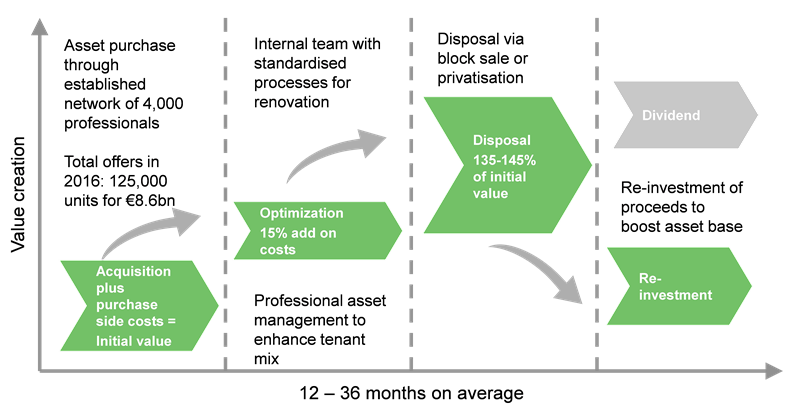
Noratis combines these models: it acquires existing rental income-generating real estate assets, incurring initial sizeable cash outflows. It then invests in the assets to improve the quality, with a pre-defined focus for the exit strategy (ie private sale or block sale). This typically lasts 12 to 36 months. After the disposal, it re-invests the funds and starts the process again. This implies that it does two to three transactions during the period a developer of new assets requires to fully develop one asset. Although the margins of Noratis’s asset sales are lower than those of new asset developers – as these are older, existing assets – they occur more frequently.
As a result, Noratis’s total return aims to be superior to that of developers and asset holders alike. In addition, it should create positive cash returns ahead of those of typical asset holders.
Business model: Upgrading and selling
Since 2014 Noratis has acquired 1,900 residential units for a total of €110m (average €58,000/unit) in multi-tenanted buildings. Noratis employs a standardised acquisition process, which determines the disposal process (block sale or individual sales) at the time of the acquisition. These multi-tenant buildings are improved by investments into the building itself and selectively into the units (if these are vacant or become vacant during the investment period), improving the asset quality mainly through energy efficiency, modernisation, external improvements and marketability. The profile of the buildings and hence commercial attractiveness is improved by a reduction in vacancies, higher rents per square metre (by letting the newly refurbished units) and an improved tenant mix (gentrification). By letting out vacant units for the first time after refurbishment, the average rent per square metre should be higher than existing levels. For example in Dormagen (its most recent transaction in November 2016), rent per square metre has lifted from c €6.50 to up to c €7.60 in certain apartments, following investments.
It is important to note that the Mietspiegel rent uplift restriction typically does not apply, as it is only applicable in densely populated cities (the top seven cities in Germany), where Noratis does not typically invest. Since 2014 (through 2016), Noratis has invested €12m (ie an average of €6,300/unit) into its asset base, increasing the total cost per acquired unit to €64,300. During the period, Noratis has received average rental income of €4.7m pa. Since 2014, Noratis has sold 1,324 units for €100m, or €77,000/unit, representing an average margin of 19.6% on renovated assets, excluding rental income results.
|
Exhibit 1: Business cycle |
|
|
Source: Edison Investment Research |
Noratis has re-invested its proceeds, but also distributes some of its profits. Since 2014, the company has paid dividends to its owners. The owners partly reinvested the received funds in the form of shareholder loans back into the company. This policy will change in the future, when Noratis aims to distribute approximately 50% of cash net profits to its shareholders. The existing shareholder and ‘friends & family’ loans (totalling €5.7m at end 2016) are to be converted into a five-year 7.5% straight bond, expiring in June 2022.
The funds from the IPO (€17.25 gross) are to be used to acquire up to c €70m in assets, with the intention of significantly increasing the existing asset base. The acquisitions will be funded by a split of c 25% equity and c 75% debt, ideally non-recourse short-term loans. The company suggests that this will result in an asset base from which growth would be driven by economies of scale and the three-year business cycle of asset purchase, improvement and re-investment of proceeds to further boost the asset base.
Acquisition procedure: Assets with appreciation potential
Noratis acquires assets or portfolios with 20-2,000 residential units of low to average quality in ‘secondary’ locations and towns with more than 10,000 inhabitants, preferably as block sales. These assets need to provide ‘optimisation’ potential, ie they could be meaningfully improved by relatively low investment. Typically, the assets have been built during the 1950s to 1970s. Noratis benefits from its huge network of 4,000 real estate professionals in Germany. Noratis’s standardised acquisition procedure is supported by a proprietary IT database with CRM functions, where it records all offers (€8.6bn in 2016 alone). Noratis has a reputation in the market for its swift (up to eight weeks) due diligence and acquisition process, making it attractive for realtors and agents. Typical asset sellers are ageing private owners and large asset holders, wishing to dispose of smaller non-core assets. In May 2017 Noratis had €70m (1,720 units) in the due diligence process for acquisition. Due to the structure of the business, the potential acquisition volume can change significantly over time.
Optimisation: Creating value
The acquisition process determines the exit process: Noratis either sells its assets as a ‘block’ transaction (entire multi-tenant houses or portfolios) or through private sales (individual units sold to tenants or private investors). While the latter achieves higher unit prices than block trades, it also requires more investment: Noratis typically invests up to €150/sqm in assets for block sales against up to €400/sqm for individual assets. The main investments are energy efficiency modernisation, increasing rental space through roof extensions, selected unit renovation and investment in the surroundings of an asset. Here, Noratis differs from typical property asset holders (annual maintenance approximately €50/sqm) and developers (average costs €1,800-3,000/sqm). In addition to any physical investment, Noratis optimises the tenant structure, using tenant turnover to improve the demographic profile of the tenant base to reposition the asset to achieve higher rents. In general, the optimisation process aims to increase rental multiples from 12x (at acquisition) to about 14-15x on an increased rental level after 36 months, depending on the location of the assets.
Disposal: Cashing in on investments and improvements
Noratis is not a long-term asset holder, but invests in existing assets and then sells these optimised assets to re-invest into new investment opportunities. For individual private sales, Noratis has an established sales team, which actually lives in the building until the last unit is sold, and is incentivised only at the end of the selling process. Repositioned houses and portfolios are also sold to institutional or financial investors. Since 2014 Noratis has sold 1,324 units largely to professional investors with average margins above 20%. Since 2011 the average sales period for 120 individual units has been 28 months, while block sales of 1,206 units took an average of 21 months. Noratis aims at overall disposal margins, based on acquisition plus investment costs, of 20-22%, which equals pre-investment/capex margins of 35-45%. In 2016, the overall sales margin reached 24.5%. Noratis has been able to avoid selling into weak markets, as rental income produces sufficient cash flow to cover operating costs – a main differentiation factor versus pure developers.
Rental income: Risk mitigation and cost coverage
Noratis acquires occupied residential assets, which yield rental income from day one of the acquisition. With the increase in its asset base, Noratis’s annual gross rental income rose from €2.7m in 2014 to €6.7m in 2016. Net rental income reached €3.9m (the difference to gross rental income are booked rental costs, which have to be passed on to service providers, and other rent related costs), fully covering interest costs in 2016 (and also in the previous two years). SG&A and salaries were not covered by recurring income, but by asset sales. Following the IPO, Noratis aims to significantly increase its asset base, hence boosting the gross rental income. Given the effects of economies of scale, Noratis’s intention is to achieve self-financing of its operations through net rental income.
|
Exhibit 2: Asset sales (€000s) and sales margin |
Exhibit 3: Net rental income (€000s) and net rental income margin |
|
|
|
Source: Noratis accounts |
|
Exhibit 2: Asset sales (€000s) and sales margin |
|
|
Source: Noratis accounts |
|
Exhibit 3: Net rental income (€000s) and net rental income margin |
|
|
Source: Noratis accounts |
2016 and Q117 business review and post IPO outlook
2016 was Noratis’s most successful year in terms of revenues and profitability. This was mainly driven by record sales of almost €38m. Q117 sales represented 67% of FY16 sales at €29.7m.
Given the structure of Noratis’s business and the current asset size, its past business years can be characterised as either ‘acquisition years’ or ‘disposal years’.
|
Exhibit 4: Turnover by segment 2016 (€’000s) – a disposal year |
Exhibit 5: Turnover by segment 2015 (€’000s) – an acquisition year |
|
|
|
Source: Noratis 2016 accounts |
Source: Noratis 2015 accounts |
|
Exhibit 4: Turnover by segment 2016 (€’000s) – a disposal year |
|
|
Source: Noratis 2016 accounts |
|
Exhibit 5: Turnover by segment 2015 (€’000s) – an acquisition year |
|
|
Source: Noratis 2015 accounts |
‘Performance’ includes sales revenues, ie proceeds from asset sales and rental income. In addition, it includes the net additions to the real estate asset portfolio the company makes throughout the year.
Noratis acquires assets using cash and secured bank loans where possible. The company has been able to boost its financial power through unsecured loans. The degree of both equity and unsecured loans has enabled Noratis to achieve attractive conditions for bank loans.
Noratis’s balance sheet in Q117 shows €9m in total equity, of which €0.5m was nominal equity. Total net debt amounted to €63.9m. Most of the debt is secured mortgage loans on assets of €75m. Noratis also shows cash of €7.9m. Prior to the IPO, the company converted €1.5m of capital reserves into equity, in order to streamline the balance sheet structure. Hence, the pre-IPO nominal equity was €2m, divided into 2m shares.
The IPO raised gross funds of €17.25m through the issue of 920,000 new shares at €18.75. The total number of shares is now 2.92m. Pro forma equity stands at c €25.5m and pro-forma net debt at c €47.7m (using Q117 reported figures).
Historically Noratis’s new investments were governed by the level of available equity, which needed to be ‘earned’ from asset sales, before re-investing was possible. Noratis also received unsecured loans, which bridged the equity required, at a 7.0-8.0% interest rate. Noratis needed to participate with sufficient equity in acquisitions to allow banks to provide loans within loan-to-value (LTV) brackets, which banks could then refinance themselves at attractive conditions.
Noratis typically finances its acquisitions with 25% equity and 75% debt, which ideally is non-recourse short-term financed by local Sparkassen and banks. This leverage appears high compared to long-term asset holders, such as REITs (maximum 50% under German law), but low compared to standard developers (up to 90%). However, importantly, the majority of Noratis’s debt is secured mortgage loans.
Following the IPO, management suggests that the reduction in the higher interest rate paying unsecured debt and the growth in the asset base will result in a self-funding model of growth. The increased equity base (c €25.5m, ie €9m as of Q117 plus c €16.2m net IPO proceeds) as a result of the IPO should increase the firm’s financial flexibility and acquisition speed, potentially allowing for more attractive deals. At the same time, earnings volatility should be reduced, as net rental income is targeted to cover operating costs in addition to interest costs.
Based on current economics as described in the IPO papers, Noratis aims to significantly increase its asset base and net rental income streams to cover operating costs (SG&A, salaries and interest costs) by 2018/19. Post IPO, Noratis aims to increase its optimisation activities, as this is a key value driver. In addition, management indicates that there will be a targeted sales approach to accelerate disposals without compromising on price.
Recent newsflow and upcoming catalysts
Noratis reported asset sales of €28.5m in Q117, representing 75% of full year 2016 sales. The key driver was the sale of the Dormagen II portfolio of 309 units and selective private sales in Zweibrücken (Saarland). The selling margin increased to 27.7% (24.4% in 2016). As a result of the disposal of Dormagen II, booked in Q117, Q1 pre-tax profits rose by €6.0m versus Q116 to €7.0m, leading to net profits of €5.1m. Additionally, Noratis acquired 260 units in Q117. As a consequence, group equity rose 36% from end 2016 to €9.1m at the end of Q117.
In Q117, Noratis agreed to acquire 260 units for €14m (€53,800/unit) on Rügen, Germany’s largest island in the Baltic Sea, and the company has agreed to acquire a further 132 units for €21m in Western Germany. Management expects these acquisitions of €35m to achieve €2m in initial annual rent.
Based on the typical investment structure (ie 25% equity and 75% debt) for this total project of 392 units, Noratis would have invested €8.8m of equity and unsecured bank loans and the rest would be bank financed.
Market overview and outlook
The German residential market is still largely a tenant-based market, with an ownership ratio of just 45.5% (source: Destatis 2016, based on Zensus 2014). Market surveys suggest that the ratio will rise above 55% in the next 10 years.
Exhibit 6: Ownership and age of assets in different locations
Year |
Total units |
Germany |
West Germany |
East Germany |
City states* |
Average |
100% |
46% |
50% |
46% |
13% |
1950-59 |
12% |
37% |
39% |
39% |
16% |
1960-69 |
16% |
39% |
44% |
15% |
19% |
1970-79 |
16% |
48% |
54% |
20% |
22% |
1980-89 |
11% |
52% |
60% |
28% |
20% |
Source: Destatis 2016, Zensus 2014. Note:*City states – Berlin, Bremen, Hamburg.
Noratis’s focus is on the tenanted 55% of Germany’s existing housing base, targeting the areas where the average ownership value and rents are typically low and inhabited by low-income tenants. These units tend to involve high levels of maintenance. These assets are typically owned by larger companies, municipalities and private investors. Larger companies tend to dispose of these assets where they represent a marginal part of their business, since they are costly to manage. Noratis specialises in the required management process and, together with local partners, aims to act more cost efficiently. It focuses on areas outside but in close proximity to the most densely populated areas in Germany.
German mortgage interest rates have fallen substantially in the past decade, from 4.89% in May 2007 to 1.40% by the end of June 2017 (source: www.interhyp.de/zins-charts/), while disposable incomes grew by 17% during the same period (source: http://vgrdl.de). While unit prices in top cities rose significantly over the past few years, this has not been the case in most of the other regions. This has led to a dramatic improvement in ‘affordability ratios’, making Germany the second most affordable country in Western Europe. This suggests that higher-margin private sales could continue to increase in the coming years, supporting Noratis’s business case. With enhanced environments and modernisation of energy efficiency, the buildings fulfil the requirements of various potential buyers, including young families, which changes the tenant mix positively. Regarding the disposal of assets, key demographic and wealth trends are beneficial to Noratis.
Exhibit 7: Affordability ratios in Europe (%)
Country |
Price/income |
Rent mult. city |
Rent mult. region |
Mortgage/wage |
Affordability |
Switzerland |
14.04 |
33.24 |
31.78 |
81.89 |
1.22 |
Luxembourg |
13.93 |
25.37 |
27.01 |
84.38 |
1.19 |
France |
11.58 |
33.29 |
27.22 |
73.86 |
1.35 |
Austria |
9.66 |
27.55 |
26.46 |
59.08 |
1.69 |
Netherlands |
8.52 |
18.60 |
16.86 |
56.24 |
1.78 |
Germany |
7.46 |
26.68 |
24.47 |
45.91 |
2.18 |
Belgium |
6.96 |
17.18 |
16.88 |
44.69 |
2.24 |
Source: numbeo.com. Note: The higher affordability ratio, the easier an asset can be financed. Calculation based on a 90sqm apartment, average price in region, 20-year fixed rate mortgage.
The table above shows the attractiveness of the German market, not only for private sales, but also for financial investors.
Management structure designed for growth
CEO Igor Christian Bugarski (DIPL.-ING.) has been a shareholder of Noratis since 2011. He is responsible for the acquisition, development/optimisation, sales and legal at Noratis. He previously held management positions at CRBE and DeTeImmobilien. His experience includes the purchase and distribution of more than 4,000 residential and commercial units, including the OpernTurm in Frankfurt.
CFO André Speth (DIPL.-KFM.) has been with Noratis since 2015. He is responsible for finance & controlling, IT and IR. He has previously held management positions in the real estate segment of investment banks including Morgan Stanley and Deutsche Bank, participating in several M&A and IPO transactions, including the IPO of LEG Immobilien.
Oliver C Smits (DIPL.-KFM.) is head of the investment board. He founded Noratis in 2002 and since 2011 has developed the company into a fast-growing asset developer. In the past 20 years, he has managed the purchase, optimisation and sale of more than 10,000 units. In addition, he developed two real estate companies that were then successfully sold to investors. He is head of a supervisory team of three professionals with excellent contacts in the real estate sector.
Noratis has attracted a strong second management layer, covering all business segments:
■
Flaminia Prinzessin zu Salm-Salm (nine years’ experience) heads an acquisition team of three;
■
Jens Walter (15 years’ experience) is an architect and heads a team of six technical specialists;
■
Susan Herrmann (13 years’ experience) is the in-house lawyer and heads a team of three asset managers; and
■
Thomas Machtenberg (22 years’ experience) heads a team of two distribution specialists.
Financials
Noratis’s balance sheet shows a high level of debt: gross debt at end 2016 was €77m, or 88% of the balance sheet total. Of this, c €5.7m was unsecured loans from shareholders and family and friends, while the vast majority of debt (€64m) was secured mortgage loans. Equity was €6.6m, represented mostly by cash (€5.8m). Assets included real estate assets worth €80m. Noratis needs a relatively high cash buffer in order to be flexible in asset acquisitions.
Noratis’s accounts are prepared under HGB standards. Unlike IFRS, HGB does not use mark-to-market valuations or annual impairments. This implies that all Noratis’s asset sales revenues are booked at the time of the disposal and are therefore cash earnings. On the balance sheet, this implies that hidden reserves are building due to optimisation and rent multiple expansions. In IFRS accounts, these value increases would be seen as profits and typically are then seen in equity. Based on the valuation by an international RICS appraiser, Noratis’s asset value as of end 2016 was €110m against book value of €80m. This explains the company’s ability to build up an asset portfolio of €80m (2016) with just €6.6m of reported equity and €5.7m of unsecured loans in 2016. Approximately 83% of Noratis’s debt at end 2016 was secured mortgage loans, ie loans directly allocated to a single asset or asset portfolio and therefore only indirectly attributable to Noratis’s shareholders.
Overall, c 90% of Noratis’s 2016 balance sheet comprises ‘assets available for sale’. Excluding these inventories, Noratis is an asset-light company and there is therefore minimal depreciation holding back earnings creation for shareholders.
Looking at the income statement, Noratis’s annual interest payments are already covered by net rental income, again underlining the risk mitigation stemming from holding rental income-producing assets.
Adjusting the number of shares throughout the years under review to 2m shares (ie the number of shares before the IPO for better comparison in order to provide investors with an easy multi-year comparison; this has been approved by the company and its auditors and is part of the IPO prospectus), we arrive a notional 25% payout ratio for the past three years. It should be noted that in the past shareholders reinvested the dividends as shareholder loans to allow Noratis to continue to grow.
Following the IPO and the capital increase of 920,000 shares (post IPO 2.92m shares), Noratis should have a cash position of €24.1m. Based on pre IPO net debt of €63.9m, the post IPO net debt level is c €47.7m. In addition, the stated NAV (excluding non-realised valuation gains) should increase from €9m to €25.2m, or €8.63 per share.
Exhibit 10: Financial summary
€000s |
2014 |
2015 |
2016 |
Q117 |
||
Year end 31 December |
HGB |
HGB |
HGB |
HGB |
||
Income statement |
||||||
Revenue |
|
16,705 |
23,814 |
44,560 |
29,737 |
|
Rental income |
|
2,705 |
4,766 |
6,719 |
1,259 |
|
Income from asset sales |
|
14,000 |
19,048 |
37,841 |
28,478 |
|
Net change in asset base |
|
25,843 |
42,547 |
(9,165) |
(4,439) |
|
Profit Before Tax (as reported) |
1,164 |
1,516 |
6,012 |
6,985 |
||
Attrib. net income (as reported) |
|
804 |
1,077 |
4,205 |
5,054 |
|
|
|
|
|
|
|
|
EPS (adjusted to 2m shares pre IPO) – (€) |
|
0.40 |
0.54 |
2.10 |
2.53 |
|
Dividend per share (adjusted to 2m shares) (€) |
|
0.19 |
0.35 |
0.67 |
– |
|
NAV/share (adjusted to 2m shares pre IPO) (€) |
|
0.70 |
1.89 |
3.32 |
4.52 |
|
|
|
|
|
|
|
|
EPS (adjusted to 2.92m shares post IPO) – (€) |
|
0.28 |
0.37 |
1.44 |
1.73 |
|
Dividend per share (adjusted to 2.92m shares) (€) |
|
0.13 |
0.24 |
0.46 |
– |
|
NAV/share (adjusted to 2.92m shares post IPO) (€) |
0.48 |
1.29 |
2.27 |
3.10 |
||
|
|
|
|
|
|
|
Balance sheet |
|
|
|
|
|
|
Total non-current assets |
|
46 |
76 |
84 |
81 |
|
Total current assets |
|
47,054 |
89,590 |
81,195 |
77,765 |
|
Cash |
|
1,369 |
2,470 |
5,761 |
7,920 |
|
Total assets |
|
48,914 |
92,711 |
87,482 |
86,192 |
|
Total non-current liabilities |
|
824 |
20,008 |
15,189 |
25,575 |
|
Total current liabilities |
|
46,670 |
68,860 |
65,597 |
51,496 |
|
Total liabilities |
|
47,494 |
88,868 |
80,786 |
77,071 |
|
Net debt |
|
43,953 |
83,174 |
70,559 |
63,922 |
|
Net assets |
|
1,420 |
3,843 |
6,696 |
9,121 |
|
Shareholder equity |
|
1,391 |
3,769 |
6,637 |
9,038 |
|
Cash flow statement |
|
|
|
|
|
|
Net cash from operating activities |
|
(23,768) |
(39,331) |
18,705 |
10,199 |
|
Net cash from investing activities |
|
(40) |
(45) |
(38) |
(91) |
|
Net cash from financing activities |
|
24,446 |
40,477 |
(15,376) |
(7,949) |
|
Net cash flow |
|
638 |
1,101 |
3,291 |
2,159 |
|
Source: Noratis annual reports & IPO documents. Note: HGB = German GAAP.
Given the low reported balance sheet equity, ROE is high and above 50% in 2016 and in Q117.
|
Exhibit 11: Net profit and ROE margin progression |
Exhibit 12: ROCE progression |
|
|
|
Source: Noratis accounts |
|
Exhibit 11: Net profit and ROE margin progression |
|
|
Source: Noratis accounts |
|
Exhibit 12: ROCE progression |
|
|
Source: Noratis accounts |
Valuation
Noratis’s business model sits between asset holder and a developer, making direct comparisons to listed companies rather difficult. However, we have identified the following comparable companies:
■
RCM Beteiligungs AG, which operates mainly in Dresden (Saxony) and has a similar business model to Noratis. RCM had sales of c €7m in 2016.
■
BUWOG AG, a listed spin-off of IMMOFINANZ in Austria. It is focused on asset holding and privatisation. Most of its assets are in Germany. It had sales of €400m in 2015/16.
■
Accentro AG, a privatisation specialist historically in Berlin, now operating across Germany. It acquires assets suitable for privatisation. In 2016, it reported revenues of c €45m.
■
Publity AG, which operates in the area of commercial real estate and is a very active asset manager and asset seller. In 2016, it reported sales of €41m.
Exhibit 13: Comparable companies
|
Market cap |
P/E (x) |
P/BV (x) |
||||
(€m) |
2016 |
2017e |
2018e |
2016 |
2017e |
2018e |
|
RCM Beteiligungs AG |
36.2 |
19.47 |
- |
- |
2.06 |
- |
- |
Accentro Real Estate |
251.0 |
11.20 |
- |
- |
2.01 |
- |
- |
BUWOG (A) AG |
2,947.0 |
11.04 |
31.18 |
23.85 |
1.38 |
1.31 |
1.19 |
Publity AG |
248.8 |
9.31 |
5.40 |
5.11 |
4.03 |
2.39 |
1.92 |
Peer group average |
12.75 |
9.15 |
14.48 |
2.37 |
1.85 |
1.56 |
|
|
|
|
|
|
|
|
|
Based on 2m shares |
|
EPS (€) |
|
|
BV/share (€) |
|
|
Noratis AG |
|
2.10 |
|
|
4.52 |
|
|
Noratis AG implied share price |
26.81 |
|
|
10.72 |
|
|
|
Source: Bloomberg, Noratis accounts. Note: P/E valuations based on year-end prices. Noratis EPS and BV/share based on 2m shares.
The table above illustrates peer P/E and P/BV multiples. It shows Noratis’s reported 2016 EPS (based on 2m shares) and its 2016 reported book value (ie equity). It should be noted that Noratis’s balance sheet contains – as mentioned – c €30m of potential hidden reserves, ie an additional €15/share, which would lift its 2016 book value to c €19.5/share, based on 2m shares pre IPO..
Exhibit 14: Sector valuation
Item |
industry |
sector |
average |
Implicit |
P/E Ratio (TTM) |
22.95 |
20.63 |
21.79 |
45.81 |
Beta |
1.60 |
1.54 |
1.57 |
|
Price to Sales (TTM) |
4.44 |
5.02 |
4.73 |
105.38 |
Price to Book (MRQ) |
1.49 |
2.46 |
1.98 |
36.28 |
Price to Cash Flow (TTM) |
17.16 |
15.35 |
16.26 |
26.75 |
Source: Reuters. Note: All items multiples; industry: financials; sector: RE development & operations; Noratis 2016: €/share on 2m shares.
The table above combines the current multiples in the industry and sector with Noratis 2016 data, based on 2m shares (pre-IPO). This results in the implied Noratis share prices given in Exhibit 14 above. P/E ratios for the sector reflect the strong development of the real estate industry in the past years. As operators, the companies are asset light, leading to relatively high price/sales ratios.
Based on our German/Austrian peer group (Exhibit 13) we arrive at prices between €26.8 (P/E base) and €10.7 (P/BV base), leading to an average value of €18.8, while the median of the industry values is €41 (based on 2m shares pre-IPO).
In February 2017, the company was able to streamline its balance sheet further at attractive conditions (compared to the table above) by buying back €2.5m of preference shares from a departing shareholder, representing 10% of the company capital, implying an equity value of €25m.
Sensitivities
In terms of the equity base, Noratis’s business is highly leveraged. Hence, changes in interest rates could affect the group’s results significantly. Based on the 2016 results, a 1pp change in interest rates would alter pre-tax profits by 11% (€640k). A rise in interest rates would also affect the projected sales multiple on the important asset sales business. Assuming a 14.5x exit rent multiple (=1/14.5 = 6.8%) as a base, a 1pp increase to 7.8% would reduce the multiple to 12.8x. On the basis of the assets for sale at the end of 2016 (€80.1m) and the projected 30% margin, the sales profit would decline by €12.2m, reducing the margin to 14.7%.
On the other hand, Noratis would benefit from a decline in asset prices as a result of higher interest rates. As Noratis is not a long-term asset holder, a decline in prices would lower its acquisition costs, while rental income would, all other things being equal, remain unchanged.
It should be noted that Noratis runs a set of ‘emergency plans’, which embrace a number of risk scenarios. Interest risks could be countered by focusing on optimisation and boosting of rental income. The interest rate change risk on the asset financing, a key risk for asset holders, is less onerous for Noratis since it hopes to dispose of the assets after a 12- to 24-month period.
Macro issues
The main risk is a rapid rise in interest rates, as this affects the assets held and improved for disposal. A gradual rise should not be a major factor, as this would lead to a ‘cost averaging’ on the purchase side (lower acquisition costs), which could offset lower disposal prices. In Germany, more than 90% of mortgage finance is at fixed rates and typically fixed for more than 10 years.
A further and more pronounced interest in and focus on the top seven cities in Germany could impair the pricing environment for secondary areas. As the overall population in Germany is barely increasing, certain areas are at risk of being depopulated. This is particularly the case in certain eastern German areas. Noratis carefully analyses the macro and micro environment to eliminate such risks, which would lead to very difficult markets for its assets.
Larger real estate companies could become interested in the higher-yielding market in secondary locations. The consolidation trend in the industry created large, nationwide operating companies, which might change their focus to manage secondary locations, where their size might give them a competitive edge. These companies could make it more difficult for Noratis to acquire assets at attractive prices. However, Noratis has a network that allows it to complete off-market transactions, where fast action and closing is required. Following the IPO, Noratis should be able to act even faster as it is better capitalised, allowing greater flexibility.
Frankfurt +49 (0)69 78 8076 960 Schumannstrasse 34b 60325 Frankfurt Germany |
London +44 (0)20 3077 5700 280 High Holborn London, WC1V 7EE United Kingdom |
New York +1 646 653 7026 295 Madison Avenue, 18th Floor 10017, New York US |
Sydney +61 (0)2 8249 8342 Level 12, Office 1205 95 Pitt Street, Sydney NSW 2000, Australia |
|
Foresight (FRSX) shares have become significantly more investible in recent months with the company listing on Nasdaq on 15 June, publication of accounts in English and the company becoming self-financing with completion of a NIS43m ($11.7m) funding round. Indeed, with $17m in cash and an estimated c NIS158m ($45m) of its warrants deep in the money, we see the potential for FRSX to exercise its $11.3m options to increase its stake in RV to 45% and build a substantial cash cushion in the coming years if these are converted. In this note we launch our dollar-based US GAAP forecasts and review recent developments.