Last close As at 05/08/2026
EUR8.32
▲ 0.12 (1.46%)
Market capitalisation
EUR491m
Research: Financials
ProCredit Holding (PCB) produced another strong set of quarterly results with a net income of €34.6m in Q223, implying an annualised return on equity (ROE) of 15.0% (and 14.2% in H123). Importantly, most of PCB’s regional banks contributed to the solid profitability, including ProCredit Bank Ukraine, which posted a 39.7% ROE in H123. This makes the company well positioned to meet management’s FY23 ROE guidance of 8–10%, despite headwinds in the Ukrainian agricultural sector, further deposit repricing and personnel cost inflation. Still, PCB’s shares currently trade at just 0.46x our FY23e book value per share.
ProCredit Holding |
On track to meet FY23 ROE guidance of 8–10% |
Q223 results |
Banks |
23 August 2023 |
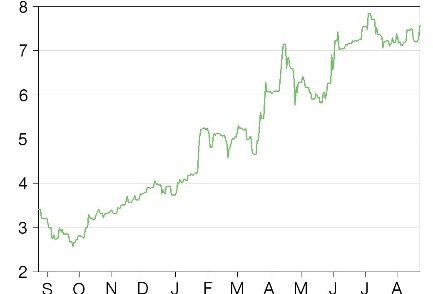
Share price performance
Business description
Next events
Analyst
ProCredit Holding is a research client of Edison Investment Research Limited |
||||||||||||||||||||||||||||||||||||||||||||||||||||
ProCredit Holding (PCB) produced another strong set of quarterly results with a net income of €34.6m in Q223, implying an annualised return on equity (ROE) of 15.0% (and 14.2% in H123). Importantly, most of PCB’s regional banks contributed to the solid profitability, including ProCredit Bank Ukraine, which posted a 39.7% ROE in H123. This makes the company well positioned to meet management’s FY23 ROE guidance of 8–10%, despite headwinds in the Ukrainian agricultural sector, further deposit repricing and personnel cost inflation. Still, PCB’s shares currently trade at just 0.46x our FY23e book value per share.
Year end |
Net interest income (€m) |
EPS* |
DPS |
P/BV |
P/E* |
ROE |
12/21 |
222.0 |
1.35 |
0.00 |
0.52 |
5.6 |
9.7 |
12/22 |
264.6 |
0.28 |
0.00 |
0.51 |
27.0 |
1.9 |
12/23e |
304.0 |
1.55 |
0.52 |
0.46 |
4.9 |
10.0 |
12/24e |
312.5 |
1.71 |
0.57 |
0.43 |
4.4 |
10.1 |
Note: *EPS as reported by the company
Still benefiting from a high net interest margin
PCB’s net interest margin (NIM) remained high at 3.6% in Q223 (Q222: 3.1%), supported by base rates that further increased or remained at levels visibly above last year in most of its countries of operations. PCB’s NIM also benefited from an improved funding mix, with customer deposits up 2.7% in H123 and the deposit-to-loan ratio up to 104.9% at end-June 2023 versus 103.1% at end-2022. Despite a focus on margin optimisation and targeted loan reduction in some countries, PCB’s loan book increased by 0.8% in H123 (Q223: 1.6%). Together with a 9.1% yoy growth in net fee and commission income, this led to an 18.8% y-o-y rise in operating income (above the growth in operating expenses), resulting in a cost income ratio of 59.7% in Q223 (Q222: 61.0%). PCB’s cost of risk was minimal at 2bp in H123.
Management reiterated its FY23 guidance
Management still guides to an ROE of 8–10% for FY23, which at first glance may seem conservative given the 14.2% ROE in H123. However, PCB may have to book additional loss allowances due to Russia’s recent withdrawal from the grain deal and its air strikes on Ukrainian port and grain storage infrastructure. Moreover, PCB’s deposit base is yet to fully reflect the higher base rates, and the group sees pressure on wages, which will lead to higher personnel expenses in H223. That said, even after factoring in the above headwinds (including FY23 cost of risk at the upper end of its guidance, ie 45bp), we expect an FY23 ROE of c 10%.
Valuation: Remaining underappreciated
We have raised our fair value estimate in our base scenario (which assumes a sustainable return on tangible equity, RoTE, of 10%) to €11.40/share (from €10.30 previously) due to updates to the country risk premiums and regression P/BV multiple used in our valuation model, as well as higher FY23 forecasts. Assuming an RoTE in line with PCB’s mid-term guidance (12%), PCB would be valued at €13.40/share. Finally, in a worst-case scenario of full write-off of the local bank in Ukraine, we would value PCB at €10.00/share.
Q223 annualised ROE at 15.0%
PCB reported a strong €34.6m net income in Q223 (vs €9.4m in Q222, see Exhibit 1), translating into a 15.0% annualised ROE in Q223 and bringing the H123 annualised figure to 14.2%. This is well above PCB’s current FY23 guidance of 8–10% (raised in May 2023 from 6–8% communicated earlier this year) and ahead of the medium-term guidance of around 12%. Encouragingly, most of the regional banks contributed to the healthy profitability, with all Southeastern European (SEE) banks reporting an annualised ROE of 11–13% (except for Kosovo at 23% and Albania at 7%), while banks in Ukraine, Georgia and Moldova reported ROEs of c 40%, 19% and 20%, respectively. Ecuador was again an outlier with a slight loss in H123 (see more details on Ecuador below).
Exhibit 1: Q223 and H123 results highlights
€m, unless otherwise stated |
Q223 |
Q222 |
y-o-y change |
H123 |
H122 |
y-o-y change |
Net interest income |
80.2 |
64.7 |
24.1% |
155.7 |
124.8 |
24.7% |
Net interest margin (annualised) |
3.6% |
3.1% |
47bp |
3.5% |
3.0% |
49bp |
Expenses for loss allowances |
-1.3 |
21.7 |
NM |
0.5 |
57.3 |
NM |
Cost of risk (annualised, bp) |
-9 |
141 |
-150bp |
2 |
188 |
-186bp |
Net fee and commission income |
14.9 |
13.7 |
9.1% |
28.9 |
26.3 |
9.9% |
Pre-tax profit |
40.8 |
10.4 |
292% |
76.7 |
6.6 |
NM |
Net income |
34.6 |
9.4 |
267% |
64.1 |
7.7 |
NM |
ROE |
15.0% |
4.4% |
1066bp |
14.2% |
1.8% |
NM |
Cost income ratio |
59.7% |
61.0% |
-129bp |
59.7% |
60.1% |
-41bp |
CET-1 ratio |
14.2% |
13.7% |
0.4pp |
14.2% |
13.7% |
0.4pp |
Deposit-to-loan ratio |
104.9% |
91.2% |
13.7pp |
104.9% |
91.2% |
13.7pp |
Gross loan portfolio growth (q-o-q) |
1.6% |
4.4% |
-2.5pp |
3.9% |
6.2% |
-2.3pp |
Customer deposits growth (q-o-q) |
2.1% |
4.1% |
-2pp |
2.7% |
3.6% |
-0.9pp |
Source: ProCredit Holding
NIM still strong, CIR below 60%
The solid set of results was assisted by a continuously high NIM (3.6% in Q223 vs 3.1% in Q222) amid interest rate normalisation across most countries of PCB’s operations (despite some rate cuts in the Eastern European countries), see Exhibits 2 and 3. It is worth noting that almost all local PCB banks contributed to the sequential NIM expansion. The stronger interest income was driven by customer loans, but also by central bank balances and investment securities.
|
Exhibit 2: Central bank policy rates in the SEE region |
Exhibit 3: Central bank policy rates in the EE region |
|
|
|
Source: Local central banks |
|
Exhibit 2: Central bank policy rates in the SEE region |
|
|
Source: Local central banks |
|
Exhibit 3: Central bank policy rates in the EE region |
|
|
Source: Local central banks |
NIM was also assisted by the improving deposit-to-loan ratio (104.9% at end-June 2023 vs 91.2% at end-June 2022 and 103.1% at end-2022), on the back of a 2.7% increase in customer deposits, as well as the fact that customer deposits are yet to fully capture the base rate hikes (see Exhibit 4). Together with a slight sequential increase in the loan book (up 0.8% during H123, down c 2.2% yoy due to targeted loan book reduction and local currency devaluation in July 2022 in Ukraine), this resulted in a 24.1% y-o-y rise in net interest income to €80.2m in Q223. In Q223 alone, the loan book rose by 1.6% as PCB experienced gradually improving sentiment among SMEs to pursue new investments.
|
Exhibit 4: PCB’s net interest income H123 versus H122 (€m) |
|
|
Source: ProCredit Holding |
PCB’s earnings were further driven by 9.1% y-o-y growth in net fee and commission income to €14.9m (assisted by a focus on adding private individual and non-loan business clients), translating into an 18.8% y-o-y improvement in operating income in Q223 to €98.0m, outpacing the 16.3% yoy growth in operating expenses to €58.6m. This allowed PCB to keep the cost income ratio (CIR) under control at 59.7% in both Q223 (vs 61.0% in Q222) and H123, ahead of the 62–64% management guidance for FY23. After adjusting for extraordinary items, PCB’s CIR was 58.3% in H123, 1.5pp below H122 and close to PCB’s medium-term target of c 57%.
H123 cost of risk at a low level
PCB booked a €1.3m net release of loan loss provisions in Q223 (or 9bp of the gross loan book), resulting in an H123 cost of risk of 2bp. The H123 net provisioning was driven by €6.7m in recoveries of written off loans and a €6.2m positive impact from model parameter updates. This has more than offset new loss allowances from stage transfers (€11.0m) and some minor incremental management overlays (€1.5m). Total management overlays for macroeconomic risks as at end-June 2023 reflected in PCB’s loan loss provisions stood at €41.0m (of which c €11.1m was attributable to ProCredit Bank Ukraine). The share of credit-impaired loans in PCB’s loan book outside of Ukraine stood at a moderate 2.3% at end-June 2023 (12.4% in Ukraine, with a 130% coverage ratio of the default portfolio).
Capital base remains sound
PCB’s CET1 ratio stood at 14.2% at end-June 2023 versus 13.5% at end-2022 and the current regulatory requirement of 9.2%, assisted by the full attribution of FY22 profit and continued improvements to risk-weighted asset (RWA) efficiency (see our last outlook note for details). Two-thirds of the H123 result will be attributed to the CET1 capital in Q323, which on a pro-forma basis translates into a CET1 ratio of 14.8%.
PCB’s Multilateral Investment Guarantee Agency (MIGA) collaboration was broadened to include an additional agreement for Ukraine (signed in June 2023), with the latter resulting in a €35m RWA release, bringing the combined MIGA collaboration effect to €140m (or 25bp in CET1 ratio improvement year-to-date). Moreover, PCB embarked on a securitisation project with the European Investment Fund in Bulgaria, with a positive RWA impact of €180m (or a 32bp contribution to the year-to-date CET1 ratio improvement). PCB’s total capital ratio reached 15.3% at end-June 2023 versus 14.3% at end-2022 and the current regulatory requirement of 14.2%.
Environmental and governance milestones achieved
PCB achieved an important milestone on its carbon neutrality agenda (see the key takeaways from PCB’s Impact Report 2022 in our previous update note for details) by commissioning its 3MW photovoltaic park in Kosovo, which will compensate for 85–90% of its stage 1 and 2 emissions. We also note that PCB’s 2023 AGM resolved with a large majority to change its legal form to a stock corporation (with conversion expected to be completed in Q323).
Why has management not raised its FY23 guidance further by now?
We estimate that, following the strong H123 results (14.2% ROE), the management’s current FY23 ROE guidance of 8–10% implies an H223 annualised ROE of c 2–6%, which at first glance looks conservative. However, there are several factors that may lead to lower profitability for PCB in the second half of the year:
■
War in Ukraine: while the bulk of portfolio reclassification at ProCredit Bank Ukraine was completed as at end-June 2023, PCB’s provisions are yet to reflect the impact of Russia’s recent withdrawal from the grain deal and its air strikes on the Black Sea and Dnipro port and grain storage infrastructure across Ukraine. The share of agricultural loans in PCB’s local loan book is substantial, ahead of group level of 18% at end-June 2023. That said, management highlighted that the upper end of the FY23 cost of risk guidance of 45bp covers an even more adverse scenario than what is currently unfolding in Ukraine. We note that ProCredit Bank Ukraine contributed €12.4m of net profit in H123 (above the pre-war H121 net profit of €10.7m). This represented a 39.7% annualised ROE, though boosted by the equity decline from c €130.0m at end-2021 to €67.7m at end-June 2023. Management cautiously assumes in its current FY23 guidance ‘zero’ bottom-line group contribution from ProCredit Bank Ukraine.
■
Contracting NIM: PCB’s management expects a continued repricing of deposits, as most of the growth it has seen recently has come (unsurprisingly) from term deposits rather than sight deposits. This should result in a reduced NIM compared to H123.
■
Wage inflation: salary reviews are now being carried out throughout the year rather than at a single point during the year. PCB’s management highlighted that average wages went up by 9% y-o-y in H123 and it expects a further increase in Q323. The H123 rise was accompanied by a c 10% y-o-y headcount increase, as PCB continues to expand the teams across local banks (including in Ukraine).
■
Seasonal factors: the fourth quarter of each year is often characterised by additional operating expenses (eg payments for untaken leave).
Forecast revisions
However, given the encouraging H123 results, we have raised our FY23 net income forecast by 7.6% to €91.2m, primarily on the back of higher net interest income assumptions, especially for assets other than customer loans. This implies an FY23 ROE of 10%, which is at the upper end of management’s FY23 guidance (vs our previous forecast of 9.3%) and also translates into an FY23 CIR ratio of 63.8% (ie within management guidance of 62–64%). We have slightly reduced our longer-term ROE assumptions though, as we now cautiously do not assume that PCB’s Ecuadorian bank will return to sustainable profitability in the medium term. Therefore, our FY27 ROE forecast is now 11.4% versus 11.5% previously and management’s medium-term target of around 12%.
Exhibit 5: Forecast revisions
|
2022 |
2023e |
2024e |
||||||
€m, unless otherwise stated |
Actual |
Old |
New |
Change |
Growth |
Old |
New |
Change |
Growth |
Net interest income |
264.6 |
296.5 |
304.0 |
2.5% |
14.9% |
305.6 |
312.5 |
2.2% |
2.8% |
Net interest margin (%, annualised) |
3.1% |
3.3% |
3.4% |
0.1pp |
0.2pp |
3.2% |
3.2% |
0pp |
-0.1pp |
Expenses for loss allowances |
104.6 |
28.5 |
28.0 |
-1.7% |
-73.2% |
29.1 |
24.1 |
-17.4% |
-14.0% |
Cost of risk (annualised in bp) |
174 |
46 |
45 |
-1bp |
-129bp |
45 |
37 |
-8bp |
-8bp |
Net fee and commission income |
54.7 |
59.4 |
59.6 |
0.3% |
8.9% |
62.5 |
63.2 |
1.1% |
6.0% |
Operating expenses |
217.4 |
237.2 |
241.7 |
1.9% |
11.2% |
242.7 |
248.4 |
2.4% |
2.8% |
Pre-tax profit |
17.8 |
102.8 |
109.2 |
6.3% |
512.0% |
109.8 |
118.9 |
8.2% |
8.9% |
Net income |
16.5 |
84.7 |
91.2 |
7.6% |
452.8% |
92.5 |
101.0 |
9.1% |
10.7% |
ROE |
1.9% |
9.3% |
10.0% |
0.7pp |
8pp |
9.4% |
10.1% |
0.7pp |
0.2pp |
CET1 ratio (%) |
13.5% |
14.4% |
14.6% |
0.2pp |
1.1pp |
14.2% |
14.3% |
0pp |
-0.4pp |
Total capital ratio (%) |
14.3% |
15.6% |
15.8% |
0.2pp |
1.5pp |
15.4% |
15.4% |
0pp |
-0.4pp |
CIR (%) |
64.0% |
64.4% |
63.8% |
-0.6pp |
-0.2pp |
63.6% |
63.5% |
-0.1pp |
-0.3pp |
Gross loan portfolio |
6,103.2 |
6,258.6 |
6,250.3 |
-0.1% |
2.4% |
6,674.7 |
6,633.8 |
-0.6% |
6.1% |
Net loan portfolio |
5,888.3 |
6,056.6 |
6,030.5 |
-0.4% |
2.4% |
6,491.4 |
6,433.6 |
-0.9% |
6.7% |
Customer deposits |
6,289.5 |
6,910.2 |
6,777.9 |
-1.9% |
7.8% |
7,583.0 |
7,390.9 |
-2.5% |
9.0% |
Source: ProCredit Holding, Edison Investment Research
Our revised forecasts, together with new country risk premiums (based on updated data published by Aswath Damodaran in July) and updated FY23e P/BV-ROE peer analysis (see below) now imply a fair value in our base scenario (assuming a 10% sustainable ROE) of €11.40/share. Assuming an RoTE in line with management’s mid-term guidance (12%), PCB would be valued at €13.40/share. Finally, in a worst-case scenario of the full write-off of the local bank in Ukraine, we would value PCB at €10.00/share.
|
Exhibit 6: P/BV versus ROE – PCB’s peers (2023e) |
|
|
Source: Refinitiv consensus at 23 August 2023 |
Exhibit 7: Financial summary
Year ending 31 December, €000s |
2018 |
2019 |
2020 |
2021 |
2022 |
2023e |
2024e |
2025e |
2026e |
2027e |
Income statement |
|
|
|
|
|
|
|
|
|
|
Net interest income |
186,235 |
194,533 |
201,561 |
222,021 |
264,634 |
304,004 |
312,455 |
320,733 |
345,830 |
370,534 |
Net fee and commission income |
52,172 |
51,972 |
47,380 |
50,855 |
54,731 |
59,609 |
63,195 |
67,738 |
72,177 |
76,944 |
Operating income |
240,678 |
249,275 |
252,114 |
281,881 |
339,848 |
378,896 |
391,365 |
405,499 |
436,692 |
467,932 |
Operating expenses |
167,866 |
175,737 |
171,430 |
180,859 |
217,428 |
241,690 |
248,391 |
257,660 |
269,148 |
281,186 |
Loss allowances |
(4,714) |
(3,327) |
28,600 |
6,490 |
104,573 |
27,975 |
24,066 |
17,750 |
17,936 |
20,023 |
PBT |
77,526 |
76,865 |
52,084 |
94,532 |
17,847 |
109,231 |
118,908 |
130,090 |
149,608 |
166,723 |
Net profit after tax |
54,477 |
54,304 |
41,395 |
79,641 |
16,497 |
91,191 |
100,960 |
110,519 |
127,488 |
142,238 |
Reported EPS (€) |
0.90 |
0.89 |
0.70 |
1.35 |
0.28 |
1.55 |
1.71 |
1.88 |
2.16 |
2.41 |
DPS (€) |
0.30 |
0.00 |
0.53 |
0.00 |
0.00 |
0.52 |
0.57 |
0.63 |
0.72 |
0.80 |
Balance sheet |
|
|
|
|
|
|
|
|
|
|
Cash and balances at Central Banks |
963,714 |
1,081,723 |
1,405,349 |
1,545,523 |
1,939,681 |
2,278,533 |
2,534,082 |
2,783,457 |
2,992,523 |
2,788,761 |
Loans and advances to banks |
211,592 |
320,737 |
236,519 |
252,649 |
280,453 |
280,453 |
280,453 |
280,453 |
280,453 |
280,453 |
Investment securities |
297,308 |
378,281 |
336,476 |
410,400 |
480,168 |
480,168 |
480,168 |
480,168 |
480,168 |
480,168 |
Loans and advances to customers |
4,267,829 |
4,690,961 |
5,131,582 |
5,792,966 |
5,892,796 |
6,030,516 |
6,433,593 |
6,942,131 |
7,489,844 |
8,012,527 |
Property, plant and equipment and investment properties |
130,153 |
138,407 |
140,744 |
137,536 |
133,703 |
134,943 |
134,943 |
134,943 |
134,943 |
134,943 |
Intangible assets |
22,191 |
20,345 |
19,316 |
18,411 |
17,993 |
19,236 |
19,236 |
19,236 |
19,236 |
19,236 |
Other assets |
73,396 |
67,106 |
59,315 |
58,416 |
81,330 |
80,076 |
81,038 |
80,076 |
81,038 |
80,076 |
Total assets |
5,966,184 |
6,697,560 |
7,329,301 |
8,215,901 |
8,826,124 |
9,303,926 |
9,963,512 |
10,720,464 |
11,478,205 |
11,796,164 |
Liabilities to banks |
1,014,182 |
1,079,271 |
1,235,763 |
1,313,666 |
1,318,647 |
1,199,969 |
1,175,969 |
1,234,768 |
1,284,159 |
834,703 |
Liabilities to customers |
3,825,938 |
4,333,436 |
4,898,897 |
5,542,251 |
6,289,511 |
6,777,901 |
7,390,925 |
8,012,212 |
8,629,914 |
9,297,587 |
Debt securities |
206,212 |
343,727 |
266,858 |
353,221 |
191,988 |
181,296 |
181,296 |
181,296 |
181,296 |
181,296 |
Subordinated debt |
143,140 |
87,198 |
84,974 |
87,390 |
93,597 |
113,660 |
113,660 |
113,660 |
113,660 |
113,660 |
Other liabilities |
33,076 |
50,436 |
63,080 |
63,059 |
62,946 |
68,395 |
68,395 |
68,395 |
68,395 |
68,395 |
Total liabilities |
5,222,549 |
5,894,068 |
6,549,573 |
7,359,587 |
7,956,689 |
8,341,221 |
8,930,245 |
9,610,331 |
10,277,424 |
10,495,641 |
Total shareholders' equity |
743,634 |
803,492 |
779,728 |
856,314 |
869,435 |
962,704 |
1,033,267 |
1,110,133 |
1,200,782 |
1,300,523 |
BVPS |
12.5 |
13.5 |
13.2 |
14.5 |
14.8 |
16.3 |
17.5 |
18.8 |
20.4 |
22.1 |
TNAV per share |
12.1 |
13.1 |
12.9 |
14.2 |
14.5 |
16.0 |
17.2 |
18.5 |
20.1 |
21.8 |
Ratios |
|
|
|
|
|
|
|
|
|
|
NIM |
3.30% |
3.10% |
2.90% |
2.90% |
3.11% |
3.35% |
3.24% |
3.10% |
3.12% |
3.18% |
Costs/Income |
69.7% |
70.5% |
68.0% |
64.2% |
64.0% |
63.8% |
63.5% |
63.5% |
61.6% |
60.1% |
ROAE |
7.6% |
6.9% |
5.3% |
9.7% |
1.9% |
10.0% |
10.1% |
10.3% |
11.0% |
11.4% |
CET-1 ratio |
14.4% |
14.1% |
13.3% |
14.1% |
13.5% |
14.6% |
14.3% |
14.3% |
14.6% |
15.5% |
Tier 1 ratio |
14.4% |
14.1% |
13.3% |
14.1% |
13.5% |
14.6% |
14.3% |
14.3% |
14.6% |
15.5% |
Capital adequacy ratio |
17.2% |
15.7% |
14.7% |
15.3% |
14.3% |
15.8% |
15.4% |
15.4% |
15.6% |
16.4% |
Payout ratio (%) |
33.3% |
0.0%* |
33.3%* |
0.0% |
0.0% |
33.3% |
33.3% |
33.3% |
33.3% |
33.3% |
Customer loans/Total assets |
73.6% |
71.6% |
71.7% |
72.1% |
69.1% |
67.2% |
66.6% |
66.6% |
66.9% |
69.6% |
Deposits/loans |
87.1% |
90.3% |
93.2% |
93.5% |
103.1% |
108.4% |
111.4% |
112.3% |
112.4% |
113.3% |
Source: Company data, Edison Investment Research. Note: *In 2021, PCB distributed one-third of the accumulated profits from 2019 and 2020.
|
|
Research: Consumer
Borussia Dortmund’s headline (income statement) results for FY23 were ahead of management’s previous guidance and our estimates. The company enjoyed a year of recovery following the disruption of COVID-19 in the prior year and the first team enjoyed better sporting success than the previous season, although it fell agonisingly short of winning the Bundesliga. We will update our underlying FY24 estimates when the full financial statements are published at the end of September 2023 but, in the interim, we include part of the disclosed transfer profit on the recent sale of Jude Bellingham.