Last close As at 05/08/2026
GBP0.44
▲ 0.60 (1.37%)
Market capitalisation
GBP89m
Research: Financials
Record continues to deliver on its diversification and modernisation strategy, reporting FY23 revenues of £44.7m, up 27% y-o-y. Excluding exceptionally strong performance fees of £5.8m, revenues grew by a solid 12% with all areas contributing. Additionally, in the Q124 trading update, Record earned performance fees of £0.5m, implying a run rate above our forecast for FY24. During Q124, net outflows of $2.5bn were recorded, predominantly in passive hedging. Our estimates are broadly unchanged since the passive hedging product is a lower fee earner. The strong pipeline of opportunities in Asset Management implies a material contribution to operating profit in FY24 and beyond. We introduce FY25 revenue and diluted EPS expectations of £52.0m and 6.97p, respectively, conservatively factoring in no major new asset management wins in FY25.
Written by
Record |
Positive outlook for FY24 |
FY23 and Q124 results |
Financial services |
25 July 2023 |
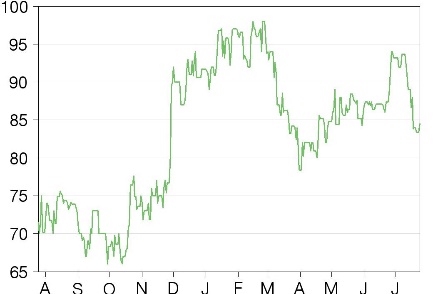
Share price performance
Business description
Next events
Analysts
Record is a research client of Edison Investment Research Limited |
|||||||||||||||||||||||||||||||||||||||||||||||||
Record continues to deliver on its diversification and modernisation strategy, reporting FY23 revenues of £44.7m, up 27% y-o-y. Excluding exceptionally strong performance fees of £5.8m, revenues grew by a solid 12% with all areas contributing. Additionally, in the Q124 trading update, Record earned performance fees of £0.5m, implying a run rate above our forecast for FY24. During Q124, net outflows of $2.5bn were recorded, predominantly in passive hedging. Our estimates are broadly unchanged since the passive hedging product is a lower fee earner. The strong pipeline of opportunities in Asset Management implies a material contribution to operating profit in FY24 and beyond. We introduce FY25 revenue and diluted EPS expectations of £52.0m and 6.97p, respectively, conservatively factoring in no major new asset management wins in FY25.
Year end |
Revenue (£m) |
PBT* |
EPS* |
DPS** |
P/E |
Yield |
03/22 |
35.2 |
10.9 |
4.37 |
3.60 |
19.3 |
4.3 |
03/23 |
44.7 |
14.6 |
5.81 |
4.50 |
14.6 |
5.3 |
03/24e |
45.6 |
14.7 |
5.67 |
4.40 |
14.9 |
5.2 |
03/25e |
52.0 |
18.0 |
6.97 |
5.40 |
12.1 |
6.4 |
Note: *EPS is diluted. **DPS excludes special dividends.
Positive FY23 despite inflationary headwinds
FY23 revenue of £44.7m was in line with our expectations and headline operating margin increased slightly to 32% compared to 31% in FY22. However, excluding performance fees, the operating margin slipped from 30.3% to 27.4% as inflation affected personnel costs during a time of increased IT investment. Net income rose 31% y-o-y to £11.3m but was 5.4% below our estimates, mostly due to a higher tax rate of 22% versus 19% expected. Diluted EPS rose from 4.37p to 5.81p. In accordance with the shareholder-friendly dividend policy, the ordinary dividend jumped from 3.6p to 4.5p – higher than our estimate of 4.10p – while a special dividend of 0.68p took the total dividend for the year to 5.18p versus 4.52p.
Background and outlook
UK inflation remains sticky despite interest rates now at 5%. Consequently, Record is likely to face a more challenging cost environment. Notwithstanding this, core revenue momentum is strong and management remains focused on striving towards its ambitious FY25 targets: £60m in revenue, operating margin of c 40% and a dividend payout ratio of 70–90%. Positively, the newly obtained BaFin licence and opening of the Luxembourg Fund Umbrella are expected to result in new revenue sources.
Valuation: Trading at a premium to peers
Record trades at a significant premium to our selected list of comparable UK asset managers (see Exhibit 7). Year to date, Record’s share price has performed reasonably better than its comparators, driven by AUME inflows. On our FY25 estimates, the group trades at a P/E ratio of 12.1x with a yield of 6.4% (excluding the special dividend).
Record in numbers
We update our profile in numbers including assets under management equivalent (AUME), fee income, clients and asset class exposure (Exhibit 1). This includes our estimates of average fee rates by strategy and hedging fee exposure by underlying asset class. We highlight the following points:
■
Hedging services in total account for 90% of AUME and 65% of management fees, reflecting the lower fees that apply to passive hedging. The growth in dynamic hedging and currency for return since FY19 has reduced the proportion of management fees accounted for by passive hedging from 52% to 34% in FY23.
■
Since 2018, AUME has increased from $62.2bn to $87.7bn, a compound annual growth rate of 7.1%. The average fee rate has been maintained at 5.6bp.
■
Measured by AUME, 61% of clients have been with Record for over six years. However, with the expansion and diverse product offering of the business, it has exhibited a healthy inflow of new clients, with 46% joining within the past three years – measured by number. Typically, new clients will start off with a small amount of AUME but will grow this over time.
■
Geographically, Switzerland accounts for 38% of revenues, followed by the United States with 32%.
■
We estimate that 52% of hedging mandate fees relate to underlying equity assets, 16% to fixed income and 32% to other assets.
Exhibit 1: Profile in numbers (FY23 except where indicated)
Analysis by strategy |
|||||||||||||||||||||
AUME (%) |
Management fees* (%) FY19 |
FY23 |
Est. average fee rate (bp)** |
||||||||||||||||||
Dynamic hedging |
16.8 |
20.6 |
31.4 |
12.4 |
|||||||||||||||||
Passive hedging |
72.7 |
52.0 |
33.7 |
2.5 |
|||||||||||||||||
Currency for return |
4.4 |
8.0 |
17.7 |
18.2 |
|||||||||||||||||
Multi-product |
5.9 |
19.4 |
17.2 |
17.9 |
|||||||||||||||||
Cash |
0.1 |
N/A |
N/A |
5.6 |
|||||||||||||||||
Total |
100.0 |
100.0 |
100.0 |
||||||||||||||||||
Value |
$87.7bn |
£22.3m |
£38.3m |
||||||||||||||||||
Client analysis |
|||||||||||||||||||||
Concentration |
% AUME |
% fees |
Longevity (years) |
% clients |
% AUME |
||||||||||||||||
Top 10 |
57 |
72 |
0-1 |
23 |
10 |
||||||||||||||||
Next 10 |
14 |
14 |
1–3 |
23 |
18 |
||||||||||||||||
Balance |
30 |
14 |
3–6 |
23 |
11 |
||||||||||||||||
6–10 |
12 |
24 |
|||||||||||||||||||
>10 |
19 |
37 |
|||||||||||||||||||
100 |
100 |
100 |
100 |
||||||||||||||||||
Geographical analysis and AUME progression |
|||||||||||||||||||||
By country |
% revenue |
By invoice currency |
% revenue |
AUME progression |
($bn) |
||||||||||||||||
US |
32 |
US dollar |
52 |
2018 |
62.2 |
||||||||||||||||
Switzerland |
38 |
Swiss franc |
35 |
2019 |
57.3 |
||||||||||||||||
Europe (rest) |
21 |
Euro |
9 |
2020 |
58.6 |
||||||||||||||||
UK |
6 |
Sterling |
3 |
2021 |
80.1 |
||||||||||||||||
Other |
4 |
Other |
2 |
2022 |
83.1 |
||||||||||||||||
100 |
100 |
2023 |
87.7 |
||||||||||||||||||
Underlying asset class exposure of dynamic and passive hedging AUME (%) |
|||||||||||||||||||||
Dynamic |
Passive |
Estimated % of hedging fees |
|||||||||||||||||||
Equity |
84 |
23 |
52 |
||||||||||||||||||
Fixed income |
0 |
31 |
16 |
||||||||||||||||||
Other |
16 |
46 |
32 |
||||||||||||||||||
100 |
100 |
100 |
|||||||||||||||||||
Source: Record, Edison Investment Research. Note: *Management fees excluding performance fees. **Fee rate is our own calculation and within each strategy there will be a range of mandate types and fee structures/levels. Rounding may mean some columns do not sum.
FY23 and Q124 results analysis
AUME and management fees
As reported in the Q423 trading update, positive net inflows of $9.1bn were dampened by market moves and foreign exchange movements, resulting in an overall rise in AUME of $4.6bn to $87.7bn, up 5.5% and 19.6% in US dollar and sterling terms respectively.
Average AUME (which drives management fees) rose by a respectable 12% in sterling terms. In US dollar terms, average AUME fell by 1%. Record uses US dollars to report AUME figures, but it should be noted that only 24% of AUME is denoted in US dollars. Therefore, to avoid misrepresenting growth in AUME when the US dollar is strong against major currencies, it is more accurate to use the sterling figure to observe underlying growth.
Exhibit 2: FY23 AUME movements and management fees
Year end March |
AUME movements ($bn) |
End period AUME ($bn) |
Average AUME (£bn) |
Management fees (£000) |
|||||||
FY22 |
FY23 |
FY22 |
FY23 |
% change |
FY22 |
FY23 |
% change |
FY22 |
FY23 |
% change |
|
Net inflow |
|||||||||||
Dynamic hedging |
1.4 |
4.2 |
10.6 |
14.7 |
39% |
7.6 |
9.7 |
27% |
10,020 |
12,013 |
20% |
Passive hedging |
1.1 |
4.9 |
62.8 |
63.8 |
2% |
46.3 |
51.3 |
11% |
11,768 |
12,912 |
10% |
Currency for return |
0.4 |
(0.6) |
5.0 |
3.9 |
(22%) |
3.5 |
3.7 |
5% |
5,513 |
6,789 |
23% |
Multi-product |
(0.5) |
0.6 |
4.5 |
5.2 |
16% |
3.7 |
3.7 |
(1%) |
6,782 |
6,584 |
(3%) |
Cash and futures |
0.0 |
0.0 |
0.2 |
0.1 |
(50%) |
0.1 |
0.1 |
(8%) |
|||
Total |
2.4 |
9.1 |
83.1 |
87.7 |
6% |
61.3 |
68.5 |
12% |
34,083 |
38,298 |
12% |
Markets |
0.3 |
(3.8) |
|||||||||
FX and scaling |
0.3 |
(0.7) |
|||||||||
Total change |
3.0 |
4.6 |
|||||||||
Opening AUME |
80.1 |
83.1 |
|||||||||
Closing AUME |
83.1 |
87.7 |
|||||||||
Source: Record, Edison Investment Research
In Exhibit 3, we outline the changes in AUME following the Q124 update. The update reported outflows of $2.5bn, primarily driven by $3bn in outflows related to passive hedging. However, these outflows were partially offset by FX and scaling mandates, resulting in a net negative change to $1.3bn, bringing AUME to a total of $86.4bn.
We observe a consistent trend of outflows in passive hedging since Q323. Importantly, we note that such outflows do not necessarily indicate that Record is losing business, but we can assume that some AUME is being reallocated into other products.
The net $2.5bn outflow is only 2.9% of opening AUME ($87.7bn). Considering that passive hedging fees are relatively small, outflows have a minimal impact on final revenue. As Exhibit 5 shows, our new revenue estimates are broadly flat compared with our previous assumptions.
Exhibit 3: Q124 AUME movements
AUME ($bn) |
Net flows ($bn) |
||||||||
Q422 |
Q123 |
Q423 |
Q124 |
Q123 |
Q223 |
Q323 |
Q423 |
Q124 |
|
Dynamic hedging |
10.6 |
10.6 |
14.7 |
15.3 |
1.5 |
0.2 |
1.8 |
0.7 |
0.3 |
Passive hedging |
62.8 |
58.2 |
63.8 |
61.6 |
0.7 |
6.5 |
(1.3) |
(1.0) |
(3.0) |
Currency for return |
5.0 |
4.5 |
3.9 |
4.1 |
(0.3) |
0 |
0.3 |
(0.6) |
0.1 |
Multi-product |
4.5 |
4.4 |
5.2 |
5.3 |
0.1 |
(0.1) |
(0.2) |
0.8 |
0.1 |
Cash and futures |
0.2 |
0.2 |
0.1 |
0.1 |
0.0 |
0.0 |
0.0 |
0.0 |
0.0 |
Total |
83.1 |
77.9 |
87.7 |
86.4 |
2.0 |
6.6 |
0.6 |
(0.1) |
(2.5) |
Other movements |
|||||||||
Markets |
(3.9) |
(0.9) |
0.3 |
0.7 |
|||||
FX and scaling |
(3.3) |
(2.8) |
4.3 |
1.1 |
1.2 |
||||
Total change |
(5.2) |
2.9 |
5.2 |
1.7 |
(1.3) |
||||
Opening AUME |
83.1 |
77.9 |
80.8 |
86 |
87.7 |
||||
Closing AUME |
77.9 |
80.8 |
86.0 |
87.7 |
86.4 |
||||
% AUME change |
3.7% |
6.4% |
2.0% |
(1.5%) |
|||||
Source: Record, Edison Investment Research
Key points from the income statement for FY23
Exhibit 4 shows the P&L account. We draw out key line items, with all comparisons made against FY22 unless stated otherwise:
■
Record reported £38.3m in management fees, up from £34.1m, as the group benefited from a $4.6bn addition to AUME in the year. Passive hedging, which has historically been a low-fee, low-growth strategy, saw revenues grow 9.7% as margin pressure began to ease and, increasingly, international managers are seeing value in outsourcing their hedging operations to Record. Dynamic hedging generated 20% more in revenue as strong inflows of $4.2bn were combined with the full year realisation of the $0.8bn net inflows recorded in FY22. Management fees for currency for return increased by 23% – despite net outflows of $0.6bn – to £6.8m as Record realised the full year impact of the EM Sustainable Finance Fund (EMSF) launched in June 2021 and achieved a higher average management fee of 18.2bp versus 15.5bp. The net outflows of $0.6bn can be expected to partially offset the gains made in FY23.
■
Average fee rates in FY23 remained flat at 5.6bp but the fee mix changed slightly: a drop in dynamic hedging by 80bp, an increase of 270bp to currency for return and a decrease of 40bp in multi-product (for comparison, see Exhibit 1 in our FY22 results note).
■
The differing pace of global central bank interest rate policy has allowed Record to capitalise on interest rate differentials, which were largely absent in a zero-rate world. Consequently, it earned performance fees of £5.8m in the year, an above-normal amount considering the 2015–22 average of £0.69m. Supported by performance fees, total revenue increased 27.4% to £44.7m. We highlight that Record does not consider performance fees as part of its plan to reach £60m in revenue by FY25. Stripping out performance fees, Record generated revenues of £38.9m or a 12% y-o-y increase. This is far above the 2012–22 CAGR of 5.4%.
■
Administrative expenses rose 26% to £29.9m, mainly attributable to increasing staff costs as Record employed more personnel. Average costs per employee, including directors, stands at £231,955 versus £200,963. Seeking to limit operational gearing in the long term, the group paid a one-off £3,000 to employees (excluding executive directors and board members) during the year to help with the cost-of-living crisis. The group has decided to offer an additional £2,000 to its employees during FY24. Record increased its spending on IT by 51% to £3.6m as it continues to focus on expanding operational efficiency and technological sophistication. IT spending represented 12% of administrative expenses (FY22: 10%).
■
Headline operating profit margin grew 1.6pp to 32.4% (FY21: 30.8%) due to exceptionally strong performance fees. The core margin excluding performance fees fell to 27.4% against 30.3% in FY22 as a result of cost inflation. We expect that the core operating margin will trend upwards through the growth of higher-margin products and the benefit of scale efficiencies via the integration of technology. Record aims to generate an operating margin of c 40% by FY25.
■
Profit before tax increased 35% to £14.6m, driven by robust year-on-year revenues. Notably, the contribution from performances fees virtually mitigated the increase in costs incurred.
■
An ordinary dividend of 4.50p has been declared for the full year, representing a payout ratio of 76% and an uplift of 25% from the FY22 dividend of 3.60p. Record has a progressive dividend policy and targets a payout ratio of 70–90% of basic EPS in the form of ordinary dividends. As the business is highly cash generative, there is usually ample room to pay additional special dividends while still investing capital for growth. In line with its policy of returning excess capital to shareholders, a special dividend of 0.68p has been declared for FY23, bringing total dividends declared to 5.18p (FY22: 4.52p), a total payout of 87% (FY22: 100%). Special dividends are subject to capital and liquidity requirements like working capital needs and expense buffers, and can be expected to be variable.
Exhibit 4: FY23 P&L analysis
£000s |
FY20 |
FY21 |
FY22 |
FY23 |
% change vs FY22 |
Dynamic hedging |
3,995 |
5,623 |
10,020 |
12,013 |
19.9% |
Passive hedging |
12,026 |
11,377 |
11,768 |
12,912 |
9.7% |
Currency for return |
1,982 |
2,005 |
5,513 |
6,789 |
23.1% |
Multi-product |
5,130 |
5,873 |
6,782 |
6,584 |
(2.9%) |
Management fees |
23,133 |
24,878 |
34,083 |
38,298 |
12.4% |
Performance fees |
1,819 |
81 |
499 |
5,805 |
1,063.3% |
Other investment services income |
611 |
453 |
570 |
586 |
2.8% |
Total revenue |
25,563 |
25,412 |
35,152 |
44,689 |
27.1% |
Cost of sales |
(255) |
(399) |
(219) |
(370) |
(83.1%) |
Gross profit |
25,308 |
25,013 |
34,933 |
44,652 |
27.8% |
Administrative expenses |
(17,741) |
(18,934) |
(23,726) |
(29,888) |
26.0% |
Other income/expense |
82 |
41 |
(372) |
(293) |
(21.2%) |
Operating profit |
7,649 |
6,120 |
10,835 |
14,471 |
33.6% |
Net finance income |
88 |
33 |
21 |
127 |
504.8% |
Profit before tax |
7,737 |
6,153 |
10,856 |
14,598 |
34.5% |
Taxation |
(1,365) |
(802) |
(2,225) |
(3,259) |
46.5% |
Profit after tax |
6,372 |
5,351 |
8,631 |
11,339 |
31.4% |
Basic EPS (p) |
3.26 |
2.75 |
4.52 |
5.95 |
31.8% |
Diluted EPS (p) |
3.26 |
2.73 |
4.37 |
5.81 |
32.7% |
DPS (p) |
2.71 |
2.75 |
4.52 |
5.18 |
14.6% |
Operating margin |
29.9% |
24.1% |
30.8% |
32.4% |
|
Operating margin excluding performance fees |
27.0% |
23.9% |
30.3% |
27.4% |
|
Tax rate |
18% |
13% |
20% |
22% |
Source: Record, Edison Investment Research
Update on three-pillar strategy
Record has a three-pillar strategy: modernisation, diversification and succession. These pillars form the blueprint for its ambitious medium-term targets in FY25: £60m in revenue, operating margins of c 40% (subject to falling inflation and excluding performance fees) and an ordinary dividend payout ratio of 70–90% of basic EPS. We examine progress on the strategy below.
Modernisation
Record continues to allocate capital towards improving IT infrastructure, spending £3.6m in FY23 or 12% of total operating expenses (10% in FY22). The enhanced IT capability is enabling Record to extend its commercial capabilities, remain competitive and enhance productivity and efficiency within the company. Following the year-end, the group launched R-platform, a client and business-facing portal focused on the automation of FX trade execution. The group intends to use the technology to provide an automated passive hedging service. Ultimately, this should enhance the client reporting experience via better data visualisation, while simultaneously improving operational costs and efficiency associated with trading activities. By upgrading and implementing new software, Record aims to scale efficiently and improve client service in the process. As we highlighted in a previous note, the group has already employed several tools: Microsoft Azure, Microsoft Power BI and Xceptor. These platforms serve the business to enhance security and data visualisation and enable scale.
Diversification
For 40 years Record served solely as a specialist currency overlay manager, which had become a profitable but low-growth business with ongoing fee compression. With the diversification strategy now being put into action, the group is expecting to generate significant business through its Record Asset Management (RAM) subsidiary, which is authorised and regulated in Germany by BaFin. The subsidiary is run by the CEO and group head of sales, Jan Witte, and focuses predominately on alternative assets. RAM has also opened its Luxembourg RAIF Fund Umbrella. Through the formation of partnerships with other asset managers, RAM is able to take on the role of structurer, distributor, portfolio manager and currency hedger at significantly enhanced revenue margins compared to traditional currency hedging businesses. Although there has recently been a delay in the launch of some of these new products, management has emphasised the very strong pipeline of opportunities in FY24. For instance, the group is close to launching an infrastructure fund, which is likely to be of significant size, where it will assume the role of asset manager. This is expected to become live during FY24. Record will further use its partnerships to enhance its offering, exampled by the Protected Equities product it created for a multi-family office (expected to be released in Q224).
Another subsidiary adding to both the diversification and modernisation pillars is Record Digital Asset Ventures (RDAV) run by CEO and group CTO Rebecca Venis. RDAV has ring-fenced c £2m in capital to invest in early-stage financial technology companies and digital assets. By the end of FY23, 75% in capital has been committed in the form of direct investments and investment funds investing in start-up and early-stage technology and digital asset companies. An example of the progress made is in the partnership with Fasanara Capital, a specialist in digital lending, where Record was able to win three mandates with its unique investment objectives. Although investments made through RDAV are immaterial to Record’s bottom line, the initiative reflects its intention to become more technologically sophisticated.
Succession
Record announced in March this year that founder Neil Record will step down from the role of chairman at the July AGM, to be replaced by David Morrison, current non-executive director. In addition to serving on the board, David has a strong background in venture and growth businesses. Neil Record will continue to be a significant shareholder.
Record’s operational structure also changed during FY23 to facilitate the three-pillar strategy. Under the parent company Record Financial Group, Record Currency Management (RCM), Record Group Services, RDAV and RAM operate as subsidiaries. Jan Witte, group global head of sales, has been promoted to CEO of RCM from 1 May 2023 and this has enabled group CEO Leslie Hill to put increased focus on delivering group targets.
Similarly, Rebecca Venis, group CTO and incumbent CEO of RDAV, is responsible for modernising the group’s IT infrastructure alongside leading Record’s digital venture business. The new business structure serves to provide autonomy to each division, while adhering to the group’s goals. Management continues to place emphasis on supporting the professional growth and well-being of its employees. Following the restructuring, staff retention has returned to 90% after sliding to 74% in FY22.
Outlook and estimates: Trending upwards
In this section we reflect on the FY23 results, adjust our FY24 estimates, introduce our FY25 estimates and construct a hypothetical scenario whereby Record achieves its FY25 targets.
Overall results for FY23 were close to our estimates, with the tax line explaining most of the difference. Revenues for FY23 were reported largely in line at £44.7m. PBT came in 1% lower than our estimate due to slightly higher ‘other expenses’ than originally forecast. The final tax rate was 22% versus our assumed 19%, meaning reported net income was 5% below our forecast at £11.3m. Consequently, diluted EPS was also 5% below our estimates. On the other hand, the ordinary dividend per share was 4.50p, 10% higher than our forecast of 4.10p.
Based on the outflows in passive hedging revealed in the Q124 trading update, we have lowered our FY24 AUME forecast from $92.6bn to $91.7bn. This is still a positive AUME movement, implying 4.6% growth from end-FY23 AUME of $87.7bn. This is based on forecast net inflows of $3.9bn. Within the $3.9bn net flow figure, we factor in $1.65bn of new flows from RAM based on the performance of the EMSF and comments on the potential near-term pipeline during the earnings call. We have maintained an annualised management fee of 6.1bp. We assume marginal increases to fee rates in currency for return and multi-product while passive hedging rates stay flat and dynamic hedging drops a touch versus FY23. Despite the outflow observed in Q124 in passive hedging, it has minimal impact on our forecasts due to the low management fees it generates. Subsequently, our revenue estimate, which includes performance fees, has increased marginally from £45.5m to £45.6m. As inflation appears to be quite sticky in the UK, we have increased our previous estimate of operating expenses by 2% to £31.4m. Thus, our PBT assumption has fallen marginally by 2% to £14.7m, compared to our previous estimates of £15m. On a diluted EPS estimate of 5.67p, we expect Record to declare an ordinary dividend of 4.40p, implying a dividend payout ratio of 76% on basic EPS of 5.76p.
We highlight that FY23 revenues were boosted by performance fees of £5.8m. In FY24 we factor in £1.5m in performance fees, which is more in line with historical averages supported by continuing interest differentials in the market. However, we note that performance fees of £0.5m in Q124 imply an annualised performance fee of £2m, above our current estimate. Our estimated operating margin for FY24 is consequently 31.1%, just over a percentage point lower than 32.4% in FY23. However, we expect the underlying operating margin excluding performance fees to be 29.9% in FY24, better than 27.4% in FY23 as a result of higher-margin new products and positive operating leverage.
Introducing our FY25 estimates, we assume a further 5.2% growth in AUME to $96.5bn driven by $4.8bn in net inflows. We estimate annualised management fees of 6.64bp, with fee rate increases mainly derived from currency for return and multi-product. Passive hedging remains flat with FY24, while dynamic hedging fees drop slightly to 12.2bp. In FY25, we have conservatively assumed no flows or additions to AUME in the Asset Management business as visibility on exact timings of new product launches is low. On this assumption, we calculate revenue of £52.0m, which includes £1m in performance fees and £0.6m in other investment income. We forecast administrative expenses growing by 10% from FY24 as the company continues its expansion and incurs costs in the form of IT and increased staff costs. We forecast operating income of £17.5m, representing a 33.6% operating margin (on an underlying revenue basis) and 33.0% margin excluding performance fees. In line with FY24, we maintain a tax rate of 25%.
Record maintains its FY25 target to achieve £60m in revenue, with an operating margin of c 40% (subject to inflation) and maintaining a dividend payout ratio of 70–90% by FY25. We regard this target as achievable but ambitious given the impact of inflation on costs and the uncertainty around the timing of new product launches, which will be lumpy. However, should additional product launches come to market more quickly, the FY25 targets become more easily achievable due to the pipeline effect on revenues. For example, the group is currently developing an infrastructure fund where it will assume the position of asset manager. We would expect the infrastructure fund to be relatively large (similar to the EMSF) and secure attractive long-term fee rates due to the nature of the underlying asset. We highlight that some of these new funds have been delayed and are now expected to be more material contributors to revenue later in FY24.
In our model, we have conservatively assumed zero inflows into the Asset Management segment in FY25 following $1.65bn of assumed inflows assumed for FY24. The FY24 inflows relate to the $1bn EMSF, which is performing very well with further inflows expected from the potential infrastructure mandate and other asset management initiatives.
Exhibit 5: Estimate changes and introducing FY25 estimates
£m |
FY23 |
FY24 |
FY25 |
||||
Old |
Actual |
Change |
Old |
New |
Change |
New |
|
Revenue |
44.8 |
44.7 |
0% |
45.5 |
45.6 |
0% |
52.0 |
PBT |
14.8 |
14.6 |
(1%) |
15.0 |
14.7 |
(2%) |
18.0 |
EPS* (p) |
6.10 |
5.81 |
(5%) |
5.72 |
5.67 |
(1%) |
6.97 |
DPS (p) |
4.10 |
4.50 |
10% |
4.20 |
4.40 |
5% |
5.40 |
Source: Record, Edison Investment Research. Note: *EPS is diluted.
As explained above, our FY25 forecasts for revenues and operating margin are below Record’s targets. In Exhibit 6 below we model a scenario for Record to achieve its targets.
According to our current revenue assumptions, we would need to see an increase in pre-performance fee revenues of £9m in order to achieve the target £60m. To bridge this gap, we focus on modifying our net inflow assumptions into the Asset Management business. As it stands, between Q224 and end FY25, we assume average AUME of $1.1bn in the RAM business. To meet the £60m target, average AUME would have to increase to $3.0bn during the period, all other things being equal.
Our implied operating margin, excluding performance fees, is 33%, falling short of the c 40% target. To reach the 40% margin, operating costs would have to be limited to £36m, or 5% above our current estimates, keeping our investment income assumptions constant. The cost increase is modest considering the extra AUME Record would have to facilitate to achieve the revenue target. In our opinion, it would be difficult to envision a scenario where Record onboarded a sizeable increase in AUME while only slightly increasing its costs.
Exhibit 6: Sensitivity table
£m unless otherwise stated |
Current FY25 estimates |
FY25 target scenario |
Revenue excluding performance fees |
50,968 |
60,000 |
Operating costs |
(34,403) |
(36,000) |
Operating profit |
17,485 |
24,000 |
Average AUME ($bn) |
1.1 |
3.0 |
Average management fee rate (bp) |
30 |
30 |
Operating margin excluding performance fees |
33.0% |
40.0% |
Source: Edison Investment Research
Valuation
We update our comparative valuation table in Exhibit 7. Year to date, Record shares are down by 6.8% compared to our chosen asset manager peer group, which is down an average of 10.2%. Although Record is not a traditional asset manager, its earnings growth relies on being able to grow AUME and, in contrast to the peer group which is suffering net outflows, Record has generated net inflows of 11% of opening AUME in FY23. Additionally, we expect AUME to reach $91.7bn in FY24, a 6% increase from the opening AUME of $86.4bn in Q124.The company is also on the verge of a step change in growth and profitability from its Asset Management initiatives. As a result, Record currently trades at a 18% premium to the average calendarized P/E and 66% premium to the peer group EV/EBITDA multiple. On our FY25 estimates, Record trades at a P/E ratio of 12.1x with a yield of 6.4% excluding special dividends. Including the special dividend, Record has a prospective yield of 7.6%.
Exhibit 7: Comparing valuation with UK fund managers
Price |
Market cap |
P/E |
EV/EBITDA |
Dividend yield |
|
Ashmore |
203 |
1,449 |
15.2 |
6.8 |
8.3 |
City of London Investment Group |
415 |
210 |
N/A |
N/A |
8.0 |
Impax Asset Management |
581 |
772 |
15.4 |
10.5 |
4.8 |
Jupiter |
105 |
572 |
9.0 |
2.3 |
8.0 |
Liontrust |
664 |
432 |
7.4 |
3.6 |
10.9 |
Man Group |
233 |
3,598 |
13.0 |
8.7 |
5.2 |
Polar Capital |
486 |
493 |
13.0 |
2.9 |
9.5 |
Schroders |
459 |
7,405 |
14.4 |
11.0 |
4.6 |
Average |
12.5 |
6.5 |
7.4 |
||
Record |
84.50 |
168 |
14.8 |
10.8 |
5.3 |
Source: Refinitiv, Edison Investment Research. Note: P/E and EV/EBITDA are on a calendar-year basis. Record’s (FY23) dividend yield excludes the special dividend. Priced at 25 July 2023.
Exhibit 8: Financial summary
Year end 31 March, £'000s |
|
|
2019 |
2020 |
2021 |
2022 |
2023 |
2024e |
2025e |
PROFIT & LOSS |
|
|
|
|
|
|
|
|
|
Revenue |
|
|
24,973 |
25,563 |
25,412 |
35,152 |
44,689 |
45,578 |
51,968 |
Operating expenses |
|
|
(17,089) |
(17,996) |
(19,333) |
(23,945) |
(29,925) |
(31,365) |
(34,443) |
Other income/(expense) |
|
|
(8) |
82 |
41 |
(372) |
(293) |
(40) |
(40) |
Operating profit (before amort. and except.) |
|
|
7,876 |
7,649 |
6,120 |
10,835 |
14,471 |
14,173 |
17,485 |
Finance income |
|
|
113 |
88 |
33 |
21 |
127 |
500 |
550 |
Profit before tax |
|
|
7,989 |
7,737 |
6,153 |
10,856 |
14,598 |
14,673 |
18,035 |
Taxation |
(1,559) |
(1,365) |
(802) |
(2,225) |
(3,259) |
(3,668) |
(4,509) |
||
Minority interests |
|
|
0 |
48 |
0 |
0 |
0 |
0 |
0 |
Attributable profit |
|
|
6,430 |
6,420 |
5,351 |
8,631 |
11,339 |
11,004 |
13,526 |
Revenue/AUME (excluding perf fees) bp |
|
|
4.9 |
4.9 |
4.8 |
5.6 |
5.6 |
6.1 |
6.6 |
Operating margin (%) |
|
|
31.5 |
29.9 |
24.1 |
30.8 |
32.4 |
31.1 |
33.6 |
Average number of shares outstanding (m) |
|
|
198.1 |
197.1 |
196.2 |
197.3 |
195.3 |
194.2 |
194.2 |
Basic EPS (p) |
|
|
3.27 |
3.26 |
2.75 |
4.52 |
5.95 |
5.76 |
7.08 |
EPS - diluted (p) |
|
|
3.25 |
3.26 |
2.73 |
4.37 |
5.81 |
5.67 |
6.97 |
Dividend per share (p) |
|
|
2.30 |
2.30 |
2.30 |
3.60 |
4.50 |
4.40 |
5.40 |
Special dividend per share (p) |
|
|
0.69 |
0.41 |
0.45 |
0.92 |
0.68 |
0.80 |
1.00 |
Total dividend (p) |
|
|
2.99 |
2.71 |
2.75 |
4.52 |
5.18 |
5.20 |
6.40 |
BALANCE SHEET |
|
|
|
|
|
|
|
|
|
Non-current assets |
|
|
2,161 |
4,868 |
5,153 |
6,084 |
7,813 |
7,918 |
8,048 |
Intangible Assets |
|
|
288 |
470 |
420 |
562 |
1,390 |
1,850 |
2,310 |
Tangible Assets |
|
|
761 |
751 |
683 |
401 |
377 |
352 |
352 |
Investments |
|
|
1,112 |
2,472 |
3,046 |
3,447 |
4,901 |
4,901 |
4,901 |
Other |
|
|
0 |
1,175 |
1,004 |
1,674 |
1,145 |
815 |
485 |
Current assets |
|
|
31,427 |
31,149 |
28,045 |
27,141 |
28,924 |
28,707 |
30,644 |
Debtors |
|
|
7,562 |
8,704 |
8,006 |
9,883 |
14,373 |
15,145 |
16,861 |
Cash |
|
|
12,966 |
14,294 |
6,847 |
3,345 |
9,948 |
8,959 |
9,180 |
Money market instruments |
|
|
10,735 |
7,958 |
12,932 |
13,913 |
4,549 |
4,549 |
4,549 |
Other |
|
|
164 |
193 |
260 |
0 |
54 |
54 |
54 |
Current liabilities |
|
|
(6,158) |
(6,955) |
(5,992) |
(6,210) |
(7,630) |
(7,623) |
(8,011) |
Creditors |
|
|
(2,736) |
(3,009) |
(3,426) |
(4,721) |
(6,011) |
(6,334) |
(7,052) |
Financial liabilities |
|
|
(2,621) |
(2,191) |
(1,696) |
0 |
0 |
0 |
0 |
Other |
|
|
(801) |
(1,755) |
(870) |
(1,489) |
(1,619) |
(1,289) |
(959) |
Non-current liabilities |
|
|
(29) |
(901) |
(407) |
(1,085) |
(816) |
(816) |
(816) |
Net assets |
|
|
27,401 |
28,161 |
26,799 |
25,930 |
28,291 |
28,186 |
30,236 |
Minority interests |
|
|
60 |
132 |
0 |
0 |
0 |
0 |
0 |
Net assets attributable to ordinary shareholders |
|
27,341 |
28,029 |
26,799 |
25,930 |
28,291 |
28,186 |
29,866 |
|
No of shares at year end |
|
|
199.1 |
199.1 |
199.1 |
199.1 |
199.1 |
199.1 |
199.1 |
NAV per share p |
|
|
13.7 |
14.1 |
13.5 |
13.0 |
14.2 |
14.2 |
15.0 |
CASH FLOW |
|
|
|
|
|
|
|
|
|
Operating cash flow |
|
|
7,026 |
6,543 |
6,798 |
11,355 |
12,263 |
10,775 |
12,698 |
Capex |
|
|
(72) |
(243) |
(230) |
(75) |
(272) |
(225) |
(250) |
Cash flow from other investing activities |
|
|
(561) |
1,513 |
(6,210) |
(3,392) |
7,498 |
(100) |
(50) |
Dividends |
|
|
(5,517) |
(5,888) |
(5,290) |
(6,512) |
(9,095) |
(10,610) |
(11,346) |
Other financing activities |
|
|
(613) |
(943) |
(2,368) |
(5,019) |
(3,942) |
(830) |
(830) |
Other |
|
|
205 |
346 |
(147) |
141 |
151 |
0 |
0 |
Net cash flow |
|
|
468 |
1,328 |
(7,447) |
(3,502) |
6,603 |
(989) |
221 |
Opening cash/(net debt) |
|
|
12,498 |
12,966 |
14,294 |
6,847 |
3,345 |
9,948 |
8,959 |
Closing net (debt)/cash |
|
|
12,966 |
14,294 |
6,847 |
3,345 |
9,948 |
8,959 |
9,180 |
Closing net (debt)/cash incl. money market instruments |
23,701 |
22,252 |
19,779 |
17,258 |
14,497 |
13,508 |
13,729 |
||
AUME ($bn) |
|
|
|
|
|
|
|
|
|
Opening |
|
|
62.2 |
57.3 |
58.6 |
80.1 |
83.1 |
87.7 |
91.7 |
Net new money flows |
|
|
(4.5) |
4.6 |
9.7 |
2.4 |
9.1 |
2.1 |
3.8 |
Market/other |
|
|
(0.4) |
(3.3) |
11.8 |
0.6 |
(4.5) |
1.9 |
1.0 |
Closing |
|
|
57.3 |
58.6 |
80.1 |
83.1 |
87.7 |
91.7 |
96.5 |
Source: Record accounts, Edison Investment Research
|
|
Research: Consumer
musicMagpie (MMAG) is a leader in the circular economy, providing consumers and corporates with a sustainable alternative to buying and selling consumer technology and physical media. The Consumer Technology division is the key driver of its future growth, including growing recuring revenue streams from rentals. Management continues to focus on improving the sourcing of products while growing its end-markets and enhancing gross margin. Our EBITDA forecasts for FY23 and FY24 are unchanged. Our DCF-based valuation is 61p/share, reflecting significant upside from the current price.