Last close As at 05/08/2026
GBP2.27
— 0.00 (0.00%)
Market capitalisation
—
Research: Investment Companies
Underpinned by attractively low valuations, the investment managers for Henderson Opportunities Trust (HOT) believe that smaller companies will rally strongly on a turn in market sentiment. Although the timing and catalyst for this is no easier to pinpoint than when we wrote our detailed note in July, in their view, the most likely trigger will be a return to confidence in the UK economy. In this respect, growing indications that the interest rate cycle has peaked, and a more robust domestic economy than implied by smaller company valuations, are positive indicators.
Henderson Opportunities Trust |
Patience is bitter but the fruit is sweet |
Investment trusts |
17 November 2023 |
Analyst
|
||||||||||||||||||||||||||||||||||||||||||||||||||||||||||||||||||||||||||||||||||||||||||||||||||
Underpinned by attractively low valuations, the investment managers for Henderson Opportunities Trust (HOT) believe that smaller companies will rally strongly on a turn in market sentiment. Although the timing and catalyst for this is no easier to pinpoint than when we wrote our detailed note in July, in their view, the most likely trigger will be a return to confidence in the UK economy. In this respect, growing indications that the interest rate cycle has peaked, and a more robust domestic economy than implied by smaller company valuations, are positive indicators.
|
Smaller companies’ underperformance has continued |
|
|
Source: Refinitiv |
Ready and waiting
With its focus on long-term growth, HOT has consistently maintained significantly more smaller company exposure than its broad UK equity market benchmark. Faster-growing smaller companies have outperformed their large-cap counterparts over the long term but are, on average, more domestic in their exposure and more sensitive to the economic cycle. Since mid-2021, smaller companies, particularly those listed on the AIM market (45% of the portfolio), have materially underperformed their larger counterparts. Despite increasing larger company exposure (to c 30%), the weakness of smaller companies has been deeper and more protracted than the investment managers expected. In the financial year ending 31 October, HOT’s NAV total return of -9.3% trailed the broad market benchmark return of +7.1% and the impact of smaller company underperformance can now be seen on an otherwise strong long-term track record.
While the last two years have been painful, past recoveries have shown how this can quickly change, and for HOT, this has historically generated strong NAV appreciation and discount narrowing. The managers note that in many cases, valuations already discount a sharp recession and that the breadth of the sell-off has indiscriminately affected many companies with strong management, robust operational performance and good long-term growth prospects. While the timing of a small company recovery is difficult to predict, we believe the potential for strong returns makes HOT an attractive complement to more mainstream trusts, which should more closely track broader market developments. HOT’s size makes it nimble, and its permanent capital base supports a patient approach.
Henderson Opportunities Trust is a research client of Edison Investment Research Limited
Targeting growth with stability
This note provides an update on our detailed review published on 19 July. In brief, the trust seeks growth opportunities from across the market, including those listed on AIM, underpinned by a value-driven style that invests in out-of-favour or under-researched companies. At its core, HOT’s portfolio is a blend of what could be tomorrow’s leading British companies, across a wide range of activities and market caps, at different stages of their life cycle, from promising early-stage businesses to established businesses reinventing themselves. ‘Tomorrow’s leaders’ are complemented in the portfolio by investment in ‘stabilisers’. These are often larger, mature but still growing businesses, with more predictable cash flows, as well as natural resources companies that provide a hedge against unexpected developments in commodity markets.
The data in Exhibits 1 and 2 are taken from the interim results, but we do not believe there has been any material change since. Current exposure to AIM-listed companies is c 45%.
|
Exhibit 1: HOT versus market by segment |
Exhibit 2: HOT versus market by capitalisation |
|
|
|
Source: Henderson Opportunities Trust, 30 April 2023 (last available data). Note: *Other includes unlisted equities. |
Source: Henderson Opportunities Trust, 30 April 2023 (last available data) |
|
Exhibit 1: HOT versus market by segment |
|
|
Source: Henderson Opportunities Trust, 30 April 2023 (last available data). Note: *Other includes unlisted equities. |
|
Exhibit 2: HOT versus market by capitalisation |
|
|
Source: Henderson Opportunities Trust, 30 April 2023 (last available data) |
While small-cap weakness continues to weigh on performance, past recoveries have been strong
Smaller companies recovered strongly from the pandemic sell-off and, although the managers identified pockets of small company exuberance as prices rose through 2021, selectively reducing exposures accordingly, the ensuing correction has been much deeper and more enduring than they expected and is yet to show any signs of unwinding.
|
Exhibit 3: Indices performance over 10 years |
Exhibit 4: Indices performance over one year |
|
|
|
Source: Refinitiv, Edison Investment Research |
|
Exhibit 3: Indices performance over 10 years |
|
|
Source: Refinitiv, Edison Investment Research |
|
Exhibit 4: Indices performance over one year |
|
|
Source: Refinitiv, Edison Investment Research |
Given HOT’s significantly greater focus on smaller companies compared with its all-market benchmark, marked divergence in net asset value (NAV) total return performance over shorter time periods is inevitable. Over the past two years, the negative impact of small-cap weakness on HOT’s NAV total return performance relative to the benchmark now obscures the positive performance of earlier years.
Exhibit 5: HOT performance versus Indices
Cumulative returns to 31 October 2023 |
1m |
3m |
6m |
1y |
2y |
3y |
5y |
10y |
Share price total return |
-8.9% |
-11.5% |
-16.4% |
-12.2% |
-33.9% |
5.4% |
-0.2% |
34.4% |
NAV total return |
-8.8% |
-10.2% |
-14.6% |
-9.3% |
-33.2% |
5.9% |
-1.6% |
42.1% |
Benchmark total return |
-4.1% |
-4.8% |
-5.9% |
5.8% |
2.9% |
39.2% |
20.8% |
57.4% |
Numis Smaller Companies + AIM ex-investment companies |
-7.0% |
-10.7% |
-12.2% |
-5.9% |
-29.3% |
1.4% |
0.4% |
33.3% |
AIM |
-6.2% |
-10.6% |
-17.2% |
-14.1% |
-42.6% |
-25.3% |
-25.7% |
-4.2% |
Source: Refinitiv, Edison Investment Research
During the past two years, HOT’s Achilles heel has been its exposure to AIM. While the market covers a wide range of market caps (several companies have market caps of more than £1bn and up to c £2bn), it is here where most of the smaller and early-stage companies, with the strong, secular growth potential, targeted by the investment managers, can be found. Not all of these companies succeed, and the outcomes are often binary, but over the longer term HOT’s investments in AIM stocks have created significant value, driven by a combination of stock selection and risk mitigation. Stocks such as Serica Energy, Blue Prism and Keywords Studios have provided exceptional returns on a 10-year view and, in aggregate, the top 10 AIM performers have contributed more than 50% to performance.1
For example, data for the 10 years to May 2023 show that HOT’s investments in AIM-listed Serica Energy, Blue Prism Group and Keywords Studios provided exceptional returns of c 1,400%, 1,500% and 1,200%, respectively.
The greater volatility of smaller company performance can better be seen in HOT’s returns on a discrete calendar year basis. HOT has tended to outperform the index when the market is rising, and this was clearly the case in 2020 as the market recovered strongly from the pandemic low point.
Exhibit 6: HOT’s calendar year performance relative to its broad market benchmark
2023 ytd* |
2022 |
2021 |
2020 |
2019 |
2018 |
2017 |
2016 |
2015 |
2014 |
2013 |
2012 |
|
HOT NAV total return |
-8.8% |
-21.5% |
17.8% |
14.0% |
18.0% |
-14.1% |
24.8% |
11.1% |
4.0% |
1.9% |
45.5% |
35.0% |
Broad UK market total return |
-4.1% |
0.4% |
18.3% |
-9.8% |
19.2% |
-9.5% |
13.1% |
16.8% |
1.0% |
1.2% |
20.8% |
12.3% |
Source: Henderson Opportunities Trust. Note: *Data to 31 October 2023.
The investment managers see a strong opportunity to benefit from a small-cap performance recovery
The investment managers firmly believe there is a strong opportunity to benefit from a recovery in smaller stocks. This is based on several observations and expectations, including:
■
UK equities trade at low valuations, both in absolute terms and relative to global markets, and UK smaller stock valuations have fallen versus large caps. Despite market uncertainty limiting market-wide M&A activity, low valuations have been reflected in takeover activity (most recently for HOT, K3 Capital and Tribal Group). Looking at price to sales ratios (P/sales) rather than using earnings, a less reliable indicator of underlying value, the small-cap index trades at a lower level than larger companies. While this is not unusual, as the small-cap ratio includes the impact of relatively younger companies where faster sales growth may be expected, at c 0.5x on a trailing basis it is at the lower end of its historical range. This is equally the case relative to larger companies.
|
Exhibit 7: Small-cap P/sales at low end of range |
Exhibit 8: Small-cap P/sales low versus large-cap |
|
|
|
Source: Refinitiv, Edison Investment Research |
|
Exhibit 7: Small-cap P/sales at low end of range |
|
|
Source: Refinitiv, Edison Investment Research |
|
Exhibit 8: Small-cap P/sales low versus large-cap |
|
|
Source: Refinitiv, Edison Investment Research |
On a blended basis, including its larger company exposure, as well as early stage companies where currently sales may be of little significance, HOT calculates its end-FY23 P/sales ratio at c 0.6x, a five-year low, and well below the long-term average of little under 1x.
■
The UK economy has remained more robust than had previously been expected, inflation is slowing, and markets are signalling that interest rates have peaked and will soon follow. Against this improving backdrop, investor sentiment towards smaller companies has remained weak and expectations for their operational performance low.
■
Small-cap weakness has been broadly based. The investment managers note that for many economically sensitive companies, earnings performance has outstripped low expectations. More generally, for many smaller companies, growth is driven by capturing market share within large end-markets or creating new markets, mitigating any impact from general economic conditions.
■
Equity market performance has been led by larger-cap stocks and the investment managers anticipate that this should eventually broaden out, as has typically been the case in previous market cycles.
■
As and when negative investor sentiment turns, the liquidity constraints that have recently worked against smaller company valuations will work in their favour.
P/NAV has historically followed NAV growth
At c 16%, HOT’s discount to NAV is not materially different to its five- and 10-year averages of c 15% and c 14% respectively, although it has traded within a broad range. Early in the period, it reached a premium of c 5% before moving to discount range of 15–20%. In 2021 it again re-rated, to close to par, as small- and mid-cap shares recovered strongly from the pandemic. Similar peaks and troughs can be seen in a comparison of HOT’s P/NAV with that of its Association of Investment Companies (AIC) peer group. As the performance data above indicate, when share prices rise strongly, HOT’s performance in absolute and relative terms tends to follow, to a degree that more than reflects gearing, and also, perhaps unsurprisingly, its absolute and relative P/NAV follows. HOT’s discount compares with an average of a little more than 10% within its AIC UK All Companies sector, which we estimate is similar to the 10-year average. AIC data show a c 12% average discount for the UK smaller companies sector and a c 13% for all funds.
|
Exhibit 9: 10-year premium/discount to NAV (%)* |
Exhibit 10: 10-year premium/discount vs peers (%)* |
|
|
|
Source: Refinitiv, Edison Investment Research. Note: *NAV at fair value cum income. |
Source: Refinitiv, Edison Investment Research. Note: *Relative to simple average for AIC UK All Companies sector peers. |
|
Exhibit 9: 10-year premium/discount to NAV (%)* |
|
|
Source: Refinitiv, Edison Investment Research. Note: *NAV at fair value cum income. |
|
Exhibit 10: 10-year premium/discount vs peers (%)* |
|
|
Source: Refinitiv, Edison Investment Research. Note: *Relative to simple average for AIC UK All Companies sector peers. |
A complementary portfolio, widely held by retail investors
HOT has consistently provided an investment strategy that is complementary to a wider range of more mainstream offerings, seeking to provide long-term growth, mainly from smaller companies, while balancing the risks, through a high level of stock diversification (c 100 holdings) and meaningful exposure to larger, more established businesses. For many investors, this would be difficult to replicate, and HOT’s permanent capital base is ideally suited to the long-term, patient approach required. While the past two years have been painful, past recoveries have shown how this can quickly change.
HOT shares are widely held by retail investors, with holdings via the platforms Hargreaves Lansdown, Interactive Investor and Halifax Share Dealing accounting for more than 40% of shares outstanding. Outside of this, its largest shareholders are Saba Capital Management (7.1%2), Cazenove (5.8%) and Janus Henderson (5.1%, held through other funds that it manages). Saba Capital Management, a New York-based investment adviser, founded in 2009, has been an investor in HOT for some time and first disclosed an interest of 5.05% in May 2022. Among a range of investment strategies, within investment trusts it focuses on securities that are trading at significant discounts to NAV, and selectively pursues an activist approach where it believes this may be an effective way to unlock shareholder value.
The last published interest in the voting rights of the company, as reported at October 2022. HOT had received no notification of changes as of 2 February 2023.
Saba has reported stakes in a number of other UK investment trusts, and recent press reports3 have said that has ambitions to expand its investments in the sector, through a new fund that will specifically focus on activist positions4. There has been widespread press coverage of Saba’s activist stance with European Opportunities Trust (EOT), including pressing for an increase in the scale of company’s plans for capital return, and urging a vote against continuation at the AGM that was held on 15 November. In the event, all resolutions put to shareholders, including for a continuation of the company, were passed by a comfortable margin.
Investment Week, 26 October 2023.
Investment Week reports up to $500m.
Exhibit 11: Disclosed Saba Capital Management holdings in UK investment trusts
Trust |
Total assets (£m) |
Discount to NAV (%) |
Saba Capital holding |
AIC sector |
Date of last disclosure |
Date threshold crossed |
Henderson Opportunities Trust |
99.1 |
16.5 |
7.10% |
UK All Companies |
N/A* |
N/A |
European Opportunities Trust |
930.8 |
7.6 |
5.02% |
Europe |
08-Sep-23 |
05-Sep-23 |
Herald |
1162.9 |
13.6 |
10.10% |
Global Smaller Companies |
20-Sep-23 |
28-Jul-23 |
Schroder UK Mid Cap |
237.8 |
10.5 |
5.65% |
UK All Companies |
21-Sep-23 |
29-Sep-23 |
Keystone Positive Change |
164.3 |
16.2 |
5.20% |
Global |
21-Sep-23 |
24-May-23 |
Baillie Gifford US Growth |
627.1 |
17.3 |
5.05% |
North America |
21-Sep-23 |
30-Aug-23 |
CQS Natural Resources Growth & Income |
145.6 |
14.5 |
5.00% |
Commodities & Natural Resources |
22-Sep-23 |
20-Sep-23 |
JP Morgan European Discovery |
784.0 |
11.1 |
12.03% |
European Smaller Companies |
09-Oct-23 |
06-Oct-23 |
BlackRock Smaller Companies |
740.6 |
10.0 |
10.20% |
UK Smaller Companies |
13-Oct-23 |
11-Oct-23 |
Edinburgh Worldwide |
723.7 |
13.1 |
11.01% |
Global Smaller Companies |
17-Oct-23 |
16-Oct-23 |
Average |
287.3 |
13.0 |
Source: Company holdings data, AIC. Note: See footnote 2 on page 5.
We have no particular insight into Saba’s investment rationale other than to reasonably assume that it believes that HOT’s share price undervalues the company This should send a positive signal to other investors. With a discount to NAV towards the low end of its historical range, share repurchases would certainly be accretive, but much the same could be said of the UK investment trust sector. As a relatively small trust, HOT is able to operate nimbly in the smaller company space, and despite its size, costs are broadly in line with its peer group average.5 The management fee is charged at 0.55% of net assets per annum, on a quarterly basis, and performance fee arrangements were recently removed,6 allowing shareholders to benefit fully from a performance recovery. We would also add that the strong conviction of the investment managers suggests this would be an inopportune time to be shrinking the trust’s asset base and we would see any reduction in share trading liquidity as unwelcome.7
Ongoing charge ratio of 0.9% compared with a simple average 0.8% for the AIC UK All Companies Sector.
The performance fee arrangements were removed with effect from 20 October 2023. These had previously been set at 15% of any outperformance of the benchmark, subject to the NAV having increased in absolute terms, with a cap on total management and performance fees of 1.5% of average net assets. Any underperformance versus the index (or any unrewarded outperformance over the fee cap) was carried forward and set against outperformance or underperformance in subsequent years. No performance fee was paid during FY22, and none was accrued in the six months to 30 April 2023 (H123).
12-month average daily trading volume of £7.5m.
HOT has not repurchased shares in the past three years and it is the board’s position that if these were to be considered, it would be with the aim of enhancing the NAV for existing shareholders rather than seeking to maintain the discount at any specific level. A continuation vote is held every three years, most recently at the March 2023 AGM. A clear majority of votes cast (c 76%) were in favour of continuation, although this was lower than in 2020 (99%).
|
Exhibit 12: Major shareholders at 31 October 2022 |
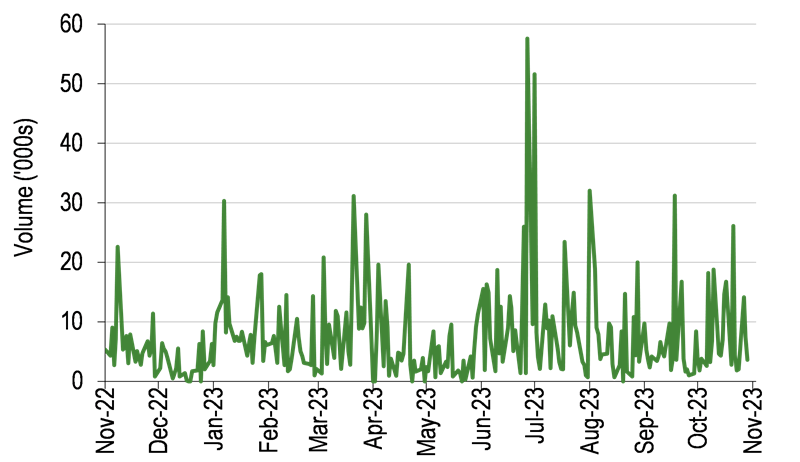
Exhibit 13: Average daily volume |
|
|
|
Source: Henderson Opportunities Trust 2022 Annual Report. |
Source: Refinitiv. Note 12 months to 21 June 2023. |
|
Exhibit 12: Major shareholders at 31 October 2022 |
|
|
Source: Henderson Opportunities Trust 2022 Annual Report. |
|
Exhibit 13: Average daily volume |
|
|
Source: Refinitiv. Note 12 months to 21 June 2023. |
|
|
Investment Companies
Research: TMT
Dentsu’s Q323 trading update describes demanding trading conditions with continuing spending constraint from customers in technology and finance, and ongoing delays to larger digital transformation projects. Full year organic revenue guidance is revised to -5% (from 0% to -2%), with an operating margin of 13.5%, depressed by one-off factors from 15.0%. The outlook is improving, albeit patchily, and initiatives to streamline the business and structure it more effectively to meet client needs should benefit the operating margin in FY24 and beyond.