Last close As at 05/08/2026
GBP4.98
▲ −1.00 (−0.20%)
Market capitalisation
GBP990m
Research: Investment Companies
Invesco Asia Trust (IAT) aims to deliver significant capital gains to shareholders over a three- to five-year horizon, primarily through investing in Asian equities, following a disciplined, bottom-up process. It has a solid long-term track record of NAV total return outperformance against its benchmark and has delivered annualised returns of 13% pa over the past 10 years. Although the primary objective is capital gains, since 2001 IAT has also consistently maintained or grown dividends, which increased 28% in FY18. The MSCI Asia ex-Japan index has corrected nearly 20% from its January 2018 peak and the manager believes many interesting investment ideas are emerging.
Written by
Invesco Asia Trust |
Opportunities emerging in Asian equities |
Investment trusts |
18 September 2018 |
Share price/discount performance
Three-year performance vs index
Gearing
Analysts
|
|||||||||||||||||||||||||||||||||||||||||||||||||||||||||||||||||||||||||||||||||||||||||||||
Invesco Asia Trust (IAT) aims to deliver significant capital gains to shareholders over a three- to five-year horizon, primarily through investing in Asian equities, following a disciplined, bottom-up process. It has a solid long-term track record of NAV total return outperformance against its benchmark and has delivered annualised returns of 13% pa over the past 10 years. Although the primary objective is capital gains, since 2001 IAT has also consistently maintained or grown dividends, which increased 28% in FY18. The MSCI Asia ex-Japan index has corrected nearly 20% from its January 2018 peak and the manager believes many interesting investment ideas are emerging.
12 months ending |
Share price |
NAV |
Benchmark* |
MSCI World |
FTSE All-Share |
31/08/14 |
23.5 |
23.6 |
13.0 |
13.4 |
10.3 |
31/08/15 |
(9.2) |
(10.4) |
(12.7) |
4.1 |
(2.3) |
31/08/16 |
39.3 |
39.3 |
33.0 |
26.0 |
11.7 |
31/08/17 |
26.9 |
28.0 |
27.2 |
18.8 |
14.3 |
31/08/18 |
(1.1) |
0.8 |
2.2 |
12.7 |
4.7 |
Source: Thomson Datastream. Note: All % on a total return basis in GBP. *Benchmark is MSCI AC Asia Pacific ex-Japan until 30 April 2015 and MSCI AC Asia ex-Japan thereafter.
Investment strategy: Valuation discipline
IAT follows a bottom-up investment process to identify well-managed companies with strong business franchises and robust balance sheets. Valuation is of particular importance and the manager looks for stocks that are intrinsically undervalued on a long-term view. Stock selection leads portfolio construction and IAT’s holdings of 50-70 investments represent the manager’s highest conviction ideas. The rigorous approach, which involves around 700 company visits pa, is supported by a team of six experienced Asian equities specialists.
Market outlook: Asia trading at discount to global
MSCI Asia ex-Japan index peaked in late January 2018, following a strong two-year rally fuelled by easy monetary conditions, including unprecedentedly low interest rates and synchronous global growth. The outlook is now more challenging as interest rates are rising, and monetary conditions are less accommodative. Asian equity markets have responded with a near 20% correction from the peak, although global equities have continued to appreciate. Meanwhile, 2017 earnings in the region have been stronger than expected, bringing valuations close to historic averages, but at a significant discount to global equities.
Valuation: 11.6% discount to ex-income NAV
IAT currently trades on a 11.6% discount to ex-income NAV, which is slightly deeper than the three-year average of 10.4%. The board is committed to managing the discount and views a level below 10.0% to be desirable, in normal market conditions. Dividends have grown, or been maintained, consistently over the long term and the FY18 dividend increased 27.9% to 5.5p per share, representing a yield of 2.0%, which is above the peer group average.
Exhibit 1: Trust at a glance
Investment objective and fund background |
Recent developments |
||||||||||||||||||||||||||||||||||||||||||||||||||||||||||||||||||||||
IAT’s objective is to provide long-term capital growth by investing in a diversified portfolio of Asian companies. On 1 May 2015 the trust adopted a new benchmark, MSCI AC Asia ex-Japan, in place of the former benchmark, MSCI AC Asia Pacific ex-Japan. While the new benchmark excludes Australasia, the trust may still invest in these markets. |
■ 31 July 2018 AGM: Carol Ferguson retired as chairman and was replaced by Neil Rogan. ■ 28 June 2018: Annual report for 12 months ending 30 April 2018. NAV TR +14.5% versus benchmark TR +16.8%. Share price TR +13.0%. ■ 14 December 2017: Interim report for six months ending 31 October 2017. NAV TR +14.8% versus benchmark TR +15.5%. Share price TR +13.4%. ■ 11 August 2017: 12.5m shares repurchased for cancellation in tender offer at a 312.9p per share. ■ 10 August 2017: Neil Rogan appointed as a non-executive director. |
||||||||||||||||||||||||||||||||||||||||||||||||||||||||||||||||||||||
Forthcoming |
Capital structure |
Fund details |
|||||||||||||||||||||||||||||||||||||||||||||||||||||||||||||||||||||
AGM |
August 2019 |
Ongoing charges |
0.98% (July 2018) |
Group |
Invesco Asset Management Ltd |
||||||||||||||||||||||||||||||||||||||||||||||||||||||||||||||||||
Interim results |
December 2018 |
Net cash |
3.8% |
Manager |
Ian Hargreaves |
||||||||||||||||||||||||||||||||||||||||||||||||||||||||||||||||||
Year end |
30 April |
Annual mgmt fee |
0.75% |
Address |
125 London Wall |
||||||||||||||||||||||||||||||||||||||||||||||||||||||||||||||||||
Dividend paid |
August |
Performance fee |
None |
||||||||||||||||||||||||||||||||||||||||||||||||||||||||||||||||||||
Launch date |
July 1995 |
Trust life |
Indefinite |
Phone |
+44 (0)20 3753 1000 |
||||||||||||||||||||||||||||||||||||||||||||||||||||||||||||||||||
Continuation vote |
Three-yearly, next in 2019 |
Loan facilities |
£20m multi-currency |
Website |
|||||||||||||||||||||||||||||||||||||||||||||||||||||||||||||||||||
Dividend policy and history (financial years) |
Share buyback policy and history (financial years) |
||||||||||||||||||||||||||||||||||||||||||||||||||||||||||||||||||||||
Dividends are paid annually in August. Income is a by-product of stock selection and there is no yield target. |
Renewed annually, the trust has authority to purchase up to 14.99% and allot up to 5% of issued share capital. |
||||||||||||||||||||||||||||||||||||||||||||||||||||||||||||||||||||||
|
|
||||||||||||||||||||||||||||||||||||||||||||||||||||||||||||||||||||||
Shareholder base (as at 3 September 2018) |
Portfolio exposure by sector (as at 31 July 2018, ex-cash) |
||||||||||||||||||||||||||||||||||||||||||||||||||||||||||||||||||||||
|
|
||||||||||||||||||||||||||||||||||||||||||||||||||||||||||||||||||||||
Top 10 holdings (as at 31 July 2018) |
|||||||||||||||||||||||||||||||||||||||||||||||||||||||||||||||||||||||
|
|||||||||||||||||||||||||||||||||||||||||||||||||||||||||||||||||||||||
Source: Invesco Asia Trust, Edison Investment Research, Bloomberg, Morningstar. Note: *N/A where not in end-July 2017 top 10.
Market outlook: Less benign environment
The MSCI Asia ex-Japan index performed strongly between early 2016 and 2018, fuelled by synchronous global growth, exceptionally accommodative monetary conditions and positive earnings momentum. Many of these factors are now less benign as interest rates are rising, while global leading economic indicators have started to roll over (although they remain strong in the US, underpinned by the impact of recent tax reforms). Equity markets globally are also more volatile than before, as indicated by the sharp increase in the VIX since late January 2018, signalling investors have become more sensitive to risk. As shown in Exhibit 2 (LHS), the MSCI Asia ex-Japan has correctly sharply by around 18% since late-January, while the MSCI World Index (led by US equities) has continued to reach new highs. Coupled with stronger than expected earnings growth of around 23% for 2017, Asia’s valuations have moderated, and are trading close to their 10-year averages, while the discount to global equities has widened meaningfully.
|
Exhibit 2: Market performance and valuation |
|
Performance of indices (last five years, all in £) |
DS Asia ex-Japan vs DS World valuation comparison |
|
|
|
Source: Thomson Datastream, Edison Investment Research. Note: Valuation data as at 7 September 2018. |
|
Fund profile: Bottom-up, valuation focused
IAT was launched in 1995 and aims to provide long-term capital growth through investing in a diversified portfolio of Asian and Australasian companies across the whole market cap spectrum. The trust has been benchmarked against the MSCI AC Asia ex-Japan index since 1 May 2015 (previously the MSCI Asia Pacific ex-Japan index) to better reflect its habitual low exposure to Australasia. Fund manager Ian Hargreaves and a team of six Asian equities specialists follow a bottom-up approach to select fundamentally attractive, intrinsically undervalued stocks with a three- to five-year investment horizon. The portfolio typically consists of 50-70 high conviction names. Gearing of up to 25% of the portfolio is permitted; however, in practice, it is used conservatively.
The fund manager: Ian Hargreaves
The manager’s view: Correction brings opportunities
Hargreaves believes Asian equity valuations already reflect a more challenging outlook compared to the benign conditions of the past few years. Early in 2018 he identified a number of headwinds which have become apparent, including a shift to tighter monetary conditions globally, slowing credit growth in China as it sought to mitigate risk in the shadow banking sector, and a peaking in global leading indicators feeding through to moderating export growth from above-trend levels. In his view, a market correction has brought Asian valuations to levels where historically, attractive long-term gains have been made.
The manager also believes Asian economies and corporates, as a whole, are in relatively good shape, sharing few of the fragilities of the emerging markets asset class. However, Hargreaves thinks investors often fail to make this distinction and Asian equities can suffer unjustifiably during indiscriminate ‘risk-off’ market sell-offs. Most Asian countries have strengthened their balance of payment and current account positions over the past five years (which are vastly improved compared to the previous cycle peak in 2009). Meanwhile, corporates have been cautious and capital expenditure has been weak. This has helped to reduce the acute excess capacity problems across many industries over the past years (especially in China), which have hindered profitability. Many companies have much improved free cash flow and carry high levels of cash on their balance sheets, which the manager believes offers some downside protection, as well as prospects for growth in dividends. In this environment, Hargreaves is finding interesting investment opportunities.
Asset allocation
Investment process: Looking for intrinsic undervaluation
The investment process is active and fundamental in its approach to identify companies with attractive market positions, robust financials, strong managements and that trade below their long-term intrinsic values. A team of six Asian equities specialists travel regularly to the region and conduct around 700 company visits pa, with candidate companies subject to rigorous analysis. Valuation is paramount to the investment process and a shortlist of potential investments is ranked by their potential return over a three-year horizon. This bottom-up process is the key driver of portfolio construction, but it is also influenced by the team’s top-down macroeconomic analysis, which helps guide country and sector weights. Risks are managed through ensuring a diversified portfolio of 50-70 stocks across countries and sectors and in-depth knowledge of portfolio companies, involving ongoing monitoring and dialogues with managements. The team and the portfolio are also subject to regular ‘CIO challenges’, facilitated by the Invesco Perpetual Investment Oversight team, which provides constructive scrutiny over the decisions taken within the portfolio, including assumptions, performance review and attributions, and the conviction level of stock decisions.
Current portfolio positioning
IAT is well diversified across 11 countries and sectors and there has been relatively modest activity since our report in March 2018. The portfolio remains overweight India and South Korea. India is at an early stage of a recovery cycle, particularly for banks, where the manager also sees positive structural trends as government measures to address impaired loans are starting to bear fruit. The private sector banks should be the main beneficiaries of these policies and are well-placed to take market share from banks in the state sector, which still commands a 70% industry share, but are under-capitalised and poorly managed. The manager has been adding to Indian financials, and portfolio holdings in this sector include ICICI Bank and companies within the HDFC Group, which Hargreaves believes have potential for high-teens, multi-year growth. South Korea has many cash-rich companies, and traditionally, dividend payout ratios have been low, while deployment of excess capital has often disappointed the international investment community. These factors partly explain the market’s low multiples relative to the region. Hargreaves believes this trend is changing, led by the South Korea’s largest company, Samsung Electronics, which has committed to allocate a minimum of 50% of free cash flow to be returned to shareholders. Other companies are moving in this direction, encouraged by a government focused on improving corporate governance and generating better returns for the National Pension Service. The manager believes there is scope for the South Korean equity market to re-rate over time.
Exhibit 3: Portfolio geographic exposure vs benchmark (% unless stated)
Portfolio end-July 2018 |
Portfolio end-July 2017 |
Change (pp) |
Benchmark weight |
Active weight vs index (pp) |
Trust weight/ index weight (x) |
|
Hong Kong and China |
42.2 |
39.8 |
2.5 |
47.1 |
(4.9) |
0.9 |
South Korea |
18.2 |
22.0 |
(3.8) |
16.2 |
2.0 |
1.1 |
India |
15.6 |
14.2 |
1.3 |
10.3 |
5.2 |
1.5 |
Taiwan |
12.5 |
15.1 |
(2.6) |
13.6 |
(1.1) |
0.9 |
Singapore |
2.3 |
2.1 |
0.3 |
4.0 |
(1.6) |
0.6 |
Thailand |
2.2 |
0.0 |
2.2 |
2.6 |
(0.5) |
0.8 |
Japan |
2.0 |
1.1 |
0.9 |
0.0 |
2.0 |
N/A |
Australia |
1.6 |
0.7 |
0.9 |
0.0 |
1.6 |
N/A |
Indonesia |
1.2 |
3.0 |
(1.8) |
2.2 |
(1.0) |
0.5 |
Philippines |
1.1 |
1.2 |
(0.1) |
1.1 |
(0.1) |
1.0 |
Malaysia |
1.1 |
0.9 |
0.2 |
2.8 |
(1.7) |
0.4 |
Pakistan |
0.0 |
0.0 |
0.0 |
0.1 |
(0.1) |
0.0 |
Total |
100.0 |
100.0 |
100.0 |
Source: Invesco Asia Trust, Edison Investment Research. Note: Rebased for cash/gearing.
IAT is most underweight Hong Kong and China, which reflects diversification considerations given they account for nearly half the index. It is also underweight countries in South East Asia, including Malaysia and Indonesia, where the manager sees more market risks. In Malaysia, politics remains unclear following financial scandals associated with the previous government and the return of the 92-year old former prime minister to the post. Indonesia is perceived as one of the weaker economies in the region. As a result, its stock market and currency corrections have been particularly pronounced, presenting IAT the opportunity to add to Bank Negara International at a single-digit P/E multiple valuation.
Exhibit 4: Portfolio sector exposure vs benchmark (% unless stated)
Portfolio end-July 2018 |
Portfolio end-July 2017 |
Change |
Benchmark weight |
Active weight vs index (pp) |
Trust weight/ index weight (x) |
|
Financials |
29.9 |
24.5 |
5.4 |
23.0 |
6.8 |
1.3 |
Information technology |
29.8 |
34.9 |
(5.1) |
31.3 |
(1.5) |
1.0 |
Consumer discretionary |
10.0 |
11.7 |
(1.7) |
8.6 |
1.4 |
1.2 |
Industrials |
7.7 |
7.6 |
0.1 |
6.6 |
1.1 |
1.2 |
Materials |
5.9 |
3.8 |
2.1 |
4.8 |
1.1 |
1.2 |
Energy |
5.0 |
1.8 |
3.2 |
4.7 |
0.3 |
1.1 |
Telecom services |
3.7 |
4.4 |
(0.6) |
3.7 |
0.0 |
1.0 |
Real estate |
3.2 |
5.0 |
(1.8) |
6.1 |
(2.8) |
0.5 |
Healthcare |
1.9 |
1.6 |
0.3 |
3.0 |
(1.1) |
0.6 |
Utilities |
1.8 |
3.2 |
(1.4) |
3.2 |
(1.4) |
0.6 |
Consumer staples |
1.1 |
1.6 |
(0.6) |
4.9 |
(3.8) |
0.2 |
Total |
100.0 |
100.0 |
100.0 |
Source: Invesco Asia Trust, Edison Investment Research. Note: Rebased for cash/gearing.
As shown in Exhibit 4, IAT’s financials position increased by 5.4pp over the year to end-July 2018, making it the largest and most overweight sector exposure in the portfolio. Information technology has been reduced by 5.1pp, in large part reflecting profit-taking in the sector, which has performed strongly for much of the past two years. This included a significant trimming of the Samsung Electronics holding, which has fallen from 8.1% of the portfolio to 5.6% over the year to end-July 2018.
Recent additions to the portfolio have mainly been in cash-rich companies that the manager views as oversold or out-of-favour and command attractive valuations. These include China Communication Services (CCS), a service provider to domestic telecom operators in China; and Taiwan handset chip design company MediaTek. Both stocks were out-of-favour, suffering from a lull in the telecoms’ capital expenditure as 4G technology matured, while investment in 5G was deemed too distant for investors’ consideration. MediaTek trades on a free cash flow yield of over 10%, while cash and investments on CCS’s balance sheet represents over half its market value. Trials of 5G technology are currently underway, and its commercialisation is on the horizon for late 2019, which could signal the start of a new capex cycle for the industry, and support re-ratings for these two stocks.
Performance: Significant long-term outperformance
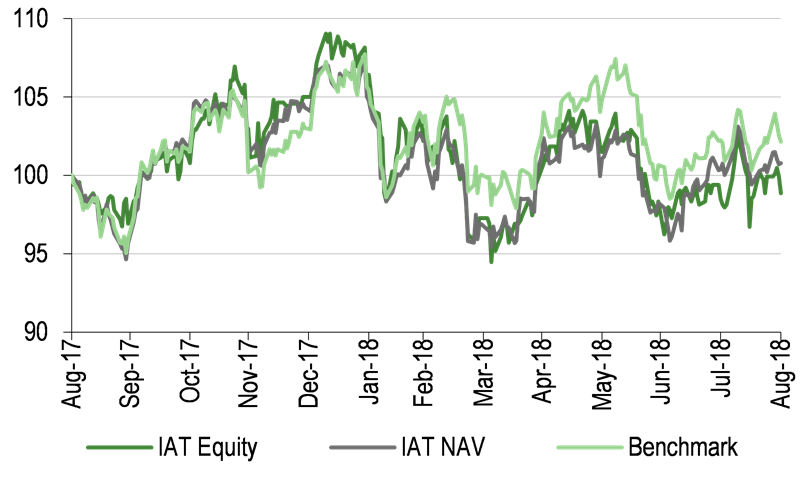
As shown in Exhibits 5 and 6, IAT’s NAV total return performance is significantly ahead of its benchmark over the longer periods of five and 10 years. Three-year performance is slightly ahead of the benchmark, but the absolute return is high at an annualised 22% pa. Compared to the FTSE All-Share index, IAT’s outperformance over three, five and 10 years is even more pronounced. Performance over one year, however, has lagged the benchmark. However, this will not influence the manager as IAT’s objective is to outperform over a long-term horizon of three- to five-years, looking to capitalise on the market’s short-termism.
|
Exhibit 5: Investment trust performance to 31 August 2018 |
|||||||||
Price, NAV and benchmark total return performance, one-year rebased |
Price, NAV and benchmark total return performance (%) |
||||||||
|
|
||||||||
|
Source: Thomson Datastream, Edison Investment Research. Note: Three-, five- and 10-year performance figures annualised. Benchmark is MSCI AC Asia Pacific ex-Japan until 30 April 2015 and MSCI AC Asia ex-Japan thereafter. |
|||||||||
|
Exhibit 6: Share price and NAV total return performance, relative to indices (%) |
|||||||||
|
One month |
Three months |
Six months |
One year |
Three years |
Five years |
10 years |
||
Price relative to benchmark |
0.4 |
(0.0) |
(2.1) |
(3.2) |
1.1 |
14.9 |
28.1 |
||
NAV relative to benchmark |
0.5 |
2.3 |
(0.3) |
(1.3) |
4.0 |
16.8 |
29.1 |
||
Price relative to FTSE All Share |
3.2 |
(0.9) |
(8.4) |
(5.6) |
30.7 |
35.9 |
64.1 |
||
NAV relative to FTSE All Share |
3.3 |
1.4 |
(6.7) |
(3.7) |
34.4 |
38.2 |
65.3 |
||
|
Source: Thomson Datastream, Edison Investment Research. Note: Data to end-August 2018. Geometric calculation. |
|||||||||
|
Exhibit 7: NAV total return performance relative to benchmark over three years |
|||||||||
|
|||||||||
|
Source: Thomson Datastream, Edison Investment Research |
|||||||||
Discount: In line with three-year average
IAT currently trades at a 10.5% discount to ex-income NAV, which is broadly in-line with the three-year average of 10.4%. The board considers an average discount of 10.0% or below to the trust’s ex-income NAV to be desirable in normal market conditions and is committed to managing the discount. Previously, it had used tender offers to buy back shares if the average discount over the financial year was greater than 10%. However, in 2017 the board reconsidered the effectiveness of this approach and concluded it to be against shareholders’ long-term interests. Instead, the board can buy back shares at its discretion, taking into account factors such as market conditions and discounts of comparable investment companies. Renewable annually, it has the ability to repurchase up to 14.99% of share capital.
|
Exhibit 8: Share price premium/discount to NAV (excluding income) over three years (%) |
|
|
Source: Thomson Datastream, Edison Investment Research |
Capital structure and fees
IAT is a conventional investment trust with one class of share. During FY18, the board conducted a tender offer for 15% of ordinary shares at a 2% discount to NAV on 11 August 2017. This resulted in the repurchase and cancellation of 12.5m shares at an average price of 312.9p per share and there are currently 70.9m shares in issue. No share repurchases have taken place during the current financial year. The trust is subject to a three-yearly continuation vote; the next is at the August 2019 AGM.
Gearing is permitted up to 25% of net assets and IAT has a £20m 364-day multi-currency revolving credit facility with The Bank of New York Mellon. Historically, use of leverage is very modest and was not deployed during FY18. As at end-July 2018, IAT had a net cash position of 3.8%. Invesco Fund Managers is paid an annual management fee of 0.75% of net assets, split 25:75 between the revenue and capital accounts. There is no performance fee. As at end-July 2018, the ongoing charge was 0.98%.
Dividend policy and record
Although IAT’s primary objective is to generate long-term capital growth rather than income, the trust has a long track record of growing or maintaining annual dividends. For FY18, revenue return per share rose to 5.98p, reflecting the higher earnings of companies within the portfolio and the continued weakness of sterling following the Brexit vote. IAT pays one dividend per year in August, and the final dividend for FY18 of 5.5p represents a 27.9% increase over FY17 and a current yield of 2.0%.
Peer group comparison
In Exhibit 9 we show 12 members of the AIC Asia Pacific ex-Japan sector, after excluding three trusts with an income mandate and a smaller trust with a shorter performance track record. IAT is one of the smallest funds. Its NAV total return has outperformed the average of the peer group over three, five and ten years; ranking fifth, fourth and fourth over these respective periods. Performance over one year has lagged, and is towards the bottom of the group. IAT’s dividend yield is above average among peers, ranking third, however, it trades at a wider than average discount to ex-par NAV, ranking seventh.
Exhibit 9: Selected peer group as at 15 September 2018*
% unless stated |
Market cap £m |
NAV TR |
NAV TR |
NAV TR |
NAV TR |
Discount (ex-par) |
Ongoing charge |
Perf. |
Net |
Dividend yield (%) |
Invesco Asia Trust |
192.2 |
0.7 |
75.6 |
88.4 |
253.5 |
(10.7) |
1.0 |
No |
100 |
2.0 |
Aberdeen Asian Smaller |
354.5 |
1.2 |
53.4 |
39.1 |
339.8 |
(12.1) |
1.2 |
No |
111 |
1.1 |
Aberdeen New Dawn |
245.5 |
0.6 |
59.4 |
46.2 |
175.8 |
(12.8) |
0.8 |
No |
110 |
2.0 |
Edinburgh Dragon |
656.8 |
0.9 |
59.4 |
48.0 |
183.9 |
(10.3) |
1.1 |
No |
102 |
0.9 |
Fidelity Asian Values |
274.7 |
2.9 |
73.2 |
81.4 |
237.7 |
0.5 |
1.3 |
No |
100 |
1.2 |
JPMorgan Asian |
310.5 |
1.4 |
83.3 |
83.3 |
171.5 |
(11.5) |
0.7 |
No |
100 |
4.6 |
Martin Currie Asia Unconstrained |
133.7 |
3.3 |
64.1 |
47.8 |
118.8 |
(11.8) |
1.1 |
No |
101 |
4.5 |
Pacific Assets |
319.5 |
10.3 |
55.7 |
85.6 |
216.3 |
(1.5) |
1.3 |
No |
100 |
1.0 |
Pacific Horizon |
183.1 |
3.1 |
93.6 |
93.4 |
205.9 |
(4.6) |
1.1 |
No |
109 |
0.2 |
Schroder Asia Pacific |
705.5 |
(0.0) |
78.6 |
88.7 |
263.8 |
(9.8) |
1.0 |
No |
105 |
1.3 |
Schroder Asian TR Inv. Company |
305.7 |
1.9 |
76.5 |
93.6 |
200.3 |
4.7 |
1.0 |
Yes |
105 |
1.4 |
Scottish Oriental Smaller Cos |
285.9 |
(2.6) |
45.1 |
48.7 |
335.5 |
(12.7) |
1.0 |
Yes |
100 |
1.1 |
Average |
330.6 |
2.0 |
68.1 |
70.3 |
225.2 |
(7.7) |
1.0 |
103 |
1.8 |
|
Trust rank in sector (12) |
10 |
9 |
5 |
4 |
4 |
7 |
7 |
8 |
3 |
Source: Morningstar, Edison Investment Research. Note: *Performance data to 14 September 2018. TR = total return. Net gearing is total assets less cash and equivalents as a percentage of net assets (100 = ungeared).
The board
IAT’s board consists of four independent non-executive directors. At the conclusion of the 31 July 2018 AGM, Carol Ferguson retired as chairman, following over nine years of service on the board, and Neil Rogan (appointed in September 2017) assumed the role. The board believes his broad experience of investment companies, both as an investment manager and as a non-executive director, provide him with the appropriate skills to lead the trust. The nomination committee continues to review the composition of the board and succession planning. The other directors are Tom Maier (March 2009), Owen Jonathan (March 2013) and Fleur Meijs (December 2016).
|
|
Research: Healthcare
Hutchison China MediTech’s (HCM) lead TKI asset, fruquintinib, has received China registration approval from the National Medical Products Administration of China (NMPA) for the treatment of CRC (third line). The approval serves as a major validation of the R&D innovation strategy, which HCM has cultivated over the years. This is the first innovative drug for an oncology indication, discovered and developed in China through a randomized clinical trial, to be unconditionally approved in that country. We expect launch in China by HCM and partner Eli Lilly during Q418. The approval has triggered a $13.6m milestone payment to HCM from Lilly. Our revised valuation is £74/ share.