Last close As at 05/08/2026
GBP16.60
▲ 38.00 (2.34%)
Market capitalisation
GBP316m
Research: Investment Companies
The Biotech Growth Trust (BIOG) is managed by Geoff Hsu at healthcare specialist OrbiMed Capital, and benefits from OrbiMed’s presence in 11 offices across the globe. While the trust has had a weak period of absolute and relative performance over the last 12 months, the manager believes that the focus on emerging biotech (smaller-cap) and emerging market biotech stocks is the correct strategy; following this approach proved very successful for BIOG’s FY21 results. Investors are currently not focusing on the biotech sector’s strong fundamentals, and the sell-off since early-February 2021 may have created a very attractive entry point for those willing to look beyond the current cyclical/value stock market leadership.
The Biotech Growth Trust |
Manager expects a reversal of recent results |
Investment trusts |
1 April 2022 |
Analysts
|
||||||||||||||||||||||||||||||||||||||||||||||||||||||||||||||||||||||||||||||||||||||||||||||||||||
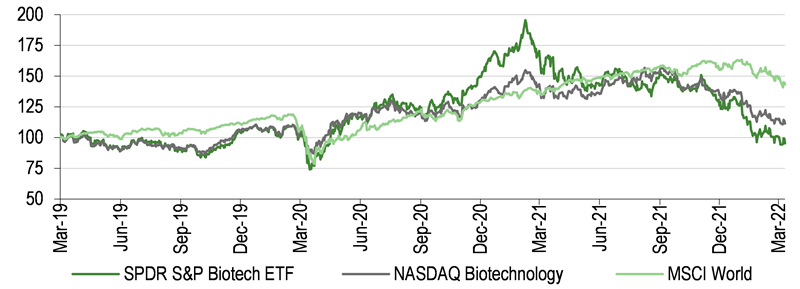
The Biotech Growth Trust (BIOG) is managed by Geoff Hsu at healthcare specialist OrbiMed Capital, and benefits from OrbiMed’s presence in 11 offices across the globe. While the trust has had a weak period of absolute and relative performance over the last 12 months, the manager believes that the focus on emerging biotech (smaller-cap) and emerging market biotech stocks is the correct strategy; following this approach proved very successful for BIOG’s FY21 results. Investors are currently not focusing on the biotech sector’s strong fundamentals, and the sell-off since early-February 2021 may have created a very attractive entry point for those willing to look beyond the current cyclical/value stock market leadership.
|
Major drawdown in biotech stocks since early-February 2021 |
|
|
Source: Refinitiv, Edison Investment Research. Note: Indices shown in US$. SPDR S&P Biotech ETF represents smaller-cap and NASDAQ Biotechnology larger-cap biotech stocks. |
The analyst’s view
The duration and magnitude of the current drawdown in biotech indices is unprecedented, which suggests now may be a good time to revisit a sector that continues to benefit from very favourable fundamentals. There is a high level of industry innovation and 2021 was another near-record year for US approvals of new molecular entities. BIOG offers investors a diverse exposure to the global biotech sector and the manager believes that the best growth opportunities are available in emerging and emerging market stocks (which are unrepresented in the benchmark), although these have been particularly out of favour with investors over the last year. The majority of the trust’s portfolio is made up of listed North American equities (c 75%) reflecting the region’s global dominance, but up to 10% of the fund may be invested in unlisted companies, typically via crossover deals, which are the last round of financing before a firm’s initial public offering (IPO). Hsu remains confident that BIOG’s performance record can be restored, driven by diligent bottom-up stock selection.
Current valuation is higher than historical averages
Perhaps reflecting weakness in the biotech sector, BIOG’s valuation has been volatile since the middle of 2021. Its current 6.6% discount to cum-income NAV compares with a range of a 3.3% premium to an 11.5% discount over the last 12 months. Over the last one, three, five and 10 years the trust’s average discounts are 2.5%, 4.3%, 5.0% and 4.6%, respectively.
Market outlook: Valuations looking very interesting
Shown in Exhibit 1 (left-hand side), long-term investors have benefited from an allocation to biotech stocks, although the sector is not for the faint of heart given periodic meaningful drawdowns. Valuation compression within the biotech sector has provided an opportunity to revisit this part of the market, which has high long-term growth potential; however, growth stocks have come under pressure with the prospects of higher interest rates. Factors for the biotech sector’s growth potential include high levels of innovation, a supportive regulatory environment and positive demographic trends. A pick-up in merger and acquisition (M&A) activity could provide a catalyst for an end to the current biotech bear market, as it could put a floor under company valuations. Major pharma companies are looking to acquire or partner with biotech companies as they have capital available and are looking to bolster their product pipelines.
Exhibit 1 (right-hand side) shows the valuation of the Datastream World Biotech Index; it is currently trading at a forward P/E multiple of 26.7x, which is a 14.6% discount to its five-year average. On a relative basis the index is trading at a 30.7% premium to the Datastream US Index, which is much lower than the 62.8% and 73.3% premiums over the last five and 10 years, respectively.
|
Exhibit 1: Biotech index performance and valuation |
|
NASDAQ biotechnology and MSCI world indices (10 years, £-based) |
DS World Biotech Index P/E and relative to DS US Index (past five years) |
|
|
|
Source: Refinitiv, Edison Investment Research. Note: Valuation data at 30 March 2022. |
|
The fund manager: Geoff Hsu
The manager’s view: The biotech sector is very oversold
Hsu explains that there has been a significant reversal in BIOG’s fortunes. Having generated a +30pp excess return in its NAV versus its benchmark in FY21 (ending 31 March), in the 11 months to end-February 2022, BIOG’s excess return was -22.1pp. There has been a major turnaround within the biotech sector as what worked in FY21 has not done so in FY22. The manager comments that fundamentals have not mattered, there has been a large rotation from growth to value stocks, small caps have underperformed large caps and there has been a pullback in emerging markets especially in China; emerging and Chinese biotech stocks are areas favoured in the trust’s investment strategy. Hsu notes that the biotech sector has experienced the longest and largest drawdown in its history; data from OrbiMed show that between 8 February 2021 and 2 February 2022, the SPDR S&P Biotech ETF underperformed the US S&P 500 Index by 64.4%. According to the manager, between summer 2015 and now, emerging biotech stocks are flat, while the S&P 500 Index has more than doubled. Also, from 30 June 2021 to 29 December 2021, the Hang Seng Healthcare Index underperformed the MSCI World Healthcare Index by 53.8%. He says that high levels of innovation within the biotech industry are not reflected in biotech stock prices.
Investors have concerns about healthcare stocks in general; the S&P 500 healthcare sector is trading at a c 20% discount to the S&P 500 Index, which is similar to during the global financial crisis and concerns about the introduction of Obamacare. Hsu believes that such a discount indicates a favourable point to invest in healthcare stocks given their positive innovation and growth trends. While he acknowledges that FY22 has been challenging, he has confidence that BIOG’s performance can improve. The manager highlights that in the United States, a permanent Food and Drug Administration commissioner has been appointed, so the high level of approvals of new molecular entities is expected to continue, US drug price reform is off the table as President Biden has higher priorities and there are upcoming mid-term elections, and he expects an uptick in M&A activity; in the Q421 reporting period, pharma companies indicated that acquiring assets is a high priority for them. Hsu is confident that he is employing the right strategy by focusing on emerging and emerging market biotech stocks (for more colour, please see the Current portfolio positioning section below).
Comparing the performance of the modified equally weighted SPDR S&P Biotech ETF to the market-cap weighted S&P 500 Index since 2006, the manager highlights that biotech stocks have outperformed significantly, so he believes that the sector is a good longer-term investment, despite periods of relative underperformance. Looking at three previous drawdowns, data from OrbiMed show that biotech stocks subsequently experienced very strong recoveries. In 2014 to 2016 there were two periods where biotech stocks fell due to concerns about drug pricing; the first was a 31.2% drawdown followed by a 109.0% recovery, while the second was a 43.8% drawdown followed by a 68.0% recovery. In 2018–19, investor focus on the risk of the US Federal Reserve tightening monetary policy led to a 30.0% drawdown in biotech stocks, which was followed by an 83.3% recovery.
Hsu remains positive on the outlook for biotech stocks, noting that in calendar years when the SPDR S&P Biotech ETF declines, it tends to rally in the following one. He says that in aggregate, the valuations of biotech stocks are at a 20-year low, while 16% of biotech companies, with market caps greater than $10m, have net cash on their balance sheets (c 90 companies, which is around one-sixth of the universe). The manager notes that there has been a strong biotech IPO market in recent years, and he believes that there is a compelling valuation case for emerging biotech stocks. While the Federal Reserve has started to raise interest rates, the manager says that there is a low correlation between the performance of biotech stocks and the level of interest rates.
Current portfolio positioning
At end-February 2022, BIOG’s top 10 holdings made up 37.0% of the fund, which was a higher concentration compared with 30.3% a year before; just two names were common to both periods. There were 79 companies in the fund, which was lower than 83 at end-February 2021.
Exhibit 2: Top 10 holdings (as at 28 February 2022)
Company |
Country |
Sector |
Portfolio weight % |
|
28 February 2022 |
28 February 2021* |
|||
Seagen |
US |
Emerging biotech |
5.0 |
N/A |
BioMarin Pharmaceutical |
US |
Emerging biotech |
4.4 |
N/A |
Keros Therapeutics |
US |
Emerging biotech |
3.9 |
2.8 |
GH Research |
Ireland |
Emerging biotech |
3.7 |
N/A |
Horizon Therapeutics |
US |
Emerging biotech |
3.6 |
4.5 |
Xenon Pharmaceuticals |
Canada |
Emerging biotech |
3.5 |
N/A |
Yisheng Biopharma** |
China |
Emerging biotech |
3.3 |
N/A |
Aclaris Therapeutics |
US |
Emerging biotech |
3.3 |
N/A |
Syndax Pharmaceuticals |
US |
Emerging biotech |
3.2 |
N/A |
Gilead Sciences |
US |
Major biotech |
3.1 |
N/A |
Top 10 (% of portfolio) |
37.0 |
30.3 |
||
Source: BIOG, Edison Investment Research. Note *N/A where not in end-February 2021 top 10. **Unquoted.
BIOG’s strategy of focusing on emerging rather than major biotech stocks is highlighted in Exhibit 3. The benchmark does not include any emerging market biotech stocks, which made up around 15% of the portfolio at the end of February 2022.
Exhibit 3: Portfolio market cap breakdown at end-FY21 (%)
Market |
BIOG |
NASDAQ Biotechnology Index |
Delta (pp) |
Large cap (> $10bn) |
26 |
59 |
(33) |
Mid cap ($2–10bn) |
22 |
29 |
(7) |
Small cap (< $2bn) |
51 |
13 |
38 |
Total |
100.0 |
100.0 |
Source: BIOG, Edison Investment Research. Note: Subject to rounding.
Over the 12 months to the end of February 2022, the largest changes in BIOG’s geographic exposure were a lower weighting to quoted Chinese stocks (-5.9pp) and a higher weighting to unquoted companies (+4.8pp).
Exhibit 4: Portfolio geographic breakdown (%)
Sector |
End-February 2022 |
End-February 2021 |
Change (pp) |
North America |
74.3 |
75.2 |
(0.9) |
Continental Europe |
9.2 |
7.9 |
1.3 |
Unquoted* |
8.1 |
3.3 |
4.8 |
China (quoted) |
6.6 |
12.5 |
(5.9) |
South Korea |
0.8 |
0.0 |
0.8 |
UK |
0.7 |
1.1 |
(0.4) |
Singapore |
0.3 |
0.0 |
0.3 |
Total |
100.0 |
100.0 |
Source: BIOG, Edison Investment Research. Note: Adjusted for gearing. *Of the 8.1% unquoted investments, 7.6% was in China, 0.4% was in Asia, and 0.1% was in Canada.
Hsu says that a high level of innovation is reflected in BIOG’s portfolio, with c 45% of the portfolio held in companies with novel drug development technologies: antibody-drug conjugates (12.9% of NAV at end-January 2022); gene therapy/gene editing (9.8%); cell therapy (6.4%); multi-specific antibodies/T-cell engagers (5.9%); oligonucleotide therapeutics (5.6%); and liquid biopsy (4.2%). The manager believes that these businesses are at a very early stage of their value potential.
Performance: Major change in BIOG’s fortune
Exhibit 5: Five-year discrete performance data
12 months ending |
Share price |
NAV |
NASDAQ Biotech (%) |
World-DS Pharm & Bio (%) |
MSCI World |
28/02/18 |
(2.0) |
(5.2) |
(0.8) |
0.5 |
6.6 |
28/02/19 |
(2.2) |
0.5 |
8.6 |
10.8 |
4.6 |
29/02/20 |
23.8 |
29.7 |
6.0 |
9.2 |
9.6 |
28/02/21 |
69.2 |
52.8 |
26.6 |
11.3 |
18.8 |
28/02/22 |
(38.6) |
(38.9) |
(15.0) |
7.4 |
15.9 |
Source: Refinitiv. Note: All % on a total return basis in pounds sterling.
Exhibit 5 illustrates that the biotech sector and BIOG’s relative performance can be very volatile. The trust’s weak performance over the last year due it its relatively high exposure to smaller-cap and emerging market biotech stocks has negatively affected its long-term record, although its NAV remains ahead of the benchmark over the last three years. However, the manager is confident that the trust’s positioning will lead to future strong results, pointing to BIOG’s notable outperformance in FY21 when its NAV outpaced the performance of the NASDAQ Biotech Index by 30.0pp. He believes that the biotech sector is experiencing a ‘golden era’ of innovation and notes that the number of first-in-class approvals is increasing, while there have been several important innovation milestones. Hsu expects a rebound in Chinese biotech stocks as companies there are closing the innovation gap with businesses in the United States and Europe. The number of novel drug approvals in China has increased in recent years, while western companies in-licensing Chinese innovation is a validation of these companies’ success, and the Chinese authorities have a stated priority to develop a domestic biotech industry. Anticipating a rebound, the manager has been taking advantage of share price weakness to add to some of BIOG’s emerging biotech stocks.
|
Exhibit 6: Investment trust performance to 28 February 2022 |
|
Price, NAV and benchmark total return performance, one-year rebased |
Price, NAV and benchmark total return performance (%) |
|
|
|
Source: Refinitiv, Edison Investment Research. Note: Three-, five- and 10-year performance figures annualised. |
|
Exhibit 7: Share price and NAV total return performance, relative to indices (%)
|
One month |
Three months |
Six months |
One year |
Three years |
Five years |
10 years |
Price relative to NASDAQ Biotechnology |
4.3 |
(2.6) |
(4.0) |
(27.7) |
12.8 |
0.4 |
0.3 |
NAV relative to NASDAQ Biotechnology |
1.1 |
(4.8) |
(8.2) |
(28.1) |
6.2 |
(6.1) |
(2.6) |
Price relative to World-DS Pharm & Bio |
1.3 |
(16.2) |
(20.2) |
(42.8) |
(1.5) |
(15.2) |
12.1 |
NAV relative to World-DS Pharm & Bio |
(1.8) |
(18.1) |
(23.7) |
(43.2) |
(7.3) |
(20.8) |
8.9 |
Price relative to MSCI World |
2.8 |
(15.5) |
(24.6) |
(47.0) |
(14.7) |
(26.7) |
15.8 |
NAV relative to MSCI World |
(0.4) |
(17.4) |
(27.9) |
(47.3) |
(19.7) |
(31.5) |
12.4 |
Price relative to CBOE UK All Companies |
0.3 |
(23.1) |
(28.2) |
(47.4) |
9.5 |
(1.0) |
106.8 |
NAV relative to CBOE UK All Companies |
(2.8) |
(24.8) |
(31.3) |
(47.7) |
3.1 |
(7.5) |
100.8 |
Source: Refinitiv, Edison Investment Research. Note: Data to end-February 2022. Geometric calculation.
|
Exhibit 8: NAV performance versus benchmark over 10 years |
|
|
Source: Refinitiv, Edison Investment Research |
Peer group comparison
BIOG is one of a seven funds in AIC Biotechnology & Healthcare sector. To provide a broader comparison, in Exhibit 9 we also include two Switzerland-listed funds: BB Biotech and HBM Healthcare Investments. BIOG’s underperformance over the last year due to its overweight exposure to smaller-cap and emerging market biotech stocks means that its NAV total return ranks ninth over the last 12 months. Over the last three and five years, the trust ranks fifth and seventh out of eight funds respectively, while it ranks fifth out of six funds over the last decade. BIOG has a modestly lower valuation than the selected peer group average, a competitive ongoing charge, although a performance fee may be payable, and a level of gearing that is above the mean. The trust is one of three funds in the selected peer group that does not pay a dividend.
Exhibit 9: Biotech and healthcare investment companies, as at 30 March 2022*
% unless stated |
Market cap £m |
NAV TR |
NAV TR |
NAV TR |
NAV TR |
Discount (ex-par) |
Ongoing charge |
Perf. |
Net gearing |
Dividend yield |
Biotech Growth Trust |
370.8 |
(30.3) |
24.3 |
20.8 |
289.2 |
(6.6) |
1.1 |
Yes |
108 |
0.0 |
BB Biotech |
3,023.0 |
(13.2) |
2.3 |
20.1 |
393.9 |
28.2 |
1.5 |
No |
103 |
5.9 |
Bellvue Healthcare |
1,063.3 |
6.1 |
51.0 |
98.2 |
|
(2.1) |
1.1 |
No |
107 |
3.3 |
HBM Healthcare Investments |
1,608.9 |
0.9 |
74.6 |
107.7 |
553.1 |
(10.8) |
1.3 |
Yes |
100 |
3.4 |
International Biotechnology Trust |
261.9 |
0.7 |
23.9 |
32.4 |
309.9 |
(8.6) |
1.2 |
Yes |
116 |
4.7 |
Polar Capital Global Healthcare |
357.7 |
22.7 |
47.2 |
63.8 |
252.1 |
(12.2) |
0.9 |
Yes |
105 |
0.7 |
RTW Venture Fund |
216.0 |
(27.4) |
|
|
|
(6.9) |
2.1 |
Yes |
100 |
0.0 |
Syncona |
1,048.1 |
(2.0) |
(7.1) |
57.9 |
|
(21.1) |
1.6 |
No |
100 |
0.0 |
Worldwide Healthcare Trust |
2,124.1 |
(1.6) |
33.3 |
53.9 |
360.7 |
(7.4) |
0.9 |
Yes |
102 |
0.7 |
Average |
1,119.3 |
(4.9) |
31.2 |
56.8 |
359.8 |
(5.3) |
1.3 |
105 |
2.1 |
|
Trust rank in sector (9 funds) |
6 |
9 |
5 |
7 |
5 |
3 |
4 |
2 |
7 |
Source: Morningstar, Edison Investment Research. Note: *Sterling performance to 29 March 2022 based on ex-par NAV. TR = total return. Net gearing is total assets less cash and equivalents as a percentage of net assets.
Dividends
BIOG aims to generate long-term capital growth rather than income and a large proportion of the fund is invested in early-stage companies that invest for future growth rather than returning cash to shareholders. In FY21, the trust’s revenue return was -0.2p per share, compared with 1.0p per share in FY20. No dividend has been paid since 2001 (0.2p per share).
Discount: Volatile since mid-2021
BIOG’s shares are currently trading at a 6.6% discount to cum-income NAV, which compares with a range of a 3.3% premium to an 11.5% discount over the last 12 months. Over the last one, three, five and 10 years the trust has traded in a 2.5% to 5.0% range of average discounts. Renewed annually, BIOG has authority to purchase up to 14.99% and allot up to 10% of issued share capital. The board remains committed to limiting the discount to 6% in normal market conditions. So far in FY22, a modest c 0.2m shares were issued raising c £2.1m, while c 0.6m were bought back at a cost of c £6.9m.
|
Exhibit 10: Discount over three years (%) |
Exhibit 11: Buybacks and issuance |
|
|
|
Source: Refinitiv, Edison Investment Research |
Source: Morningstar, Edison Investment Research |
|
Exhibit 10: Discount over three years (%) |
|
|
Source: Refinitiv, Edison Investment Research |
|
Exhibit 11: Buybacks and issuance |
|
|
Source: Morningstar, Edison Investment Research |
Fund profile: All-cap, global biotech exposure
BIOG was launched in June 1997 and is listed on the Main Market of the London Stock Exchange. The trust is managed by Geoff Hsu at OrbiMed Capital, which is a global healthcare specialist investor with c $17bn of assets under management. OrbiMed operates from 11 offices around the globe and has a team of around 100 investment professionals, of whom more than 30 hold PhD or MD qualifications and around 15 are former CEOs or company founders.
Hsu aims to generate long-term capital growth from a diversified portfolio of global biotech equities and related securities. BIOG’s performance is measured against the NASDAQ Biotechnology Index (sterling-adjusted), and its currency exposure is unhedged. The trust’s investment guidelines state that at the time of investment, a maximum of 15% of gross assets may be held in a single stock; up to 10% may be in unquoted securities (excluding a maximum $15m in private equity funds managed by OrbiMed and its affiliates); and swaps exposure is permitted up to 5% of gross assets. Hsu may employ gearing up to 20% of net assets; net gearing was 8.2% at end-February 2022.
Investment process: Bottom-up stock selection
Hsu aims to generate long-term capital growth from a globally diversified portfolio of biotech companies across the market cap spectrum. He is able to draw on the broad resources of OrbiMed’s experienced investment team; their scientific expertise is deemed critical in terms of evaluating potential investments. Stocks are selected on a bottom-up basis following thorough in-depth fundamental research, which includes financial modelling, an assessment of research pipelines and identification of potential catalysts; company meetings are a very important element of the research process. Reasons to initiate a new position include whether an early-stage company is approaching profitability, ahead of anticipated positive clinical data, or if a business is considered a potential takeover target.
While the manager seeks out the best potential opportunities across the globe, the majority of the portfolio is held in US companies, reflecting its current dominance in the biotech industry, although BIOG has a notable exposure to China. The trust’s holdings are regularly reviewed to ensure the original investment theses are still valid and positions are sized correctly. Hsu notes that BIOG’s portfolio turnover is relatively high as a result of its emerging biotech exposure, where stocks can be volatile around news about clinical results. The manager continues to invest in unquoted companies (8.1% of the fund at end-February 2022).
BIOG’s approach to ESG
OrbiMed believes that there is a high congruence between companies seeking to act responsibly and those that succeed in building long-term shareholder value. To the extent that it is practicable and reasonable, OrbiMed takes into account applicable environmental, social and corporate governance factors when evaluating a prospective or existing investment via a five-step process:
■
Negative screening – OrbiMed does not invest in businesses that lead to negative effects on public health or wellbeing, such as banned or illegally marketed pharmaceuticals or tobacco.
■
Due diligence – fundamental analysis to review material ESG factors.
■
Monitoring – performance of portfolio companies is regularly monitored on multiple factors.
■
Engagement – occurs with portfolio companies on a regular basis including meetings with management, proxy voting and ESG conferences.
■
Reporting – OrbiMed is introducing a quarterly ESG update covering sector and portfolio highlights, along with engagements on material issues.
OrbiMed may seek to engage with portfolio companies to promote changes in their conduct or policies and could ultimately decide to sell the investment in these firms. In some cases, it may adopt an ‘activist’ approach to encourage change at investee companies, which may include a proxy campaign or seeking representation on their boards of directors. OrbiMed is leading the charge with ESG initiatives in the healthcare sector. As an example, in March 2022 it brought together ESG leaders from select pharma companies and healthcare sector analysts, along with Alliance Bernstein’s healthcare and ESG analysts.
The manager seeks to invest in reputable management teams and is especially cognisant of corporate governance in emerging markets, as company credentials in these regions may not be as high as those of firms in developed regions.
Gearing
Gearing of up to 20% of NAV is permitted and is employed via a loan facility with JP Morgan Securities, priced at 45bp above the US Federal Funds rate. At the end of February 2022, the trust’s net gearing was 8.2%, which compares with the typical range of 5–10%.
Fees and charges
OrbiMed is paid an annual management fee of 0.65% of BIOG’s NAV. It is also entitled to a performance fee of 15.0% of outperformance versus the benchmark if the cumulative outperformance since the commencement of the arrangement on 30 June 2005 gives rise to a total fee greater than the total of all performance fees paid to date.
Frostrow Capital is the trust’s alternative investment fund manager, providing company management, secretarial, administrative and marketing services. From 1 April 2021, it receives a tiered annual fee of 0.3% of BIOG’s market cap up to £500m, 0.2% between £500m and £1bn and 0.1% above £1bn. Previously Frostrow received 0.3% of the trust’s market cap, plus a fixed fee of £60k pa and a performance fee was payable (1.5% of outperformance versus the benchmark).
In H122, BIOG’s ongoing charges were 1.0%, which was 10bp lower than 1.1% in FY21. At the end of FY21, there was a c £17.7m provision for performance fees; c £7.0m crystalised in H122 and became payable on 30 June 2021, while the balance of c £10.7m was reversed due to underperformance in H122. At the end of the period there was no performance fee provision.
Capital structure
BIOG is a conventional investment trust with one class of share. There are currently 41.2m ordinary shares in issue and the average daily trading volume over the last 12 months is c 94k shares. At the end of FY21, BIOG’s shareholder base was split as follows: 71.4% retail investors (an increase from 64.4% at the end of FY20); 11.0% pension funds; 9.1% mutual funds; and 8.5% other.
The trust has a five-year continuation vote; the last was held at the July 2020 AGM when the resolution was passed by a significant majority (99.9% of votes were in favour).
|
Exhibit 12: Major shareholders |
Exhibit 13: Average daily volume |
|
|
|
Source: BIOG, as at 28 February 2022 |
Source: Refinitiv. Note: 12 months to 30 March 2022. |
|
Exhibit 12: Major shareholders |
|
|
Source: BIOG, as at 28 February 2022 |
|
Exhibit 13: Average daily volume |
|
|
Source: Refinitiv. Note: 12 months to 30 March 2022. |
The board
Exhibit 14: BIOG’s board of directors at end-FY21
Board member |
Date of appointment |
Remuneration in FY21 |
Shareholdings at end-FY21 |
Andrew Joy (chairman since 2016) |
15 March 2012 |
£37,000 |
55,000 |
Professor Dame Kay Davies* |
15 March 2012 |
£28,500 |
3,500 |
Steve Bates |
8 July 2015 |
£28,500 |
10,000 |
Rt Hon Lord Willetts |
11 November 2015 |
£26,000 |
Nil |
Julia le Blan |
12 July 2016 |
£28,500 |
7,000 |
Geoff Hsu |
16 May 2018 |
Nil |
Nil |
Dr Nicola Shepherd |
18 January 2021 |
£5,333 |
Nil |
Source: BIOG. Note: *Professor Dame Kay Davies retired from the board at the conclusion of the 14 July 2021 AGM; Steve Bates succeeded her as the senior independent director.
As Geoff Hsu is a partner at OrbiMed, he is considered to be a non-independent director. On 16 November 2021, the board announced the appointment of a new non-executive director, Roger Yates, effective from 1 December 2021. He joined the board as BIOG’s chairman-designate and is expected to succeed Andrew Joy, after he retires at the trust’s next AGM in July 2022. Yates is a non-executive, senior independent director and remuneration committee chairman at St James’s Place and Jupiter Fund Management. He is also a non-executive, senior independent director at Mitie Group. Yates started his career in investment management at GT Management in 1981 and subsequently held positions at Morgan Grenfell and Invesco as CIO. He was appointed CEO of Henderson Group in 1999 and led the company for a decade. More recently, Yates was the senior independent director and remuneration committee chairman at IG Group Holdings, chairman of Electra Private Equity and chairman of Pioneer Global Asset Management. He was also a non-executive director of JPMorgan Elect from 2008 until 2018.
|
|
Research: TMT
Ebiquity’s FY21 results showed good growth in revenue, up 13%, and a strong recovery in operating margin to 7.5% (operating loss in FY20). The figures were accompanied by two acquisitions, Media Management (MMi) in the US and MediaPath, a Sweden-based global media consultancy. Ebiquity is paying initial consideration of £6.1m for MMi and £15.5m for MediaPath, funded from cash and proceeds of an intended £15.0m placing at 53p. Management anticipates the acquisitions will be earnings enhancing in FY22, with group prospects boosted by the scaling up in the US and the wider use across the group of MediaPath’s proprietary technology platform. Our forecasts are under review.