Last close As at 05/08/2026
SEK1.39
▲ −0.01 (−0.43%)
Market capitalisation
SEK197m
Research: Healthcare
IRLAB’s inaugural capital markets day outlined the depth of its expanding pipeline and the catalysts that will underpin share momentum over both the near and mid-term. Looking beyond its lead asset mesdopetam, pirepemat is increasingly coming into focus and the upcoming Phase IIb in Parkinson’s disease (PD) is expected to start imminently, enabling top-line data during H223. Progression of three preclinical assets (IRL942, IRL757 and P003) into the clinic can be expected throughout 2023, and will broaden the company’s therapeutic scope into new neurological disorders and indications outside PD. Mesdopetam ultimately remains the key, near-term value driver and top-line data from the Phase IIb/III PD-LIDs trial expected in H222 will define sentiment. We value IRLAB at SEK106/share.
Written by
IRLAB Therapeutics |
Looking beyond mesdopetam |
R&D update |
Pharma & biotech |
30 March 2022 |
Share price performance
Business description
Next events
Analysts
IRLAB Therapeutics is a research client of Edison Investment Research Limited |
|||||||||||||||||||||||||||||||||||||||||||||||||||||||||
IRLAB’s inaugural capital markets day outlined the depth of its expanding pipeline and the catalysts that will underpin share momentum over both the near and mid-term. Looking beyond its lead asset mesdopetam, pirepemat is increasingly coming into focus and the upcoming Phase IIb in Parkinson’s disease (PD) is expected to start imminently, enabling top-line data during H223. Progression of three preclinical assets (IRL942, IRL757 and P003) into the clinic can be expected throughout 2023, and will broaden the company’s therapeutic scope into new neurological disorders and indications outside PD. Mesdopetam ultimately remains the key, near-term value driver and top-line data from the Phase IIb/III PD-LIDs trial expected in H222 will define sentiment. We value IRLAB at SEK106/share.
Year end |
Revenue (SEKm) |
PBT** |
EPS** |
DPS |
P/E |
Yield |
12/19 |
0.4 |
(95.1) |
(2.34) |
0.0 |
N/A |
N/A |
12/20 |
0.4 |
(91.4) |
(1.92) |
0.0 |
N/A |
N/A |
12/21e* |
207.9 |
91.1 |
1.76 |
0.0 |
N/A |
N/A |
12/22e |
42.9 |
(95.7) |
(1.85) |
0.0 |
N/A |
N/A |
Note: *Based on unaudited numbers. **PBT and EPS are normalised, excluding amortisation of acquired intangibles, exceptional items and share-based payments.
Pirepemat Phase IIb enrolment expected imminently
Pirepemat is a first-in-class drug being developed for the treatment of postural dysfunction and falls in Parkinson’s disease (PD-Falls). These are untapped markets that represent a significant burden on healthcare systems. IRLAB estimates the addressable market to be c $30bn, albeit we take a more conservative approach with our forecast c $1bn peak sales (as outlined in our initiation). The Phase IIb trial will enrol c 150 recurrent fallers and investigate pirepemat’s ability to reduce fall frequency when used as an add-on therapy. Top-line data are expected in H223, after which we anticipate a partner will be sought.
New preclinical assets progressing into clinic in 2023
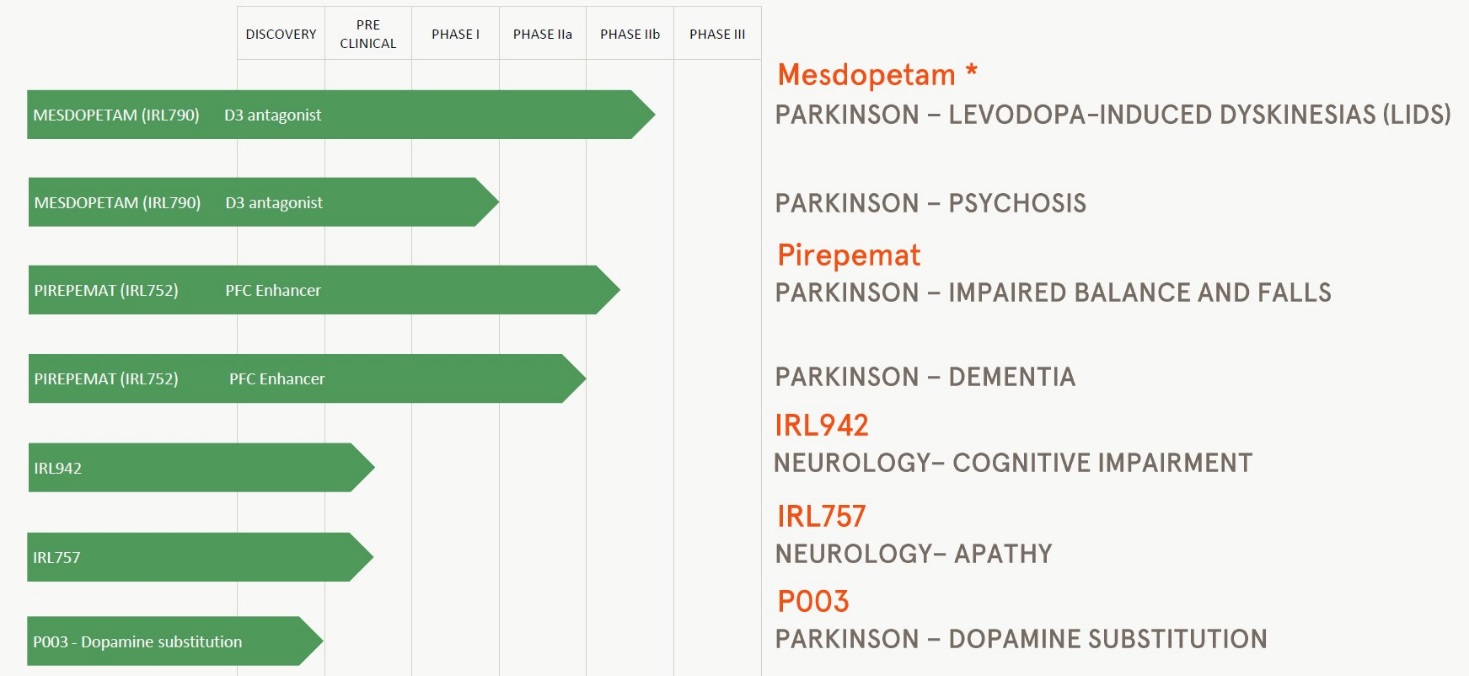
With resources freed up following the Ipsen deal, IRLAB can focus on its core research and development competencies utilising its ISP platform. During the capital markets day (CMD), it highlighted three new programmes that it expects to progress into Phase l development throughout 2023. Leading the way are IRL942 (cognitive dysfunction) and IRL757 (apathy), both with potential use in indications other than PD. These are undergoing the requisite preclinical studies to enable clearance to start clinical trials. IRLAB’s P003 programme is developing an oral, long-acting alternative to levodopa therapy for PD and candidate nomination is expected in 2022.
Valuation: SEK5.5bn or SEK106/share
Our valuation is virtually unchanged at SEK5.5bn or SEK106/share. Mesdopetam remains the largest value contributor at c SEK65/share (PD-LIDs and PD-Psychosis) with pirepemat c SEK33/share (PD-Falls). We do not currently include the early-stage, preclinical portfolio or the ISP platform in our valuation, but highlight that these could provide additional upside as additional progress is made.
Sustaining pipeline momentum
Despite focus increasingly shifting onto the rest of the pipeline, mesdopetam remains the most advanced asset in IRLAB’s pipeline and the most important near-term value driver in our view. As a quick reminder, mesdopetam is a D3 receptor antagonist being investigated in an ongoing Phase IIb trial for levodopa-induced dyskinesia (PD-LIDs). These are the troublesome, involuntary movements associated with levodopa therapy, which is the mainstay for treating the cardinal motor symptoms of Parkinson’s disease. Global rights to mesdopetam were successfully licensed to Ipsen in July 2021, with IRLAB receiving $28m upfront and remaining eligible for up to $335m in additional milestones plus low double-digit royalties on sales.
During the CMD, based on its assessment management believes the addressable PD-LIDs market to be worth c $12bn, which is broadly in line with our model albeit we only assume 10% penetration or $1.2bn peak sales. Top-line data from the ongoing Phase IIb trial are expected in H222 and will be key to defining the strategy for a subsequent registrational Phase III study, which we note will be solely led and fully funded by Ipsen. The CMD was attended by representatives from Ipsen, who reiterated the company’s intentions additionally to pursue psychosis in Parkinson’s disease (PD-Psychosis) as part of the lifecycle management, with IRLAB informing that a Phase II trial start is a decision to be made by Ipsen.
The Ipsen deal has been transformative for IRLAB and ultimately de-risked its strategy, with the upfront payment alone providing it with a cash runway into 2024 and enabling it to focus on progressing the rest of the pipeline (Exhibit 1).
|
Exhibit 1: IRLAB’s pipeline |
|
|
Source: IRLAB. Note: *Ipsen holds exclusive global licence to develop and commercialise. |
Pirepemat
Impaired balance and the increased risk of falls are motor symptoms of PD which are incredibly debilitating for patients. These represent a significant unmet medical need, are highly prevalent and not addressed by current PD treatments. Pirepemat is an innovative, first-in-class drug discovered through IRLAB’s Integrative Screening Process (ISP) and developed in house. Pirepemat is primarily an antagonist of the 5-HT7 and alpha-2 receptors, which potentially has cognitive-enhancing effects and can restore the normal function of the cerebral cortex by selectively increasing extracellular levels of the neurotransmitters, norepinephrine and dopamine. To the best of our knowledge, there are no other treatments in development with a similar mechanism of action and IRLAB estimates that it is four to five years ahead of potentially similar competitors.
The planned Phase IIb PD-Falls study is expected to start enrolling patients imminently. This will enrol c 150 patients at sites in the EU and US and will focus on recurrent fallers, which represent c 40–50% of the patient population. Pirepemat will be given orally t.i.d as an add-on therapy at one of two dose levels for 12 weeks. The primary endpoint will look at the change in frequency of falls versus placebo. Based on discussions at the CMD, a c 25% reduction in fall frequency can be considered clinically meaningful and could be considered the bar for success. The study is expected to take c 18 months to complete with top-line data becoming available in H223, after which we anticipate a licensing partner will be sought. IRLAB has guided that a pivotal Phase III study could start in 2024, which we believe could enable approval and launch in 2027, in line with our previous assumptions.
IRL942 and IRL757
Two new assets from the preclinical P001 programme have now been nominated as clinical candidates. These are undergoing the requisite preclinical work to enable regulatory clearance to start Phase I clinical trials, both of which are expected to start in 2023. IRL942 is being developed for cognitive dysfunction, which has potential use in a range of neurological disorders and dementias. This would expand the company’s therapeutic scope beyond PD into other indications, such as Alzheimer’s disease. The US Centers for Disease Control and Prevention (CDC) estimates that c 12% of all adults ≥65 years old have reported experiencing some level of cognitive decline, so this potentially represents a significant market opportunity. The exact mechanism and therapeutic target(s) of IRL942 have not yet been disclosed, but in animal models this drug has been shown to improve cognition function through activating frontal-subcortical circuits, which IRLAB believes is unique and could potentially have both symptomatic and disease-modifying benefits.
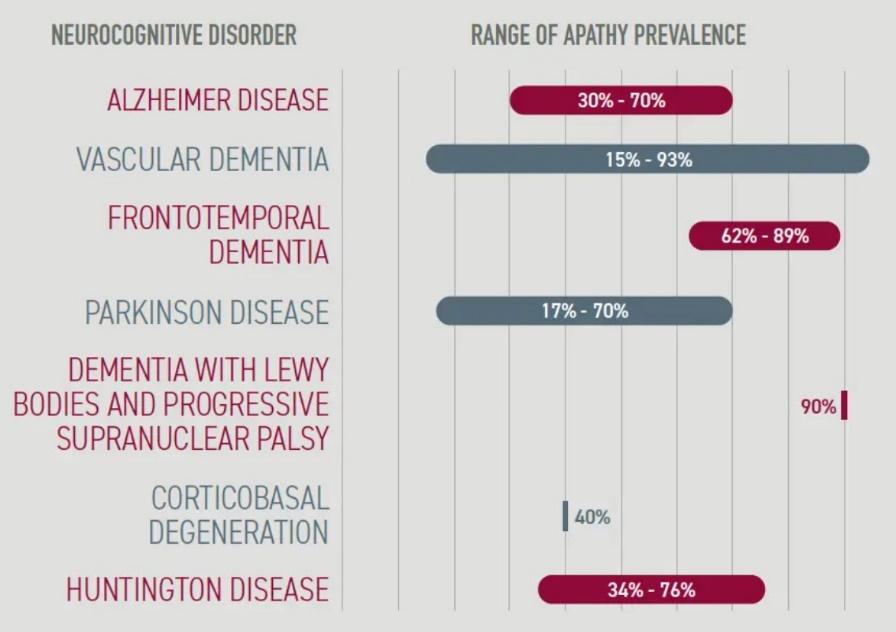
Also from its P001 programme, IRL757 was nominated as a candidate molecule for the treatment of apathy in March. Again, no mechanism or target(s) have been disclosed, but IRLAB has guided that IRL757 increases neuronal activity in frontal neurocircuits, disruption of which is associated with apathy. As highlighted in Exhibit 2, apathy is a common symptom in various neurocognitive disorders and the company believes that c 10 million people in the US, and a similar number in the EU, may be affected, with no specifically approved drug treatments. IRLAB intends to initiate Phase I trials in early Q323.
|
Exhibit 2: Prevalence rates of apathy across neurocognitive disorders |
|
P003
The company also provided an update on its preclinical P003 programme at the CMD. This is focused on the discovery of an oral, long-acting dopaminergic-based alternative to levodopa therapy for PD. Although levodopa regimens are efficacious and broadly used, in the long term their use is complicated by motor fluctuations caused by the intermittent stimulation of dopamine receptors with oral dose regimes. These become progressively harder to control as the disease progresses and the therapeutic response to levodopa can vary over time, with periods of excessive responses (including LIDs) and absent responses observed as dosing and metabolism take place.
The P003 programme aims to address these complications by producing a prolonged, optimal response over the same period, which should reduce the severity of the motor fluctuations patients experience through intermittent oral dosing (Exhibit 3). Lead optimisation work is currently ongoing in this programme and candidate nomination can be expected in 2022. The company has guided that it intends to start to a Phase I trial in 2023 that will include PD patients (in parallel to healthy volunteers), which could potentially enable some initial clinical proof-of-concept data and partnering options to become available sooner.
|
Exhibit 3: P003 objective in PD |
|
|
Source: IRLAB |
Valuation and financials
Our risk-adjusted net present value (NPV) model is virtually unchanged, and we value IRLAB at SEK5.5bn or SEK106/share (SEK5.4bn or SEK105/share previously). We have rolled forward our model in time. We forecast c $1.9bn peak sales for mesdopetam for its potential use in PD-LIDs and PD-Psychosis, contributing SEK49.1/share and SEK16.3 /share respectively. We forecast c $1bn peak sales for pirepemat in PD-Falls for SEK32.9/share. We do not currently include preclinical assets (IRL942 and IRL757), early-stage programmes (P003) or its proprietary ISP platform technology, but see potential for uplift as assets move into clinical development.
Exhibit 4: IRLAB sum-of-the-parts valuation
Product |
Indication |
Launch |
Peak sales |
Value (SEKm) |
Probability |
rNPV |
rNPV/share (SEK) |
Mesdopetam |
PD-LIDs |
2026 |
1,207 |
4,999.6 |
50% |
2,543.4 |
49.1 |
Mesdopetam |
PD-Psychosis |
2027 |
688 |
2,623.7 |
30% |
845.3 |
16.3 |
Pirepemat |
PD-Falls |
2027 |
1,036 |
5,839.0 |
30% |
1,704.8 |
32.9 |
Net cash at 31 Dec 2021 |
|
|
401.9 |
100% |
401.9 |
7.8 |
|
Valuation |
|
|
13,864.3 |
5,495.4 |
106.2 |
||
Source: Edison Investment Research
R&D costs associated with mesdopetam’s development will begin winding up over the near term with completion of the ongoing Phase IIb/III in 2022, but we expect these will be largely offset by the planned Phase IIb trial for pirepemat and progression of preclinical assets into the clinic. Based on foreseeable R&D plans, we forecast a cash runway into 2024, which will take the company through multiple value infections (Exhibit 5). We also highlight subsequent milestone payments from Ipsen (up to $335m due), which could potentially alleviate additional financing needs.
|
Exhibit 5: Near- and mid-term catalysts ahead |
|
|
Source: IRLAB. Note: FPFV = first patient first visit, TLR = top-line results |
Exhibit 6: Financial summary
Accounts: IFRS; year-end 31 December; SEK’000s |
|
|
2018 |
2019 |
2020 |
2021e* |
2022e |
PROFIT & LOSS |
|
|
|
|
|
|
|
Total revenues |
|
|
196 |
448 |
404 |
207,906 |
42,893 |
Cost of sales |
|
|
0 |
0 |
0 |
0 |
0 |
Gross profit |
|
|
196 |
448 |
404 |
207,906 |
42,893 |
Total operating expenses |
|
|
(74,093) |
(96,296) |
(91,862) |
(155,330) |
(138,078) |
Research and development expenses |
|
|
(58,927) |
(79,381) |
(75,989) |
(89,746) |
(114,746) |
EBITDA (reported) |
|
|
(72,565) |
(92,916) |
(89,202) |
56,050 |
(91,445) |
Operating income (reported) |
|
|
(73,897) |
(95,848) |
(91,458) |
52,576 |
(95,185) |
Operating margin % |
|
|
N/A |
N/A |
N/A |
N/A |
N/A |
Finance income/(expense) |
|
|
(202) |
(272) |
(195) |
(796) |
(796) |
Exceptionals and adjustments |
|
|
0 |
0 |
0 |
0 |
0 |
Profit before tax (reported) |
|
|
(74,099) |
(96,120) |
(91,653) |
51,780 |
(95,980) |
Profit before tax (normalised) |
|
|
(73,359) |
(95,121) |
(91,394) |
91,130 |
(95,721) |
Income tax expense (includes exceptionals) |
|
|
0 |
0 |
0 |
0 |
0 |
Net income (reported) |
|
|
(74,099) |
(96,120) |
(91,653) |
51,780 |
(95,980) |
Net income (normalised) |
|
|
(73,359) |
(95,121) |
(91,394) |
91,130 |
(95,721) |
Basic average number of shares, m |
|
|
38.2 |
40.6 |
47.7 |
51.7 |
51.7 |
Basic EPS (SEK) |
|
|
(1.94) |
(2.37) |
(1.92) |
1.00 |
(1.85) |
Adjusted EPS (SEK) |
|
|
(1.92) |
(2.34) |
(1.92) |
1.76 |
(1.85) |
Dividend per share (SEK) |
|
|
0.00 |
0.00 |
0.00 |
0.00 |
0.00 |
BALANCE SHEET |
|
|
|
|
|
|
|
Tangible assets |
|
|
1,197 |
5,919 |
4,317 |
8,348 |
8,582 |
Intangible assets |
|
|
83,269 |
82,270 |
82,011 |
42,661 |
42,402 |
Other non-current assets |
|
|
0 |
0 |
0 |
0 |
0 |
Total non-current assets |
|
|
84,466 |
88,189 |
86,328 |
51,009 |
50,984 |
Cash and equivalents |
|
|
134,442 |
110,527 |
277,009 |
401,897 |
264,252 |
Inventories |
|
|
0 |
0 |
0 |
0 |
0 |
Trade and other receivables |
|
|
6,028 |
9,351 |
6,732 |
19,542 |
19,542 |
Other current assets |
|
|
0 |
0 |
0 |
1 |
0 |
Total current assets |
|
|
140,470 |
119,878 |
283,741 |
421,440 |
283,794 |
Non-current loans and borrowings |
|
|
0 |
0 |
0 |
0 |
0 |
Non-current lease liabilities |
|
|
0 |
2,900 |
1,270 |
3,566 |
3,566 |
Other non-current liabilities |
|
|
0 |
0 |
0 |
0 |
0 |
Total non-current liabilities |
|
|
0 |
2,900 |
1,270 |
3,566 |
3,566 |
Accounts payable |
|
|
5,997 |
8,438 |
3,683 |
4,634 |
5,521 |
Non-current loans and borrowings |
|
|
0 |
0 |
0 |
0 |
0 |
Current lease liabilities |
|
|
0 |
1,643 |
1,657 |
3,034 |
3,034 |
Other current liabilities |
|
|
6,463 |
13,259 |
15,578 |
19,158 |
19,158 |
Total current liabilities |
|
|
12,460 |
23,340 |
20,918 |
26,826 |
27,713 |
Equity attributable to company |
|
|
212,476 |
181,826 |
347,879 |
399,480 |
303,500 |
CASH FLOW STATEMENT |
|
|
|
|
|
|
|
Operating income |
|
|
(73,897) |
(95,848) |
(91,458) |
52,576 |
(95,185) |
Depreciation and amortisation |
|
|
1,332 |
2,932 |
2,256 |
3,474 |
3,740 |
Share based payments |
|
|
0 |
0 |
0 |
0 |
0 |
Other adjustments |
|
|
(202) |
(244) |
(195) |
38,295 |
(796) |
Movements in working capital |
|
|
1,977 |
1,959 |
183 |
34,296 |
(41,689) |
Cash from operations (CFO) |
|
|
(70,790) |
(91,201) |
(89,214) |
128,641 |
(133,930) |
Capex |
|
|
(1,052) |
(137) |
(394) |
(708) |
(551) |
Acquisitions & disposals net |
|
|
0 |
0 |
0 |
0 |
0 |
Other investing activities |
|
|
0 |
0 |
0 |
0 |
0 |
Cash used in investing activities (CFIA) |
|
|
(1,052) |
(137) |
(394) |
(708) |
(551) |
Net proceeds from issue of shares |
|
|
131,575 |
68,970 |
257,706 |
(180) |
0 |
Movements in debt |
|
|
0 |
(1,547) |
(1,616) |
(2,865) |
0 |
Other financing activities |
|
|
0 |
0 |
0 |
0 |
(3,164) |
Cash from financing activities (CFF) |
|
|
131,575 |
67,423 |
256,090 |
(3,045) |
(3,164) |
Cash and equivalents at beginning of period |
|
|
74,709 |
134,442 |
110,527 |
277,009 |
401,897 |
Increase/(decrease) in cash and equivalents |
|
|
59,733 |
(23,915) |
166,482 |
124,888 |
(137,645) |
Effect of FX on cash and equivalents |
|
|
0 |
0 |
0 |
0 |
0 |
Cash and equivalents at end of period |
|
|
134,442 |
110,527 |
277,009 |
401,897 |
264,252 |
Net (debt)/cash |
|
|
134,442 |
110,527 |
277,009 |
401,897 |
264,252 |
Source: Company accounts, Edison Investment Research. Note: *Based on unaudited numbers.
|
|
Research: Industrials
Pyrum Innovations has developed a patented pyrolysis technology that extracts recovered carbon black and oil from end-of-life tyres that is of sufficiently high quality to be used as raw material for making new tyres. The company has been operating an industrial-scale plant since May 2020 and intends to increase capacity across a portfolio of plants, some jointly owned with partners, to 130,000 tonnes of used tyres a year by end 2025.