Last close As at 05/08/2026
GBP3.17
▲ 1.50 (0.48%)
Market capitalisation
GBP2,914m
Research: Investment Companies
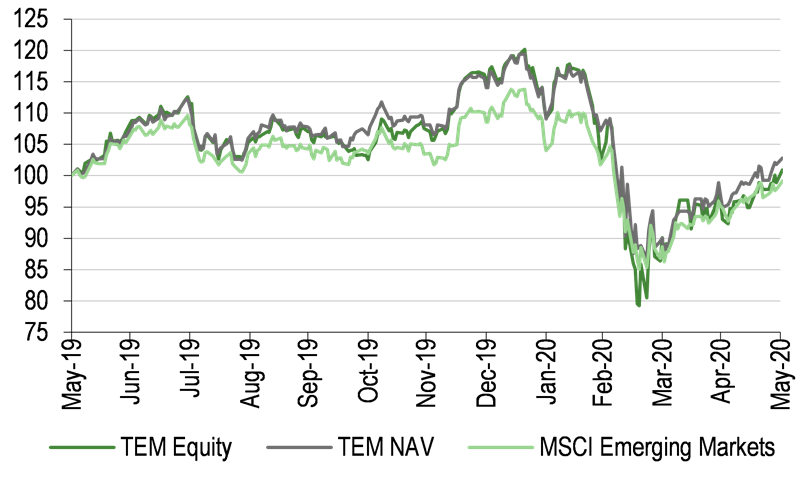
Templeton Emerging Markets Investment Trust’s (TEMIT) two managers have more than 50 years’ combined investment experience. Chetan Sehgal is based in Singapore and Andrew Ness is based in Edinburgh; they are part of a more than 80-strong team of portfolio managers and analysts across 16 countries around the globe. The trust’s relative performance was negatively affected during the coronavirus-led market sell-off earlier in 2020 but has since bounced back strongly. TEMIT has outperformed its benchmark, the MSCI Emerging Markets index, over the last one, three, five and 10 years in both NAV and share price terms.
Templeton Emerging Markets IT |
Long-term record of outperformance |
Investment trusts |
18 June 2020 |
Share price/discount performance
Three-year performance vs index
Gearing
Analysts
|
|||||||||||||||||||||||||||||||||||||||||||||||||||||||||||||||||||||||||||||||||||||||||||
Templeton Emerging Markets Investment Trust’s (TEMIT’s) two managers have more than 50 years’ combined investment experience. Chetan Sehgal is based in Singapore and Andrew Ness is based in Edinburgh; they are part of a more than 80-strong team of portfolio managers and analysts across 16 countries around the globe. The trust’s relative performance was negatively affected during the coronavirus-led market sell-off earlier in 2020 but has since bounced back strongly. TEMIT has outperformed its benchmark, the MSCI Emerging Markets index, over the last one, three, five and 10 years in both NAV and share price terms.
|
Navigating the market volatility in 2020 – NAV outperformed the benchmark over 12 months to end-May |
|
|
Source: Refinitiv, Edison Investment Research |
The market opportunity
The COVID-19 outbreak has brought significant equity market volatility in 2020, and its ultimate economic effects will take time to unfold. In such an uncertain environment, a focus on high-quality, well-financed businesses with strong management teams may help steer investors through what are likely to be continued choppy waters.
Why consider investing in TEMIT?
■
Well-established emerging market equity fund, diversified by sector, geography and market cap.
■
Highly experienced managers, supported by a very well-resourced investment team.
■
Outperformance of the market over one, three, five and 10 years, and of the peer group average over one, three and five years.
■
High level of revenue reserves, an important consideration when corporate dividends are under pressure.
Discount broadly in line with historical averages
TEMIT’s current 11.6% discount to cum-income NAV is broadly in line with the 10.3% to 12.1% range of average discounts over the last one, three, five and 10 years. Over the last 12 months the trust has traded in a range of discounts from 8.7% to a decade-wide 19.9%. TEMIT has meaningfully grown its annual dividends in recent years and currently offers a 2.5% yield.
Exhibit 1: Trust at a glance
Investment objective and fund background |
Recent developments |
||||||||||||||||||||||||||||||||||||||||||||||||||||||||||||||||||||||
Launched in June 1989, TEMIT was one of the first emerging markets funds in the UK. The trust seeks long-term capital appreciation through investment in companies operating in emerging markets, or listed on the stock markets of such countries. This may include companies that have a significant amount of their revenues in emerging markets, but which are listed on stock exchanges in developed countries. Performance is benchmarked against the MSCI Emerging Markets Index. |
■ 4 June 2020: Annual report to 31 March 2020. NAV TR -11.2% versus benchmark TR -13.2%. Share price TR -12.1%. Announcement of 14.0p final dividend (+27.3% year-on-year). ■ 28 May 2020: Announcement of £26.5m tax refund from HMRC (equivalent to 1.37% of NAV). ■ 31 January 2020: Announcement of amended debt facility (see page 8). |
||||||||||||||||||||||||||||||||||||||||||||||||||||||||||||||||||||||
Forthcoming |
Capital structure |
Fund details |
|||||||||||||||||||||||||||||||||||||||||||||||||||||||||||||||||||||
AGM |
July 2020 |
Ongoing charges |
1.02% |
Group |
Templeton Asset Management |
||||||||||||||||||||||||||||||||||||||||||||||||||||||||||||||||||
Interim results |
November 2020 |
Net cash |
1.7% |
Managers |
Chetan Sehgal and Andrew Ness |
||||||||||||||||||||||||||||||||||||||||||||||||||||||||||||||||||
Year end |
31 March |
Annual mgmt fee |
Tiered (see page 8) |
Address |
5 Morrison Street, Edinburgh, |
||||||||||||||||||||||||||||||||||||||||||||||||||||||||||||||||||
Dividend paid |
July and January |
Performance fee |
None |
||||||||||||||||||||||||||||||||||||||||||||||||||||||||||||||||||||
Launch date |
12 June 1989 |
Trust life |
Indefinite (subject to vote) |
Phone |
+44 (0)871 384 2505 |
||||||||||||||||||||||||||||||||||||||||||||||||||||||||||||||||||
Continuation vote |
Five yearly (next in 2024) |
Loan facilities |
£220m |
Website |
|||||||||||||||||||||||||||||||||||||||||||||||||||||||||||||||||||
Dividend policy and history (financial years) |
Share buyback policy and history (financial years) |
||||||||||||||||||||||||||||||||||||||||||||||||||||||||||||||||||||||
FY18 dividend was boosted by a change in fee allocations. Dividends were historically paid annually in July, but starting in FY19, are paid twice a year in July and January. |
Subject to annual renewal, TEMIT is authorised to repurchase up to 14.99% and allot up to 5% of its issued ordinary shares. |
||||||||||||||||||||||||||||||||||||||||||||||||||||||||||||||||||||||
|
|
||||||||||||||||||||||||||||||||||||||||||||||||||||||||||||||||||||||
Shareholder base (as at 21 May 2020) |
Portfolio exposure by geography (as at 31 May 2020) |
||||||||||||||||||||||||||||||||||||||||||||||||||||||||||||||||||||||
|
|
||||||||||||||||||||||||||||||||||||||||||||||||||||||||||||||||||||||
Top 10 holdings (as at 31 May 2020) |
|||||||||||||||||||||||||||||||||||||||||||||||||||||||||||||||||||||||
|
|||||||||||||||||||||||||||||||||||||||||||||||||||||||||||||||||||||||
Source: Templeton Emerging Markets Investment Trust, Edison Investment Research, Bloomberg, Morningstar. Note: *N/A where not in end-May 2019 top 10.
Market outlook: Focus on quality warranted
The performance of indices (in sterling) over the last five years is shown in Exhibit 2 (LHS). Emerging market equities have outperformed UK shares over the period but have been unable to keep up with global indices, which are dominated by the US, a market that has been relatively strong over the last few years.
Long-term structural growth trends in emerging markets remain intact, including an expanding educated middle class with higher levels of disposable income, and robust infrastructure spending. However, the coronavirus pandemic has seriously affected recent economic activity across the globe, despite supportive monetary and fiscal policies aiming to mitigate the negative effects of the virus outbreak.
In the chart below (RHS), we show a range of valuation multiples; emerging market equities look relatively attractive on these measures, although investors should remain wary about the absolute figures as corporate earnings estimates are in a state of flux and some dividend payments are under threat. Given the uncertain backdrop and the fact that some businesses will be permanently impaired by the effects of COVID-19, investors are likely to be well served by focusing on high-quality businesses, with strong balance sheets and competent management teams, that will be able to come out the other side of the current crisis.
|
Exhibit 2: Market performance and valuation |
|
Performance of indices in £ (last five years) |
Valuation metrics (as at 31 May 2020) |
|
|
|
Source: Refinitiv, Edison Investment Research, MSCI |
|
Fund profile: Broad exposure to emerging markets
TEMIT was launched in June 1989 and is the UK’s largest emerging markets trust. While most of its shareholders are based in this country, TEMIT’s shares are quoted on both the London and New Zealand stock exchanges. It is managed by Franklin Templeton Emerging Markets Equity (FTEME), which has c $23bn of assets under management.
The trust’s managers are Chetan Sehgal (lead manager since 1 February 2018, 27 years’ investment experience, based in Singapore) and Andrew Ness (joined FTEME in September 2018, 25 years’ investment experience, based in Edinburgh). They aim to generate long-term capital growth by investing in companies listed in emerging markets or those listed in developed markets that earn a significant amount of their revenues in emerging markets. TEMIT’s performance is measured against the MSCI Emerging Markets Index. In order to mitigate risk, at the time of investment, a maximum 10% of assets may be invested in a single issuer. Gearing of up to 10% of NAV is permitted; at the end of May 2020, the trust had a 1.7% net cash position.
Data from FTEME show that since launch to end-FY20 (31 March), TEMIT's NAV total return was +2,963.9% compared to the benchmark’s +1,308.7% total return.
The fund managers: Chetan Sehgal and Andrew Ness
The manager’s view: Part of a strong investment team
Sehgal highlights the strength of the FTEME team, saying that while COVID-19 has been a test of remote working, things are going well. Team members are undertaking many company and industry meetings and ‘engagement is at an all-time high’. The manager says that companies appear comfortable with remote meetings, which have proved ‘equally good’ as face-to-face interactions. Sehgal notes that there were significant changes to the FTEME investment team following the departure of TEMIT’s prior manager in early 2018; however, there have been a series of new hires to fill the available roles, including increased resources covering China, and ‘we now have a very strong team on the research side’, he adds.
The manager’s philosophy is that economic earnings, rather than dividends, valuation or currencies, are the primary driver of share prices in emerging markets. He believes that mispriced quality companies can be identified via thorough fundamental analysis. Comparing TEMIT with some of its peers, Sehgal says its portfolio is very valuation oriented and ‘well rounded’, and he is not prepared to chase stocks with strong share price momentum. He says that over time, companies generating higher-than-average returns on invested capital tend to outperform the broader market, hence it is important to monitor companies continuously to ensure that they are not ‘losing their edge’. The manager highlights TEMIT’s top two holdings in Taiwan Semiconductor Manufacturing (TSMC) and Samsung Electronics, suggesting that ‘they have maintained their leadership and are reasonably immune to the US-China trade conflict’.
Commenting on the current investment backdrop, Sehgal says the outlook for the global economy is highly uncertain, and it is difficult to assess the negative impact of the COVID-19 pandemic on growth and corporate earnings in the short term. However, he argues that TEMIT’s focus on long-term sustainable earnings power should help the fund navigate the coming months, and that over time, he expects the fundamentals of the trust’s holdings to remain intact. The manager comments that the FTEME team are ‘no strangers to crisis and are experienced in investing through highly volatile periods, including the Asian and global financial crises’. He adds that ‘this period will pass; history has shown us that economies and markets will eventually stabilise and recover’.
Asset allocation
Investment process: Bottom-up stock selection
Sehgal and Ness are able to draw on the considerable resources of FTEME’s investment team, which includes more than 80 analysts and portfolio managers in 16 offices around the globe, providing very good access to company managements and other important contacts. They are keen to stress that in recent years the levels of collaboration and communication within the team have been improved. There are regular meetings, both formal and informal, and all analysts and portfolio managers are expected to contribute to investment returns.
The managers aim to achieve long-term capital growth by investing in companies with sustainable growth, strong management teams and sound governance, which are trading at a discount to their intrinsic value. Sehgal believes that given the wide dispersion of returns between companies in emerging markets, the managers can ‘add alpha via stock selection, which trumps sector and geographic selection’.
There is a three-stage investment process of idea generation, stock research and portfolio construction, and consideration of a company’s environmental, social and governance (ESG) track record is a very important element of stock selection. FTEME’s investment team undertakes around 2,000 to 2,500 company interactions each year, meeting with management teams, touring facilities, and meeting suppliers, clients and competitors, to help determine a company’s intrinsic value. Risk management is embedded across all three stages of the process and includes an independent risk review. TEMIT’s portfolio is diversified by geography, sector and market cap, and has 70 to 100 holdings selected from an investible universe of more than 750 companies. Its active share typically ranges from 70% to 85% (this is a measure of how a fund differs from its benchmark, with 0% representing full index replication and 100% indicating no commonality).
While the managers invest on a bottom-up basis, a series of themes is represented in the portfolio: technology – opportunities in the areas of e-commerce, disruption and data; emerging market consumers – under-penetration of products and services, and demand for higher-end products; all-cap opportunities – more than 15% of the portfolio is invested in companies with market caps of less than $5bn; and corporate governance – companies are adopting better standards, including higher levels of reporting and engagement with shareholders, and improving capital allocation which, over time, should make emerging market equities more attractive to international investors.
Current portfolio positioning
At end-May 2020, TEMIT’s top 10 holdings made up 52.7% of the portfolio, which was a higher concentration compared with 42.5% a year earlier; nine positions were common to both periods.
The trust’s sector breakdown is shown in Exhibit 3. The most significant weighting changes over the 12 months to the end of May were a higher exposure to communication services (+9.1pp) and a lower exposure to financials (-8.2pp). Compared with the benchmark, the largest deviations are overweight positions in communication services (+7.0pp) and technology (+6.2pp).
Exhibit 3: Portfolio sector exposure vs benchmark (% unless stated)
Portfolio end-May 2020 |
Portfolio end-May 2019 |
Change |
Index |
Active weight |
Trust weight/ |
|
Information technology |
22.9 |
20.2 |
2.7 |
16.7 |
6.2 |
1.4 |
Communication services |
20.0 |
10.9 |
9.1 |
13.0 |
7.0 |
1.5 |
Consumer discretionary |
19.3 |
19.8 |
(0.5) |
15.9 |
3.4 |
1.2 |
Financials |
18.4 |
26.6 |
(8.2) |
20.2 |
(1.8) |
0.9 |
Consumer staples |
5.4 |
7.8 |
(2.4) |
6.7 |
(1.3) |
0.8 |
Energy |
4.8 |
8.7 |
(3.9) |
6.4 |
(1.6) |
0.8 |
Materials |
3.7 |
3.1 |
0.6 |
7.1 |
(3.4) |
0.5 |
Industrials |
2.0 |
2.8 |
(0.8) |
5.0 |
(3.0) |
0.4 |
Healthcare |
1.8 |
1.9 |
(0.1) |
3.8 |
(2.0) |
0.5 |
Utilities |
0.0 |
0.0 |
0.0 |
2.5 |
(2.5) |
0.0 |
Real estate |
0.0 |
0.0 |
0.0 |
2.7 |
(2.7) |
0.0 |
Other net assets |
1.7 |
(1.8) |
3.5 |
0.0 |
1.7 |
N/A |
100.0 |
100.0 |
100.0 |
Source: Templeton Emerging Markets Investment Trust, Edison Investment Research
In terms of TEMIT’s geographic exposure (Exhibit 4), the largest changes to the end of May are higher weightings to China/Hong Kong (+8.3pp) and South Korea (+4.8pp), with a lower weighting to South Africa (-4.0pp).
Exhibit 4: Portfolio geographic exposure (% unless stated)
Portfolio end-May 2020 |
Portfolio end-May 2019 |
Change (pp) |
|
China/Hong Kong |
32.1 |
23.8 |
8.3 |
South Korea |
18.1 |
13.3 |
4.8 |
Taiwan |
11.4 |
9.2 |
2.2 |
Russia |
7.8 |
9.9 |
(2.1) |
Brazil |
6.9 |
9.9 |
(3.0) |
India |
5.8 |
8.1 |
(2.3) |
South Africa |
3.0 |
7.0 |
(4.0) |
UK |
3.0 |
3.5 |
(0.5) |
Thailand |
2.1 |
4.0 |
(1.9) |
US |
1.9 |
3.3 |
(1.4) |
Other |
7.9 |
8.0 |
(0.1) |
100.0 |
100.0 |
Source: Templeton Emerging Markets Investment Trust, Edison Investment Research
A recent addition to the portfolio is Tencent Music Entertainment, which is a leader in online music streaming in China. The managers believe that this company benefits from the extensive platform of its parent, internet giant Tencent Holdings. Tencent Music has a large user base and there is the potential for the firm to monetise its business.
Looking back at some of the less recent purchases and sales, the managers initiated positions in Prosus (a spin-off from Naspers), Samsung Life Insurance (attractive valuation) and Vale (resilient iron ore price, and ‘compelling value’). Three positions sold were PT Bank Danamon Indonesia, China Construction Bank Corporation and Compañia de Minas Buenaventura.
Performance: Outperformance in FY20
Exhibit 5: Five-year discrete performance data
12 months ending |
Share price |
NAV |
MSCI Emerging |
MSCI World |
CBOE UK All Companies (%) |
31/05/16 |
(16.2) |
(14.5) |
(13.3) |
1.3 |
(5.8) |
31/05/17 |
56.0 |
54.8 |
44.2 |
32.0 |
24.4 |
31/05/18 |
6.4 |
7.8 |
11.0 |
8.8 |
6.6 |
31/05/19 |
6.7 |
1.0 |
(3.2) |
5.9 |
(3.4) |
31/05/20 |
(1.1) |
1.8 |
(2.2) |
9.5 |
(12.0) |
Source: Refinitiv. Note: All % on a total return basis in pounds sterling.
|
Exhibit 6: Investment trust performance to 31 May 2020 |
|
Price, NAV and benchmark total return performance, one-year rebased |
Price, NAV and benchmark total return performance (%) |
|
|
|
Source: Refinitiv, Edison Investment Research. Note: Three-, five- and 10-year performance figures annualised. |
|
Having been in positive territory for the first nine months of FY20, following the coronavirus-led market weakness, TEMIT ended the financial year to 31 March with NAV and share price total returns of -11.2% and -12.1% respectively, which were ahead of the benchmark’s -13.2% total return. The top three contributors to relative returns were TSMC (+1.1pp), NAVER (+1.0pp) and Tencent (0.9pp). TSMC is one of the world's leading semiconductor makers and posted solid revenue and earnings growth in Q319 and Q419. It benefited from better-than-expected sales of Apple’s latest iPhone, and in the future there are growth opportunities from the roll-out of 5G networks. NAVER is South Korea's largest internet search engine. Its shares rallied following the announced merger of its subsidiary Line Corporation, the largest messenger app in Japan, with Yahoo! Japan. The company also plans to spin off its digital payments unit, NAVER Pay, to form a financial services company and a roadmap for the monetisation of the NAVER Webtoon (digital comic) publishing portal was also viewed favourably by investors. Tencent is one of the largest internet services companies in China, providing online gaming, social network, fintech, cloud and other entertainment-related services. The company reported solid Q420 corporate results, with double-digit revenue and earnings growth driven by strong performances in its online gaming, advertising, fintech and cloud operations. The three largest detractors to TEMIT’s relative performance in FY20 were all banks, due to concerns about the COVID-19 pandemic: Banco Bradesco (-0.7pp); Banco Santander Mexico (-0.7pp); and Itaú Unibanco (-0.6pp).
|
Exhibit 7: Share price and NAV total return performance, relative to indices (%) |
|||||||
|
One month |
Three months |
Six months |
One year |
Three years |
Five years |
10 years |
Price relative to MSCI Emerging Markets |
0.3 |
0.3 |
(2.8) |
1.1 |
6.8 |
11.7 |
1.3 |
NAV relative to MSCI Emerging Markets |
2.3 |
(1.3) |
(0.5) |
4.0 |
5.3 |
11.6 |
6.3 |
Price relative to MSCI World |
(3.6) |
(7.6) |
(7.4) |
(9.7) |
(11.0) |
(13.0) |
(47.9) |
NAV relative to MSCI World |
(1.7) |
(9.0) |
(5.1) |
(7.0) |
(12.2) |
(13.1) |
(45.3) |
Price relative to CBOE UK All Companies |
0.1 |
5.2 |
10.7 |
12.4 |
23.9 |
38.2 |
(12.5) |
NAV relative to CBOE UK All Companies |
2.1 |
3.5 |
13.4 |
15.7 |
22.2 |
38.0 |
(8.2) |
|
Source: Refinitiv, Edison Investment Research. Note: Data to end-May 2020. Geometric calculation. |
|||||||
TEMIT’s relative returns are shown in Exhibit 7; it has outperformed its benchmark over the last one, three, five and 10 years in both NAV and share price terms. The trust has also meaningfully outperformed the broad UK market over the last one, three and five years. Commenting on recent portfolio performance, Sehgal says that TEMIT had a ‘terrible March, but bounced back in April and May’. During the market sell-off, the trust’s performance was particularly negatively affected by an increased exposure to Brazil, a collapse in the oil price, and its holdings in banks.
|
Exhibit 8: NAV total return performance relative to benchmark over three years |
|
|
Source: Refinitiv, Edison Investment Research |
Capital structure and fees
TEMIT is a conventional investment trust with one class of share; there are currently 240.3m ordinary shares in issue. Prior to 31 January 2020, it had a £220m three-year unsecured multicurrency (sterling, US dollars and Chinese renminbi) revolving credit facility (RCF) with Scotiabank; on that date, the terms were amended and restated. TEMIT now has two debt facilities, both with the existing lender – a £120m three-year multi-currency RCF expiring on 31 January 2023 and a £100m, 2.089%, sterling fixed-rate term loan maturing on 31 January 2025. Interest on the RCF will be based on market rates at the time of drawdown and may be in sterling, US dollars or Chinese renminbi; the maximum amount of renminbi that may be drawn down is 45% of the £220m total debt facility. The board believes that it is an opportune time to extend TEMIT’s debt facilities given its positive view on the long-term outlook for emerging markets and current low interest rates. At end-May 2020, the trust had a net cash position of 1.7%. Gearing is used tactically, and Sehgal says that he ‘wants enough ammunition available if markets are volatile’.
FTEME is currently paid an annual management fee of 1.0% of net assets up to £1bn and 0.85% of net assets above this level; no performance fee is payable. From 1 July 2020, the rate on net assets above £1bn will be reduced from 0.85% to 0.80%. In FY20, TEMIT’s ongoing charges were 1.02%, which was in line with FY19.
TEMIT is subject to a five-yearly continuation vote, with the next due at the July 2024 AGM (the July 2019 vote was passed by a 99.95% majority). In May 2019, the board announced a five-year, performance-related conditional tender offer, subject to the next continuation vote being passed. If the trust’s NAV performance lags its benchmark in the five years ending 31 March 2024, the board, at its discretion, will undertake a tender offer for up to 25% of TEMIT’s shares in issue, at a price equivalent to the prevailing NAV minus 2% and the costs of the offer.
Dividend policy and record
In FY20, TEMIT received revenue earnings of 21.80p per share, which was 26.3% higher than 17.26p per share in FY19. This excludes 2.60p per share received as a special dividend in H120 from Brilliance China Automotive, which was distributed to the trust’s shareholders with the interim dividend in January 2020. TEMIT’s total ordinary dividends of 19.00p per share in FY20 were 18.8% higher year-on-year.
It should be noted that the vast majority of the trust’s revenue earnings were received before the full effects of the COVID-19 pandemic became apparent. However, while TEMIT focuses on capital growth rather than targeting a particular level of income, the board notes that the trust’s substantial revenue reserves (equivalent to more than 2.5x the last annual dividend payment) will enable the level of ordinary dividends at least to be maintained for the foreseeable future. Based on its current share price, TEMIT offers a 2.5% dividend yield.
Peer group comparison
TEMIT is the largest of the 15 funds in AIC Global Emerging Markets sector by quite some margin. In Exhibit 10 we show the largest eight, with market caps greater than £200m. TEMIT’s NAV total returns are above average over one, three and five years, ranking first, second and second respectively. Indeed, it is one of only two funds to have generated a positive total return over the last 12 months. Over the last decade, TEMIT ranks third out of five funds. Its discount on the date shown in the table is modestly wider than average, in a group where none of the funds is trading at a premium. The trust has a competitive ongoing charge, is currently ungeared, and has a dividend yield that is modestly below the mean.
Exhibit 10: Selected global emerging markets peer group as at 17 June 2020*
% unless stated |
Market cap (£m) |
NAV TR |
NAV TR |
NAV TR |
NAV TR |
Discount (cum fair) |
Ongoing charge |
Perf. |
Net gearing |
Dividend yield |
Templeton Emerging Markets IT |
1,821.4 |
4.3 |
16.6 |
65.1 |
70.4 |
(12.4) |
1.0 |
No |
100 |
2.5 |
Aberdeen Emerging Markets |
239.0 |
(1.9) |
3.2 |
40.3 |
50.1 |
(17.4) |
1.1 |
No |
100 |
0.0 |
BlackRock Frontiers |
232.6 |
(21.1) |
(19.1) |
12.7 |
|
(5.6) |
1.4 |
Yes |
112 |
5.4 |
Fundsmith Emerging Equities Trust |
284.4 |
(4.1) |
6.3 |
27.3 |
|
(12.4) |
1.4 |
No |
100 |
0.3 |
Genesis Emerging Markets Fund |
857.6 |
(2.5) |
5.9 |
39.1 |
59.9 |
(11.8) |
1.1 |
No |
100 |
2.1 |
JPMorgan Emerging Markets |
1,160.3 |
2.7 |
22.3 |
73.2 |
105.7 |
(8.5) |
1.0 |
No |
100 |
1.4 |
JPMorgan Global EM Income |
326.2 |
(6.8) |
4.5 |
37.4 |
|
(9.7) |
1.3 |
No |
107 |
4.6 |
Utilico Emerging Markets |
401.4 |
(17.8) |
(6.6) |
18.1 |
85.6 |
(14.5) |
1.1 |
Yes |
101 |
4.2 |
Average (8 trusts) |
665.4 |
(5.9) |
4.1 |
39.1 |
74.3 |
(11.5) |
1.2 |
103 |
2.6 |
|
TEM rank in peer group |
1 |
1 |
2 |
2 |
3 |
5 |
8 |
4= |
4 |
Source: Morningstar, Edison Investment Research. Note: *Performance as at 16 June 2020 based on ex-par NAVs. TR = total return. Net gearing is total assets less cash and equivalents as a percentage of net assets.
The board
There are currently six directors on TEMIT’s board, five of whom are independent. Chairman Paul Manduca joined the board on 1 August 2015 and assumed his current role on 20 November 2015. The other four independent directors and their dates of appointment are: Beatrice Hollond (senior independent director, 1 April 2014); Simon Jeffreys (15 July 2016); David Graham (1 September 2016); and Charlie Ricketts (12 July 2018). Gregory Johnson is TEMIT’s non-independent director; he is chairman and CEO of Franklin Resources (FTEME’s parent) and joined the board on 12 December 2007. Johnson has announced his intention to stand down at the July 2020 AGM, which will mean TEMIT’s board is fully independent.
|
|
In terms of the Formula One racing performance, 2019 was another challenging year on the track as well as financially. Williams also disposed of a majority stake in Williams Advanced Engineering (WAE) on 31 December 2019 for £37.8m. The 2020 racing season is being severely disrupted by COVID-19, the relationship with the ROK Group of companies is being terminated early and new bank facilities have been secured. On 29 May 2020, the company started a strategic review and entered a formal sale process under the UK’s Takeover Code