Last close As at 05/08/2026
GBP2.02
▲ 3.00 (1.51%)
Market capitalisation
GBP183m
Research: Investment Companies
UIL Limited’s (UIL’s) value-focused manager, Charles Jillings, is supported by a seasoned global team of sector specialists. The company has experienced a difficult spell of relative performance during a period of economic uncertainty and stock market volatility. Also, growth stock valuation multiples have come under pressure due to rising interest rates. However, the manager has high conviction that over the longer term significant value can be realised from UIL’s portfolio companies. Financial companies Resimac and Waverton Investment Management are the two largest exposures in the fund. Despite robust fundamentals, Resimac’s share price has languished and Jillings considers its 5.6x P/E multiple and 8.7% dividend yield to be very appealing.
UIL |
Investing for long-term value creation |
Investment companies |
3 October 2023 |
Analyst
|
||||||||||||||||||||||||||||||||||||||||||||||||||||||||||||||||||||||||||||||||||||||||||||||||||||||
UIL Limited’s (UIL’s) value-focused manager, Charles Jillings, is supported by a seasoned global team of sector specialists. The company has experienced a difficult spell of relative performance during a period of economic uncertainty and stock market volatility. Also, growth stock valuation multiples have come under pressure due to rising interest rates. However, the manager has high conviction that over the longer term significant value can be realised from UIL’s portfolio companies. Financial companies Resimac and Waverton Investment Management are the two largest exposures in the fund. Despite robust fundamentals, Resimac’s share price has languished and Jillings considers its 5.6x P/E multiple and 8.7% dividend yield to be very appealing.
|
Higher growth potential in emerging and developing economies |
|
|
Source: International Monetary Fund World Economic Outlook July 2023, Edison Investment Research. Note: e is estimated, p is projected. |
Why consider UIL?
UIL has a unique portfolio of what the manager believes are undervalued assets. While its performance is measured against that of the UK stock market, investors interested in a mainstream UK equity fund should look elsewhere. The company has an eclectic mix of investments as evidenced by its geographic and sector weightings. In terms of geography, there is a large, c 41% exposure to Australia followed by a c 18% allocation to the UK. Looking at the company’s sector allocations, the vast majority are concentrated in three areas, which make up c 83% of the portfolio: financial services (c 43%), technology (c 23%) and resources and gold mining (c 17%). Most of the portfolio (around 70%) is made up of platforms, which are collective investment companies, with the remaining around 30% held in direct investments.
Not only is UIL trading at a wide discount, an investor in the company also effectively receives a ‘double discount’. As examples, at end-August 2023, number two holding, Zeta Resources (17.0% of the fund), was trading at a 21.8% discount to net tangible assets, while number three holding, Utilico Emerging Markets Trust (12.3% of the fund), was trading at a 13.9% discount to NAV. Generally, investment company discounts across the board have widened in an environment of higher-than-average investor risk aversion. Therefore, a positive change in sentiment, maybe in response to less economic uncertainty in global markets, could lead to a material uplift in UIL’s share price.
UIL: A high-conviction, unique portfolio
UIL is a unique closed-end investment company, offering investors a range of assets from around the globe that Jillings believes are undervalued. They broadly reflect his three medium-term views: the world’s financial markets are over indebted; technological change offers strong investment upside; and emerging markets offer better GDP growth opportunities than developed markets.
To provide some context, UIL’s performance is compared with that of the broad UK market. In Exhibit 1 we illustrate the company’s upside/downside capture versus the CBOE UK All Companies Index over the last decade. The upside capture is 85% and the downside capture is 101%. This suggests that the fund does not keep up with the UK market when share prices are rising, but fully participates when share prices fall. Substituting the CBOE UK All Companies index with the MSCI AC World Index, the upside capture is not dissimilar at 78%, however the downside capture is much larger at 129%, suggesting that when global shares fall, UIL will underperform. While this data is useful to know, Jillings and his team avoid market noise, investing in assets where they have high conviction in long-term value creation.
|
Exhibit 1: UIL’s upside/downside capture over the last decade |
|
|
Source: Refinitiv, Edison Investment Research. Note: Cumulative upside (downside) capture calculated as the geometric average NAV TR of the fund during months with positive (negative) benchmark total returns, divided by the geometric average benchmark total return during these months. A 100% upside (downside) indicates that the fund’s TR was in line with the benchmark’s during months with positive (negative) returns. |
Macroeconomic themes affecting UIL’s portfolio
■
Geopolitics and globalisation – increased political tensions and populism are leading to the unwinding of global supply chains that have been built up over several decades. Protectionism is leading to higher tariffs and trade barriers, which is negatively affecting global GDP and increasing frictions, notably between the US and China.
■
Resources – growth in electric vehicles and renewable energy is driving long-term demand for certain commodities. Negative interest rate policies have led to inflation, supporting gold as a store of value. Energy price inflation is largely due to underinvestment in fossil fuels and sanctions on Russian exports. Demand for industrial commodities remains high following supply chain disruptions during the COVID-19 pandemic.
■
Digitalisation – a broad range of opportunities including 5G mobile and broadband fibre roll-out, innovative fintech solutions and the increased use of connected sensors, cloud storage and data processing with machine learning techniques.
■
Financials and artificial intelligence (AI) – high demand for non-traditional financial service products from an increasingly tech-savvy population. Individuals are now having to take on more responsibility for their savings and investments. Digitalisation and the use of big data and AI are making financial products more efficient.
■
Governance and transparency – corporates with strong governance tend to outperform over the long term, while countries with robust regulatory systems are more attractive to investors. Reputational risk is becoming as important as financial risk, while opaque businesses are facing increased scrutiny. Cyber crime is now more prevalent; hence, the increased importance of consumer data protection.
■
Environmental policy – climate change and the need to address emissions have moved higher up on the global agenda. Important areas of development include renewable energy, electric vehicles, battery storage and waste treatment. These businesses are increasingly becoming economic without the need for subsidies. Increased urbanisation brings more air and water pollution and associated health and economic risks.
■
Emerging markets, urbanisation and a rising middle class – major infrastructure projects are required to support the urbanisation trend, including roads, railways, electricity and sanitation. A rising middle class drives increased demand for consumer goods and services, along with a higher expectation about quality public services.
Current portfolio positioning
At end-August 2023, UIL’s top 10 holdings made up 94.9% of the fund, which was a higher concentration compared with 92.9% a year earlier; six positions were common to both periods.
Exhibit 2: Top 10 holdings (at 31 August 2023)
Company |
Country* |
Sector |
Portfolio weight % |
|
31 Aug 2023 |
31 Aug 2022** |
|||
Somers |
Bermuda |
Financial services investment holding co |
36.5 |
29.7 |
Zeta Resources |
Australia |
Resources investment company |
17.0 |
16.5 |
Utilico Emerging Markets Trust |
UK |
Emerging markets investment trust |
12.3 |
13.8 |
Resimac Group |
Australia |
Financial services |
6.3 |
6.2 |
Allectus Capital |
Bermuda |
Fintech investment company |
5.9 |
6.2 |
West Hamilton Holdings |
Bermuda |
Property |
4.9 |
N/A |
Allectus Quantum Holdings |
UK |
Investment holding company |
4.7 |
N/A |
The Market Herald |
Australia |
Financial services |
3.7 |
2.8 |
Arria NLG |
UK |
Technology company |
2.1 |
N/A |
Littlepay Mobility |
UK |
Payments technology |
1.5 |
N/A |
Top 10 (% of portfolio) |
94.9 |
92.9 |
||
Source: UIL, Edison Investment Research. Note: *Country of listing or domicile. **N/A where not in end-August 2022 top 10.
However, it is important to note that four of the top 10 holdings (Somers, Zeta Resources, Utilico Emerging Markets Trust and Allectus Capital) are platforms with portfolios of underlying investments, so UIL’s fund is less concentrated than Exhibit 2 suggests.
On a look-through basis, at end-August 2023, UIL’s top 10 positions made up 64.8% of the fund, with the top 20 at 76.8% and the top 50 at 89.4%. The three largest holdings were: Resimac (17.8%, held by UIL and Somers); Waverton Investment Management (13.4%, Somers); and Koumbia Bauxite Investments (formerly Alliance Mining Commodities, 8.4%, Zeta Resources).
The total number of positions including the platforms is c 30 and c 16% of the fund is held in unlisted investments (excluding loans to listed companies and listed companies classed as level 3 investments, which are valued using inputs that are not based on observable market data).
A relatively new entry to UIL’s top 10 holdings is Allectus Quantum Holdings, an unlisted holding company with an investment in Sydney-based quantum computing startup Diraq. Diraq is building a quantum computing platform that leverages the advanced manufacturing capabilities of the semiconductor industry. It was spun out of the University of New South Wales in May 2022 and is led by Professor Andrew Dzurak, who has over two decades of experience in the quantum computing field, having invented Diraq’s approach to quantum computing in 2004. In FY23, the company saw technical progress including a new method to control qubits, which was published in the prestigious Nature Nanotechnology journal, and won more than A$10.0m in grants. Diraq has increased its patents and patent applications from 28 to 59 patents across key jurisdictions. In the coming year, the company will continue to work towards its technical milestones as it aims to prove out its technology at scale.
Exhibit 3 shows UIL’s look-through geographic breakdown at the end of August 2023. Illustrating the unconventional nature of the fund, the two largest exposures are Australia and the UK, which together make up around 60% of the portfolio. Over the prior 12 months, the largest changes were higher weightings to the UK (+5.7pp) and Bermuda (+4.2pp), although comparisons are not straightforward as at the end of August 2022 there was a separate classification ‘other – gold mining’, the assets of which are now included in the relevant regions/countries.
Exhibit 3: Portfolio geographic exposure on a look-through basis (% unless stated)
Portfolio end-August 2023 |
Portfolio end-August 2022* |
Change (pp) |
|
Australia |
40.9 |
37.9 |
3.0 |
UK |
17.8 |
12.1 |
5.7 |
Bermuda |
9.3 |
5.1 |
4.2 |
Middle East/Africa |
9.2 |
6.3 |
2.9 |
Asia |
7.5 |
9.3 |
(1.8) |
Europe (ex-UK) |
5.2 |
7.5 |
(2.3) |
Latin America |
4.2 |
4.3 |
(0.1) |
US |
2.8 |
5.1 |
(2.3) |
Canada |
2.3 |
5.2 |
(2.9) |
New Zealand |
0.8 |
2.1 |
(1.3) |
Total adjusted for cash |
100.0 |
94.9 |
|
Source: UIL, Edison Investment Research. Note: *At end-August 2022, 5.1% was classified as other – gold mining, which was incorporated in the relevant countries/regions at end-August 2023.
UIL’s look-through sector breakdown is shown in Exhibit 4; year-on-year changes are modest. There is a higher weighting to ‘other’ businesses (+4.0pp) and financial services (+2.9pp) with a lower exposure to resources (-3.2pp).
Exhibit 4: Portfolio sector exposure on a look-through basis (% unless stated)
Portfolio end-August 2023 |
Portfolio end-August 2022 |
Change (pp) |
|
Financial services |
43.0 |
40.1 |
2.9 |
Technology |
23.3 |
24.7 |
(1.4) |
Resources |
13.0 |
16.2 |
(3.2) |
Gold mining |
3.9 |
5.1 |
(1.2) |
Ports |
2.8 |
2.9 |
(0.1) |
Electricity |
2.4 |
2.6 |
(0.2) |
Renewables |
1.8 |
1.6 |
0.2 |
Water |
1.0 |
0.9 |
0.1 |
Oil & gas |
0.9 |
1.1 |
(0.2) |
Airports |
0.7 |
0.8 |
(0.1) |
Telecoms |
0.7 |
1.4 |
(0.7) |
Infrastructure investments |
0.5 |
0.6 |
(0.1) |
Other |
6.0 |
2.0 |
4.0 |
100.0 |
100.0 |
Source: UIL, Edison Investment Research
Performance: Patiently waiting for value to be realised
UIL is a member of the AIC Flexible Investment sector, an eclectic mix of 23 funds following a wide range of investment mandates. Exhibit 5 shows the 11 companies with market caps of at least £100m that have been listed for more than three years. UIL’s NAV total returns are below average over the periods shown. However, it does rank fourth out of 10 funds over the last decade. The company has one of the widest discounts in the selected peer group, the highest ongoing charge (for more information please refer to the following Fees and charges section) and by far the highest level of gearing (most of the funds are ungeared). UIL offers a very attractive dividend yield, which is the second highest in the selected peer group and 3.3pp above the mean.
Exhibit 5: Selected peer group at 2 October 2023*
% unless stated |
Market |
NAV TR |
NAV TR |
NAV TR |
NAV TR |
Discount |
Ongoing charge |
Perf. |
Net |
Dividend |
UIL |
102.3 |
(19.4) |
(25.8) |
(28.7) |
73.6 |
(38.3) |
2.8 |
Yes |
187 |
6.6 |
abrdn Diversified Income & Growth |
248.2 |
2.2 |
9.8 |
10.6 |
24.7 |
(26.4) |
0.6 |
No |
101 |
6.9 |
Caledonia Investments |
1,828.5 |
1.9 |
63.5 |
57.9 |
182.2 |
(34.1) |
0.8 |
No |
100 |
2.0 |
Capital Gearing |
1,094.3 |
(1.0) |
8.6 |
21.9 |
62.6 |
(2.3) |
0.5 |
No |
100 |
1.3 |
Hansa Investment Co Class A |
148.0 |
7.1 |
24.1 |
18.2 |
66.4 |
(41.9) |
1.2 |
No |
100 |
1.7 |
JPMorgan Global Core Real Assets |
165.2 |
(8.2) |
18.5 |
|
|
(20.4) |
1.2 |
No |
100 |
5.5 |
Majedie Investments |
102.8 |
15.0 |
13.3 |
(8.1) |
50.5 |
(21.5) |
1.3 |
Yes |
114 |
5.4 |
Personal Assets |
1,715.3 |
0.4 |
9.0 |
26.6 |
63.2 |
(1.5) |
0.6 |
No |
100 |
1.2 |
RIT Capital Partners |
2,831.6 |
(3.5) |
25.4 |
35.5 |
114.8 |
(20.6) |
0.9 |
No |
100 |
0.0 |
Ruffer Investment Company |
1,031.3 |
(0.3) |
15.4 |
27.1 |
47.0 |
(4.5) |
1.1 |
No |
100 |
1.0 |
Tetragon Financial |
673.5 |
(4.6) |
35.8 |
61.1 |
236.6 |
(67.2) |
2.3 |
Yes |
100 |
4.5 |
Simple average |
903.7 |
(0.9) |
18.0 |
22.2 |
92.1 |
(25.3) |
1.2 |
109 |
3.3 |
|
Fund rank in sector (11 funds) |
11 |
11 |
11 |
10 |
4 |
9 |
1 |
1 |
2 |
Source: Morningstar, Edison Investment Research. Note: *Performance to 29 September 2023 based on ex-par NAV. TR = total return. Net gearing is total assets less cash and equivalents as a percentage of net assets.
|
Exhibit 6: Investment company performance to 31 August 2023 |
|
Price, NAV* and index total return performance, one-year rebased |
Price, NAV and index total return performance (%) |
|
|
|
Source: Refinitiv, Edison Investment Research. Note: Three-, five- and 10-year performance figures annualised. *Monthly NAVs. |
|
In FY23 (ending 30 June 2023), UIL’s NAV and share price total returns of -20.6% and -18.5% underperformed the broad UK market index’s +7.9% total return. Of the company’s c 21% NAV decline, c 12% was due to portfolio movements and c 9% due to gearing. UIL’s average annual NAV gain inception was 7.8% at end-FY23 compared with 9.5% at end-FY22.
The company’s top 10 holdings at the end of FY23 and their performance over the period were:
■
Somers (valuation -24.2%) – primarily due to currency losses and a decline in value of the holding company’s largest investment Resimac, a leading Australian non-bank financial company.
■
Zeta Resources (share price -7.6%) – largely due to commodity price weakness, which more than offset an increase in the holding company’s second largest investment, Copper Mountain Mining, which was taken over by Hudbay Minerals.
■
Utilico Emerging Markets Trust (share price +7.7%) – robust fundamentals and positive share price moves for many investee companies.
■
Allectus Capital (valuation -26.0%) – its largest investment, Nautilus, was written down by around 50% due to negative sentiment in global capital markets and rising interest rates.
■
Resimac (share price -23.5%) – despite a decent operational performance, the company’s share price was negatively affected by higher interest rates and mortgage interest margin pressure from larger banks.
■
West Hamilton Holdings (new position) – a Bermuda-listed property company.
■
Allectus Quantum Holdings (valuation +533.6%) – a rise in the fair value of its holding in quantum computing startup Diraq and additional investment by UIL.
■
The Market Herald (new position) – a classified advertising and financial media company.
■
Arria NLG (valuation +506.5%) – a generative AI software provider that has been operating in a mature part of the market for more than a decade.
■
Littlepay (valuation -14.1%) – strong revenue growth, but lower average transaction value due to UK fare-capping policies.
Exhibit 7: Share price and NAV total return performance, relative to indices (%)
|
One month |
Three months |
Six months |
One year |
Three years |
Five years |
10 years |
Price relative to CBOE UK All Companies |
(0.9) |
(1.7) |
4.8 |
(28.4) |
(27.7) |
(19.1) |
(6.4) |
NAV relative to CBOE UK All Companies |
4.9 |
5.2 |
(5.8) |
(29.1) |
(44.3) |
(39.5) |
(5.1) |
Price relative to MSCI AC World |
(2.2) |
(4.9) |
(4.4) |
(28.2) |
(25.3) |
(36.5) |
(45.3) |
NAV relative to MSCI AC World |
3.5 |
1.8 |
(14.1) |
(28.9) |
(42.5) |
(52.5) |
(44.5) |
Price relative to MSCI Emerging Markets |
1.3 |
(2.1) |
1.8 |
(19.1) |
(3.7) |
(12.8) |
(6.0) |
NAV relative to MSCI Emerging Markets |
7.3 |
4.9 |
(8.5) |
(19.9) |
(25.9) |
(34.8) |
(4.7) |
Source: Refinitiv, Edison Investment Research. Note: Data to end-August 2023. Geometric calculation.
While UIL has significantly lagged the performance of the UK market over the last one, three and five years, readers should remember that the company has a portfolio of unique global assets, whose fair value is likely to be generated over the long term. The company’s relative performance was particularly difficult over the last year due to volatile markets and UIL’s requirement to fund the redemption of its 2022 ZDPs and reduce its bank debt (please see the following Gearing section).
|
Exhibit 8: NAV total return performance relative to CBOE UK All Cos Index over 10 years |
|
|
Source: Refinitiv, Edison Investment Research |
Exhibit 9: Five-year discrete performance data
12 months ending |
Share price |
NAV |
CBOE UK All Companies (%) |
MSCI AC |
MSCI Emerging Markets (%) |
31/08/19 |
37.0 |
21.0 |
0.3 |
7.0 |
2.5 |
31/08/20 |
(29.2) |
(22.2) |
(13.5) |
6.5 |
4.5 |
31/08/21 |
77.0 |
42.6 |
27.1 |
25.7 |
18.2 |
31/08/22 |
(26.2) |
(28.8) |
1.8 |
(0.0) |
(7.1) |
31/08/23 |
(24.4) |
(25.2) |
5.5 |
5.2 |
(6.6) |
Source: Refinitiv. Note: All % on a total return basis in pounds sterling.
Dividends: Uncovered in FY23 – higher financing costs
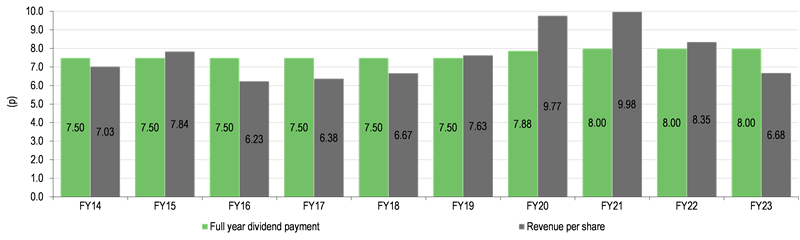
UIL pays regular quarterly dividends in December, March, June and September. The board aims to at least maintain the total annual distribution, using revenue reserves as required (it also has the flexibility to pay dividends out of capital). At the end of FY23, UIL had revenue reserves of 14.0p per share, which is equivalent to c 1.8x the current annual dividend.
In FY23, UIL’s revenue income was 6.68p per share, which was a 20% decline compared with 8.35p per share in FY22 and was due to higher financing costs. This meant that the annual dividend of 8.00p per share was not fully covered (0.84x), which was the first time this had occurred since FY18.
|
Exhibit 10: UIL’s dividend and revenue history since FY14 |
|
|
Source: UIL, Edison Investment Research |
Valuation: Board still seeking narrower discount
Over the last three years, UIL’s shares have regularly traded in a broad range of 25% to 40% (based on monthly NAVs, Exhibit 11). The current 38.3% discount to cum-income NAV is not dissimilar to the average discounts of 33.0%, 34.2%, 36.3% and 34.9% over the last one, three, five and 10 years, respectively.
The manager is hopeful that, over time, UIL’s discount can narrow to the 20% target set by the board, helped by share buybacks and continued marketing to existing and potential investors.
In FY22, c 0.5m shares (c 0.5% of the share base) were repurchased. The last buyback was at the end of March 2022 as any available liquidity was then put towards redeeming the 2022 ZDPs. As shown in Exhibit 12, there were no share repurchases in FY23.
|
Exhibit 11: Discount over last three years (%) |
Exhibit 12: Buybacks and issuance |
|
|
|
Source: Refinitiv, Edison Investment Research. Note: Based on monthly NAVs. |
Source: Morningstar, Edison Investment Research |
|
Exhibit 11: Discount over last three years (%) |
|
|
Source: Refinitiv, Edison Investment Research. Note: Based on monthly NAVs. |
|
Exhibit 12: Buybacks and issuance |
|
|
Source: Morningstar, Edison Investment Research |
Fund profile: Seeking undervalued assets
UIL began trading on 20 June 2007 as the successor vehicle to Utilico Investment Trust, which was launched in August 2003. It is a Bermuda-registered company listed on both the Specialist Fund Segment of the London Stock Exchange (which does not have any free float requirements) and the Bermuda Stock Exchange. UIL is managed by ICM Investment Management and ICM (collectively referred to as ICM), which has c £1.8bn of assets directly under management and is responsible for a further c £22.9bn of assets in subsidiary investments. ICM has more than 80 staff based in nine offices around the world.
Jillings and the other members of the ICM investment team aim to identify and invest in compelling long-term investments across the globe, where their forecast underlying values are not fully recognised. UIL may invest in shares, bonds, convertibles and other types of securities, including non-investment-grade bonds. Unlisted securities of up to 25% of gross assets at the time of investment are also permitted. Derivative instruments have been used for investment purposes and efficient portfolio management and at times currency exposure may be hedged. UIL’s sector and geographic exposure is unrestricted, but at the time of investment, a single investment may not exceed 30% of gross assets (except for platforms, which may not exceed 50%).
The company’s performance is benchmarked against a broad UK equity market index. UIL employs a levered strategy through ZDP shares and a limited amount of bank debt. Its ZDP shares are listed on the Standard Segment of the Main Market of the London Stock Exchange.
Investment process: Long-term perspective
ICM’s investment teams are led by Duncan Saville and Charles Jillings. The other senior members of the team are sector focused and include: Alasdair Younie, who covers financial services; resources specialist Tristan Kingcott; Jason Cheong and Matt Gould, who focus on technology and emerging technologies; Jacqueline Broers, Jonathan Groocock and Mark Lebbell, focused respectively on the telecommunications, utilities and infrastructure sectors in emerging markets; Dugald Morrison, who covers ICM Mobility Group in his role as head of Australasia; and fixed income specialist Gavin Blessing.
UIL seeks to generate long-term capital growth by investing in undervalued assets across the globe. Businesses may be under-priced for a variety of reasons including technological change, competition, an inefficient balance sheet, an underperforming management team or a lack of investor interest. Around 70% of UIL’s portfolio is invested in four ICM-managed funds, referred to as ‘platforms’: Somers (financial services), Zeta Resources (natural resources), Utilico Emerging Markets Trust (emerging markets utilities and infrastructure) and Allectus Capital (technology, with a particular focus on fintech). Jillings suggests this approach offers the following benefits:
■
Focused strategy – each platform has a dedicated mandate and the strategy has an objective of finding and implementing attractive investments within these.
■
Dedicated research analysts – for each platform the analysts are focused on understanding existing portfolio businesses and identifying compelling investments.
■
Financial support – ability to draw on UIL’s support and financial backing.
■
Deep knowledge – utilising ICM’s knowledge across many jurisdictions to optimise investment opportunities and undertake corporate finance-led transactions.
The remaining c 30% of the fund is in direct holdings. The manager stresses the importance of supporting investee companies with their capital requirements and says UIL may often be among their largest shareholders, maintaining regular contact with them. There is no limit as to how much of a company UIL can own, and it may sometimes take legal or management control of a firm.
UIL’s approach to ESG
ICM is committed to a strong ESG framework and is taking steps to strengthen its policy and public profile. The company is a signatory of the United Nations-supported Principles for Responsible Investment (PRI). The PRI is an international organisation that works to promote the incorporation of ESG factors into investment decision-making. UIL’s board believes it is in shareholders’ best interests to consider ESG factors when selecting and retaining investments. In conjunction with assessing the financial, macroeconomic and political drivers when making and monitoring an investment, the manager embeds ESG opportunities and risks into the firm’s investment process. Companies are scanned using a rigorous in-depth framework. However, the decision on whether to make an investment is not made on ESG grounds alone. Factors are incorporated into the process in three main ways:
■
Understanding – in-depth analysis of the important business issues faced by potential and current holdings as well as a deep understanding of the industries in which they operate.
■
Integration – incorporation of the understanding into full company analysis to ensure there is a clear and complete picture of the investment opportunity.
■
Engagement – regular communication with investee companies, both virtually and on location, where possible, to discuss and identify any gaps in their ESG policies and to further develop and improve their ESG disclosure and implementation.
The board believes that an analysis of ESG factors helps to enhance the understanding of a company, as these factors affect their business models and their long-term ability to generate sustainable returns. It also enables UIL’s investment team to fully question a company’s investment potential from a variety of perspectives.
Fees and charges
ICM receives an annual management fee of 0.5% pa of UIL’s total assets less current liabilities (excluding borrowings and excluding the value of all holdings in companies managed or advised by ICM or its subsidiaries from which it receives a management fee), along with 45% of ICM’s costs of providing company secretarial services. ICM is entitled to a 15% performance fee on NAV returns over benchmark at the higher of 5.0% or the UK gilt five- to 10-year index post-tax yield plus RPIX (RPI excluding mortgage payments) inflation. The NAV must exceed the high-water mark NAV from when the performance fee was last paid (adjusted for capital events and dividends paid) and the fee is capped at 2.5% of financial year-end NAV (adjusted for capital events and dividends paid). It is also reduced to take into account any performance fees paid to ICM by companies where UIL is an investor.
In FY23, UIL’s ongoing charges were 2.8%, which was 60bp higher than 2.2% in FY22; no performance fees were payable in either period. UEM’s ongoing charges appear high compared with other investment companies as the expense calculation is based on a percentage of average net assets (after the deduction of the ZDP shares).
Capital structure
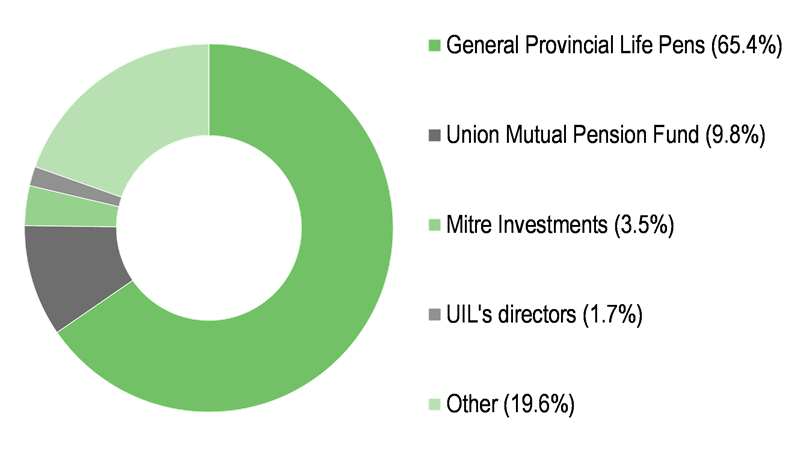
UIL has 83.8m ordinary shares outstanding, the majority are of which are held by companies associated with ICM manager Duncan Saville or UIL’s directors; hence, the free float is c 20%. Over the last 12 months, the company had an average daily trading volume of c 18k shares.
|
Exhibit 14: Major shareholders |
Exhibit 15: Average daily volume |
|
|
|
Source: UIL. Note: At 31 August 2023. |
Source: Refinitiv. Note: 12 months to 2 October 2023. |
|
Exhibit 14: Major shareholders |
|
|
Source: UIL. Note: At 31 August 2023. |
|
Exhibit 15: Average daily volume |
|
|
Source: Refinitiv. Note: 12 months to 2 October 2023. |
The board
Former director Christopher Samuel retired on 31 May 2023. The board is continuing with four members unless there is a need to appoint another director for a period to provide a future orderly succession. Collectively, UIL’s board has experience in a wide range of financial services and the law. David Shillson is viewed as a non-independent director as he is a senior partner of a law firm that has acted for associates of UIL and ICM from time to time.
In FY24 the directors’ fees will be £52.5k for the chairman, £38.9k for directors and £50.2k for the chairman of the audit & risk committee.
Exhibit 16: UIL’s board of directors
Board member |
Date of appointment |
Remuneration in FY23 |
Shareholding at 31 Aug 23* |
Peter Burrows (chair since November 2015) |
September 2011 |
£50,000 |
909,617 |
Alison Hill |
November 2015 |
£37,000 |
122,729 |
David Shillson |
November 2015 |
£37,000 |
156,069 |
Stuart Bridges (chair of the audit & risk committee) |
October 2019 |
£47,750 |
190,032 |
Source: UIL
|
|
Research: Healthcare
OSE Immunotherapeutics (OSE) has announced its H123 results, providing an operational and a financial update. Highlights from the period included positive recommendations for a confirmatory pivotal Phase III trial for lead asset Tedopi in non-small cell lung cancer (NSCLC), which is on track to commence in 2024. OSE also claimed full rights to its most advanced immuno-inflammation asset, Lusvertikimab (previously being developed in partnership with Servier). Post period, the company reported a positive safety review for Lusvertikimab from the ongoing Phase II trial in ulcerative colitis (UC). Patient enrolment is expected to be completed in Q423, with top-line results in the next few months. OSE also recently announced a €200,000 grant from the French government and Region Pays de la Loire to weave RNA therapeutics into its preclinical R&D engine, representing a new opportunity for the company. At end-June 2023, OSE had a pro-forma gross cash position of €33.6m, which we estimate will provide a runway through to Q424 (H123 cash burn of €11.7m). We value OSE at €311.3m or €14.4 per share, with Tedopi as the primary contributor to this valuation.