Last close As at 22/08/2026
—
— 0.00 (0.00%)
Market capitalisation
—
Research: Investment Companies
Henderson Smaller Companies Investment Trust (HSL) is managed by Neil Hermon, who has been at the helm for more than 20 years. While FY23, ending 31 May, was a difficult year as growth stocks derated in an environment of rising interest rates and bond yields, this should be put into context as the manager has outperformed the trust’s benchmark in 16 of the last 20 years. Hermon believes that there is a disconnect between portfolio companies’ valuations and the strength of their operations as, faced with higher input costs, businesses have adapted to protect their margins. The manager has taken the opportunity of share price weakness to add some new high-quality names to the portfolio, which would have previously been disregarded on valuation grounds. HSL is now one of just 20 funds designated as an AIC dividend hero.
Henderson Smaller Companies Investment Trust |
Valuation opportunities in quality UK small caps |
Investment trusts |
22 August 2023 |
Analyst
|
||||||||||||||||||||||||||||||||||||||||||||||||||||||||||||||||||||||||||||||
Henderson Smaller Companies Investment Trust (HSL) is managed by Neil Hermon, who has been at the helm for more than 20 years. While FY23, ending 31 May, was a difficult year as growth stocks derated in an environment of rising interest rates and bond yields, this should be put into context as the manager has outperformed the trust’s benchmark in 16 of the last 20 years. Hermon believes that there is a disconnect between portfolio companies’ valuations and the strength of their operations as, faced with higher input costs, businesses have adapted to protect their margins. The manager has taken the opportunity of share price weakness to add some new high-quality names to the portfolio, which would have previously been disregarded on valuation grounds. HSL is now one of just 20 funds designated as an AIC dividend hero.
|
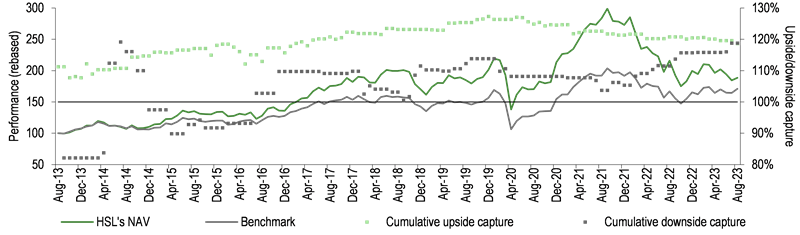
NAV outperformance record vs the benchmark under pressure since Q321 |
|
|
Source: Refinitiv, Edison Investment Research |
Why consider HSL?
HSL has a long-term record of outperformance versus its benchmark and has recently been classified as an AIC dividend hero, following its delivery of 20 years of consecutive dividend growth. The portfolio is (adjusted for gearing) split between: the UK 250 index (62.5%); the UK small-cap index (12.7%); and the UK AIM index (24.8%). These UK smaller companies have demonstrated outperformance over the long term, although have lagged larger-cap businesses in recent quarters during a period of heightened investor risk-aversion due to an uncertain macroeconomic environment. Given HSL is trading at a wider discount than many of its sector peers and its own historical averages, now could be an opportune time to consider this high-quality UK small-cap fund.
Hermon and his team employ a solid, repeatable investment process based on four M’s: a company’s business model, the quality of its management team, its financial strength (money) and momentum in terms of a firm’s recent and longerterm news flow. ESG considerations are an integral part of the thorough fundamental approach. The manager is closely supported by two colleagues, both of whom are also qualified accountants, which is a particular benefit in the analysis of a smaller company’s financial strength. Hermon is also able to draw on the broad resources of Janus Henderson Investors’ wider investment team, which has both UK and global specialists, including other small- and mid-cap focused managers.
HSL: looking forward to a better market environment
Recent quarters have proved challenging for investors due to a range of macroeconomic issues. Rapid increases in interest rates have put pressure on economies and stock markets and, as inflation has proved to be stickier than expected, further interest rate hikes are possible. With this as a backdrop, a focus on quality companies with strong balance sheets that can successfully navigate the current choppy waters seems to be a sensible approach.
High-quality, GARP portfolio
HSL has a bias towards growth stocks; it could be described as a growth at a reasonable price (GARP) fund, rather than a portfolio that is invested in growth companies without regard as to how expensive they are. Higher interest rates have put pressure on growth company valuations as they decrease the present value of their long-term earnings streams. However, while growth stocks have de-rated, Hermon reports that at an operational level, portfolio companies are performing well and on average are generating year-on-year earnings growth of around 20%, which is supporting the trust’s rising revenue stream and covered dividend.
HSL’s investee companies have very strong balance sheets; half of the portfolio has net cash. Firms have been increasing their prices to cover higher input costs to protect their margins and now cost pressures are moderating, which should mean a less challenging operating environment. When economic conditions improve, the trust appears well positioned with more than 55% of the fund invested in industrial and consumer discretionary stocks.
HSL has a relatively high level of gearing compared with the average in the AIC Smaller Companies sector (Exhibit 1) and is towards the higher end of its own historical range. This reflects Hermon’s bullish outlook and should amplify capital gains in a rising market.
|
Exhibit 1: Net gearing, HSL vs the AIC UK Smaller Companies sector average |
|
|
Source: Morningstar, Edison Investment Research |
HSL is delivering strong dividend growth and, having achieved 20 consecutive years of higher dividends, has joined the ranks of the AIC’s dividend heroes. This is a select group of just 20 funds and it is interesting to note that the latest three to join are all UK smaller company funds. Typically, UK smaller-cap businesses were considered in terms of their growth rather than income potential.
Despite HSL’s high-quality attributes and long-term record of outperformance, the trust is trading at a double-digit discount that is wider than the majority of most of its peers. This could provide a good opportunity for investors seeking an attractively priced asset class with strong long-term capital appreciation and, increasingly, income growth prospects. For more information about HSL’s dividends and valuation, please see the relevant sections on page 7.
Growth stock price weakness has provided new opportunities
Hermon describes the UK small and mid-cap market as ‘vibrant and exciting’ and as growth names de-rated this opened up more portfolio opportunities. New holdings include:
■
Ergomed – a specialist pharmaceutical services business, both as a clinical research organisation and providing pharmacovigilance services. It is a global operation with 24 offices servicing customers in 140 countries. Ergomed’s business model is capital light enabling the company to generate high returns. It has net cash on its balance sheet, which can be used to acquire companies to augment the firm’s robust organic growth.
■
GlobalData – provides high-level data intelligence, analytics and insights across a wide range of industries primarily to executive-level customers at major organisations. The company’s important product differentiator is a focus on live and real-time updated datasets and analysis rather than large reference reports. Strong topline growth and cost control offer margin expansion potential.
■
Morgan Advanced Materials – a thermal and ceramic products company, which has a wide range of end markets, customers and applications producing extreme precision materials or those required to perform in very harsh environments. Morgan’s management has upgraded the firm’s product portfolio in recent years and organic growth has exceeded investors’ expectations. Net cash on the balance sheet provides inorganic growth opportunities.
■
Wilmington – a training, events and education business operating out of two units. Intelligence provides a combination of risk and compliance data to insurance, pension and healthcare customers across the world. Training & Education offers bespoke technical support for customers across the financial services and healthcare sectors. Wilmington generates high margins and sells into defensive areas of corporate spend with attractive growth opportunities. It also has potential to make accretive acquisitions.
HSL’s portfolio structure
The trust’s sector exposure is shown in Exhibit 2. In the six months to end-July 2023, the largest changes were a higher allocation to industrial stocks (+2.7pp) and a lower weighting in basic materials (-1.2pp).
Looking at a Morningstar analysis of HSL’s portfolio in terms of its sector weightings, there are a broad range of industrial businesses represented in its largest sector; some of the biggest holdings are top 10 name Balfour Beatty (an international contractor), Alpha Financial Markets Consulting (an investment management consultancy, classified as a business service), Volution (a producer of ventilation products), Serco (a provider of outsourcing services) and Bodycote (an engineering group). Within the second ranked sector, the largest consumer discretionary stocks include top 10 names Bellway (a housebuilder), Mitchells & Butlers (a hospitality operator) and Watches of Switzerland (a luxury watch retailer).
Exhibit 2: Portfolio sector exposure
Portfolio end-July 2023 |
Portfolio end-January 2023 |
Change (pp) |
|
Industrials |
35.0 |
32.3 |
2.7 |
Consumer discretionary |
22.0 |
22.6 |
(0.6) |
Financials |
16.2 |
17.0 |
(0.8) |
Technology |
12.3 |
12.2 |
0.1 |
Real estate |
5.6 |
5.2 |
0.4 |
Energy |
3.3 |
4.0 |
(0.7) |
Basic materials |
2.1 |
3.3 |
(1.2) |
Telecoms |
2.1 |
2.0 |
0.1 |
Healthcare |
1.5 |
1.3 |
0.2 |
Total |
100.0 |
100.0 |
Source: HSL, Edison Investment Research. Note: Numbers subject to rounding.
As shown in Exhibit 3, at the end of June 2023, HSL’s top 10 holdings made up around a quarter of the portfolio, which was broadly in line with 25.5% a year before; eight positions were common to both periods.
|
Exhibit 3: Top 10 holdings (at 31 July 2023) |
||||||||||||||||||||||||||||||||||||||||||||||||||
|
||||||||||||||||||||||||||||||||||||||||||||||||||
|
Source: HSL, Edison Investment Research. Note: *N/A where not in end-January 2023 top 10. |
||||||||||||||||||||||||||||||||||||||||||||||||||
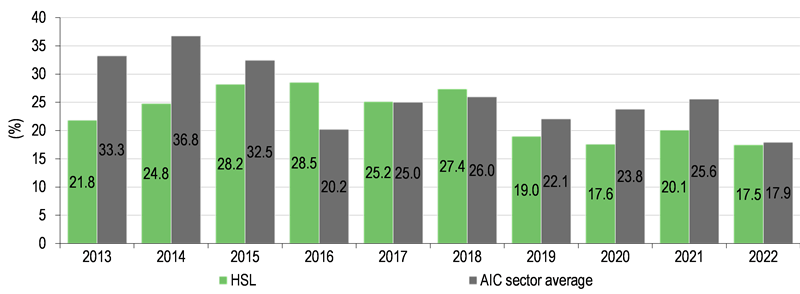
The modest year-on-year sector changes shown above are unsurprising as the manager and his team take a long-term investment perspective. HSL’s portfolio turnover is generally below the AIC sector average (Exhibit 4); an annual turnover of less than 20% equates to a holding period of more than five years.
|
Exhibit 4: Annual portfolio turnover, HSL vs the AIC UK Smaller Companies sector average |
|
|
Source: Morningstar, Edison Investment Research |
The UK valuation backdrop
UK equities have been out of favour with global investors over a multi-year period due to concerns about Brexit, the UK’s relatively low economic growth, political turmoil, and a perception that the country lacks significant exposure to higher-growth sectors such as technology. This has resulted in UK valuations looking very attractive in both absolute and relative terms, which may lead to an acceleration in M&A that could be very supportive for UK stock prices.
Looking at the valuation of the UK stock market, the Datastream UK Index is trading on a 10.5x forward P/E multiple, which is a 22.2% discount to its 13.6x 10-year average. In relative terms, this index is currently at a 26.3% discount to the Datastream World Index, which is considerably wider than the 12.4% average discount over the last decade.
The manager points to the wide valuation gap in the UK market that favours smaller UK companies and given that stock markets are cyclical and tend to discount economic conditions by around six to nine months, he anticipates that market conditions will be brighter in the coming year.
Performance: Looking to a return to form
There are 24 funds in the AIC UK Smaller Companies sector and Exhibit 5 includes the largest 13 with market caps above £100m. HSL’s underperformance since Q321 has had a negative impact on its standing within the selected peer group. The trust’s NAV total returns are below average over the periods shown, ranking 13th over the last one and five years, 11th over the last three years and 10th out of 11 funds over the last decade. HSL’s discount is wider than average, in a group where no funds are trading at a premium. The trust has the lowest ongoing charges ratio in the selected peer group and is 50bp below the mean, although it is one of four funds that can earn a performance fee. HSL has an above-average level of gearing, ranking fourth and a dividend yield that is 120bp above the mean.
Exhibit 5: Selected peer group at 21 August 2023*
% unless stated |
Market |
NAV TR |
NAV TR |
NAV TR |
NAV TR |
Discount |
Ongoing charge |
Perf. |
Net gearing |
Dividend yield |
Henderson Smaller Companies |
527.4 |
(18.4) |
(4.3) |
(13.1) |
70.7 |
(13.6) |
0.4 |
Yes |
112 |
3.7 |
Aberforth Smaller Companies |
1,023.1 |
(0.4) |
50.5 |
2.7 |
74.4 |
(13.3) |
0.8 |
No |
104 |
3.9 |
Aberforth Split Level Income |
132.8 |
(0.3) |
64.4 |
(6.3) |
|
(2.2) |
1.3 |
No |
142 |
7.2 |
abrdn UK Smaller Cos Growth |
353.7 |
(17.2) |
(15.1) |
(10.0) |
82.0 |
(13.0) |
0.8 |
No |
103 |
2.0 |
BlackRock Smaller Companies |
608.3 |
(13.7) |
1.7 |
(5.5) |
104.3 |
(12.5) |
0.7 |
No |
112 |
3.2 |
BlackRock Throgmorton Trust |
541.0 |
(7.2) |
1.5 |
4.5 |
127.6 |
(7.3) |
0.5 |
Yes |
117 |
2.0 |
Invesco Perpetual UK Smaller |
137.0 |
(16.0) |
3.3 |
(1.5) |
92.0 |
(9.6) |
1.0 |
No |
100 |
0.0 |
JPMorgan UK Smaller Companies |
202.2 |
(10.0) |
9.2 |
13.7 |
101.2 |
(12.9) |
1.0 |
No |
115 |
2.7 |
Montanaro UK Smaller Companies |
167.4 |
(9.7) |
(8.7) |
(7.6) |
33.4 |
(7.8) |
0.9 |
No |
107 |
4.5 |
Odyssean Investment Trust |
178.7 |
(6.9) |
50.7 |
58.4 |
|
(1.3) |
1.5 |
Yes |
100 |
0.0 |
Oryx International Growth |
147.0 |
6.5 |
29.0 |
64.6 |
283.0 |
(33.6) |
1.4 |
No |
100 |
0.0 |
Rights & Issues Investment Trust |
109.7 |
(7.3) |
20.5 |
(3.0) |
159.6 |
(15.7) |
0.5 |
No |
100 |
2.1 |
Strategic Equity Capital |
152.4 |
6.1 |
42.8 |
33.5 |
155.7 |
(10.0) |
1.1 |
Yes |
100 |
0.7 |
Simple average (13 funds) |
329.3 |
(7.3) |
18.9 |
10.0 |
116.7 |
(11.7) |
0.9 |
109 |
2.5 |
|
HSL rank |
4 |
13 |
11 |
13 |
10 |
11 |
1 |
4 |
4 |
Source: Morningstar, Edison Investment Research. Note: *Performance to 21 August 2023. Based on ex-par NAV. TR, total return. Net gearing is total assets less cash and equivalents as a percentage of net assets.
|
Exhibit 6: Investment trust performance to 31 July 2023 |
|
Price, NAV and benchmark total return performance, one-year rebased |
Price, NAV and benchmark total return performance (%) |
|
|
|
Source: Refinitiv, Edison Investment Research. Morningstar. Note: Three-, five- and 10-year performance figures annualised. |
|
In FY23, HSL’s NAV and share price total returns of -13.8% and -12.0% respectively lagged the benchmark’s -7.4% total return. The largest positive contributors to the trust’s relative performance were: Balfour Beatty (+0.9pp), a new management team has transformed the business in recent years, increasing margins in its UK, US and Hong Kong operations, while maintaining the value of its infrastructure investment portfolio. Improved cash flow has facilitated higher returns to shareholders via share repurchases and larger dividends; National Express (now Mobico, not owned, +0.6pp) its business has struggled post-COVID-19 due to weaker demand and higher wage costs, along with high levels of debt; and Oxford Instruments (+0.6pp) a manufacturer of advanced instrumentation equipment selling to a range of high-growth industries. The company also has a business improvement programme, which is bearing fruit.
On the other side of the ledger, the largest detractors to HSL’s performance were its holdings in: Future (-1.3pp), a global business-to-business specialised media company, which suffered from both earnings downgrades and a de-rating. Apart from operational issues, the firm’s highly regarded CEO retired. The manager is confident that Future’s business conditions will improve, and a new CEO is in place; Synthomer (-0.9pp) was a COVID-19 beneficiary due to high demand for its nitrile latex that is used to manufacture surgical gloves, and there was a cyclical downturn in some of its other product segments. A new management team is working to strengthen the company’s debtladen balance sheet and Hermon is anticipating a recovery in the nitrile latex market; and GB Group (-0.7pp), a data identity, fraud prevention and address verification business, where some of its customers experienced weaker trading conditions. Also, the company’s shares were negatively affected by the general de-rating of growth stocks.
Exhibit 7: Share price and NAV total return performance, relative to indices (%)
|
One month |
Three months |
Six months |
One year |
Three years |
Five years |
10 years |
Price relative to Numis Smaller Cos ex-ICs |
(1.5) |
(8.7) |
(11.4) |
(16.6) |
(16.5) |
(13.9) |
14.9 |
NAV relative to Numis Smaller Cos ex-ICs |
(1.4) |
(7.0) |
(9.0) |
(15.3) |
(16.6) |
(12.3) |
10.7 |
Price relative to Numis Smaller Cos plus AIM ex-ICs |
(0.2) |
(6.4) |
(7.8) |
(10.2) |
(7.5) |
(8.5) |
23.2 |
NAV relative to Numis Smaller Cos plus AIM ex-ICs |
(0.0) |
(4.6) |
(5.3) |
(8.8) |
(7.7) |
(6.8) |
18.7 |
Price relative to CBOE UK All Companies |
0.1 |
(6.6) |
(12.3) |
(19.5) |
(21.9) |
(20.8) |
16.0 |
NAV relative to CBOE UK All Companies |
0.3 |
(4.9) |
(10.0) |
(18.2) |
(22.1) |
(19.3) |
11.7 |
Source: Refinitiv, Edison Investment Research. Note: Data to end-July 2023. Geometric calculation.
As shown in Exhibit 7, a difficult period of relative performance due to the de-rating of growth stocks and cyclical weakness in some of the trust’s more cyclical businesses over the last few quarters has hurt HSL’s medium term performance. Despite this, the trust remains comfortably ahead of its benchmark over the last decade in both NAV and share price terms.
Exhibit 8: Five-year discrete performance data
12 months ending |
Total share price return (%) |
Total NAV |
Numis Smaller Cos ex-ICs (%) |
Numis Smaller Cos plus AIM ex-ICs (%) |
CBOE UK All Companies (%) |
31/07/19 |
(6.2) |
(6.8) |
(6.1) |
(7.4) |
1.1 |
31/07/20 |
(10.9) |
(8.4) |
(13.6) |
(8.7) |
(18.5) |
31/07/21 |
79.4 |
66.5 |
49.4 |
50.3 |
26.4 |
31/07/22 |
(27.4) |
(23.2) |
(13.0) |
(16.0) |
6.1 |
31/07/23 |
(14.3) |
(13.0) |
2.7 |
(4.6) |
6.4 |
Source: Refinitiv. Note: All % on a total return basis in pounds sterling.
|
Exhibit 9: HSL’s upside/downside capture over the last decade |
|
|
Source: Refinitiv, Edison Investment Research. Note: Cumulative upside (downside) capture calculated as the geometric average NAV TR of the fund during months with positive (negative) benchmark total returns, divided by the geometric average benchmark total return during these months. A 100% upside (downside) indicates that the fund’s TR was in line with the benchmark’s during months with positive (negative) returns. |
Exhibit 9 shows how HSL has performed in months when the benchmark rose and fell. Over the last decade, the trust’s cumulative upside and downside capture were both 119%. As they are above 100%, it suggests that HSL outperforms on the upside but loses more on the downside. The increase in the trust’s downside capture since Q321 coincides with HSL’s underperformance as growth stock valuations have come under pressure and gearing has exacerbated the trust’s capital losses during periods of market weakness.
Dividends: HSL is now an AIC dividend hero
HSL has increased its annual distribution for the last 20 consecutive years, which means the trust qualifies as an AIC dividend hero; one of just 20 funds that has achieved this status. Hermon expects the underlying earnings and dividend strength of HSL’s portfolio companies will continue.
|
Exhibit 10: HSL dividend history since FY13 |
|
|
Source: HSL, Edison Investment Research |
In FY23, HSL’s revenue per share increased by 19.6% to 29.38p. The board has proposed a 19.0p final dividend bringing the total annual distribution to 26.0p (c 1.1x covered), which is an 8.3% increase compared with 24.0p in FY22. At end-FY23, HSL had c £17.2m in revenue reserves, which have been rebuilt following lower dividend receipts during the pandemic, and is equivalent to c 0.9x the FY23 payment. Dividends may also be paid out of capital reserves when required. Over the last decade, the trust’s annual distributions have compounded at a rate of 14.9%.
Valuation: Scope for a narrower discount
|
Exhibit 11: Discount over three years (%) |
|
|
Source: Refinitiv, Edison Investment Research |
HSL’s latest 14.8% share price discount to cum-income NAV is towards the wider end of the 8.2% to 17.3% range of average discounts over the last 12 months. It is also wider than the 9.4% to 12.3% range of average discounts over the last one, three, five and 10 years.
There is scope for the trust to be afforded a higher valuation given its long-term record of outperformance generated using a well-articulated, repeatable investment process. The board regularly monitors HSL’s discount and discusses the merits of share repurchases; however, it does not currently believe that share buybacks are the most effective way to generate long-term shareholder value.
Fund profile: Smaller-cap UK equity specialist
HSL was launched in December 1887 and is quoted on the Main Market of the London Stock Exchange. Manager Neil Hermon (with effect from November 2002) and deputy fund manager Indriatti van Hien (with effect from June 2016) aim to maximise shareholders’ total returns (capital and income) by investing in smaller UK-quoted companies. These are defined as any company outside of the largest 100 UK company index; if a portfolio holding enters this index, in normal circumstances, it will be sold within six months. The manager and his team tend to avoid companies with a market cap less than £150m to mitigate liquidity risk.
HSL’s performance is measured against the Numis Smaller Companies (ex-investment companies) Index, which is the bottom 10% of the UK stock market by market cap (up to c £1.5bn market cap). The manager’s team receives a proportion of any performance fee paid by HSL, part of which is deferred into the company’s shares.
There are a series of investment parameters in place: equities are 80–100% of total gross assets, fixed income and cash are 0–20%, a maximum 5% in a single holding and a maximum 10% of an investee company’s equity (at the time of initial or additional investment). In exceptional circumstances and with board approval, limits can be exceeded to 10% in a single holding and 20% in an investee company’s equity. Derivatives are permitted for efficient portfolio management. Net gearing is limited to 30% of shareholders’ funds. In practice, individual positions are limited to ±4% versus the benchmark with sector exposures ±10%.
Investment process: Quality growth at the right price
HSL’s managers employ a three-step investment process to construct a portfolio of quality growth stocks: idea generation; research/debate; and implementation. The investible universe of more than 1,000 companies is screened for liquidity and market cap (minimum of £100m) to reduce the number to around 500 names. This potential investible universe is considered using financial statement analysis, sell-side research, along with deep market knowledge, to reduce the opportunity set to around 200 firms. These businesses form the focused investible universe and undergo thorough fundamental research including company meetings and the managers’ proprietary 4M approach to evaluating companies:
■
Model – focuses on a company’s competitive advantage, and barriers to entry, such as an enduring franchise. While a business may not score highly in this area, it could still be favoured for medium-term growth potential and valuation support. An unexpected change in a company’s strategy could provide a sell signal.
■
Management – an assessment of the quality of a company’s leadership team including its past record and entrepreneurial vision, and whether its interests are aligned with those of minority shareholders. Management changes or insider selling could be a red flag.
■
Money – an analysis of a company’s financial position, balance sheet, cash flow and debt profile. Deteriorating fundamentals, especially cash outflows are a cause for concern.
■
Momentum – a consideration of near- and longer-term news flow that can influence a company’s share price. A firm that can deliver persistent positive earnings surprises could benefit from a rerating. Conversely, negative earnings surprises or earnings downgrades is generally bad news.
Different valuations measures are taken into account, depending on which are the most appropriate and include P/E and EV/EBITDA multiples, free cash flow yield and dividend yield, along with ESG factors and a consideration of the macroeconomic backdrop.
The resulting portfolio is a fund of around 100 names. HSL’s managers employ a long-term view, so portfolio turnover is low. Investee companies with deteriorating 4M scores are reevaluated and may be sold. Stocks may exit the portfolio on valuation grounds, if there is a deterioration in its risk profile or if a company has become too large; as noted in the Fund profile section, any business entering the UK 100 large-cap index will be sold within six months.
HSL’s approach to ESG
ESG analysis is an integral part of HSL’s 4M investment process. The managers believe that companies that score well on ESG factors and sustainability deserve a premium valuation over time. They seek to determine what is/is not a fair premium for these businesses rather than exclude stocks on ESG ratings alone.
The managers have found attractive growth opportunities in companies that provide goods and services that address aging populations, urbanisation and the savings gap, for example. They actively engage with companies to promote positive change and can draw on the specialist resources of Janus Henderson’s governance and stewardship (G&S) team. The G&S team screens portfolios for major ESG issues and highlights important engagement topics ahead of company meetings. The managers will consider selling a portfolio company if its management team does not address shareholders’ concerns.
During FY23, of the c 300 meetings the HSL team undertook, 126 were ESG interactions or engagements with investee companies, during which environmental issues were raised at 60 of the meetings, social issues at 48 and governance issues at 57 of the meetings. The team also discussed thematic ESG matters with portfolio companies including carbon-reduction targets for industrial companies, employee welfare during the cost-of-living crisis and efforts to promote a circular economy.
Gearing
HSL has a combination of debt facilities: a £30m 3.33% 20-year unsecured loan note (issued in 2016); a £20m 2.77% 30-year unsecured loan note (issued in February 2022); £85m of short-term bank borrowings; and a small number (4,257 of £1 each) of preference shares. Gearing of up to 15% of net assets is permitted and, while detrimental in FY23, the use of leverage has made a meaningful positive contribution to the trust’s investment performance during Hermon’s tenure.
Fees & charges
HSL’s management fee is a modest 0.35% of net assets per year, 0.0875% is payable quarterly in advance based on net assets, excluding any funds managed by Janus Henderson Investors (none), at the end of the prior quarter. Broadly, a performance fee is payable calculated as 15% of any outperformance versus the benchmark on a total return basis over HSL’s financial year (further details are shown in the company’s annual report, including how relative underperformance must be made good before a performance fee is paid). The annual combination of management and performance fees is limited to 0.9% of the average monthly value of the trust’s net assets during the year. Both the management and performance fees are charged 70% and 30% to the capital and revenue accounts respectively. In FY23, HSL’s ongoing charges ratio was 0.44%, which was 2bp higher year-on-year (no performance fee was payable).
Capital structure
HSL is a conventional investment trust with one class of share; there are currently 74.7m ordinary shares in issue. Over the last 12 months, HSL’s average daily trading volume was c 91k shares. The trust’s two largest holders are retail platforms Interactive Investor and Hargreaves Lansdown, which together make up around 23% of the share base.
|
Exhibit 12: Major shareholders and platforms |
Exhibit 13: Average daily volume |
|
|
|
Source: Bloomberg. Note: At 3 August 2023. |
Source: Refinitiv. Note: 12 months to 21 August 2023. |
|
Exhibit 12: Major shareholders and platforms |
|
|
Source: Bloomberg. Note: At 3 August 2023. |
|
Exhibit 13: Average daily volume |
|
|
Source: Refinitiv. Note: 12 months to 21 August 2023. |
HSL is subject to a three-year continuation vote, with the next due at the September 2025 AGM.
The board
Following nine years on HSL’s board, David Lamb retired on 30 September 2022. The trust’s newest non-executive director, effective from 3 April 2023, is Yen Mei Lim, who is managing director, CFO and head of corporate development at Anthemis Group. She is also a director of NASDAQ-listed Anthemis Digital Acquisitions I Corp.
Exhibit 14: HSL’s board of directors
Board member |
Date of appointment |
Remuneration in FY23 (£) |
Shareholdings at 2 August 2023 |
Penny Freer (chair since 1 October 2021) |
14 September 2018 |
41,500 |
3,400 |
Victoria Sant |
23 September 2016 |
28,500 |
1,670 |
Alexandra Mackesy |
14 September 2018 |
33,200 |
2,200 |
Michael Warren |
1 March 2021 |
28,500 |
6,000 |
Kevin Carter |
1 May 2021 |
28,500 |
12,000 |
Yen Mei Lim |
3 April 2023 |
4,750 |
0 |
Source: HSL
|
|
Investment Companies
Research: Real Estate
Impact Healthcare REIT delivered strong operational and financial progress in the six months to 30 June 2023 (H123). Completion of additional interest rate hedging arrangements, with interest costs on 92% of drawn debt now fixed or hedged, provides visibility over debt costs and Impact’s ability to continue to pay fully cash-covered progressive dividends.