Last close As at 05/08/2026
—
— 0.00 (0.00%)
Market capitalisation
—
Research: Investment Companies
Foresight Solar Fund (FSFL) presents investors with an attractive dividend yield (8.6%), a 10-year track record of dividend growth (25% since IPO), strong cash dividend coverage (1.5x until at least 2025) and underlying revenue security (contracted revenue accounts for 90% of total revenue in 2023, 85% in 2024 and 75% in 2025). These appealing metrics are even more surprising given the fund operates in a structural growth industry. As FSFL reaches its 10-year anniversary, the competitiveness and opportunities in solar continue to grow. Like many of its peers, in a rising rate environment, it trades at a discount to NAV (26%), which we see as an attractive opportunity.
Foresight Solar Fund |
Company update |
Investment trusts Renewable energy equities |
30 October 2023 |
Analysts
Foresight Solar Fund is a research client of Edison Investment Research Limited |
||||||||||||||||||||||||||||||||||||||||||||||||||||||||||||||||||||||||||||||||||||||||||||||||||||
Foresight Solar Fund (FSFL) presents investors with an attractive dividend yield (8.6%), a 10-year track record of dividend growth (25% since IPO), strong cash dividend coverage (1.5x until at least 2025) and underlying revenue security (contracted revenue accounts for 90% of total revenue in 2023, 85% in 2024 and 75% in 2025). These appealing metrics are even more surprising given the fund operates in a structural growth industry. As FSFL reaches its 10-year anniversary, the competitiveness and opportunities in solar continue to grow. Like many of its peers, in a rising rate environment, it trades at a discount to NAV (26%), which we see as an attractive opportunity.
|
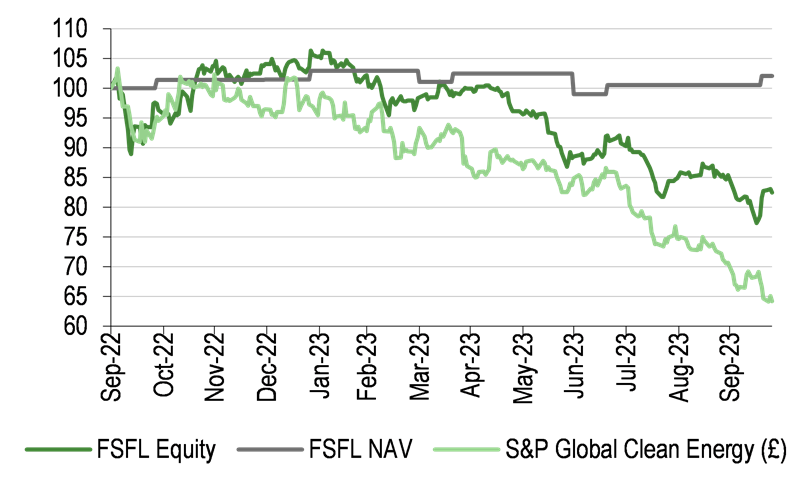
One-year cumulative performance |
|
|
|
Source: Refinitiv, Edison Investment Research |
Solar a clear winner in path to net zero
Progress in cost and efficiency has led to solar power heading towards being the largest technology in renewable energy (the International Energy Agency (IEA) predicts solar will have a 23% share of renewable energy generation by 2027). In 2022, global investment in solar power remarkably outstripped investment in conventional oil and gas for the first time, and solar power broke the record for renewable energy generation absolute growth.
The analyst’s view
FSFL’s yield is attractive given management’s confidence of a minimum dividend cover of 1.5x until at least 2025. FSFL continues to forward-fix its price exposure in the short and medium term, through contracted revenues and power purchase agreements (PPAs), providing greater revenue certainty. FSFL can fix power prices in six-month blocks, up to five years ahead via hedging. In addition, we argue that the market does not appreciate the value of FSFL’s potential pipeline and its ability to recycle capital from its current portfolio into higher return new opportunities. Investors have been attracted towards fixed income and money market products in a rising interest rate environment, although these present negative real investment returns. FSFL offers positive real yields, well covered by cash generation, and an ultimate end use with a strong structural growth story with a proportion of revenues linked to inflation that help support a growing dividend. FSFL is also trading at a 26% discount to NAV, offering an attractive entry point to investors.
Edison’s view on FSFL
In our view, FSFL presents an attractive option for investors looking for not only for a green investment but also an investment that provides a very attractive and secure dividend yield and a path to long-term growth:
■
Solar has emerged as the major growth technology: solar energy is not new, but it is gaining significant new momentum. Its acceleration has been highlighted in an IEA report, which notes that in 2022, solar photovoltaics (PV) had the largest absolute generation growth of all renewable energy technologies, increasing by a record-breaking 270TWh, reaching almost 1,300TWh globally. The IEA forecasts that by 2027 solar will have the highest cumulative power capacity percentage out of all renewable energy technologies at roughly 23%. This rise in popularity can partially be put down to solar being relatively cheap in comparison to other technologies as well as the speed and scale at which it can be deployed. FSFL has been a pioneer in listed investment trust development of solar assets (it is the largest UK-listed dedicated solar energy investment company by installed capacity) and, 10 years after its founding, the market in which it specialises continues to expand.
■
Substantially covered progressive dividend: FSFL has a progressive dividend policy and has increased its dividend over 25% from 6p/share (in 2014) to its target dividend for FY23 of 7.55p/share. Since IPO, FSFL has met every dividend target and it has forecast that the minimum dividend cash cover until at least 2025 will be 1.5x. The fund’s current dividend yield is 8.6%.
■
Strong forward-looking contracted revenue: in H123, FSFL’s strong operational performance and active power price hedges led to a 42% increase year-on-year in cash receipts from subsidiaries of £52.3m. For H123, 38% of total revenue was derived from subsidies with the remaining 62% coming from the sale of electricity. Fixed price contracts, mainly secured through PPAs, made up 92% of revenue secured from the sale of electricity in the first half of 2023. FSFL has forecast that contracted revenues as a percentage of the total expected revenue will be 90% for H223, 85% for 2024 and 75% for 2025. These contracted revenues should give investors further confidence about FSFL’s progressive dividend as well as its ability to further grow its NAV.
■
Pipeline of opportunities: in H123 the acquisition of a 467MWp development-stage pipeline in Spain saw a shift in the portfolio pipeline to focusing further on development-stage and construction-ready assets. FSFL also has preferential rights to more than 600MW of UK subsidy-free solar projects as well as an extensive pipeline of ready to build solar and battery energy storage system (BESS) projects throughout the UK and the EU; many EU countries are now implementing supportive regulatory frameworks for BESS assets.
■
Capital recycling is creating higher accretive returns: FSFL announced at its interim results (14 September 2023) that it would begin to recycle capital through a 200MWp divestment programme, in which it could reinvest any cash outside of the dividend into early-stage projects (which are typically higher return) as well as reduce short-term debt. Based on current management forecasts, the completion of the divestment programme would allow FSFL to fully fund its expected pipeline until the end of 2025 without the need for additional equity capital.
The manager’s view
Ross Driver, managing director of FSFL, gave an executive interview with Edison in August 2023, which covered FSFL as well as his views on the current state of the renewable energy investment trust market. Ross joined Foresight Group in 2021 to oversee the delivery of all aspects of FSFL’s investment mandate as part of the company’s advisory team. He has 18 years of infrastructure and renewable energy investment experience, covering deal structuring and execution, debt financing and asset management across multiple asset classes.
Ross explains that the comparatively cheap nature of solar PV in comparison to alternative renewable energy generation technologies, the speed at which solar can be deployed as well as the reliability factor are major factors for why solar PV has seen such a great period of growth in recent years, especially in the drive to net zero.
FSFL’s investment strategy has evolved over the last 10 years. This is because there has been a significant inflow of funds into the renewable energy sector, especially with the shift in focus to net zero, which has reduced valuations as well as returns on traditional renewable assets. This change resulted in FSFL investing into assets that were in the construction phase, examples being its Australian and Spanish portfolio of solar assets as well as its UK BESS portfolio. Entering in the construction phase allows FSFL to be more involved in the complete process of each asset and allows greater uplift and returns once each project gets through to completion. A mandate change in 2022 also allowed FSFL to acquire projects in the development stage. Although these assets have greater risk attached to them (ie no grid connection at the point of purchase), they can be significantly cheaper than operational assets, which means that the projects that progress through development produce greater returns.
For FSFL, 50% of revenue has historically come from government-backed subsidies and 50% from electricity sales through framework agreements over multiple years. These electricity sale agreements allow FSFL to fix prices, in six-month blocks, at values that support the level FSFL expects its progressive dividend to reach, for up to five years ahead. However, they depend on the liquidity levels available, with higher liquidity in the near term and lower liquidity in the mid-term. FSFL is not an energy trader, and the fund is not trying to second guess the market, but is actively looking to continue growing its revenue stack to provide its progressive dividend.
Ross believes there is a disconnect between the implied discount rates the market is valuing FSFL’s assets at and where FSFL sees fair value. This disconnect partly originates from one of the fastest increases in base rates seen in the UK for decades, which has provided investors with an apparently attractive alternative to real asset listed investment trusts (eg UK 20-year gilts, which are currently yielding c 5%). FSFL is seeing assets continue to change hands at far lower discount rates to what the market is currently valuing them at, and Ross believes the turning point in the market will be when gilt yields peak and there is a sign that they will decrease, in turn improving investor sentiment towards higher-yielding trusts such as FSFL.
Ross and the board feel strongly that the current disconnect in the market is resulting in the share price greatly undervaluing FSFL’s portfolio of assets. The board announced on 14 September 2023 that it was doubling its share buyback programme to £20m, believing that investing cash into FSFL, especially while it is trading at a 26% discount to NAV, is a highly competitive use of cash.
Solar is leading the charge towards net zero
The acceptance of solar energy is accelerating, helped by technology improvements in PV cell efficiency, economies of scale for manufacturing solar panels in China and improved availability of raw materials. These factors, combined with end-user and regulatory demand for decarbonised electricity and increasing scale and skill of solar park developers, has led to a substantial rise in investment.
In 2022 solar PV generation increased by a record breaking 270TWh (up 26% from 2021) reaching almost 1,300TWh. This was the largest absolute generation growth of all renewable technologies in 2022, overtaking wind for the first time. This current rate of growth is at the necessary level required, between 2023 and 2030, to ensure net zero emissions are reached by 2050. The continued development of the economic attractiveness of solar, the scalability of development and the supply chain, as well as increasing policy support, are expected to further accelerate capacity growth in coming years. Solar’s popularity has been highlighted by the IEA ,which forecasts that by 2027 solar will have the highest cumulative power capacity percentage out of all the renewable energy technologies, at roughly 23%. As can be seen in Exhibit 1, the IEA forecasts total power generated by solar PV to be roughly 2,000TWh by 2024, with over 8,000TWh required in 2030 for the net zero scenario.
|
Exhibit 1: Solar PV power generation in the net zero scenario |
|
|
Source: IEA 2023, Solar PV power generation in the Net Zero Scenario, 2015-2030, |
The IEA forecasts that solar PV capacity, including both large utility-scale and small distributed systems, will account for roughly 65% of the 2023 total projected increase in global renewables of more than 440GW. This increase was helped by the response to higher electricity prices caused by the global energy crisis, which has driven policymakers to seek out alternatives, more actively, to imported fossil fuels to increase energy security. This has resulted in, for the first time, the IEA forecasting solar investments will outstrip oil production investment in 2023. Its high scenario foresees 402GW new solar capacity in 2023 and approximately 800GW in 2027. The IEA noted that total solar capacity reached 1.3TW in 2022, but now sees the potential for an annual TW-scale market by 2030 due to the continued decline in module prices, greater uptake of distributed solar PV systems and policy pushes towards the further deployment of large-scale projects.
|
Exhibit 2: Oil production investment and solar investment, 2013 versus 2023 |
|
|
Source: IEA 2023, Oil production investment and solar investment, 2013 vs 2023, www.iea.org/data-and-statistics/charts/oil-production-investment-and-solar-investment-2013-vs-2023, Licence: CC BY 4.0 |
Solar has also benefited from reductions in battery costs due to scale effects and technology advances (see Exhibit 4 below). Solar is naturally an intermittent power source, so the continued development (in terms of scale, software and capital market/installer capabilities) of BESS (for more detail, see our report) has helped solar shift and manage its power generation, and therefore become a more commercially viable source of power.
|
Exhibit 3: Average prices for selected technologies, 2014–22 |
Exhibit 4: Global distributed solar PV net additions per year, 2017–24e |
|
|
|
Source: IEA 2023, Average prices for selected technologies, 2014-2022, www.iea.org/data-and-statistics/charts/average-prices-for-selected-technologies-2014-2022, Licence: CC BY 4.0 |
Source: IEA 2023, Global distributed solar PV net additions per year, 2017-2024, www.iea.org/data-and-statistics/charts/global-distributed-solar-pv-net-additions-per-year-2017-2024, Licence: CC BY 4.0 |
|
Exhibit 3: Average prices for selected technologies, 2014–22 |
|
|
Source: IEA 2023, Average prices for selected technologies, 2014-2022, www.iea.org/data-and-statistics/charts/average-prices-for-selected-technologies-2014-2022, Licence: CC BY 4.0 |
|
Exhibit 4: Global distributed solar PV net additions per year, 2017–24e |
|
|
Source: IEA 2023, Global distributed solar PV net additions per year, 2017-2024, www.iea.org/data-and-statistics/charts/global-distributed-solar-pv-net-additions-per-year-2017-2024, Licence: CC BY 4.0 |
H123 summary
FSFL’s interim results for the six-month period ending 30 June 2023 saw its net asset value (NAV) at £726.6m (down from the FY22 value of £771.5m) and gross asset value (GAV) at £1,237.2m (down from the FY22 value of £1,296.3m). NAV per share fell 5.2% to 119.9 pence per share (from 126.5p on 31 December 2022). This was primarily driven by the fall in near-term power prices and the increase in discount rates, which have both affected the renewable energy investment sector drastically as a whole. However, much of the downside was mitigated by FSFL’s active power price hedging and higher inflation (see Exhibit 5 for a full NAV breakdown over the period).
The portfolio’s total global renewable electricity production for the period of 621.1GWh was 2.8% above FSFL’s forecast and up 21% on the comparable period of 2022. The UK displayed the best performance out of FSFL’s global portfolio due to good plant availability as well as higher than expected irradiation, which increased production 4.3% over its base case. Revenue and EBITDA from the portfolio were up 11.7% and 11.4% year-on-year, respectively, and cash receipts were 42% higher at £52.3m. Over the last three-year period, as at 30 June 2023, FSFL has returned a total shareholder return of 9.4% and a total NAV return of 52%.
The acquisition of a 467MWp development-stage pipeline in Spain saw the movement to a more focused portfolio pipeline, in which future investments are more likely to be either development stage or construction ready. The period also saw the commencement of a 200MWp divestment process, with proceeds to be used to reduce debt via the company’s revolving credit facility (RCF) and reinvest capital into yield-accretive opportunities.
Given the continued disconnect between FSFL’s share price and the underlying value of the portfolio, the board doubled its share buyback programme to £20m. As of 30 June 2023, 4.1m shares had been acquired resulting in a 0.1p NAV uplift. The company has also extended its RCF out to 2026 to further reduce refinancing risk, with its long-term debt being fully hedged. In regard to dividends, the company is on track to deliver its target of 7.55p for the year, with 3.775p per share being paid so far in the period. The dividend is also covered at a level of 1.5x on a contracted revenue basis until at least 2025.
|
Exhibit 5: NAV movement in the six-month period ending 30 June 2023 |
|
|
Source: FSFL, Edison Investment Research |
Key initiatives in H123
FSFL’s key initiatives in H123 were:
■
Share buyback programme, which has been doubled to £20m due to the continued undervaluing of the stock, which is currently trading at a significant discount to NAV. This will further address the discount while increasing NAV accretion for shareholders.
■
RCF extension to 2026 (with the same terms) to push out refinancing risk while reducing gearing in the short term.
■
Divestment programme (commenced with 200MWp in the period) with the aim of crystalising valuation uplift and releasing cash, with the outcome of improving asset values to address the discount while reducing gearing as well as recycling capital.
■
Capital recycling: reinvesting cash generated excess of the dividend, into early-stage projects and accretive investment opportunities, while making repayments to reduce gearing.
|
Exhibit 6: Capital allocation programme |
|
|
Source: FSFL |
Portfolio update for H123
As at 30 June 2023, FSFL’s portfolio comprised a total of 61 assets across the UK, Australia and Spain, with a total net peak capacity of 1.093GW. The largest weighting in the portfolio is the UK, which has 50 operational assets with a total installed capacity of 723MW. The company also has 50% shareholdings in three BESS projects equivalent to 75MW, which are currently under construction with the first proceeding on a one-hour basis and the other two are planned to be built on a two-hour basis to capture more of the upside. The Australian portfolio consists of four operational solar assets, with 170MW of installed capacity, and there are another four assets in its Spanish portfolio, with an installed capacity of 125MW.
FSFL’s UK solar farms all benefit from regulatory support and are accredited under the Renewables Obligation (RO) scheme, except for Yardwall, which is a feed-in-tariff (FiT) scheme accredited asset (however, Yardwall represents less than 1% of the UK portfolio). The BESS assets will predominantly trade on a merchant basis, although they will be able to bid for fixed-price service contracts under the National Grid ESO capacity auctions. The expected weighted average life of the UK portfolio was 30.8 years as of 30 June 2023 from the date of commissioning. This represents a remaining portfolio useful life of 22.6 years when the historical operational periods are taken into consideration.
The Australian projects benefit from Large-Scale Generation Certificate (LGC) subsidies. Although the Spanish assets do not benefit from any regulatory support, they do all have long-term PPAs, which provide a high proportion of contracted revenues. For example, the Virgen del Carmen project has a 10-year offtaker agreement with Shell, established in 2020, and the Lorca portfolio signed a 10-year long agreement with Starkraft in December 2021.
|
Exhibit 7: Geographic weighting in the portfolio* (61 solar assets with a total installed peak capacity of 1.093GW) |
|
|
Source: FSFL, Edison Investment Research. Note. *As at 30 June 2023. |
Acquisitions in the period
In March 2023 FSFL acquired the full rights to a pipeline of development-stage solar farms with a total potential capacity of 467MWp. The six subsidy-free sites are based in the south and east of Spain. Two of the assets have already sought grid connections under existing application routes. One asset, totalling 57MWp, has the potential reach ready-to-build status by the end of 2024. The remaining projects will have to apply for connections via future rounds of the capacity market auctions.
Investment focus on growth opportunities
FSFL’s investment focus is more than ever on growth opportunities, with its strategy for new assets focusing on:
■
targeting high-quality yields with a clear element of NAV growth,
■
driving growth through development or construction of assets, and
■
recycling capital via its divestment programme.
Pipeline
■
Preferential rights to more than 600MW of UK subsidy-free solar projects.
■
467MWp Spanish development portfolio.
■
Extensive pipeline of ready to build UK solar and BESS projects.
■
Several development-stage opportunities across UK and Europe.
Revenue analysis and price hedging
During the first half of 2023, roughly 38% of total revenue was derived from subsidies, with the remaining 62% from the sale of electricity. Due to the fact fixed-price contracts are mainly secured through PPAs, 92% of revenue in the period was considered contracted, with the remaining 8% coming from merchant sales. The UK accounted for 84% of revenue in H123, with an average fixed price of £127/MWh. In the period operational performance and active power price hedges led to £52.3m in cash receipts from subsidiaries (up 42% y-o-y).
Contracted revenue for the portfolio as a percentage of the total expected revenue is now forecasted to be 90% for H223, 85% for 2024 and 75% for 2025 (as can be seen in Exhibit 8 below).
|
Exhibit 8: Contracted versus merchant FSFL revenue forecast breakdown |
|
|
Source: FSFL, Edison Investment Research. Note: *Remainder of 2023 (H223). |
FSFL will continue to enter fixed-price arrangements for the sale of electricity to minimise the effect of power price volatility on future cash flows. The aim is to achieve a high percentage of annual fixed revenue in the short and medium term through actively managing its power price exposure.
Performance
As of 30 June 2023, FSFL has an annualised total NAV return since IPO of 8.3% (9% as at 31 December 2022) and an annualised total shareholder return since IPO of 5.6% (7.8% as at 31 December 2022). An investment in one share of FSFL at IPO would have delivered a total shareholder return of almost 70% to 30 June 2023. Over the three-year period to 30 June 2023, FSFL returned a 9.4% total shareholder return and a 52% total NAV return to its investors.
As shown in Exhibit 9 and 11, FSFL’s total share price return and total NAV return performance for the one-year period to end-September 2023 has outperformed both the benchmark used (S&P Global Clean Energy Index) and the World Renewable Energy Index but was behind the two other comparative indices we have used. However, FSFL’s weaker performance over the last year, in comparison to the previous year, is mainly a reflection of the reaction of the renewable energy investment trust market to the increase in interest rates, which has driven yields higher through shares moving towards discounts to NAV, often alongside strong results off the back of the increase in energy prices. FSFL demonstrated a significantly greater performance in comparison to the year prior (end-September 2022), which highlights its recent share price performance is due to the nature of the challenging market conditions.
Exhibit 9: Five-year discrete performance data
12 months ending |
Total share price return (%) |
Total NAV return (%) |
Benchmark* (%) |
World Renewable Energy Index (%) |
MSCI AC World (%) |
CBOE UK All Companies |
30/09/19 |
19.2 |
7.7 |
38.0 |
30.0 |
7.9 |
2.7 |
30/09/20 |
(11.3) |
(6.4) |
64.6 |
121.9 |
5.8 |
(17.9) |
30/09/21 |
1.3 |
17.0 |
14.0 |
23.8 |
22.7 |
28.5 |
30/09/22 |
25.8 |
29.1 |
9.0 |
2.2 |
(3.7) |
(3.4) |
30/09/23 |
(14.6) |
0.5 |
(29.3) |
(29.9) |
11.0 |
14.5 |
Source: Refinitiv. Note: All % on a total return basis in pounds sterling. *Benchmark is S&P Global Clean Energy Index.
Exhibit 10: Share price and NAV total return performance,* relative to indices (%)
|
1 month |
3 months |
6 months |
1 year |
3 years |
5 years |
10 years |
Price relative to S&P Global Clean Energy Index (£) |
5.8 |
15.9 |
14.6 |
20.9 |
24.0 |
(42.3) |
(29.9) |
NAV relative to S&P Global Clean Energy Index (£) |
5.7 |
22.0 |
31.4 |
42.2 |
73.0 |
(23.2) |
(7.1) |
Price relative to World Renewable Energy Index |
6.9 |
20.8 |
18.7 |
21.8 |
22.8 |
(55.0) |
(60.4) |
NAV relative to World Renewable Energy Index |
6.8 |
27.2 |
36.1 |
43.4 |
71.3 |
(40.1) |
(47.6) |
Price relative to MSCI AC World |
0.5 |
(4.2) |
(16.8) |
(23.1) |
(17.0) |
(23.1) |
(43.5) |
NAV relative to MSCI AC World |
0.4 |
0.8 |
(4.5) |
(9.5) |
15.8 |
2.3 |
(25.1) |
Price relative to CBOE UK All Companies |
(2.1) |
(5.6) |
(14.6) |
(25.4) |
(23.4) |
(3.9) |
(5.5) |
NAV relative to CBOE UK All Companies |
(2.2) |
(0.6) |
(2.0) |
(12.2) |
6.9 |
27.9 |
25.3 |
Source: Refinitiv. Note: *Relative performance to end-September 2023. Geometric calculations
|
Exhibit 11: Investment trust performance to 31 September 2023 |
|
Price, NAV and benchmark total return performance, one-year rebased |
Price, NAV and benchmark total return performance (%) |
|
|
|
Source: Refinitiv, Edison Investment Research. Note: Three-, five- and 10-year performance figures annualised. |
|
|
Exhibit 12: Three-year relative performance against benchmark |
|
|
Source: Refinitv, Edison Investment Research |
Relative peer group performance
Exhibit 13 illustrates the competitive performance and fund characteristics of FSFL relative to its four UK peers listed on the London Stock Exchange.
Across the metrics in Exhibit 13, taken at 25 October 2023, with performance measures to end-September 2023, FSFL ranks second (out of four) in regard to market cap, NAV total return (TR) since inception and one-year NAV TR. However, FSFL’s discount to NAV has continued to widen, placing it third in the peer group, again reflecting the wider market move towards NAV discounts and higher dividends yields. Within the peer group FSFL has the highest-ranking NAV TR over the last three years (52.9%), which demonstrates its strong performance over the medium to longer term. Its dividend yield ranks third in the peer group.
Exhibit 13: Solar funds peer group performance, to end-September 2023
% unless stated |
Market cap* £m |
NAV TR |
NAV TR |
NAV TR |
NAV TR** |
Discount* (cum-fair) |
Ongoing charge |
Performance fee |
Dividend yield* |
Foresight Solar |
540.2 |
0.6 |
52.9 |
54.0 |
115.7 |
(26.1) |
1.1 |
No |
8.6 |
Bluefield Solar Income Fund |
715.4 |
2.6 |
48.7 |
71.7 |
165.0 |
(19.6) |
1.0 |
No |
7.9 |
NextEnergy Solar |
505.2 |
(5.4) |
34.4 |
44.5 |
|
(28.0) |
1.1 |
No |
10.6 |
US Solar Fund |
167.2 |
(16.2) |
6.0 |
(34.3) |
1.4 |
No |
10.2 |
||
Simple average |
482.0 |
(4.6) |
35.5 |
56.7 |
140.4 |
(27.0) |
1.2 |
9.3 |
|
FSFL rank in peer group |
2 |
2 |
1 |
2 |
2 |
2 |
1 |
3 |
Source: Source: Morningstar, Edison Investment Research. Note: TR, total return. Gearing is total long-term debt including all revolving credit facilities and subsidiaries’ debt as a percentage of gross assets. *As at 25 October 2023. **SI, since inception, 29 October 2013.
Dividends
|
Exhibit 14: Dividend history |
|
|
Source: FSFL, Edison Investment Research. Note: *1.880p paid as of 25 August 2023 and 1.895p declared for payment 24 November 2023. |
FSFL has targeted a sustainable and progressive quarterly dividend since inception and is on track to deliver its target dividend for 2023 of 7.55 pence per share. The investment manager has forecast a target minimum dividend cover of 1.5x via contracted revenues until at least 2025. FSFL has met every dividend target since IPO and has grown its dividend over 25% from 6p/share (2014) to 7.55p/share. As of 25 October 2023, FSFL’s dividend yield is 8.6%.
Discount to NAV and share buybacks
|
Exhibit 15: Premium/discount over three years |
Exhibit 16: Buybacks and issuance |
|
|
|
Source: Refinitiv, Edison Investment Research |
|
Exhibit 15: Premium/discount over three years |
|
|
Source: Refinitiv, Edison Investment Research |
|
Exhibit 16: Buybacks and issuance |
|
|
Source: Refinitiv, Edison Investment Research |
As can be seen in Exhibit 15, over the past three years FSFL has traded from a premium to NAV to a discount, with the most significant move coming in September 2022 in line with the failed minibudget by then UK Prime Minister Liz Truss and the change in forward interest rates. In the one-year period ending September 2023, FSFL’s discount has grown and the fund currently trades at a 26% discount to cum-income NAV.
FSFL’s original share buyback programme was announced on 4 May 2023 for a total of £10m. The board has since decided to double this to £20m due to the continued undervaluing of the stock and the significant discount to NAV. The aim is to further address the discount while increasing NAV accretion for shareholders.
Current environment surrounding renewables in the UK
The UK government’s Electricity Generator Levy (EGL) came into full legal effect during H123. The EGL also applies a 45% additional charge on generation revenue over £10m. The reference price remains £75/MWh (index-linked to the Consumer Price Index (CPI) from April 2024), which will limit the levy’s impact as power prices fall. The levy is scheduled to remain in place until April 2028, and does apply to FSFL’s UK assets.
Wholesale power prices have fallen from record highs in 2022, with N2EX Day Ahead prices averaging £108/MWh across the first six months of 2023. This decrease was driven mainly by lower commodity prices, especially for natural gas, which has still traded above historical averages but significantly below the level seen after Russia’s invasion of Ukraine.
Buy-out prices for Renewables Obligation Certificates (ROCs), the main UK support mechanism for large-scale renewable electricity projects, in the 2023/24 annual compliance period increased to £59.01 (2022/23: £52.88). This rise reflected the mean monthly percentage change in the Retail Price Index (RPI). Overall FSFL received 1.41 ROC/MWh across its portfolio.
The Review of Electricity Market Arrangements (REMA) in the UK is being led through consultation by the Office of Gas and Electricity Markets (Ofgem). REMA represents the most comprehensive review of the country’s electricity market arrangements in over 30 years. Under consideration are proposals that include: separating the wholesale market between renewable energy and other generation; location based pricing; and evolutionary change to existing markets, such as contracts for difference (CfDs), capacity markets and system operation. The government is likely to provide an update with more guidance on measures potentially being taken forward in the last quarter of this year.
UK power price forecasts and FSFL’s hedging strategy
The investment manager uses forward-looking power price assumptions to assess the likely future income of the portfolio’s assets for valuation purposes. These assumptions are formed from a blended average of forecasts from three independent consultants, which are then adjusted to accommodate the expected capture price discounts for solar generation. For assets with a fixed-price arrangement, the contracted values are used instead of the blended forecast and for assets with subsidy arrangements for a period shorter than their assumed useful economic life, the blended forecast is used for the remaining period.
|
Exhibit 17: UK wholesale power price forecasts |
|
|
Source: FSFL |
As can be seen in Exhibit 17 (above) the power price forecasts FSFL uses have materially decreased in comparison to December 2022, due to the corresponding fall in commodity prices (especially natural gas). The most significant fall was in the near-term prices between 2023 and 2026, which is parallel to the periods FSFL has already fixed high levels of energy sales, therefore limiting any exposure to falls in merchant prices. Overall, the annual decrease in the longer term (after 2026) is 1.6%, which largely represents FSFL’s view on capture price discounts.
Hedging strategy
FSFL benefitted in the first half of 2023 due to its active hedging strategy, securing attractive power prices and income to underpin the dividend. For example, arrangements signed in 2022 have fixed prices at higher rates than current wholesale prices, with deals guaranteeing advantageous conditions up until 2026 for some assets. The average realised price across the UK portfolio, including fixed-price arrangements and merchant exposure, was £121.23/MWh, a 13.6% increase on the £106.69/MWh that was secured in H122 and 12% above the N2EX average for the period from January to June 2023.
Leverage and gearing
As at 30 June 2023, FSFL’s total outstanding long-term debt of £395.6m, of which £90.9m was linked directly to inflation, represented 32% of GAV. Total outstanding debt including the RCF equalled £510.6m, which is 41.3% of GAV, and the company’s net debt position after deducting cash balances was therefore £407.1m, which represents 32.9% of GAV.
At the six-month mark, the average cost of long-term debt was 2.7% per annum, including the cost of inflation-linked facilities of 1.25% per annum but excluding the inflationary increase of the nominal balances of the index linked facilities of £90.9m. The company expects the costs of these facilities to increase over time, assuming the company’s long-term annual RPI expectations of 3% in the medium term and 2.25% after 2030.
FSFL has used £115m of its RCF as of 30 June 2030, with £35m remaining undrawn, of which £5.1m has been allocated to letters of credit due to expire in 2023 and 2024. At end-H123 FSFL pushed out refinancing risk by agreeing a one-year extension of its RCF under existing terms. The weighted total cost of the RCF was 4.13% per annum (2.08% at the same point for 2022) at the half-year mark.
The board
Exhibit 18: FSFL’s board of directors
Board members |
Date of appointment |
Renumeration in FY22 |
Shareholdings at 31 December 2022 |
Alexander Ohlsson (Chairman) |
16-Aug-13 |
£76,000 |
25,000 |
Chris Ambler |
16-Aug-13 |
£49,000 |
36,162 |
Monique O'Keefe |
01-Jun-19 |
£49,000 |
- |
Ann Markey |
04-Sep-20 |
£60,000 |
- |
Lynn Cleary |
18-Sep-23 |
- |
- |
Source: FSFL
Research: Healthcare
Management presented its quarterly earnings, adding context to the recent capital markets day (CMD), highlighting IRLAB’s strategic focus on continuing with further development of mesdopetam after securing full rights from Ipsen (in August). As a reminder, management shared detailed analysis of the Phase IIb trial in August 2023, which indicated statistically significant secondary endpoints. All eyes are now on the end-of-Phase II (EoP2) meeting with the FDA (possibly in H124) which, if favourable, could lead to the anticipated Phase III trial. Management also reported a positive interim review of the Phase IIb pirepemat study data in July 2023 and remains on track to share top-line results in Q224. At end-Q323, IRLAB had net cash of SEK118.8m, which we estimate will provide a runway through H124. Our valuation of IRLAB is SEK4.51bn or SEK87.0 per share.