Last close As at 05/08/2026
—
— 0.00 (0.00%)
Market capitalisation
—
Research: Healthcare
Shield Therapeutics reported its FY22 preliminary results and Q123 business update, the key emphasis of which was the growing traction of Accrufer in the US following the December 2022 co-commercialisation deal with Viatris. The FY22 revenue of £4.5m (+194% y-o-y) was driven by Accrufer US sales (£2.9m vs £0.1m in FY21) and underpinned by a material q-o-q growth in prescriptions during FY22 (25,200 vs 2,500 in FY21). Encouragingly, this trend has continued in Q123 (10,500 prescriptions; +12% q-o-q growth) despite initial operational disruptions related to the integration. With the salesforce approaching full strength (total 100 people) by May, we anticipate H223 to be a vital period for sales traction and market coverage. We have updated our FY23–24 pricing and costs estimates for the FY22 results but maintain our long-term Accrufer growth assumptions. Our revised valuation is £388.9m (£403.4m previously).
Written by
Shield Therapeutics |
FY23 a key year for business traction |
FY22 update |
Pharma and biotech |
4 May 2023 |
Share price performance
Business description
Next events
Analysts
Shield Therapeutics is a research client of Edison Investment Research Limited |
|||||||||||||||||||||||||||||||||||||||||||||||||||
Shield Therapeutics reported its FY22 preliminary results and Q123 business update, the key emphasis of which was the growing traction of Accrufer in the US following the December 2022 co-commercialisation deal with Viatris. The FY22 revenue of £4.5m (+194% y-o-y) was driven by Accrufer US sales (£2.9m vs £0.1m in FY21) and underpinned by a material q-o-q growth in prescriptions during FY22 (25,200 vs 2,500 in FY21). Encouragingly, this trend has continued in Q123 (10,500 prescriptions; +12% q-o-q growth) despite initial operational disruptions related to the integration. With the salesforce approaching full strength (total 100 people) by May, we anticipate H223 to be a vital period for sales traction and market coverage. We have updated our FY23–24 pricing and costs estimates for the FY22 results but maintain our long-term Accrufer growth assumptions. Our revised valuation is £388.9m (£403.4m previously).
Year |
Revenue |
PBT* |
EPS* |
DPS |
P/E |
Yield |
12/21 |
1.5 |
(17.7) |
(8.6) |
0.0 |
N/A |
N/A |
12/22 |
4.5 |
(23.0) |
(9.4) |
0.0 |
N/A |
N/A |
12/23e |
22.0 |
(19.9) |
(3.4) |
0.0 |
N/A |
N/A |
12/24e |
68.6 |
(7.7) |
(1.3) |
0.0 |
N/A |
N/A |
Note: *PBT and EPS are normalised, excluding amortisation of acquired intangibles, exceptional items and share-based payments.
FY22 performance driven by US Accrufer sales
The 194% y-o-y growth in FY22 revenues was underpinned by the strong US traction and supported by royalties for Feraccru from European partner Norgine (£1.4m; +10% y-o-y) and a £0.2m upfront payment from KYE Pharmaceuticals. We note that the £4.2m upfront payment from Viatris is now being recognised as other operating income in FY22 (£0.7m) and FY23 (guided by management to be £3.5m). The FY22 EBITDA loss of £23.3m (FY21: £18.1m) was higher than anticipated but can be attributed to increased investments in marketing efforts. We see the Viatris deal, with its expanded salesforce and payor relationships, as key to generating future upside.
H223 to set the pace for medium-term growth
While 12% q-o-q growth in prescriptions in Q123 is encouraging, we expect a sustainable underlying growth trend to become visible from H223, once the full-strength salesforce team hits the field. Management is targeting 125–160k prescriptions in FY23, which we see as achievable, assuming a steady ramp up in prescriptions per salesperson per quarter (which we estimate was 420 in Q123 assuming an average 25-member sales team).
Valuation: £388.9m or 66p per basic share
We tweak our estimates marginally (slightly lowering sales and adjusting operating expenses) to reflect the FY22 results and directional near-term guidance from management, while keeping our long-term underlying growth expectations for Accrufer unchanged. Following the £24.4m raised in net proceeds in January 2023 (£16.6m equity raise plus £8.2m shareholder loan from largest shareholder AOP Health), we continue to see the company as financed to profitability, which we project by FY25. Our overall valuation readjusts to £388.9m (from £403m) and per share valuation readjusts downwards to 66p (from 79p) on the higher share count following recent raises.
Sales momentum underpinned by US prescriptions
Shield reported c £4.5m in sales in FY22 versus c £1.5m in FY21, of which c £2.9m was attributable to US Accrufer sales (FY21: c £0.1m; Edison FY22 estimate: £3.5m), £0.2m was an upfront licence payment from commercial partner KYE Pharmaceuticals in Canada and £1.4m (FY21: £0.9m) was from sales royalties for Feraccru sales in Europe from licensing partner Norgine. US total prescriptions continue to track up, growing 12% q-o-q to 10,500 at the end of Q123, versus c 9,400 in Q422. We also note that over 90% of Accrufer prescriptions are now written by primary care physicians or general practitioners (GPs) and obstetrician/gynaecologists (OB/GYNs), the target market for Shield (see Exhibit 1). Management has highlighted that of the 2,230 health care providers (HCPs) who prescribed Accrufer in 2022, over 70% were first-time prescribers, reflecting the growing market visibility and reach of Accrufer.
|
Exhibit 1: Quarter-on-quarter growth in prescription volumes |
|
|
Source: Shield Therapeutics presentation, April 2023 |
Total prescriptions written for the year stood at 25,200, slightly lower than our estimate of 26,700, which may have been partly due to the salesforce realignment and training requirements following the December 2022 deal with Viatris. Based on this figure, we calculate an average net selling price (ASP) for Accrufer of $144 in FY22, slightly lower than the Q322 price of $151. Management has indicated that a number of prescriptions sales are still subsidised through patient assistant programmes, resulting in the lower prices. This translates to a gross-to-net sales price discount of c 70%, which management plans to bring down to the eventual target of 50% by FY25, to be driven by growing prescription volumes and increased commercial payor and state-run Medicaid coverage. Accrufer continues to have coverage of more than 100 million insured lives (40% of all covered lives in the US) and is on the formulary list of several pharmacy benefit managers (PBMs) in the United States, including Express Scripts, Optum and Cigna. With Viatris now onboard, we expect Shield to leverage the company’s market expertise and relationships with payors to accelerate its efforts to approach additional payors in the coming few months.
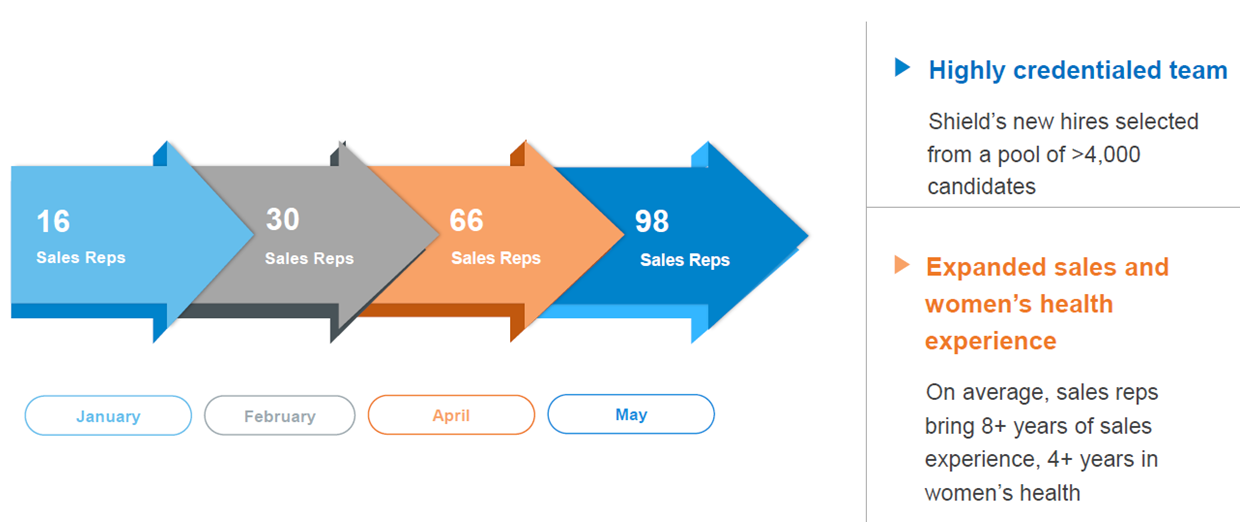
We are also encouraged by the continued growth in prescription volumes in Q123 despite some possible disruptions related to training and integration with Viatris. Shield disclosed that the number of salespeople actively promoting Accrufer was 16 in January and 30 in February and March (average of 25 for the quarter) and that 38% of the total quarterly volume came in March, reflecting tangible, albeit initial, benefits from having a larger sales team in the market. As of April, the active salesforce promoting Accrufer had increased to 66 with the target of reaching full strength by May 2023 (Exhibit 2).
|
Exhibit 2: Salesforce expansion timeline |
|
|
Source: Shield Therapeutics presentation, April 2023 |
With its previous salesforce, Shield was targeting 3,500 HCPs, but anticipates that the broader salesforce will allow it to target up to 12,000 HCPs across the country. The graphic below highlights the targeted scale of market coverage across the United States by the expanded team (Exhibit 3). The larger salesforce should allow for broader market coverage and an increased number of touch points with relevant stakeholders, which we believe will have an incremental flowthrough impact on prescription figures.
|
Exhibit 3: Target market coverage by the enhanced salesforce |
|
|
Source: Shield Therapeutics presentation, April 2023 |
With greater visibility on salesforce expansion timelines and market feedback in the form of Q123 prescriptions, Shield has reiterated its previously communicated targets for prescription growth volumes across FY23–25 (Exhibit 4). Management’s target for FY23 stands at 125,000–160,000 prescriptions.
Exhibit 4: Management’s internal targets for prescription volumes
FY23e |
FY24e |
FY25e |
|
Total number of Accrufer prescriptions |
125,000–160,000 |
370,000–420,000 |
550,000–600,000 |
As a percentage of the total oral iron prescription market |
1.1% |
2.9% |
4.3% |
Source: Shield Therapeutics presentation, April 2023
Based on our Q123 estimated salesforce number of 25 and total prescriptions of 10,500, we calculate the number of prescriptions per salesperson per quarter at c 420. Assuming the same-run rate for the remainder of the year translates to FY23 prescription volume of c 130,000 prescriptions, within the management’s target range of 125,000–160,000 prescriptions. We also believe that as the salesforce becomes further entrenched in the market, conversion and throughput may likely improve, supporting the possibility of achieving an even higher prescriptions figure for the year. For our model, we project c 130,000 prescriptions in FY23 at an ASP of $175/prescription. The FY24 and FY25 management targets are more aggressive in comparison (assuming 2x and 3x growth in prescriptions per salesperson), although, as previously noted, we believe they are still plausible, provided the salesforce can achieve the required market coverage and Shield gains more traction with payors, with support from Viatris. For FY24 and FY25, our prescription estimates fall in the mid-rage of the management targets.
FY22 uptick for Europe; gradual growth in long term
Shield reported £1.4m in royalty income from Europe in FY22, a 56% y-o-y increase versus the £0.9m earned in FY21. We believe that the full year performance was driven by a strong Q4, which we estimate contributed £0.6m in sales (over 40% of the FY22 figure). This growth was driven by c 10% growth in Feraccru volumes in Germany and the UK. The difference in the revenue and prescription volume growth can be attributed to a combination of geographic mix and timing of revenue recognition. Average prices for Feraccru in Germany are the highest in Europe and the region contributed 72% of the sales volume in FY22, reflected in the higher revenue growth. Moreover, the revenue recognition from Norgine royalties is accounted for in two steps. The first is when the inventory is delivered to Norgine and Shield receives a fixed purchase price. The second is when the actual sale is made by Norgine and Shield receives the balance royalty payment. The timing of these payments can differ and likely explains the difference between the FY22 revenue and prescription volumes.
We note that Germany, along with UK (18% of total unit sales in FY22) will likely remain the primary sales contributors for Norgine in the near term, although the company is looking to seek reimbursement in other European markets, such as Spain and Italy. Norgine has initiated marketing of Feraccru in Scandinavia, although we do not expect its current contribution to be material. We remind readers that Norgine has been undergoing internal restructuring (after Goldman Sachs Asset Management acquired a majority stake in the company in December 2022) and is working towards realigning its sales strategy to target the primary/women’s health market, versus its earlier focus on the gastro-intestinal market. While this may result in a larger uplift in sales in the coming years, we estimate more protracted year-on-year growth for this geography as compared to other key markets.
Partnerships offer upside potential
In January 2020, Shield secured an out-licensing deal in China for Feraccru/Accrufer. The exclusive deal with China-based Beijing Aosaikang Pharmaceutical (ASK Pharm) covers China, Hong Kong, Macau and Taiwan. Shield received an upfront payment of $11.4m on signing the deal and another $11.4m was expected following regulatory approval. ASK Pharm was to complete the required clinical trials in China and file the marketing authorisation for the treatment but its progress has been hampered by COVID-19 related restrictions in the country, delaying the potential launch of the drug in the country. With restrictions easing, Shield is in talks with ASK to seek clarity on timing and the pathway for launch. China remains an attractive market for Shield although given the ongoing uncertainty, we continue to estimate a launch in 2025 and ascribe a 75% probability of approval.
Shield signed two new international, albeit small, partnerships in 2021 and 2022. The first out-licensing deal was signed with Korea Pharma (for commercialisation in South Korea) in October 2021. It came with an upfront licence fee of £0.5m, £1.5m on first commercialisation (which we estimate in 2024), £4m in milestone payments and a flat 15% royalty on sales.
In January 2022, the company signed another partnership, with KYE Pharmaceuticals, to commercialise Accrufer in Canada. Shield received an upfront payment of £0.2m and is eligible to receive a further £0.85m in development and sales milestones, including £0.25m upon regulatory approval in Canada. The company also expected to receive double-digit royalties on Canadian sales. In July 2022, the company announced that Health Canada has accepted the New Drug Submission (NDS) filed by KYE and it expects the Canadian regulatory review to be completed in mid-2023.
In both the Korea Pharma and KYE Pharmaceuticals deals, the partner will assume all clinical and regulatory costs while Shield will be responsible for manufacturing the drug. While these deals expand the market reach and scope of Shield’s drug, given the small market sizes, we currently do not incorporate these opportunities in our valuation but note the upside potential on successful commercial launches in their respective territories.
FY22 financials and estimate revisions
Shield reported sales of £4.5m in FY22, which we note was different to the £8.5m figure reported in the February 2022 trading update. However, this can be attributed to the difference in accounting for the US$5m (£4.2m) upfront payment received from Viatris in December 2022. Rather than recognising this payment fully as part of the FY22 revenue, the company is now accounting for this payment as part of other operating income, recognising £0.7m in FY22 and deferring the remaining £3.5m to FY23. We remind that while the co-marketing deal with Viatris agrees to split the revenues and costs between the two companies in a 55/45 ratio, Shield, in its accounts, will book 100% of the revenues, with Viatris’s 45% share reflected as part of COGS. As part of the deal, Shield will also receive a further $30m in staggered milestone payments on achieving certain revenue targets ($7.5m each for every incremental $50m increase in revenue between $100m and $250m).
FY22 gross profit was £2.0m (£0.5m in FY21), which translated to a gross margin of 44.7%, higher than the 35% recorded in the previous year. We believe this reflects the growing traction from the US operations. SG&A costs of £25m in FY22 (excluding £2.4m in amortisation of intangible assets) were up from £17.9m in FY21, with the increase primarily attributable to US commercialisation activities during the year and associated headcount growth (average 28 employees vs 23 in FY21). This is higher than our previous FY22 estimate of £21.3m. The expensed R&D costs of £1.1m (up 35% yo-y), on the other hand, were lower than our estimate of £1.7m and were fully attributable to Shield’s ongoing paediatric study assessing Feraccru/Accrufer in infants, children and adolescents. The company reported that enrolment is progressing although completion timelines have not been disclosed. We note that another £1.8m of R&D related costs were capitalised during the year (c £1.7m in FY21). In FY22, Shield also recorded a £14.7m non-cash impairment expense related to the write-off of assets related to its Phosphate Therapeutics (PT20) business given the limited patent life and the company’s commercial focus on Accrufer. Excluding the impairment charge, the reported operating loss for FY22 was £25.7m. This is higher than our expectation of £18.1m loss but we note that this is partially due to the partial deferral of Viatris upfront payment to FY23.
We have updated our estimates to reflect the FY22 performance (sales and operating expenses) and near-term operational visibility. For the forecast years, we have adjusted our FX assumptions (£0.80/US$ versus £0.81/US$ previously) and now factor in the $5m (£4.2) upfront payment received from Viatris as part of other operating income (£3.5m in FY23) instead of revenue. We have kept our underlying assumptions for prescription growth broadly unchanged, but have slightly tempered our expectation of the FY23 and FY24 ASP given the lower-than-expected realised price in FY22 ($145 vs our expectation of $160). For FY23, we now assume an ASP of $175, versus $215 previously and for FY24 we assume an ASP of $200 ($225 previously). Our revised FY23 revenue estimate is £20.4m, versus £24.4m previously. For FY24, our revenue estimate changes to £68.6m (from £77.3m previously).
Based on the FY22 trends, we have also made some adjustments to our FY23 and FY24 operating expense estimates (primarily increasing SG&A and lowering R&D expectations). Our revised EBITDA loss estimates for FY23 and FY24 are £19.2m and £6.4m (vs £19.9m and £0.3m), respectively. Note that the FY23 EBITDA loss is lower than our previous estimate due to the inclusion of the £3.5m Viatris deferred income expected in FY23. Overall, we continue to project the company turning EBITDA positive in 2025. Changes to group-level estimates are presented in Exhibit 5.
Exhibit 5: Key changes to forecasts
FY22 |
FY23e |
FY24e |
|||||||
£’000s |
Estimated |
Actual |
Change (%) |
Old |
New |
Change (%) |
Old |
New |
Change (%) |
Total revenues |
8,759* |
4,467 |
-49.0% |
24,408 |
22,009 |
-9.8% |
77,329 |
68,649 |
-11.2% |
-- Accrufer US sales |
7,510 |
2,900 |
-61.4% |
20,791 |
18,319 |
-11.9% |
71,981 |
63,193 |
-12.2% |
-- Feraccru Europe sales |
1,099 |
1,400 |
-64.2% |
3,617 |
3,690 |
2.0% |
5,348 |
5,456 |
2.0% |
-- Other revenue |
150 |
167 |
11.3% |
0 |
0 |
0.0% |
0 |
0 |
0.0% |
Gross profit |
7,106 |
1,997 |
-71.9% |
10,938 |
9,335 |
-14.7% |
36,186 |
30,335 |
-16.1% |
Gross margin |
81.1% |
44.7% |
44.8% |
42.4% |
46.8% |
44.2% |
|||
Adjusted EBITDA |
(15,891) |
(23,344) |
46.9% |
(19,927) |
(19,235) |
-3.5% |
(348) |
(6,361) |
1,727% |
Adjusted PBT |
(15,727) |
(23,012) |
46.3% |
(21,238) |
(19,879) |
-6.4% |
(2,032) |
(7,713) |
280% |
Adjusted EPS (p) |
(6.5) |
(9.4) |
44.6% |
(4.2) |
(3.4) |
-19.0% |
(0.4) |
(1.3) |
225% |
Source: Shield Therapeutics reports, Edison Investment Research. Note: *Including £4.2m upfront payment received from Viatris.
Valuation
We value Shield based on a risk-adjusted net present value (rNPV) model of Feraccru/Accrufer for the treatment of iron deficiency anaemia (IDA) in Europe (as covered by Norgine), the United States (Shield- and Viatris-led commercialisation) and China (as covered by ASK Pharm). For the United States and Europe, where the drug is already launched and approved, we have used a probability of success of 100% and a 10% discount rate, while for China (where the product has not been launched yet) we assume a 75% probability of success and a 12.5% discount rate. Our valuation also reflects the updated net cash position following the period-end fund raise of £24.4m in net proceeds. This includes £16.2m in net inflows from the January 2023 placement and open offer as well as an additional net £8.2m in a convertible shareholder loan (drawn down on 12 January 2023) from the company’s largest shareholder, AOP Health (which has a 27% stake in Shield). As of 31 March 2023, the non-converted portion of the AOP debt stood at £12.4m, which translates to a net cash position of £6.8m at the end of the quarter. The FY22 free cash outflow was £20.1m, in line with our estimate of c £19.9m. While management estimates that the company will become cash flow positive by Q424, our projections suggest a more conservative timeline of FY25.
Exhibit 6: Shield Therapeutics rNPV valuation
Product |
Market |
Launch |
Sales* (£m) |
NPV |
Probability of success |
rNPV |
rNPV/basic |
|
Accrufer in IDA |
US |
2021 |
224 |
414.1 |
100% |
414.1 |
0.71 |
|
Feraccru in IDA |
Europe |
2019 |
37 |
43.6 |
100% |
43.6 |
0.07 |
|
Feraccru in IDA |
China |
2025 |
61 |
66.4 |
75% |
49.8 |
0.08 |
|
Corporate costs |
|
|
(125.5) |
(125.5) |
(0.21) |
|||
Net cash at 31 March 2023 |
|
|
6.8 |
|
6.8 |
0.01 |
||
Total equity value |
|
|
388.9 |
0.66 |
||||
Source: Edison Investment Research. Note: *Reflects end-market net sales. Shield is expected to receive a percentage of net sales as royalty revenue in Europe and China, and recognise product sales in the United States.
As a result of these changes, our valuation readjusts to £388.9m (from £403.4m previously). Moreover,given the increased share count following the recent equity raise, our per-share valuation is now 66p/share, down from 79p/share previously. We reiterate that our valuation currently does not include the incremental opportunity from other small international partnerships and the paediatric label expansion opportunity, all of which contribute to potential upside for the company.
Exhibit 7: Financial summary
£000s |
2020 |
2021 |
2022 |
2023e |
2024e |
|
31-December |
||||||
PROFIT & LOSS |
||||||
Revenue |
|
10,387 |
1,519 |
4,467 |
22,009 |
68,649 |
Cost of Sales |
(1,354) |
(980) |
(2,470) |
(12,674) |
(38,314) |
|
Gross Profit |
9,033 |
539 |
1,997 |
9,335 |
30,335 |
|
Other operating income |
0 |
111 |
700 |
3,500 |
0 |
|
Sales, General & Administrative |
(5,903) |
(17,943) |
(24,969) |
(31,269) |
(36,056) |
|
Net Research & Development |
(2,579) |
(794) |
(1,072) |
(800) |
(640) |
|
EBITDA |
|
551 |
(18,087) |
(23,344) |
(19,235) |
(6,361) |
Depreciation & amortisation of intangible assets |
(2,705) |
(2,207) |
(2,362) |
(1,005) |
(998) |
|
Operating profit (before amort. and excepts.) |
|
551 |
(18,087) |
(23,344) |
(19,235) |
(6,361) |
Operating profit before exceptionals |
(2,154) |
(20,294) |
(25,706) |
(20,240) |
(7,359) |
|
Exceptionals including asset impairment |
0 |
0 |
(14,708) |
0 |
0 |
|
Other |
0 |
0 |
0 |
0 |
0 |
|
Reported Operating Profit |
(2,154) |
(20,294) |
(40,414) |
(20,240) |
(7,359) |
|
Net Finance income (costs) |
268 |
387 |
332 |
(644) |
(1,352) |
|
Profit Before Tax (norm) |
|
819 |
(17,700) |
(23,012) |
(19,879) |
(7,713) |
Profit Before Tax (FRS 3) |
|
(1,886) |
(19,907) |
(40,082) |
(20,884) |
(8,711) |
Tax |
(744) |
229 |
(362) |
0 |
0 |
|
Profit After Tax and minority interests (norm) |
75 |
(17,471) |
(23,374) |
(19,879) |
(7,713) |
|
Profit After Tax and minority interests (FRS 3) |
(2,630) |
(19,678) |
(40,444) |
(20,884) |
(8,711) |
|
Average Number of Shares Outstanding (m) |
117.2 |
204.0 |
247.6 |
585.7 |
585.7 |
|
EPS - normalised (p) |
|
0.1 |
(8.6) |
(9.4) |
(3.4) |
(1.3) |
EPS - normalised fully diluted (p) |
|
0.1 |
(8.6) |
(9.4) |
(3.4) |
(1.3) |
EPS - (IFRS) (p) |
|
(2.2) |
(9.6) |
(16.3) |
(3.6) |
(1.5) |
Dividend per share (p) |
0.0 |
0.0 |
0.0 |
0.0 |
0.0 |
|
BALANCE SHEET |
||||||
Fixed Assets |
|
27,298 |
27,155 |
11,980 |
12,475 |
12,827 |
Intangible Assets |
27,266 |
26,851 |
11,783 |
12,278 |
12,630 |
|
Tangible Assets |
32 |
304 |
197 |
197 |
197 |
|
Investments in long-term financial assets |
0 |
0 |
0 |
0 |
0 |
|
Current Assets |
|
5,230 |
17,257 |
10,094 |
17,771 |
12,266 |
Short-term investments |
0 |
0 |
0 |
0 |
0 |
|
Cash |
2,940 |
12,117 |
2,821 |
7,079 |
1,062 |
|
Other |
2,290 |
5,140 |
7,273 |
10,692 |
11,204 |
|
Current Liabilities |
|
(2,252) |
(3,721) |
(10,639) |
(15,295) |
(18,853) |
Creditors |
(2,252) |
(3,721) |
(10,639) |
(15,295) |
(18,853) |
|
Short term borrowings |
0 |
0 |
0 |
0 |
0 |
|
Long Term Liabilities |
|
0 |
0 |
(6,008) |
(12,322) |
(12,322) |
Long term borrowings |
0 |
0 |
0 |
0 |
0 |
|
Other long term liabilities |
0 |
0 |
(6,008) |
(12,322) |
(12,322) |
|
Net Assets |
|
30,276 |
40,691 |
5,427 |
2,629 |
(6,082) |
CASH FLOW STATEMENT |
|
|
|
|
|
|
Operating Cash Flow |
(2,154) |
(20,294) |
(40,414) |
(20,240) |
(7,359) |
|
Movements in working capital |
(2,711) |
(1,201) |
4,354 |
1,326 |
3,046 |
|
Net interest and financing income (expense) |
268 |
387 |
332 |
(644) |
(1,352) |
|
Depreciation & other |
0 |
0 |
0 |
0 |
0 |
|
Taxes and other adjustments |
3,197 |
2,846 |
17,481 |
1,650 |
2,350 |
|
Net Cash Flows from Operations |
|
(1,400) |
(18,262) |
(18,247) |
(17,909) |
(3,315) |
Capex and capitalised expenditures |
(23) |
(2,064) |
(1,895) |
(1,500) |
(1,350) |
|
Acquisitions/disposals |
0 |
0 |
0 |
71 |
177 |
|
Interest received & other investing activities |
3 |
13 |
200 |
0 |
0 |
|
Net Cash flows from Investing activities |
|
(20) |
(2,051) |
(1,695) |
(1,429) |
(1,173) |
Net proceeds from share issuances |
6 |
27,705 |
87 |
18,086 |
0 |
|
Net movements in long-term debt |
0 |
0 |
8,228 |
6,314 |
0 |
|
Dividends |
0 |
0 |
0 |
0 |
0 |
|
Other financing activities |
(53) |
7 |
(608) |
(804) |
(1,529) |
|
Net Cash flows from financing activities |
|
(47) |
27,712 |
7,707 |
23,596 |
(1,529) |
Effects of FX on Cash & equivalents |
266 |
1,778 |
2,939 |
0 |
0 |
|
Net Increase (Decrease) in Cash & equivalents |
|
(1,201) |
9,177 |
(9,296) |
4,258 |
(6,018) |
Cash & equivalents at beginning of period |
4,141 |
2,940 |
12,117 |
2,821 |
7,079 |
|
Cash & equivalents at end of period |
2,940 |
12,117 |
2,821 |
7,079 |
1,062 |
|
Closing net debt/(cash) |
|
(2,940) |
(12,117) |
2,721 |
4,777 |
10,794 |
Source: Company accounts, Edison Investment Research
|
|
Research: Healthcare
IRLAB has commented on statements in Ipsen’s 2022 Universal Registration Document regarding the clinical development of mesdopetam, a D3 antagonist under clinical development for the symptomatic treatment of Parkinson’s disease (PD). Published on 6 April 2023, the document stated that the development and commercialisation rights for mesdopetam had been transferred back to IRLAB, but this is not correct. IRLAB has now communicated that, as of May 2023, discussions with Ipsen on the future development path for mesdopetam are ongoing, and management believes that the drug will soon be ready for Phase III clinical trials.