Last close As at 05/08/2026
GBP2.27
— 0.00 (0.00%)
Market capitalisation
—
Research: Investment Companies
Henderson Opportunities Trust (HOT) has performed particularly strongly over the past 12 months, leading to signs of a reappraisal among investors with the trust’s persistent double-digit discount to NAV narrowing almost to par. Managers James Henderson and Laura Foll have made the best of HOT’s flexible all-cap structure, reaping the benefits of strong performance from early-stage hydrogen plays in 2020 and rotating towards more cyclical names late in the year as the market focus switched to value. The managers see the trust as a ‘good mixer’, with its large exposure to small-cap and particularly AIM stocks meaning it offers significant differentiation both from its peers and the managers’ other portfolios. While focused on capital growth, HOT also offers a 1.9% dividend yield and has a 10-year record of dividend growth (supported by reserves in FY20).
Written by
Henderson Opportunities Trust |
Feeling HOT HOT HOT? |
Investment trusts |
24 June 2021 |
Analysts
|
||||||||||||||||||||||||||||||||||||||||||||||||||||||
Henderson Opportunities Trust (HOT) has performed particularly strongly over the past 12 months, leading to signs of a reappraisal among investors with the trust’s persistent double-digit discount to NAV narrowing almost to par. Managers James Henderson and Laura Foll have made the best of HOT’s flexible all-cap structure, reaping the benefits of strong performance from early-stage hydrogen plays in 2020 and rotating towards more cyclical names late in the year as the market focus switched to value. The managers see the trust as a ‘good mixer’, with its large exposure to small-cap and particularly AIM stocks meaning it offers significant differentiation both from its peers and the managers’ other portfolios. While focused on capital growth, HOT also offers a 1.9% dividend yield and has a 10-year record of dividend growth (supported by reserves in FY20).
|
HOT has strongly outperformed the broad UK equity index |
|
|
Source: Refinitiv, Edison Investment Research. Note: Total returns in sterling. |
Why consider HOT now?
After nearly five years in the wilderness of Brexit uncertainty, UK equities have come back into favour with international investors, with the swift rollout of COVID-19 vaccines bringing hope of a return to relative normality. Although cyclical and value sectors have performed better over the past six months, HOT’s small size and ‘go anywhere’ approach means its managers can quickly tilt the exposures of its seven ‘buckets’ (from early stage to recovery stocks) in response to changing expectations.
The analyst’s view
HOT may not have enjoyed the profile of its managers’ larger mandates, Lowland Investment Company and The Law Debenture Corporation, but in our view it is the purest expression of their valuation-aware, total return-focused approach to running diversified UK equity portfolios. While investors should not necessarily expect a repeat of the past 12 months’ stellar returns, the broad spectrum of holdings, from high-growth technology to household names, are likely to enable the trust to perform competitively in a range of market conditions.
Valuation: Discount re-rated from double digits
Having recently re-rated close to par, we see scope for HOT’s current c 8% discount to NAV to narrow if strong performance and good trading liquidity persist.
The managers’ view: Optimistic but ready for anything
HOT’s managers, James Henderson and Laura Foll of Janus Henderson Investors, say the trust’s flexible, ‘go anywhere’ mandate has helped them to ride out COVID-19 related market volatility and post strong returns both before and since the positive news on vaccines that began to emerge in late 2020. ‘Our investment approach means we can participate in different sorts of markets,’ says Henderson. ‘For example, in summer 2020 we did well out of having early-stage companies that were not tied to the economy, such as [hydrogen fuel cell names] Ceres Power and ITM Power. We’ve now dialled that down to dial up the recovery bucket, allowing us to participate in sentiment swings in the market, although we do keep looking for the new things, such as Surface Transforms, which will hopefully be making ceramic brakes for the next Tesla.’
|
Exhibit 1: Portfolio exposure by ‘bucket’ at 10 May 2021 (%) |
|
|
Source: Henderson Opportunities Trust, Edison Investment Research |
The ‘bucket’ or ‘sleeve’ system is explained more fully in our last note, but effectively aims to ensure the trust is exposed to a range of growth and value drivers across the market cap spectrum. Each bucket has an indicative exposure range, with none being larger than 40% of the total. With the early-stage theme having done so well in the last three quarters of 2020, exposure went through the indicative 20% ceiling, although profit-taking in stocks such as Ceres Power and EQTEC (waste-to-energy), in order to invest more in recovery and natural resources names, has brought the weighting back within its target range.
Exhibit 2: Top 10 holdings (at 31 May 2021)
Company |
Index |
Sector |
Portfolio weight % |
|
31 May 2021 |
31 May 2020* |
|||
Barclays |
Large-cap |
Banks |
3.1 |
N/A |
Springfield Properties |
AIM |
Household goods & home construction |
3.0 |
2.7 |
SigmaRoc |
AIM |
Construction & materials |
2.7 |
2.5 |
Ilika |
AIM |
Electronic & electrical equipment |
2.5 |
N/A |
Tracsis |
AIM |
Software & computer services |
2.5 |
3.0 |
NatWest Group |
Large-cap |
Banks |
2.3 |
N/A |
Boku |
AIM |
Software & computer services |
2.3 |
N/A |
Next Fifteen Communications |
AIM |
Media |
2.2 |
N/A |
Serica Energy |
AIM |
Oil & gas producers |
2.2 |
3.3 |
Anglo American |
Large-cap |
Mining |
2.1 |
N/A |
Top 10 (% of holdings) |
24.9 |
32.5 |
||
Source: Henderson Opportunities Trust, Edison Investment Research. Note: *N/A where not in end-May 2020 top 10.
One of the more notable moves in recent months has been the building of a c 10% position in UK high street banks, with Barclays and NatWest now among the largest positions (see Exhibit 2). ‘Our big-cap exposure has increased as we have taken some profits in earlier-stage holdings’, says Henderson. ‘We don’t want to overcompensate, but if it is simple to make money in Barclays, we will make money in Barclays.’ He explains that the UK economic recovery has so far been stronger than expected, and if that should feed into overheating, leading to higher inflation and long bond yields rising, banks will benefit. Meanwhile, in the near term they are participating in the growing confidence that the UK economy is moving forward at a fairly rapid pace. ‘But we don’t have to own anything, and Barclays or NatWest might not be top 10 holdings in a year’s time when much more of that has been priced in,’ the manager adds.
Such moves – together with the addition of other household-name stocks such as BT and Marks & Spencer (M&S) – have somewhat altered the balance of large-, mid- and small-caps in the portfolio over the 12 months to end-H121 (Exhibit 3), and even more so over the past six months (at end-FY20, large-caps were 15.6% and AIM stocks were 63.5% of the portfolio). Unusually (given both the other funds are in the UK Equity Income sector), Barclays, BT and M&S have been added across all three of Henderson and Foll’s investment trust portfolios (HOT, Lowland and Law Debenture). ‘This proves we see them as total return opportunities, not just income recovery plays,’ says Foll. ‘For example, BT now has regulatory clarity on the rollout of fibre to the home, which will give it at least a 10-year runway of growth. Given the increase in demand, they will have pricing power, and we do not think the resulting earnings growth potential is reflected in the current valuation.’
Exhibit 3: Portfolio index exposure vs benchmark (% unless stated)
Portfolio end- April 2021 |
Portfolio end- April 2020 |
Change (pp) |
Index weight |
Active weight vs index (pp) |
Trust weight/ index weight (x) |
|
Large-cap |
22.6 |
17.2 |
5.4 |
78.8 |
(56.2) |
0.3 |
Mid-cap |
11.6 |
14.7 |
(3.1) |
17.8 |
(6.2) |
0.7 |
Small-cap |
6.3 |
7.8 |
(1.5) |
3.3 |
3.0 |
1.9 |
Fledgling |
0.0 |
0.0 |
0.0 |
0.0 |
0.0 |
N/A |
AIM |
58.5 |
58.0 |
0.5 |
0.0 |
58.5 |
N/A |
Other Official List |
1.1 |
2.3 |
(1.2) |
0.0 |
1.1 |
N/A |
100.0 |
100.0 |
100.0 |
Source: Henderson Opportunities Trust, Edison Investment Research
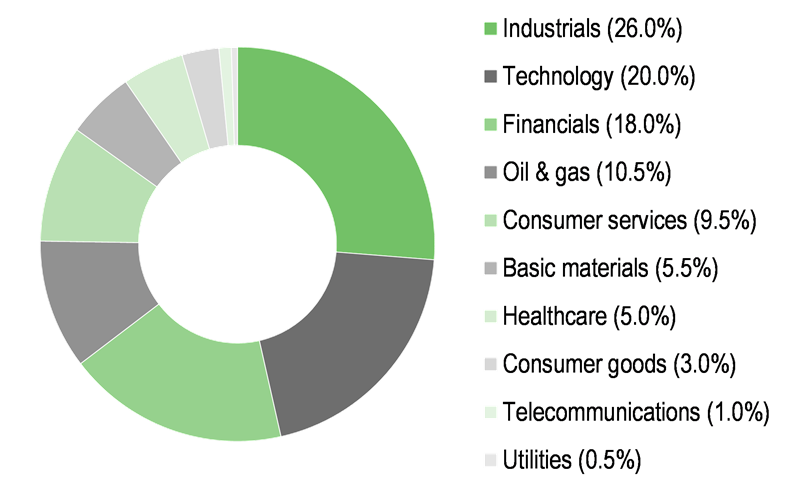
The recent change in the make-up of the Industry Classification Benchmark (ICB) industry sectors (with consumer goods and consumer services being replaced by consumer staples and consumer discretionary, oil & gas changing to energy, and real estate being split out from financials) means it is hard to make direct year-on-year comparisons (Exhibits 4 and 5). However, it is clear the managers’ principal focus remains on the top five areas of industrials (where there is a rich seam of smaller listed UK companies), financials (although the banks weighting has increased), consumer discretionary (which largely maps to the old consumer services sector), technology and energy (which in HOT’s portfolio is principally alternative energy, previously rather oddly classified within ‘oil & gas’). The natural resources bucket is mainly mining (classified in basic materials) rather than energy, with exposure to not just iron ore (in significant demand as a result of infrastructure-focused government stimulus spending around the world), but also copper and lithium, which are heavily geared to the themes of electrification and battery storage that are fundamental to the global energy transition.
|
Exhibit 4: 2021 portfolio breakdown by new ICB sector |
Exhibit 5: 2020 portfolio breakdown by old ICB sector |
|
|
|
Source: Henderson Opportunities Trust, Edison Investment Research. Note: Data at 31 May 2021 (Exhibit 4) and 31 May 2020 (Exhibit 5). End-May 2020 sector weightings are approximate. |
|
|
Exhibit 4: 2021 portfolio breakdown by new ICB sector |
|
|
|
|
Exhibit 5: 2020 portfolio breakdown by old ICB sector |
|
|
|
|
Source: Henderson Opportunities Trust, Edison Investment Research. Note: Data at 31 May 2021 (Exhibit 4) and 31 May 2020 (Exhibit 5). End-May 2020 sector weightings are approximate. |
Commenting on the outlook, Foll says she and Henderson believe there will be more positive earnings surprises as the year goes on. ‘I have been surprised by how quickly trading has gone back to 2019 levels (obviously excluding leisure and aerospace),’ she says, giving the example of slot machine hardware maker Quixant, which is exposed to the US casinos sector. ‘It obviously had a really difficult time when the casinos were shut last year but now its revenues have recovered fully, and we are hearing that across various markets – housebuilders, building materials, home improvements and so on.’ HOT’s managers were pleasantly surprised by the Q121 earnings of many of the portfolio’s more economically exposed companies, and expect further consensus upgrades. ‘There is a nervousness about making forecasts based on pre-COVID-19 numbers, both among company managements and analysts, but we think there are more upgrades to come from domestically exposed companies as reopening continues,’ says Foll, pointing to Scottish broadcaster STV, whose free-to-air ad revenues are already back to 2019 levels. ‘It has recovered very quickly – bring on Love Island!’
Performance: Strong recent returns are not an anomaly
Exhibit 6: Five-year discrete performance data
12 months ending |
Share price |
NAV |
CBOE UK All Cos (%) |
Numis Smlr Cos + AIM ex-ICs (%) |
CBOE UK Small Cos (%) |
CBOE UK 250 (%) |
31/05/17 |
16.7 |
22.2 |
24.4 |
26.4 |
25.2 |
18.7 |
31/05/18 |
16.0 |
13.5 |
6.6 |
6.3 |
7.5 |
7.6 |
31/05/19 |
(3.8) |
(3.2) |
(3.4) |
(7.0) |
(4.4) |
(7.6) |
31/05/20 |
(23.3) |
(20.1) |
(12.0) |
(12.1) |
(19.6) |
(12.3) |
31/05/21 |
113.8 |
69.3 |
23.4 |
55.6 |
66.1 |
42.9 |
Source: Refinitiv. Note: All % on a total return basis in pounds sterling.
HOT’s performance has been very strong over the past 12 months, with its share price more than doubling over the year to 31 May 2021, and its net asset value (NAV) total return of 69.3% outperforming both the broad UK index and mid- and small-cap indices both including and excluding AIM stocks (Exhibit 6). As the five discrete years’ performance numbers show, the trust has tended to perform in line with or ahead of the broad market (here shown by the CBOE UK All Companies index) in both rising and falling markets, although the sharp equity market sell-off in Q120 as a result of COVID-19 fears saw it underperform as small-caps declined more than their larger counterparts.
|
Exhibit 7: Investment trust performance to 31 May 2021 |
|
Price, NAV and index total return performance, one-year rebased |
Price, NAV and index total return performance (%) |
|
|
|
Source: Refinitiv, Edison Investment Research. Note: Three-, five- and 10-year performance figures annualised. |
|
As shown in Exhibit 7 (left-hand chart), HOT’s 12-month performance began to diverge from that of the index during the summer of 2020, buoyed by strong returns from alternative energy/fuel cell names such as Ceres Power and Ilika. However, the market rotation from growth to value stocks, which began in November 2020 as positive news on COVID-19 vaccine trials emerged, saw the gap widen, with HOT’s share price performing particularly strongly. This period largely tallies with the trust’s H121, during which Foll says the drivers of performance were much broader than in FY20. ‘FY20 was all about the early-stage names and alternative energy in particular, but H121 has been much more diverse,’ she explains. The top contributors during the half-year included Springfield Properties (a Scottish housebuilder), Next Fifteen Communications and Tracsis (rail software). In terms of the contribution from the buckets, the manager says early-stage, growth and compounders remained the largest drivers in absolute terms; although recovery stocks such as Hollywood Bowl and Gym Group have done very well since the vaccine news, they have still been eclipsed by the likes of Serica Energy and Tracsis. ‘Recovery is also a much smaller part of the portfolio, so it is harder for it to be significant when talking in contribution terms,’ Foll comments.
There continues to be a tension between growth and value factors in the broad market, with hopes of economic recovery and fears of higher inflation boosting cyclical areas such as leisure and financials, while the global semiconductor shortage and the sustainability agenda keep some technology and renewables names in the spotlight. As shown in Exhibit 8 (and the right-hand chart of Exhibit 7), HOT has mildly underperformed the comparator indices in NAV terms over the past one and three months, as well as in share price terms over the past month. However, it has performed strongly on both a relative and an absolute basis over all other periods shown. While it would be tempting to attribute this largely to the effect of the stellar year just past, a look back at our initiation note (published on 7 February 2020) shows the trust had outperformed the broad UK index over one, three, five and 10 years in the pre-COVID-19 period as well, with annualised 10-year NAV and share price total returns of c 12-15% being very similar to those shown in Exhibit 7. This gives some weight to the managers’ contention that the flexible investment approach makes HOT more of an ‘all-weather’ portfolio than some of its competitors (see Peer group section).
Exhibit 8: Share price and NAV total return performance, relative to indices (%)
|
One month |
Three months |
Six months |
One year |
Three years |
Five years |
10 years |
Price relative to CBOE UK All Cos |
(2.4) |
8.7 |
31.3 |
73.3 |
50.6 |
53.7 |
121.0 |
NAV relative to CBOE UK All Cos |
(3.2) |
(1.0) |
15.3 |
37.2 |
25.0 |
30.7 |
70.3 |
Price rel. to Numis Smlr Cos + AIM ex-ICs |
(2.2) |
7.0 |
18.6 |
37.4 |
24.1 |
25.0 |
70.0 |
NAV rel. to Numis Smlr Cos + AIM ex-ICs |
(3.1) |
(2.5) |
4.2 |
8.8 |
3.0 |
6.3 |
31.0 |
Price relative to CBOE UK Small Cos |
(3.3) |
4.7 |
13.5 |
28.7 |
23.7 |
24.3 |
66.4 |
NAV relative to CBOE UK Small Cos |
(4.2) |
(4.7) |
(0.3) |
1.9 |
2.6 |
5.7 |
28.2 |
Price relative to CBOE UK 250 |
(2.7) |
8.2 |
22.6 |
49.6 |
36.4 |
44.6 |
57.7 |
NAV relative to CBOE UK 250 |
(3.6) |
(1.4) |
7.7 |
18.5 |
13.1 |
22.9 |
21.6 |
Source: Refinitiv, Edison Investment Research. Note: Data to end-May 2021. Geometric calculation.
Peer group comparison: On top over one and five years
Exhibit 9: AIC UK All Companies peer group at 22 June 2021*
% unless stated |
Market |
NAV TR |
NAV TR |
NAV TR |
NAV TR |
Ongoing |
Perf. |
Discount |
Net |
Dividend |
Henderson Opportunities Trust |
114.1 |
58.7 |
25.6 |
85.7 |
207.6 |
0.9 |
Yes |
(7.6) |
115 |
1.9 |
Artemis Alpha Trust |
162.9 |
36.1 |
14.6 |
67.1 |
63.1 |
1.0 |
No |
(6.5) |
100 |
1.2 |
Aurora |
176.2 |
33.0 |
12.4 |
51.1 |
4.0 |
0.5 |
Yes |
0.9 |
100 |
0.2 |
Baillie Gifford UK Growth Trust |
363.8 |
23.3 |
20.3 |
52.8 |
118.5 |
0.7 |
No |
(0.1) |
100 |
1.0 |
Fidelity Special Values |
913.8 |
44.1 |
15.9 |
59.3 |
184.9 |
1.0 |
No |
2.0 |
115 |
2.0 |
Independent IT |
297.8 |
33.9 |
(2.3) |
71.0 |
201.8 |
0.3 |
No |
(10.0) |
100 |
1.4 |
JPMorgan Mid Cap |
339.0 |
43.8 |
19.3 |
60.5 |
255.3 |
0.9 |
No |
(1.1) |
110 |
2.0 |
Mercantile |
2,129.2 |
42.4 |
28.7 |
71.8 |
208.3 |
0.5 |
No |
(7.2) |
110 |
2.5 |
Schroder UK Mid Cap |
253.2 |
43.5 |
25.0 |
65.5 |
198.1 |
0.9 |
No |
(6.0) |
106 |
1.8 |
Sector average (9 funds) |
527.8 |
39.9 |
17.7 |
65.0 |
160.2 |
0.7 |
(3.9) |
106 |
1.6 |
|
HOT rank in sector |
9 |
1 |
2 |
1 |
3 |
3 |
8 |
1 |
4 |
Source: Morningstar, Edison Investment Research. Note: *Performance to 21 June 2021 based on cum-fair NAV. TR = total return. Net gearing is total assets less cash and equivalents as a percentage of net assets (100 = ungeared).
In Exhibit 9 we show HOT in the context of its AIC UK All Companies sector. With the exception of JPMorgan Mid Cap, Mercantile (small- and mid-cap) and Schroder UK Mid Cap, all of the peers have an all-cap approach. Artemis Alpha, Fidelity Special Values and Independent IT all have at least 10% invested overseas, meaning that the closest comparators for HOT based on geographic allocations are Aurora (ARR) and Baillie Gifford UK Growth (BGUK). According to Morningstar data supplied by the AIC, while all three funds have similar (c 20%) exposure to large-cap stocks, HOT is biased towards small-caps (60%+), while both BGUK and ARR have c 50% in mid-cap stocks. In style terms, HOT is quite evenly spread between growth, core and value, while BGUK has a distinct growth bias (c 50% of the portfolio) and ARR is more core (c 65%). Having outperformed both of these peers significantly over all the time periods shown, it would be natural to conclude that HOT’s balance of styles (which can be dialled up and down as deemed appropriate by the managers) and small-cap bias has served it well; however, it is also worth noting that both BGUK and ARR are ungeared, while HOT’s c 15% gearing will have boosted its performance further in the short and medium term. Ongoing charges are slightly above the mean but in line with the median, while the trust is one of two in the peer group that may pay a performance fee. The dividend yield, although modest at 1.9%, is above average for the peer group.
The combination of capturing both the growth trends of 2020 and the value rotation since last November has helped propel HOT to the top of its peer group in NAV performance terms over one and five years to 21 June, second place over three years and a marginal third (missing the second spot by less than a percentage point) over 10 years. However, while its discount to NAV has narrowed substantially from its medium-term average of c 16%, it remains on the second widest discount in the AIC UK All Companies peer group. Pointing to the recent 10-year narrowest discount of 0.1% (see Exhibit 10), Henderson says that the managers’ and board’s ambition is to get to a point where new shares could be issued, allowing them to grow what remains the smallest trust in the peer group. ‘Appetite is moving towards a more HOT-type approach as the bull market matures,’ he comments. While the trust is widely owned by retail investors (the top three shareholders, accounting for c 40% of the total, are retail platforms), Henderson says some recent buying has come from wealth managers and funds of funds, which increasingly appreciate HOT’s role as a ‘mixer’ in a diversified portfolio. Average daily trading volume over the past 12 months has been 18,000 shares, or 0.2% of the total, which compares well with much larger vehicles such as Fidelity Special Values (also 0.2% over 12 months).
|
Exhibit 10: Premium/discount over three years |
|
|
Source: Refinitiv, Edison Investment Research |
|
|
Investment Companies
Research: Investment Companies
Princess Private Equity (PEY) reported a strong c 10% NAV TR from January to end-April 2021 (10% in FY20), largely driven by its in-closing exit from GlobalLogic announced in March 2021, generating a 45% uplift from its end-February 2021 carrying value. This represents a very solid 5.3x multiple on invested capital, despite the short holding period since 2018. PEY’s attractive dividend yield of c 5% is ahead of most of its peers and the manager is confident in its ability to maintain the current dividend policy to distribute c 5% of the opening NAV. PEY has a comfortable liquidity position with a coverage ratio at c 49% at end-April 2021, further supported by proceeds from major exits agreed in 2021 but not yet closed.