Last close As at 05/08/2026
CHF12.26
▲ 0.44 (3.72%)
Market capitalisation
CHF256m
Research: Healthcare
Newron Pharmaceuticals has reported results for FY23, an active period for its lead asset, evenamide, being developed for treatment-resistant schizophrenia (TRS) and poorly managed schizophrenia (non-TRS). Strong 12-month data were shared in January 2024 from the Phase II trial (study 014/015) in TRS patients, and management is gearing up to launch a potentially pivotal Phase III trial. We expect the next major catalyst to be results of the Phase III trial (study 008A) in non-TRS patients, now anticipated in April. Improved liquidity following the recent equity raise and renegotiated debt repayment terms with the EIB provides headroom into 2025, by which time we anticipate a licensing deal for evenamide. We have revised our estimates, segregating evenamide’s potential across TRS and non-TRS populations, and refined some of our assumptions. Our valuation increases to CHF219.1m or CHF12.3/share (CHF7.7/share previously).
Written by
Newron Pharmaceuticals |
Evenamide set for a pivotal year |
FY23 results |
Pharma and biotech |
20 March 2024 |
Share price performance
Business description
Next events
Analysts
Newron Pharmaceuticals is a research client of Edison Investment Research Limited |
|||||||||||||||||||||||||||||||||||||||||||||||||||||||||
Newron Pharmaceuticals has reported results for FY23, an active period for its lead asset, evenamide, being developed for treatment-resistant schizophrenia (TRS) and poorly managed schizophrenia (non-TRS). Strong 12-month data were shared in January 2024 from the Phase II trial (study 014/015) in TRS patients, and management is gearing up to launch a potentially pivotal Phase III trial. We expect the next major catalyst to be results of the Phase III trial (study 008A) in non-TRS patients, now anticipated in April. Improved liquidity following the recent equity raise and renegotiated debt repayment terms with the EIB provides headroom into 2025, by which time we anticipate a licensing deal for evenamide. We have revised our estimates, segregating evenamide’s potential across TRS and non-TRS populations, and refined some of our assumptions. Our valuation increases to CHF219.1m or CHF12.3/share (CHF7.7/share previously).
Year end |
Revenue |
PBT* |
EPS* |
DPS |
P/E |
Yield |
12/22 |
6.09 |
(16.99) |
(0.95) |
0.0 |
N/A |
N/A |
12/23 |
9.06 |
(16.00) |
(0.90) |
0.0 |
N/A |
N/A |
12/24e |
24.33 |
(2.6) |
(0.14) |
0.0 |
N/A |
N/A |
12/25e |
27.06 |
(0.8) |
(0.04) |
0.0 |
N/A |
N/A |
Note: *PBT and EPS are normalised, excluding amortisation of acquired intangibles, exceptional items and share-based payments.
Catalysts galore in 2024
We view 2024 to be a crucial year for evenamide, with top-line results from the potentially pivotal study 008A in non-TRS patients expected in April and the Phase III study in TRS (study 017) anticipated to launch this year. The 008A study is evaluating evenamide (30mg bid) in patients non-responsive to available antipsychotics, but not classed as having TRS, a group that constitutes c 40% of the schizophrenia patient population. The upcoming pivotal study 017 will evaluate patients with TRS (30% of the patient population) with potential backed by solid results (announced in January 2024) from the Phase II and extension studies 014/015. Should the 008A study data be positive, we expect the company to be able to sign a licensing agreement for evenamide by H224.
Improved financial flexibility after recent agreements
Newron ended the year with a gross cash and cash equivalent balance of €12.6m, which has been bolstered by the recently announced financing arrangement for up to €15m in funds through a private placement (c €5.5m initially received) with improved legroom provided by the amended debt repayment terms with the European Investment Bank (first repayment now due in November 2025, from June 2024 previously, albeit with increased servicing costs). We estimate the pro forma cash to be sufficient to fund operations into 2025, past the upcoming milestones.
Valuation: CHF219.1m or CHF12.3 per share
We have updated our estimates, segregating evenamide’s value across the two target schizophrenia subsets to provide greater visibility on the potential across the two sub-indications and account for the difference in expected time to market (2025 in non-TRS and 2027 in TRS). We also update our assumptions on corporate level expenses. Our valuation is now to CHF12.3/share (CHF7.7/share previously).
Active CNS pipeline focused on schizophrenia
Newron Pharmaceuticals is a biopharmaceutical company focused on conditions of the central nervous system (CNS) (see Exhibit 1). Xadago is the company’s first marketed product and is used as an adjuvant therapy for Parkinson’s disease. Royalties from Xadago (c €9m in FY23 versus c €6m in FY22) continue to dominate the company’s top-line revenues. Newron, alongside its partners Zambon and Supernus, has continued to work to protect the intellectual property rights for Xadago. After a settlement agreement with generic manufacturers (pursuant to an Abbreviated New Drug Application filed in 2021), the company continues to hold patent protection to Xadago until at least 1 December 2027. In Europe, supplementary protection certificates have been approved in most territories of relevance, with approvals in the remaining key territories expected in the near term.
Newron’s lead clinical-stage product is evenamide, a voltage-gated sodium channel inhibitor. Evenamide is in development for the treatment of schizophrenia, including both poorly managed schizophrenia and TRS.
|
Exhibit 1: Newron’s clinical pipeline |
|
|
Source: Newron Pharmaceuticals website |
Opportunity for novel treatments in schizophrenia
Schizophrenia treatments have not progressed much since the 1950s, which saw the approval of typical antipsychotics (designed as dopamine type 2 receptor antagonists, eg chlorpromazine, haloperidol, pimozide, loxapine). In the 1970s, these treatments were complemented by atypical antipsychotics (which target serotoninergic receptors 5-HT2A, eg clozapine, olanzapine, risperidone, quetiapine and are associated with fewer side effects). While these drugs have been effective for positive symptoms (hallucinations, delusions), they have limited efficacy against negative (affective flattening, anhedonia, avolition) and cognitive (deficits in memory, attention, learning, executive function) symptoms. As understanding of schizophrenia pathophysiology progresses, we believe the field is at the precipice of a new era of treatments, with significant opportunity for Newron to address the unmet need in this space, particularly with its programmes focused on both non-TRS and TRS sub-populations (see Exhibit 2). The schizophrenia treatment market was valued at c $7.4bn in 2023 and is projected by Research and Markets to be worth c $9.5bn by 2030 (a CAGR of 3.5%).
|
Exhibit 2: Newron is focused on both non-TRS and TRS |
|
|
Source: Newron corporate presentation (February 2024) |
Recent deals suggest the pace in CNS is picking up
With transactions in the biotech sector picking up in recent months, schizophrenia has been in the spotlight, evidenced with movements from big pharma in this space. Notably, in December 2023, AbbVie announced the acquisition of Cerevel in a deal worth $8.7bn. Importantly, this gives AbbVie access to Cerevel’s promising Phase II asset, emraclidine, which is being developed for the treatment of schizophrenia. Also in December 2023, another key transaction was Bristol Myers Squibb’s acquisition of Karuna Therapeutics for $330/share in cash (total equity value of $14bn or $12.7bn net of estimated cash acquired). At the centre of this deal was Karuna’s KarXT, which is the same class of therapeutic as emraclidine for the treatment of schizophrenia, albeit at a later stage of development. The FDA has set a Prescription Drug User Fee Act (PDUFA) goal date of 26 September 2024. In our view, these deals reflect the resurgence of interest in the field, which has been relatively stagnant since the 1950s.
Evenamide: Outlook for 2024
Non-TRS: Potentially pivotal study 008A
Newron’s most advanced clinical programme is focused on the development of evenamide for the treatment of poorly managed schizophrenia in patients already receiving antipsychotics, but who are not classed as having TRS. The potentially pivotal Phase III trial (study 008A) is a randomised, double-blind, placebo-controlled study to assess the safety, efficacy and tolerability of evenamide following a four-week 30mg bid treatment regimen (n=290). The primary endpoint is improvement in the Positive and Negative Syndrome Scale (PANSS) total score from baseline. Secondary endpoints include safety and tolerability, as well as other efficacy measures. In December 2023, the company announced that patient recruitment was complete, serving as a positive indicator that the trial is progressing as anticipated, in our view. Top-line results are due to be shared in April 2024. We believe this could be the next significant catalyst for investor attention, provided the data are positive.
TRS: Study 015 exceeded expectations, onto pivotal study 017
The latest clinical data for evenamide come from the Phase II trial (study 014 – six weeks, and study 015 – extension study). This was an open-label, rater-blinded, multi-centre (India, Italy and Sri Lanka) trial to assess the long-term efficacy, safety and tolerability of evenamide (7.5mg, 15mg and 30mg bid) in TRS patients as an add-on treatment (to any single antipsychotic drug excluding clozapine, the last approved drug for TRS, in 1989). While 161 patients were initially randomised, 153 completed the initial six weeks and 144 entered the extension study. 132 patients completed treatment up to six months and 121 patients completed 12 months.
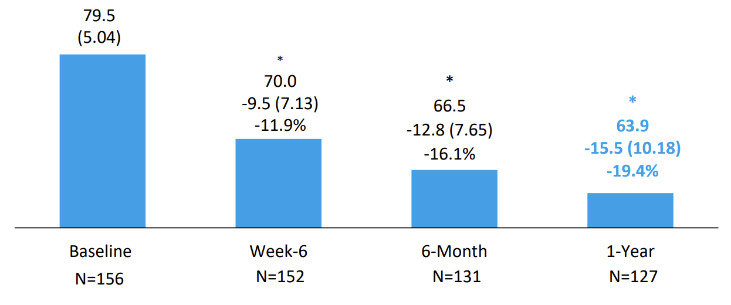
In January 2024, Newron announced 12-month data from the extension study. The results showed a statistically significant improvement in PANSS mean percentage change from baseline, showing sustained benefit with evenamide treatment from six weeks, six months, through to the 12-month follow-up (see Exhibit 3). It was also noted that c 40% of patients showed a clinically meaningful result based on PANSS measurements at 12 months, defined as showing an improvement of ≥20%.
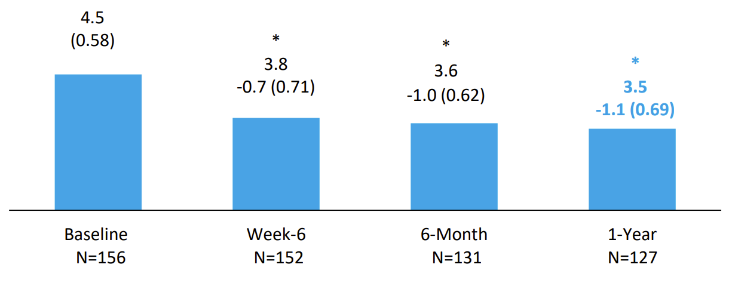
In addition, condition severity was investigated using Clinical Global Impressions (CGI) measures, which also showed statistically significant improvements versus baseline (see Exhibit 4). Importantly, the results showed a reduction in severity of the condition in over 70% of patients. Furthermore, Level of Functioning (LOF) was also investigated, and the data showed a statistically significant benefit, with over 60% of patients showing an improvement after 12 months.
|
Exhibit 3: PANSS mean percentage change from baseline (standard deviation in brackets) |
Exhibit 4: CGI-S mean percentage change from baseline (standard deviation in brackets) |
|
|
|
Source: Newron FY23 results presentation. Note: *p-value versus baseline < 0.001, paired t-test, Observed cases. |
|
Exhibit 3: PANSS mean percentage change from baseline (standard deviation in brackets) |
|
|
Source: Newron FY23 results presentation. Note: *p-value versus baseline < 0.001, paired t-test, Observed cases. |
|
Exhibit 4: CGI-S mean percentage change from baseline (standard deviation in brackets) |
|
|
Source: Newron FY23 results presentation. Note: *p-value versus baseline < 0.001, paired t-test, Observed cases. |
In our view, these results are highly encouraging for evenamide as a potential adjuvant therapy for TRS patients. This was emphasised by the fact that c 50% of patients no longer met the protocol severity criteria for a diagnosis of TRS at 12 months. Moreover, c 25% of all patients were described as achieving remission, which, to our knowledge, has not yet been observed in this sub-population. On the safety front, evenamide in combination with antipsychotics was well-tolerated, with low incidence of treatment-emergent adverse dropouts. There were also no cases of patient relapses throughout the study treatment period.
Following these positive results, focus now shifts to study 017, a potentially pivotal Phase III trial in TRS. According to the company, and subject to final agreement by potential partners and regulatory bodies, this will involve ≥510 patients randomised (1:1:1) to receive either evenamide (15mg bid), evenamide (30mg bid) or placebo for 12 weeks (Exhibit 5). This will be a double-blinded trial to mitigate any potential biases in the assessment of patients. The primary efficacy measures (at 12 weeks) will be PANSS total change from baseline, with CGI-schizophrenia (CGI-S) change from baseline as a key secondary efficacy measure. An additional endpoint of PANSS total change from baseline will be assessed at 26 weeks, referred to as the maintenance efficacy measure. A further endpoint, also the PANSS total change from baseline, will be assessed at 52 weeks, referred to as the long-term efficacy measure. An open-label extension study will be conducted after one year, with patients from the initial portion of the Phase III study moving onto the extension arm as they complete treatment. We believe that the initiation of this trial (expected within 2024) will represent an important milestone for Newron and the clinical development of evenamide in TRS.
We note that Newron is currently in various discussions with potential partners; we expect an update from management on this front once the information becomes available. For a more detailed discussion of the study 015 results and outlook for evenamide in TRS, we direct readers to our January update note.
|
Exhibit 5: Design of the potentially pivotal Phase III trial in TRS (study 017) |
|
|
Source: Newron FY23 results presentation |
Financials
Newron currently generates all its revenues from its on-market drug Xadago (safinamide), being commercialised in collaboration with licensing partners Zambon and Supernus (commercial rights in the US). In FY23, the company generated revenues of €9.1m (up 48.6% y-o-y) primarily derived from Xadago-related royalty income and other payments from partners. This was broadly in line with our estimate of €8.9m. Xadago holds patent protection to December 2027, and we therefore expect a steady revenue stream from the drug to expiry. Total operating expenses grew 6.7% y-o-y to €20.7m, of which R&D expenses comprised 64% with the remainder attributed to general and administrative (G&A) expenses. G&A expenses continued to track in line with the recent trend (€7.5m vs €7.3m in FY22) and were similar to our estimate of €7.4m. R&D expenses increased 9.6% y-o-y to €13.2m (in line with our estimate of €13.4m) but was unsurprising given the ongoing late-stage clinical activity for evenamide. The overall reported operating loss improved to €11.6m from €13.3m in FY22 (our estimate was an €11.9m operating loss in FY23). The company reported a pre-tax loss of €16.2m in FY23, compared to €17.5m in FY22, which incorporated €4.2m of net interest expense in FY22 related to accrual of the outstanding €40m EIB loan interest.
As a reminder, Newron had signed an up to €40m financing facility with the EIB in October 2018, all of which was subsequently drawn down over 2019–21 across five tranches. Each tranche had an interest rate of 3% annually to be paid as arrears. An additional fixed rate (6.75%, 6.25% or 5.25% depending on the tranche) was also payable on expiry of the facility. As part of the agreement Newron issued a total of 807,169 warrants (201,793 warrants for the first tranche and 151,344 warrants each for the remaining four tranches) to the EIB, convertible at a price of €9.25/unit (currently out of the money) following the repayment of each loan tranche. At end FY23, principal plus accrued interest under the facility stood at €48m. Note that the repayment date for the first €10m tranche was previously set for June 2024, but following renegotiations with the EIB (announced in March 2024), maturity dates have been revised (refer to our note from more details), with tranche 1 now coming due only in November 2025. As part of the deal amendment, the interest rate for all traches has been increased to 9.75%. In addition, the EIB will be entitled to certain performance-based payouts – 1% of the fair value of the company for tranche 1 (latter of the maturity date or on request) and 0.75% for all other tranches. This additional payout has been capped at €7.5m. In addition, Newron has specified that the interest rate will rise by another 3% if the company is not able to meet a certain (undisclosed) milestone on or before 31 December 2024. While these revised terms come with higher servicing costs and future obligations for Newron, we believe that they meet the broader purpose of providing the company with greater financial flexibility in what is a crucial period for the company.
We have made some adjustments to our FY24 forecasts based on the FY23 results and operational visibility and have introduced FY25 estimates. Provided the 008A study results are positive, we now model the company signing a licensing deal in H224 (previously 2025), with a risk-adjusted upfront payment of €17.5m (€25m gross), which we now show as licensing revenue in FY24. Royalty payment estimates for Xadago have been kept broadly unchanged. Our FY24 estimate for total revenue is now €24.3m versus €6.8m previously. With the pivotal Phase III 017 study anticipated to commence within 2024, we expect R&D expenses to remain high at €14.4m (albeit lower than our previous projection of €18.5m) offset by the conclusion of the 008A study. We also tweak our G&A estimates slightly to €7.9m (€7.5m previously) reflecting the FY23 trend. Overall, we now project an operating profit of €2.0m in FY24 versus an operating loss of €19.2m previously. For FY25, we estimate an operating profit of €3.2m, reflecting inflows from milestone payments from its outlicensing partner. For our model, we assume a global licensing deal for evenamide in H224 with a total deal value of €650m (including development and commercial milestone payments) and an upfront payment of €25m. We also assume a tiered royalty rate of 12–15% based on certain sales targets. For reference, we present selected clinical-stage licensing deals in schizophrenia (with deal values) in Exhibit 6.
Exhibit 6: Historical licensing deals in schizophrenia (Phase II and III)
Deal date |
Company |
Product |
Deal partner |
Status on deal date |
Upfront payment ($m) |
Deal value ($m) |
12/10/2022 |
Royalty Pharma |
MK-8189 |
Merck & Co |
Phase II |
50 |
425 |
16/06/2020 |
Neurocrine Biosciences |
TAK-831 |
Takeda |
Phase II |
120 |
2,015 |
20/06/2010 |
Cypress Bioscience |
BL-1020 |
BioLineRx |
Phase II |
30 |
345 |
28/12/2005 |
AstraZeneca |
TC-1734 |
Targacept |
Phase II |
10 |
300 |
20/10/2003 |
Pfizer |
Saphris |
Akzo Nobel |
Phase III |
100 |
370 |
29/06/2000 |
Forest Laboratories |
Namenda |
Merz |
Phase III |
10 |
55 |
Average |
53 |
585 |
||||
Source: EvaluatePharma
Newron exited FY23 with gross cash of €6.3m and liquid assets of another €6.3m (including corporate and government bonds and investment funds), which has been bolstered post-period by the receipt of c €5.5m in initial funds from a potential €15m private placement to an institutional investor (announced in March 2024). Based on our FY24 cash burn projections of €16.5m (excluding any potential inflows for a licensing deal for evenamide), we estimate the available capital to be sufficient to fund operations into FY25, even if a licensing deal does not materialise during the year. For our model (which assumes a licensing deal in H224 as stated above), we estimate the upfront, milestone and subsequent royalty payments will be sufficient to sustain operations without the need for additional external funding. Note that these estimates assume a 2026 launch of evenamide, which in the event of a delay may require the company to explore additional funding options to support its clinical pipeline. If Newron decides to develop and commercialise evenamide independently (or if a partnership deal does not happen), we estimate it will need c €30m in capital in 2025 (of which €9.5m may be available under the March 2024 private placement; the investor can subscribe for at its discretion after January 2025) and another €10m in 2026 before becoming self-sufficient. If this is achieved through equity capital, Newron will need to issue an additional c 5.1 million shares (at the current trading price of CHF7.86/share), which would dilute current shareholders by c 22% (shares outstanding would increase to 22.9 million).
Valuation
With the 008A study for evenamide approaching topline readouts and the 017-study expected to commence Phase III trials in Q224, we have revised our estimates to inject more granularity in the potential across both sub-indications in schizophrenia. We continue to value Newron on a risk-adjusted net present value (NPV) basis across its two assets, Xadago in Parkinson’s disease and evenamide in schizophrenia, but have now divided the market potential for the latter across the two sub-sets – non-responders/non-TRS and TRS. This also allows us to better reflect the different study completion and potentially launch timelines across the two programmes. For non-responders/non-TRS, we estimate the target population to be 40% of the overall schizophrenia population and factor in a conservative peak penetration rate of 5% (due to this being a more competitive market). For TRS, we assume the target patient population to be 30% of the overall schizophrenia population and model a higher peak penetration rate of 15%, given this patient subset remains underserved with limited treatment options. For non-responders/non-TRS we estimate a probability of success (PoS) of 70% and a launch date of 2026, while for TRS the PoS has been assigned at 60% with a potential launch timeline of 2027. Previously we were combining both target areas, assigning a PoS of 60% and a launch date of 2025. We assume an annual list price of $15,000 for evenamide, in line with the list price of the most recent third-generation antipsychotics.
In addition to this, we have refined certain assumptions related to corporate level expenses, primarily related to R&D costs not attributed to the two assets. Based on these revisions, forex updates, rolling our model forward and the latest year-end net debt position, our valuation for Newron revises upwards to CHF219.1m or CHF12.3share (from CHF137.4m or CHF7.7/share previously). Note that the revised valuation does not incorporate the initial €5.5m funds raised from the private placement or the commensurate share dilution. Adjusting for these would result in our valuation changing to CHF224.4m or CHF12.1/share.
Exhibit 7: Newron valuation breakdown
Product |
Indication |
Launch |
Probability |
rNPV |
NPV/share (CHF/share) |
|
Xadago |
Parkinson’s disease |
2015 |
100% |
26.8 |
1.5 |
|
Evenamide |
Schizophrenia – non-responders/non-TRS |
2026 |
70% |
139.5 |
7.8 |
|
Evenamide |
TRS |
2027 |
60% |
127.3 |
7.1 |
|
Total direct product value |
|
|
|
293.6 |
16.5 |
|
|
||||||
Direct costs to 2033 less tax |
(40.1) |
(2.2) |
||||
Gross cash at end-December 2023 |
12.2 |
0.7 |
||||
Loans (fair value December 2023) |
(46.6) |
(2.6) |
||||
Valuation |
|
|
|
219.1 |
12.3 |
|
Source: Edison Investment Research
Exhibit 8: Financial summary
Accounts: IFRS, Yr end: December 31, €:000s |
|
2021 |
2022 |
2023 |
2024e |
2025e |
PROFIT & LOSS |
|
|
|
|
|
|
Total revenues |
|
5,762 |
6,094 |
9,057 |
24,331 |
27,055 |
Cost of sales |
|
0 |
0 |
0 |
0 |
0 |
Gross profit |
|
5,762 |
6,094 |
9,057 |
24,331 |
27,055 |
Total operating expenses |
|
(18,119) |
(19,396) |
(20,686) |
(22,352) |
(23,883) |
Research and development expenses |
|
(10,725) |
(12,005) |
(13,152) |
(14,444) |
(15,577) |
SG&A |
|
(7,394) |
(7,391) |
(7,534) |
(7,909) |
(8,306) |
EBITDA (normalized) |
|
(11,386) |
(12,620) |
(11,231) |
2,134 |
3,294 |
Operating income (reported) |
|
(12,357) |
(13,302) |
(11,629) |
1,978 |
3,172 |
Finance income/(expense) |
|
(2,527) |
(4,170) |
(4,571) |
(4,578) |
(3,973) |
Exceptionals and adjustments |
|
0 |
0 |
0 |
0 |
0 |
Profit before tax (reported) |
|
(14,884) |
(17,472) |
(16,200) |
(2,600) |
(801) |
Profit before tax (normalised) |
|
(14,122) |
(16,992) |
(16,003) |
(2,600) |
(801) |
Income tax expense (includes exceptionals) |
|
(17) |
(21) |
(24) |
0 |
0 |
Net income (reported) |
|
(14,901) |
(17,493) |
(16,224) |
(2,600) |
(801) |
Net income (normalised) |
|
(14,139) |
(17,013) |
(16,027) |
(2,600) |
(801) |
Basic average number of shares, m |
|
17,845.0 |
17,845.0 |
17,845.0 |
18,407.5 |
18,595.0 |
Basic EPS (€) |
|
(0.84) |
(0.98) |
(0.91) |
(0.14) |
(0.04) |
Adjusted EPS (€) |
|
(0.79) |
(0.95) |
(0.90) |
(0.14) |
(0.04) |
|
|
|
|
|
|
|
BALANCE SHEET |
|
|
|
|
|
|
Property, Plant and Equipment |
|
87 |
72 |
53 |
39 |
29 |
Right of use assets (leases) |
|
490 |
455 |
352 |
280 |
223 |
Intangible Assets |
|
2 |
0 |
0 |
0 |
0 |
Non-current receivables (Tax credits) |
|
10,480 |
8,175 |
5,809 |
2,990 |
1,470 |
Total non-current assets |
|
11,059 |
8,702 |
6,214 |
3,309 |
1,721 |
Cash and equivalents |
|
25,019 |
13,424 |
6,338 |
12,660 |
3,692 |
Current financial assets |
|
9,575 |
9,350 |
6,261 |
6,261 |
6,261 |
Inventories |
|
0 |
0 |
0 |
0 |
0 |
Trade Accounts Receivable |
|
4,833 |
5,719 |
7,053 |
6,386 |
6,720 |
Total current assets |
|
39,427 |
28,493 |
19,652 |
25,307 |
16,672 |
Trade Accounts Payable |
|
3,504 |
4,869 |
6,106 |
6,036 |
6,678 |
Other Current Liabilities |
|
150 |
172 |
543 |
543 |
543 |
Short-term Debt |
|
0 |
0 |
22,277 |
22,277 |
12,277 |
Total current liabilities |
|
3,654 |
5,041 |
28,926 |
28,856 |
19,498 |
Long-term Debt |
|
42,542 |
45,165 |
25,753 |
25,753 |
25,753 |
Leasing Obligations |
|
389 |
325 |
210 |
133 |
69 |
Share based liabilities |
|
213 |
220 |
473 |
473 |
473 |
Long-term Provisions |
|
581 |
474 |
412 |
412 |
412 |
Total non-current liabilities |
|
43,725 |
46,184 |
26,848 |
26,771 |
26,707 |
Equity attributable to company |
|
3,107 |
(14,030) |
(29,908) |
(27,010) |
(27,811) |
|
|
|
|
|
|
|
CASH FLOW STATEMENT |
|
|
|
|
|
|
Pre-tax profit |
|
(14,884) |
(17,472) |
(16,200) |
(2,600) |
(801) |
Net Financial Income |
|
(792) |
(1,183) |
(1,162) |
10 |
6 |
Tax |
|
0 |
0 |
0 |
0 |
0 |
Depreciation and amortisation |
|
209 |
202 |
201 |
155 |
122 |
Share based payments |
|
762 |
480 |
197 |
0 |
0 |
Other adjustments |
|
3,524 |
4,996 |
5,311 |
2,819 |
1,520 |
Movements in working capital |
|
(264) |
1,885 |
1,513 |
597 |
308 |
Cash from operations (CFO) |
|
(11,445) |
(11,092) |
(10,140) |
982 |
1,156 |
Capex |
|
(20) |
(18) |
(11) |
(69) |
(55) |
Acquisitions & disposals net |
|
0 |
0 |
0 |
0 |
0 |
Other investing activities |
|
8,440 |
(299) |
3,257 |
0 |
0 |
Cash used in investing activities (CFIA) |
|
8,420 |
(317) |
3,246 |
(69) |
(55) |
Loans received |
|
15,000 |
0 |
0 |
0 |
0 |
Loan repayments |
|
0 |
0 |
0 |
0 |
(10,000) |
Equity issued |
|
0 |
0 |
0 |
5,498 |
0 |
Other Financing Cash Flows (leases) |
|
(169) |
(186) |
(192) |
(88) |
(70) |
Cash from financing activities (CFF) |
|
14,831 |
(186) |
(192) |
5,410 |
(10,070) |
Cash and equivalents at beginning of period |
|
13,213 |
25,019 |
13,424 |
6,338 |
12,660 |
Increase/(decrease) in cash and equivalents |
|
11,806 |
(11,595) |
(7,086) |
6,322 |
(8,969) |
Effect of FX on cash and equivalents |
|
0 |
0 |
0 |
0 |
0 |
Cash and equivalents at end of period |
|
25,019 |
13,424 |
6,338 |
12,660 |
3,692 |
Net (debt)/cash (including liquid resources) |
|
(7,948) |
(22,391) |
(35,431) |
(29,109) |
(28,077) |
Source: Company reports, Edison Investment Research
|
|
Research: Investment Companies
The Biotech Growth Trust’s (BIOG’s) two co-managers, Geoff Hsu and Josh Golomb, at global healthcare specialist OrbiMed, believe that now could be an opportune time to consider the biotech sector as it is recovering from the longest and largest absolute and relative drawdown since 2006. The sector was negatively affected by sharply rising interest rates rather than a deterioration in industry fundamentals; indeed, the managers continue to refer to a ‘golden era’ of innovation within the biotech sector. BIOG’s relative performance has been through a difficult period given its high weighting in emerging (smaller-cap) biotech stocks, which performed significantly worse than the shares of large-cap biotech businesses during the sector sell-off.