Last close As at 05/08/2026
GBP4.65
▲ −5.50 (−1.17%)
Market capitalisation
GBP5,792m
Research: Industrials
Melrose Industries’ investor event focused on the key GKN Aerospace engines business (Edison estimate 81% of FY23 profit). The industry-wide Risk and Revenue Sharing Partnerships (RRSPs) and its position as a design partner on both the next-generation engines under development are testament to the capabilities and technologies it possesses. Investment continues in order to maintain such leading positions as seen in additive fabrication and manufacturing, which includes a new £40m facility to support signed commercial contracts. This will put GKN Aerospace at the forefront of this step change technology, promoting future partnerships and commercial opportunities.
Melrose Industries |
Engine for growth |
Investor event |
Aerospace & defence |
24 October 2023 |
Share price performance
Business description
Next events
Analyst
Melrose Industries is a research client of Edison Investment Research Limited |
|||||||||||||||||||||||||||||||||||||||||||||
Melrose Industries’ investor event focused on the key GKN Aerospace engines business (Edison estimate 81% of FY23 profit). The industry-wide Risk and Revenue Sharing Partnerships (RRSPs) and its position as a design partner on both the next-generation engines under development are testament to the capabilities and technologies it possesses. Investment continues in order to maintain such leading positions as seen in additive fabrication and manufacturing, which includes a new £40m facility to support signed commercial contracts. This will put GKN Aerospace at the forefront of this step change technology, promoting future partnerships and commercial opportunities.
Year end |
Revenue (£m) |
PBT* |
EPS* |
DPS |
P/E |
Yield |
12/22 |
2,957 |
62 |
4.1 |
2.3 |
112.0 |
0.5 |
12/23e |
3,410 |
288 |
16.8 |
4.2 |
27.2 |
0.9 |
12/24e |
3,605 |
415 |
24.9 |
6.3 |
18.4 |
1.4 |
12/25e |
4,068 |
616 |
37.5 |
9.4 |
12.2 |
2.0 |
Note: *PBT and EPS are normalised, excluding amortisation of acquired intangibles, exceptional items and share-based payments.
Technology driving OE partnerships and RRSPs
Over 40 years GKN Aerospace migrated its engines business from being a component supplier to an integrated design and build partner through its capabilities and technology offering. As a consequence, it has developed strong relationships with all the key engine manufacturers, as demonstrated by the breadth of its 19 RRSPs. The next technology wave is likely to be in additive fabrication and manufacturing (AF/AM), offering the potential for next-generation engines and the retrofit of engines currently in production given the improvements in performance that can be achieved. GKN is investing £40m in a new facility for the engines business to support migrating current business to AF/AM. The success of this adoption, assisted by the sector’s supply constraints, could prove the tipping point to adoption of this technology and a key growth driver past 2025, when growth of the civil new build market may moderate.
Trading update
The full year margin for the Engines division is now expected to be c 24%. This reduces the increase required to meet the 2025 target of 28%, while management is forecasting medium-term margins for the business of at least 30%. A full trading update is due in mid-November. We have not changed our forecasts or valuation (628p a share) as per our note in September on the interim results.
GTF engine programme additional costs
Management provided guidance as to the expected impact in a September release. RTX announced that it anticipates costs of $1.5bn for rectification work and $4.5–5.5bn for compensation. As a full partner, GKN Aerospace will be exposed to these liabilities. Management sees potential upside from the life extension that will be required for other older engines over this period.
Overview
Melrose Industries’ recent investor event focused on the quality and potential of the Engines division, reflecting its dominance in the group. Edison expects it to generate 81% of profit in 2023 and still account for 71% of profits in 2025, when the Structures division margins are due to have recovered significantly (3% to 9%). Our key takeaways can be summarised as:
■
Strategic strength of the business – The strength of the group’s market position and relationships with the OEMs are driven by internal capabilities and technologies.
■
Financial progression – Management has confidence in the financial performance, both top line and margin, through 2025 and beyond.
Strong market positions, technology driven
The overarching slide provided by management for the capital markets day emphasised the strong relationships and market positions that the business has with all major engine original equipment groups.
|
Exhibit 1: Key operational strengths |
|
|
Source: Melrose Industries capital markets presentation October 2023 |
This is best evidenced by the group’s portfolio of 19 RRSPs. These stretch across the industry in terms of both engine supplier and short/long haul.
|
Exhibit 2: RRSP snapshot |
|
|
Source: Melrose Industries capital markets presentation May 2023 |
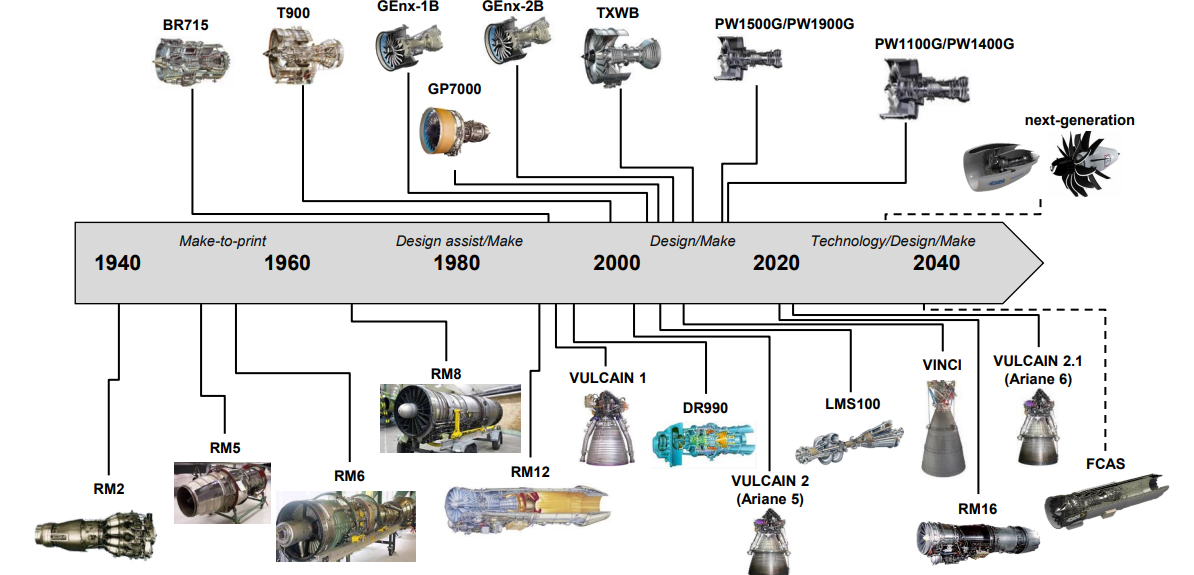
Key to achieving these positions have been GKN Aerospace’s technical and manufacturing capabilities, which differentiates the business, promoting it up the value chain as a ‘customer partner’ rather than a ‘make-to-print’ component manufacturer. The timeline/product chart in Exhibit 3 highlights this shift over time. It is further evidenced with full design and manufacturing responsibility for the exit nozzle of the Ariane 6 rocket and as the only global player involved in the technical phase on the only future jet programmes currently in development, the Pratt & Whitney (P&W) GTF next-generation and the CFMI (GE Safran JV) RISE.
|
Exhibit 3: GKN Aerospace’s key engine programme timeline |
|
|
Source: Melrose Industries capital markets presentation October 2023 |
The technology that GKN Aerospace can bring along with its manufacturing know-how enables it to add value in the development and design phase, including design for manufacture. Technical developments have been driving significant engine performance improvements, while on the production side developments have been more incremental. This could be about to change as the industry looks to embrace the use of AF/AM. Additive offers the potential to significantly reduce component weight, enhancing an engine’s performance, and reduce manufacturing cost, time, emissions and waste, providing direct financial and sustainability benefits.
Additive fabrication and manufacturing
Overview
Metallic aerospace components are currently forged or cast before being machined. The formation of the raw component (forging/casting) ensures the required mechanical properties of the component. However, ‘subtractive machining’ is wasteful. Additive approaches the challenge from the other direction, ‘building’ a component from the ground up, adding material layer by layer to create a component in a ‘near net shape’ form. The benefits of AF/AM are numerous:
■
Elimination of the casting/forging process: the potential to eliminate a high-energy consuming process.
■
Reduced waste and cost: forgings may have as much as 90% of material machined away during the manufacturing process, leading to significant scrap/waste, often of expensive alloys. Such subtractive manufacturing requires significant machine hours, which is costly and increases the total machining capacity required. AM also offers the potential for a lower carbon footprint.
■
Shorter lead times and reduced supply chain complexity: the ability to produce a component from a single machine will reduce the complexities of the supply chain where multiple components from different suppliers are combined into a single casing or component. This is particularly important at present given the sector’s capacity constraints and lengthening lead times.
■
Increased design flexibility: AM can produce more complex components, permitting non-essential elements of a component to be designed out. This in turn reduces the weight of a component and improves the overall performance of an engine. These benefits are more likely to be realised on a next-generation design.
Aerospace and additive
The aerospace industry has a number of characteristics that make it suitable for the adoption of AF/AM. Components are complex, use high-value alloys, tend to have high levels of material subtraction from machining, require exacting tolerances and are relatively low volume. However, the conservative and safety/regulation drivers mean that the industry is still very much at the early stage of adoption.
One of the leaders and greatest advocates of AM is General Electric (GE), which acquired two equipment manufacturers in 2016, Arcam and Concept Laser. GE Aerospace has been 3D-printing the fuel nozzle tip for the LEAP engine since 2015. It is a relatively small component yet, according to GE, it consolidates 20 parts into one single structure, achieving a 25% weight reduction and 30% cost efficiency improvement.
GKN Aerospace Engines additive fabrication and manufacturing
GKN Aerospace has been developing its AM capabilities for many years and has a global technology centre in Fort Worth, Texas, primarily for the Structures division. The engines business, based in Sweden, has been working on two technologies:
■
Laser metal deposition: a laser creates a melt pool on the surface of a component into which the metal powder or wire is inserted, with the laser fusing the two together, similar to welding, and subsequently constructing the required additional metal structure from the additional metal added.
■
Powder bed fusion: thin layers of metallic powder, often 0.1mm thick, are addressed by a laser or electron beam to fuse the material. The accuracy of the energy applied enables a tight tolerance lattice to be formed, by refreshing the powder and adding layer on layer so the structure of a component is built up.
GKN Aerospace Engines already supplies components that include additive fabrication features. For instance, the intermediate compressor case (ICC) for the Trent XWB-84 with laser wire additive non-structural components, as per the probe insert inspection nodes highlighted in Exhibit 5.
|
Exhibit 4: Trent XWB-84 ICC |
Exhibit 5: AM inspection nodes |
|
|
|
Source: GKN Aerospace |
Source: Melrose Industries capital markets presentation May 2023 |
|
Exhibit 4: Trent XWB-84 ICC |
|
|
Source: GKN Aerospace |
|
Exhibit 5: AM inspection nodes |
|
|
Source: Melrose Industries capital markets presentation May 2023 |
The full benefit that AM brings can be seen in Exhibit 6. Of particular note is the improved buy-to-fly ratio, reflecting the level of material required to that which ends up in the final component. In the fan case example, there is an improvement from 11:1 to 3:1, leading to a 70% reduction in scrap.
|
Exhibit 6: AM benefit example |
|
|
Source: Melrose Industries capital markets presentation May 2023. Note: 1 Entry into service. 2 Relates to savings during material processing. |
To support the development, GKN Aerospace purchased Permanova Lasersystem in October 2022. Based in Gothenburg, Permanova is a leader in advanced laser technology and laser metal deposition systems.
|
Exhibit 7: Permanova Permaflex AM station |
|
|
Source: Permanova Lasersystem |
The GKN Aerospace Engines business is now entering scale commercialisation, arguably a first for the aerospace supply sector, with a £40m investment in laser wire, based on Permanova equipment, to be followed by power bed utilising third-party equipment from SLM (SLM announced GKN Aerospace had order two of its latest 12 laser machines in September).
The programme will start by replacing complete machining of forged parts to partial machining of a smaller, tighter tolerance forging with AF/AM used to create additional features such as flanges before moving to powder metal generation to replace the base forging, enabling a fully additive produced component. This staggered adoption will permit tighter control and assist in any certification requirements, albeit these should be limited as a replacement part rather than a newly designed component. The business plans to migrate three parts currently being fully machined: a low-pressure compressor case, a fan case and a turbine rear frame component, to include laser deposition AF elements. The second stage will involve replacing the forgings with powder bed AM modules and hence, with the AF elements, a fully additive fabricated component. Full production is expected from 2025.
Financial impact
Management has pointed to a return on investment of over 20%. It has not indicated the potential margin expectations, but the savings in terms of materials and processing requirements should permit a win-win situation for both GKN Aerospace and the engine OE. More importantly, the success of establishing such a capability as the industry grapples with supply chain issues potentially offers accelerated opportunities.
Financial performance in 2025 and beyond
Management provided a short update on trading, leaving the detailed update until November. The progression expectations for the Engines business were updated, with 2023 margin guidance of 24% and further upside post 2025 above the targeted 28% to 30% and beyond.
|
Exhibit 8: Financial target bridge |
|
|
Source: Melrose Industries capital markets presentation October 2023 |
The RRSPs form a critical part of the improvement programme. These were a key focus for the capital markets event in May, including the accounting treatment for these complex long-term agreements (see Edison note page 4). The key elements are:
■
The production phase: supply of components generates significant revenue, but profit is only achievable if the manufacturing cost is below the pre-agreed ‘should cost’ rate and hence tends to be relatively low. In addition, IFRS 15 contract accounting requires an element of the aftermarket profit to be recognised, as the delivery of an engine triggers the aftermarket and associated income. Melrose has looked to be conservative on such profit recognition due to the level of uncertainty and the timing mismatch with cash.
■
The aftermarket phase: GKN Aerospace’s work is largely complete at this point as its components are ‘life of engine’. Hence the costs incurred are relatively low (admin, technical development but no cost of goods) and consequently the margin on the revenue received is very high.
Exhibit 9 provides a breakdown of the anticipated cash generation from OE delivery and from the aftermarket. The aftermarket is expected to grow significantly faster than the OE deliveries, reflecting the growth in air traffic, additional engines added to the pool and the position of many of the group’s RRSPs in terms of key maintenance shop visits. Hence there will be a clear mix benefit to margin as the richness of the aftermarket increases.
|
Exhibit 9: RRSP cashflow expectations |
|
|
Source: Melrose Industries capital markets presentation October 2023. Note: ¹ Pre-tax. ² OE sale of expected future engine deliveries on current programmes. ³ After market on delivered engines. ⁴ After market of expected future engine deliveries on current programmes. 5 Pre-tax. |
Exhibit 10 shows a breakdown of our Engine division forecasts. Note that these are above the latest guidance (2023 operating margin of 24%) but highlight how the individual components of the division are expected to perform in generating the improved performance broadly in line with management’s views. Engines is expected to generate 81% of group operating profit in 2023 and 71% of profits in 2025.
Exhibit 10: Edison forecast breakdown for the Engines division
2023e |
Annual growth |
2025e |
|
Revenue (£m) |
|||
RRSPs – aftermarket |
200 |
30% |
338 |
RRSPs OE |
488 |
13% |
622 |
Government partnerships |
125 |
10% |
151 |
Repairs |
100 |
40% |
196 |
Original equipment |
313 |
13% |
399 |
Total Engines |
1,250 |
1,707 |
|
Operating margin (%) |
|||
RRSPs – aftermarket |
85% |
80% |
|
RRSPs OE |
8% |
8% |
|
Government partnerships |
10% |
10% |
|
Repairs |
25% |
25% |
|
Original equipment |
15% |
15% |
|
Total Engines |
25% |
28% |
|
Operating profit (£m) |
|||
RRSPs – aftermarket |
170 |
270 |
|
RRSPs OE |
39 |
50 |
|
Government partnerships |
13 |
15 |
|
Repairs |
25 |
49 |
|
Original equipment |
47 |
60 |
|
Restructuring benefits |
15 |
40 |
|
Total Engines |
308 |
484 |
Source: Edison Investment Research
Exhibit 11: Financial summary
£m |
2022 |
2023e |
2024e |
2025e |
|
Year to 31 December |
IFRS |
IFRS |
IFRS |
IFRS |
|
INCOME STATEMENT |
|||||
Revenue |
|
2,957 |
3,410 |
3,605 |
4,068 |
EBITDA |
|
292 |
505 |
638 |
842 |
Operating profit (before amort. and excepts.) |
147 |
350 |
476 |
672 |
|
Amortisation of acquired intangibles |
(260) |
(300) |
(300) |
(300) |
|
Exceptionals |
(157) |
(200) |
(50) |
(10) |
|
Reported operating profit |
(270) |
(150) |
126 |
362 |
|
Net Interest |
(85) |
(62) |
(61) |
(56) |
|
Profit Before Tax (norm) |
|
62 |
288 |
415 |
616 |
Profit Before Tax (reported) |
|
(355) |
(212) |
65 |
306 |
Reported tax |
99 |
0 |
0 |
0 |
|
Profit After Tax (norm) |
48 |
227 |
328 |
487 |
|
Profit After Tax (reported) |
(256) |
(212) |
65 |
306 |
|
Minority interests |
(5) |
0 |
0 |
0 |
|
Discontinued operations |
(80) |
0 |
0 |
0 |
|
Net income (normalised) |
43 |
227 |
328 |
487 |
|
Net income (reported) |
(341) |
(212) |
65 |
306 |
|
Average Number of Shares Outstanding (m) |
1,406 |
1,350 |
1,317 |
1,297 |
|
EPS - normalised (p) |
|
4.1 |
16.8 |
24.9 |
37.5 |
EPS - normalised fully diluted (p) |
|
4.1 |
17.2 |
26.2 |
36.0 |
EPS - basic reported (p) |
|
(18.6) |
(15.7) |
5.0 |
23.6 |
Dividend (p) |
2.33 |
4.20 |
6.30 |
9.38 |
|
Revenue growth (%) |
8.5 |
15.4 |
10.1 |
12.5 |
|
Gross Margin (%) |
14.3 |
35.0 |
36.0 |
37.0 |
|
EBITDA Margin (%) |
9.9 |
14.8 |
17.7 |
20.7 |
|
Normalised Operating Margin |
5.0 |
10.3 |
13.2 |
16.5 |
|
BALANCE SHEET |
|||||
Fixed Assets |
|
11,114 |
5,391 |
5,123 |
4,857 |
Intangible Assets |
6,882 |
3,498 |
3,198 |
2,898 |
|
Tangible Assets |
2,599 |
821 |
853 |
887 |
|
Investments & other |
1,633 |
1,072 |
1,072 |
1,072 |
|
Current Assets |
|
2,873 |
1,524 |
1,596 |
1,689 |
Stocks |
1,025 |
568 |
596 |
634 |
|
Debtors |
1,426 |
849 |
892 |
947 |
|
Cash & cash equivalents |
355 |
85 |
85 |
85 |
|
Other |
67 |
23 |
23 |
23 |
|
Current Liabilities |
|
2,978 |
1,564 |
1,607 |
1,670 |
Creditors |
2,347 |
1,248 |
1,311 |
1,394 |
|
Tax and social security |
141 |
32 |
32 |
32 |
|
Short term borrowings |
63 |
63 |
63 |
63 |
|
Other |
427 |
221 |
201 |
181 |
|
Long Term Liabilities |
|
3,841 |
1,676 |
1,372 |
831 |
Long term borrowings |
1,433 |
742 |
1,045 |
809 |
|
Other long term liabilities |
2,408 |
935 |
326 |
21 |
|
Net Assets |
|
7,168 |
3,675 |
3,740 |
4,046 |
Minority interests |
39 |
0 |
0 |
0 |
|
Shareholders' equity |
|
7,129 |
3,675 |
3,740 |
4,046 |
CASH FLOW |
|||||
Operating Cash Flow |
292 |
505 |
638 |
842 |
|
Working capital |
(148) |
(79) |
(52) |
(46) |
|
Exceptional & other |
(83) |
(170) |
(140) |
(80) |
|
Tax |
(8) |
(67) |
(87) |
(129) |
|
Net operating cash flow |
|
53 |
189 |
359 |
587 |
Capex |
(31) |
(190) |
(194) |
(204) |
|
Acquisitions/disposals |
(7) |
0 |
0 |
0 |
|
Net interest |
(82) |
(62) |
(54) |
(52) |
|
Equity financing |
0 |
(150) |
(350) |
0 |
|
Dividends |
(77) |
(20) |
(64) |
(95) |
|
Other |
|||||
Net Cash Flow |
(144) |
(233) |
(304) |
236 |
|
Opening net debt/(cash) |
|
343 |
487 |
720 |
1,023 |
Closing net debt/(cash) |
|
487 |
720 |
1,023 |
787 |
Source: Melrose Industries accounts, Edison Investment Research
|
|
Research: Metals & Mining
Wheaton Precious Metals’ (WPM’s) Q323 results are scheduled for 9 November. This note adjusts our forecasts – principally for Q3 – for metals prices ( 0.3% simple average for the quarter since our last note), Penasquito (returning to production from mid October, rather than end August), a new life of mine production profile at Constancia (in the aftermath of a site visit in late September) and production at Salobo, Sudbury and Voisey’s Bay (in the aftermath of Vale’s production and sales report on 17 October). We have also re-phased capital payments for Salobo III from FY23 to FY24 and FY25.