Last close As at 05/08/2026
GBP3.05
▲ 0.50 (0.16%)
Market capitalisation
GBP167m
Research: Investment Companies
Baillie Gifford China Growth Trust (BGCG) invests in China, focusing on innovative, rapidly growing companies best positioned to benefit from China’s still favourable long-term economic outlook and the structural trends that should drive equity markets for years to come. Key portfolio themes include e-commerce, food delivery, domestic brands, semiconductors, robotics and automation, and renewable energy. The trust’s relaunch in September 2020 coincided with a series of challenges for the Chinese economy, investor confidence and the growth companies BGCG favours, so performance has lagged the benchmark. However, the operational performance of most of BGCG’s holdings is strong, their prospects are very positive, and the trust’s managers believe that it is only a matter of time until confidence returns and share prices more accurately reflect these robust fundamentals.
Baillie Gifford China Growth Trust |
China’s recovery well worth the wait |
Investment trusts |
12 December 2023 |
Analyst
|
|||||||||||||||||||||||||||||||||||||||||||||||||||||
Baillie Gifford China Growth Trust (BGCG) invests in China, focusing on innovative, rapidly growing companies best positioned to benefit from China’s still favourable long-term economic outlook and the structural trends that should drive equity markets for years to come. Key portfolio themes include e-commerce, food delivery, domestic brands, semiconductors, robotics and automation, and renewable energy. The trust’s relaunch in September 2020 coincided with a series of challenges for the Chinese economy, investor confidence and the growth companies BGCG favours, so performance has lagged the benchmark. However, the operational performance of most of BGCG’s holdings is strong, their prospects are very positive, and the trust’s managers believe that it is only a matter of time until confidence returns and share prices more accurately reflect these robust fundamentals.
|
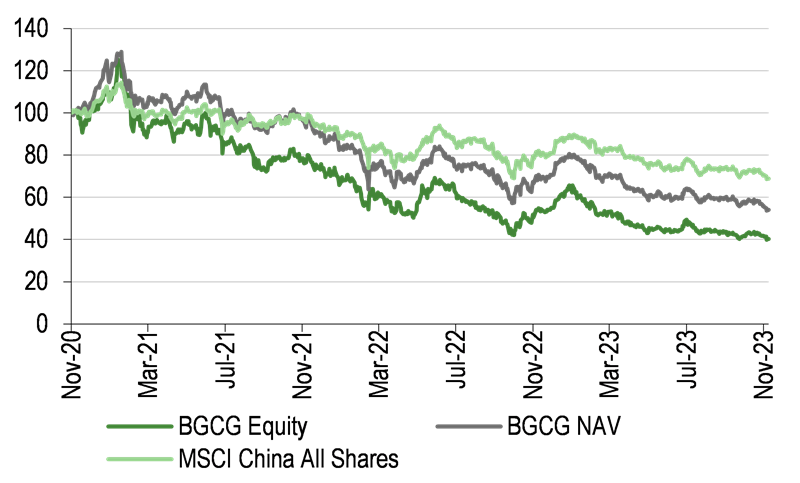
Rebased performance, three years to end-November 2023 |
|
|
Source: Refinitiv, Edison Investment Research |
The analyst’s view
■
For investors who share BGCG’s long-term perspective, the investment case for China is compelling. Economic growth, while weaker than before the pandemic, will still be strong compared to most other countries and structural changes, such as the growth of the middle class, digitalisation and the move to renewable energy, will potentially drive growth and equity returns.
■
BGCG’s performance since its relaunch has been disappointing. It has declined by 44.0% in NAV terms and 58.2% on a share price basis over the three years to the end of November 2023, compared to the benchmark MSCI China All Share Index’s 29.2% fall. Near-term returns have also been poor.
■
However, due to its long-term investment focus, BGCG’s managers ask to be judged on performance over five years or more and, on this basis, it is still very early days for the trust.
■
Investors may be reassured by the Chinese authorities’ renewed commitment to prosperity and the private sector and by an apparent warming in relations between China and the US.
BGCG: Accessing China’s growth opportunities
A recently formed trust with a long-term growth focus
BGCG was formed in September 2020 when Baillie Gifford took over management of the trust from Witan Investment Services and the focus of the trust was changed from Asia-Pacific equities to a pure Chinese equity growth strategy. This decision was based on the board’s view that the investment case for China is especially strong. Chinese economic growth may settle at around 5% per annum in the post-pandemic era, compared to average annual growth of c 6% in the previous decade, but the Chinese economy will remain one of the fastest growing in the world. Growth will be supported by significant structural opportunities and BGCG’s key investment themes seek to capitalise on these opportunities in areas such as e-commerce, food delivery, domestic brands, semiconductors, robotics and automation, and renewable energy.
The trust adopts a long-term investment perspective of five years or more and seeks out the best companies with exposure to these trends that are expected to deliver rapid growth over this timeframe. However, investors may require a tolerance of volatility along the way, as is usual when investing in emerging markets. For this reason, BGCG’s managers ask to be judged on their performance over periods of five years or more.
Launch coincided with especially tough times for China
From this perspective, it is thus still early days for BGCG and the trust has had a difficult start. In the three years since BGCG was established, China has been hit by an unprecedented series of challenges, some of its own making, such as an aggressive and unexpected regulatory clampdown, harsh restrictions in response to the COVID-19 pandemic and an escalation in geopolitical tensions with the US. These developments all damaged consumer and investor confidence and private sector activity, and weakened equity markets.
|
Exhibit 1: Equity market performance |
|
|
Source: Refinitiv, Edison Investment Research. Note: In pounds sterling. |
After a brief, sharp rally on news of China’s post-pandemic re-opening late last year, there was fresh disappointment in store for investors this year when the resultant economic rebound proved much more halting than anticipated. The downward trajectory in Chinese equities was extended in response to a recent deterioration in the property sector, as a real estate company, Country Garden, and a trust company, Zhongzhi Enterprise Group, missed coupon payments on their debt, sparking fears of broader financial market instability. In all, the MSCI China All Shares Index declined by a total of 29.2% over the three-year period to end-November 2023, significantly underperforming other markets over the period (Exhibit 1).
BGCG’s growth focus has undermined relative performance
The companies most affected by this general market sell-off have been the private sector growth names BGCG favours. As a result, the trust has underperformed the market, declining by a total of 44.0% in NAV terms and by 58.2% on a share price basis over the three years to end-November 2023. Nearer-term performance has also disappointed in absolute terms, although performance has been close to benchmark. The trust fell by 5.0% in NAV terms and by 3.2% on a share price basis over the six months ending 30 November 2023, close to the benchmark decline of 4.9%. This decline in returns has occurred even though the operational performance of most of BGCG’s portfolio holdings has been good and, in some cases, exceptional (see the performance section for details).
BGCG is not the only China-focused trust to have struggled over the past three years. All four of the AIC’s Chinese equities funds in Exhibit 2 have suffered declines of a broadly similar magnitude and have underperformed the AIC’s broader closed-ended Asia Pacific sector average over two- and three-year periods.
Exhibit 2: Selected peer group as at 11 December 2023*
% unless stated |
Market |
NAV TR |
NAV TR |
NAV TR |
NAV TR |
Discount |
Ongoing charge |
Perf |
Net |
Dividend |
|
Asia Pacific closed-ended peers |
|||||||||||
Sector average (nine funds) |
394.5 |
(4.8) |
(13.6) |
(1.8) |
34.7 |
(10.7) |
0.9 |
- |
104 |
2.1 |
|
Baillie Gifford China Growth |
122.5 |
(17.0) |
(43.0) |
(42.4) |
(26.6) |
(11.7) |
0.9 |
No |
103 |
0.9 |
|
China closed-ended peers |
|||||||||||
Aberdeen China |
180.4 |
(18.6) |
(38.7) |
(32.3) |
(13.5) |
(9.5) |
0.6 |
No |
103 |
0.8 |
|
Fidelity China Special Situations |
974.4 |
(2.8) |
(25.9) |
(32.3) |
18.5 |
(10.0) |
1.0 |
Yes |
127 |
3.0 |
|
JPMorgan China Growth & Income |
186.0 |
(22.5) |
(48.3) |
(51.4) |
9.5 |
(8.1) |
1.1 |
No |
115 |
6.1 |
|
China peers average (ex BGCG) |
446.9 |
(14.6) |
(37.6) |
(38.7) |
4.9 |
(9.2) |
0.9 |
- |
115 |
3.0 |
|
Source: Morningstar, Edison Investment Research. Note: *Performance to 30 November 2023 based on cum-fair NAV. TR, total return. Net gearing is total assets less cash and equivalents as a percentage of net assets.
Outlook ‘much brighter’ thanks to domestic demand
BGCG’s managers believe that the current market consensus is too pessimistic and the future for Chinese equities is ‘much brighter’. This view is based in part on the fact that at least some of the key drivers of recent poor investor sentiment towards China have dissipated. In addition to the lifting of COVID-19 restrictions, there has been some easing in the regulatory environment for gaming and e-commerce platforms, and the recent meeting between China’s President Xi Jinping and US President Joe Biden is the latest in a series of high-level discussions suggesting both nations wish to stabilise their relationship. BGCG’s managers expect the performance of the property sector to remain ‘lacklustre’ but they do not share the concerns of some that the sector will generate broader financial instability, as the Chinese authorities are taking gradual steps to relax restrictions on home sales and support more sustainable growth over the long term.
While property companies may still be burdened by too much debt, the balance sheets of Chinese consumers are very healthy. They have money to spend and consumer confidence is returning. In the view of BGCG’s managers, this is another reason to be optimistic about the outlook for the Chinese economy. They see clear signs that a recovery in consumer spending, the most powerful driver of Chinese growth, is gradually gathering momentum. In support of this claim, the trust’s managers cite some excellent recent results from internet platforms. For example, China’s leading online retailer, Alibaba, and the country’s largest social media platform, Tencent, both reported double-digit growth in earnings last quarter. Rising tourism numbers will provide a further boost to the hospitality industry. The trust’s managers expect this domestic recovery to take root as consumer and business confidence continue to improve.
Since the National People’s Congress in March this year, the Chinese government has reconfirmed its commitment to lifting living standards and prosperity, and to supporting growth, wealth creation and private enterprise. To give substance to this commitment, the government has delivered a package of measures designed to level the playing field for private companies competing against stateowned enterprises, improve access to finance and increase private sector input in the policymaking process. Some commentators argue these measures amount to the government’s most concerted effort ever to support the private sector. As China’s private sector accounts for 60% of GDP and 80% of jobs, these developments bode very favourably for the country’s medium-term economic prospects.
The confidence BGCG’s managers have in the Chinese market was further bolstered by their recent meetings with the founders and top management of several of China’s largest companies, all of which feature in BGCG’s portfolio (Exhibit 7). As well as Tencent and Alibaba, these included ByteDance (owner of TikTok and other social media platforms), Meituan (an online marketplace for local services) and Contemporary Amperex Technology (CATL); a supplier of batteries including for renewable energy storage). In general, the trust’s managers found those they met with were upbeat about China’s prospects, supportive of China’s new premier, Li Qiang, and confident in the country’s regulatory and macroeconomic backdrop. This renewed entrepreneurial spirit is likely to translate into more ambitious growth and investment plans over time.
Chinese equity valuations are low…
This all amounts to a very supportive environment for Chinese equities over the medium term. Yet valuations are, for the moment, still attractive, both absolutely and relative to other markets. For example, the forward price earnings (P/E) ratio of the Chinese market is 13x, much lower than historical levels, and cheaper than the Indian market’s valuation of 27x. If valuations remain at such attractive levels, BGCG’s managers believe that it is only a matter of time before investors begin to appreciate the well-priced opportunities on offer. They argue that, even if US and European investors remain wary of China, there are other pools of capital likely to provide support for the Chinese market, including from the Middle East, South America and Asia.
…and BGCG’s discount is wide by historical standards
BGCG’s shares are trading at a discount of c 12% to its NAV. The discount, shown in Exhibit 3, has trended steadily wider over the past three years. This is partly because of the deterioration in sentiment towards China over this period and partly because discounts have widened across the investment trust sector, regardless of regional or strategic focus, over the past two years and BGCG has not been immune to this trend. As Exhibit 2 shows, BGCG’s current discount is broadly comparable with those of its peers. However, as and when investor sentiment towards the investment trust sector and the Chinese market improves, BGCG’s discount has scope to narrow, especially if the growth stocks it favours begin to deliver the strong returns the managers anticipate.
In the meantime, BGCG’s historically wide discount arguably provides an opportunity for those investors who share Baillie Gifford’s confidence in the medium- to long-term prospects of Chinese equities to access this rapidly growing, vibrant market at an attractive price.
|
Exhibit 3: Three-year discount/premium to cum-fair NAV |
|
|
Source: Refinitiv, Edison Investment Research |
Performance
Exhibit 4: Five-year discrete performance data
12 months ending |
Share price |
NAV |
MSCI China All Shares (%) |
MSCI AC Asia Pacific Free (%) |
MSCI World |
30/11/19 |
13.1 |
4.6 |
9.7 |
8.3 |
13.6 |
30/11/20 |
54.4 |
19.1 |
34.5 |
14.8 |
11.5 |
30/11/21 |
(22.6) |
(3.1) |
(2.6) |
3.5 |
23.4 |
30/11/22 |
(33.1) |
(30.6) |
(18.4) |
(5.7) |
(0.5) |
30/11/23 |
(19.4) |
(16.7) |
(10.9) |
0.4 |
6.8 |
Source: Refinitiv. Note: All percentages are on a total return basis in pounds sterling.
As mentioned above, macroeconomic and political events, rather than the performance of individual companies, have driven the Chinese market over the three years since BGCG’s relaunch as a pure China growth strategy in September 2020. Furthermore, the market in general has been weak (down by 29.2%) over this whole period, with most sectors experiencing declines. BGCG has underperformed the market since its relaunch due to its concentrated exposure to a variety of holdings that fell more than the index, combined with its underweights to lower quality, low-growth businesses such as oil companies, state-owned banks and other government-owned enterprises that have done well, at least in relative terms.
|
Exhibit 5: Investment company performance to 30 November 2023 |
|
Price, NAV and index total return performance over three years, rebased |
Price, NAV and index total return performance (%) |
|
|
|
Source: Refinitiv, Edison Investment Research. Note: Three-, five- and 10-year performance figures annualised. |
|
One of the largest detractors from BGCG’s performance over the past year has been Li-Ning, China’s second-largest sportswear company, which has been hurt by China’s insipid post-pandemic rebound, and resultant inventory rises and heavy discounting. However, the trust’s managers remain confident in Li-Ning’s long-term growth potential, given its very strong brands and good management, which may provide the wherewithal for the company to encroach on the market share of premium foreign brands such as Adidas and Nike. Glodon, a leading construction software company, also detracted due to ongoing concerns about the property sector, but, as with Li-Ning, recent disappointing performance has not changed BGCG’s managers’ positive assessment of the company’s long-term outlook. Glodon expects revenues to double in the next three years and the sector is set to benefit from digitalisation over the coming decade. Asymchem Laboratories, which specialises in commercial applications of pharmaceutical technology, also detracted from BGCG’s relative performance, despite seeing 200% growth in earnings over the past two years. In the case of another detractor, SG Micro, an analogue chipmaker, BGCG’s managers took the opportunity provided by a low valuation to increase their exposure (discussed in the portfolio section below).
The main positive contributors to performance over the past year were A-share industrial manufacturing companies exposed to structurally expanding end markets. For example, Zhejiang Sanhua Intelligent Controls, which specialises in intelligent heating components for vehicles, air conditioning units and energy storage, saw a 40% profit growth over the year, due in part to demand from its prime electric vehicle (EV) manufacturing clients, Tesla and its Chinese competitor BYD. Shenzhen Megmeet Electrical was another key contributor. This company makes power supply and electrical automation products for industrial and consumer electronics products, and has exposure to what BGCG’s managers call ‘exciting end markets’ in the industrial automation, EV and smart home appliance sectors. BGCG’s performance has also been supported by several of its more defensive holdings, including Midea, a leading white goods manufacturer, which is well-run and has a strong balance sheet. However, the share price performances of these names have been disappointing in absolute terms and, in the managers’ view, this is indicative of the ‘heaviness’ and general pessimism currently pervading the market as all these companies have been performing well at a fundamental level, yet only managed to generate lacklustre share price returns.
Indeed, this is a theme across the portfolio. The operational results of many of the trust’s holdings are strong, improving and, in some cases, impressive, while share prices flounder at levels well below their highs. Asymchem, Alibaba and Tencent have already been mentioned above. In BGCG’s managers’ view, both these latter businesses have great longer-term structural growth prospects, yet both stocks remain relatively attractively valued. ByteDance, the trust’s largest position and its only unlisted holding, has also delivered double-digit growth and is targeting opportunities in advertising and e-commerce. Ping An Insurance, one of China’s leading financial services groups and a top five holding for BGCG, has also been performing well. It is China’s second-largest life insurer, a market that the trust’s managers believe has ‘multi-decade’ growth potential thanks to China’s emerging middle class and rising disposable incomes.
BGCG’s managers expect that it is only a matter of time until investor confidence returns and the good operational performances of portfolio holdings such as these are rewarded with share price rises that more accurately reflect their current successes and favourable prospects.
Exhibit 6: Share price and NAV total return performance* relative to indices
(%) |
One month |
Three months |
Six months |
One year |
Three years |
Five years |
10 years |
Price relative to MSCI China All Shares |
2.0 |
(2.5) |
1.7 |
(9.5) |
(41.0) |
(30.2) |
(33.4) |
NAV relative to MSCI China All Shares |
(0.3) |
(3.2) |
(0.2) |
(6.5) |
(20.8) |
(33.1) |
(34.7) |
Price relative to MSCI AC Asia Pacific Free |
(2.8) |
(5.9) |
(5.0) |
(19.7) |
(57.4) |
(40.1) |
(45.1) |
NAV relative to MSCI AC Asia Pacific Free |
(5.0) |
(6.5) |
(6.8) |
(17.0) |
(42.8) |
(42.7) |
(46.1) |
Price relative to MSCI World |
(4.2) |
(6.8) |
(9.3) |
(24.5) |
(68.2) |
(56.2) |
(65.0) |
NAV relative to MSCI World |
(6.4) |
(7.4) |
(11.0) |
(22.1) |
(57.3) |
(58.0) |
(65.7) |
Source: Refinitiv, Edison Investment Research. Note: Data to end-November 2023 in pounds sterling. Geometric calculation. *Shows the trust’s performance under Witan’s management until the mandate change on 16 September 2020.
Portfolio positioning
Exhibit 7: Top 10 holdings portfolio weight (%)
Company |
Sector |
31 October 2023 |
31 October 2022 |
ByteDance |
Communication services |
8.0 |
7.0 |
Alibaba |
Consumer Discretionary |
7.3 |
5.3 |
Tencent |
Communication services |
6.8 |
6.2 |
Kweichow Moutai |
Consumer Staples |
5.3 |
4.3 |
Ping An Insurance |
Financials |
3.7 |
3.3 |
Meituan Dianping |
Consumer Discretionary |
3.3 |
3.6 |
China Merchants Bank |
Financials |
3.0 |
2.5 |
Zijin Mining |
Gold mining |
2.9 |
N/A |
Zhejiang Sanhua Intelligent Controls |
Consumer Discretionary |
2.7 |
2.5 |
NetEase |
Gaming and multimedia |
2.5 |
N/A |
Top 10 (% of portfolio) |
|
45.5 |
40.0 |
Source: BGCG
The good operational performance of the trust’s portfolio holdings, combined with its long-term investment approach, mean that the managers have not made any major changes to the portfolio over the past year. Turnover has recently been unusually low at less than 10%, a reflection of the managers’ conviction in the portfolio’s holdings.
However, with valuations attractively low, BGCG’s managers have taken the opportunity to add to some holdings, including SG Micro, whose share price has come under pressure this year, as mentioned above. The US ban on chip exports to China has contributed to geopolitical tensions between the two superpowers and has created risks for Chinese producers of the most advanced semiconductor chips. Therefore, BGCG’s managers have limited the portfolio’s semiconductor exposure largely to analogue chipmakers such as SG Micro, as they are not at the leading edge of semiconductor technology and are thus likely to be insulated from the worst of any geopolitical fallout, while still benefiting from China’s efforts to localise supply chains.
Low valuations have also seen BGCG’s managers top up existing positions in Alibaba and China Merchants Bank, and in other portfolio holdings disproportionately hurt by COVID-19 and the general subsequent weakness in consumption. For instance, they increased exposure to Shenzhou International Group, one of the world’s leading garment manufacturers. In the trust’s managers’ view, this is an excellent, well-run operator with a great client base, diversified manufacturing sites and good growth prospects.
BGCG’s managers see particularly big opportunities in the renewable energy and robotics and automation sectors, and they have added exposure to these industries accordingly. China is heavily reliant on imported oil and gas, so it has a great incentive to invest in renewables to increase its energy security. The portfolio has exposure to renewable energy via existing positions in companies such as LONGi Green Energy Technology (the world’s largest producer of solar panels) and CATL (an EV battery manufacturer) and, over the past year, BGCG’s managers have bought Jiangsu Azure (a lithium battery maker) and BYD (China’s largest EV producer and its second-largest battery manufacturer). The team at BGCG believes that BYD’s vertical integration and its ability to innovate quickly help it control costs and increase its speed to market, providing it with an edge in the highly competitive EV market.
Within the robotics and automation sphere, which is home to some China’s most innovative growth companies, the trust has exposure via existing holdings in names such as Shenzhen Inovance Technology, which produces industrial automation control systems, and Yonyou, which provides software to help companies improve their efficiency. In the past year, BGCG’s managers have added a position in Dongguan Yiheda Automation, which supplies industrial automation equipment.
These top-ups and acquisitions have been partly funded by reductions in profitable positions such as Estun Automation, a supplier of industrial automation products, and Shenzhen Inovance Technology. Unlike many of BGCG’s holdings, the strong operational performance of these two companies has been matched by strong share price returns. In fact, Shenzhen Inovance Technology’s share price has tripled since purchase due to product improvements and rising market share. BGCG’s managers have also reduced a position in Hangzhou Tigermed Consulting, a contract medical research company whose share price has dropped precipitously over the past year due to greater risks around regulatory change. Positions in Tencent Music, online entertainment and video company BiliBili, and Lufax Holding, a provider of personal finance services, were closed as the companies’ investment cases deteriorated.
The net effect of these transactions has been to modestly increase the portfolio’s overweights to consumer discretionary and communication services and reduce overweights to industrials and healthcare. The portfolio’s underweight to IT has been increased, while its underweights to financials and other sectors have been maintained, including a zero weighting to conventional energy producers and a very limited exposure to real estate, given BGCG’s managers’ caution about the near-term prospects for the property sector. Its sole real estate holding is KE Holdings, an online real estate sales and services platform, set to benefit as and when the housing market regains liquidity.
Exhibit 8: Portfolio sector exposure* versus benchmark
(% unless stated) |
Portfolio endOctober 2023 |
Portfolio endOctober 2022 |
Change |
Index weight |
Active weight versus index (pp) |
Trust weight/index weight (x) |
Consumer discretionary |
26.5 |
23.6 |
2.9 |
20.7 |
5.8 |
1.3 |
Communication services |
18.2 |
16.1 |
2.1 |
12.5 |
5.7 |
1.5 |
Industrials |
14.9 |
17.7 |
(2.8) |
9.0 |
5.9 |
1.6 |
Healthcare |
9.2 |
11.2 |
(2.0) |
7.1 |
2.1 |
1.3 |
Consumer staples |
8.3 |
8.0 |
0.3 |
9.2 |
(0.9) |
0.9 |
Financials |
8.1 |
7.7 |
0.4 |
17.0 |
(8.9) |
0.5 |
Information technology |
7.2 |
8.8 |
(1.7) |
9.6 |
(2.5) |
0.7 |
Materials |
5.1 |
4.6 |
0.5 |
6.6 |
(1.4) |
0.8 |
Real estate |
1.3 |
0.6 |
0.7 |
2.3 |
(0.9) |
0.6 |
Utilities |
1.2 |
1.6 |
(0.4) |
3.0 |
(1.7) |
0.4 |
Energy |
0.0 |
0.0 |
0.0 |
3.1 |
(3.1) |
0.0 |
100.0 |
100.0 |
100.0 |
Source: BGCG, MSCI, Edison Investment Research. Note: *Adjusted for cash.
BGCG usually has around 60 holdings. It currently has only one unlisted holding, but the managers have scope to hold up to 20% of the portfolio in unlisted stocks. They are keen to have more, but only at the right price.
In April 2021, the company entered into a US$40m revolving credit facility with Royal Bank of Scotland Investments. At 31 October 2023, gearing (defined as borrowings at book value divided by shareholder funds) was at 3%, unchanged over the past year.
Dividend
Since the adoption of BGCG’s new investment policy, the focus has been to produce long-term capital growth only. Investors should, therefore, not expect to receive the same level of income after FY22 as they did before the trust was restructured. The board’s policy is that any dividend paid will be by way of a final dividend and not less than the minimum required for the company to maintain its investment trust status (retaining not more than 15% of eligible investment income arising during a financial year).
To mitigate the transition of the strategy to growth from growth and income, the board agreed and paid the 7.15p per share dividend in respect of FY22 (to 31 January 2022) and FY21, in line with the FY20 level. The dividends were paid in November and July, respectively, from the company’s £7.8m (at 31 January 2022) revenue reserves. For FY23, the dividend reset to a level consistent with the trust’s new dividend policy. A dividend of 1.7p per share was paid in July 2023. This represents of dividend yield of 0.9%, based on the current share price.
BGCG’s dividend policy means that its dividend yield is much lower than that of two of its three closed-end peers shown in Exhibit 2, although the dividend yields of both the Fidelity and JPMorgan trusts are unusually high relative to their respective histories, as their share prices, like BGCG’s, have fallen sharply amid the Chinese equities sell-off over the last 12 months.
Board
BGCG’s board has five board directors, all of whom are non-executive and independent of the manager. Susan Platts-Martin will retire from the board in the first half of 2024. An announcement has not yet been made regarding Platts-Martin’s successor as chair of the board. Nicholas Pink joined the board in September 2023.
Exhibit 9: Board of directors
Board member |
Date of appointment |
Remuneration in FY23 |
Shareholdings at end FY23 |
Susan Platts-Martin (chair) |
2014 |
£43,188 |
14,694 |
Tim Clissold |
2021 |
£25,986 |
50,000 |
Magdalene Miller |
2020 |
£26,326 |
2,300 |
Jonathan Silver (head of audit committee) |
2022 |
£10,545 |
25,000 |
Nicholas Pink* |
2023 |
N/A |
21,877 |
Source: BGCG. Note: *Joined the board in September 2023.
For details on BGCG’s investment policy, please see our initiation note.
|
|
Investment Companies
Research: Healthcare
Immix presented encouraging new data at the American Society of Hematology (ASH) 2023 meeting for its Nexcella subsidiary’s lead CAR-T asset, NXC-201, in amyloid light chain amyloidosis (ALA) patients. The update corresponds to 10 ALA patients treated with NXC-201, for which the overall response rate (ORR) stands at 100% (10/10). NXC-201 also maintains its competitive safety profile among this group, including no cases of neurotoxicity and only low-grade cytokine release syndrome associated with short onset and duration. The results to date are supportive of NXC-201 potentially becoming the first outpatient CAR-T therapy, in our view, offering a potentially desirable treatment option for a fragile patient population. While the current data come from the NEXICART-1 trial based in Israel, with the Investigational New Drug (IND) application in ALA patients recently accepted by the FDA, we believe the enrolment of patients at US trial sites (NEXICART-2) will be a key milestone for the clinical progression of NXC-201. Management has communicated that it intends to submit a Biologics License Application to the FDA once 30–40 ALA patients have been treated.