Last close As at 05/08/2026
GBP1.87
— 0.00 (0.00%)
Market capitalisation
GBP409m
Research: Investment Companies
Lowland Investment Company (LWI) targets above-average total returns, from a combination of capital and income, with a multi-cap investment policy that differentiates it from most peers in the UK Equity Income sector. Within its broad range of investment opportunities, selected large caps provide more immediate income, often with defensive characteristics, while small and mid-caps offer faster growth in income and dividends over time. LWI has a long track record of progressive dividends, which have grown c 7% pa over 10 years, and currently offers an attractive 5.2% yield. While investor focus on large-cap stocks, often with global businesses, has created a headwind for LWI’s multi-cap approach and five-year NAV total return, the managers anticipate a broadening of market performance.
Lowland Investment Company |
Capital growth to follow income? |
Investment trusts |
14 August 2023 |
Analyst
|
||||||||||||||||||||||||||||||||||||||||||||||||||||||||||||||||||||||||||||||||||||||||||||||||||||||||||||||||||||||||||||||
Lowland Investment Company (LWI) targets above-average total returns, from a combination of capital and income, with a multi-cap investment policy that differentiates it from most peers in the UK Equity Income sector. Within its broad range of investment opportunities, selected large caps provide more immediate income, often with defensive characteristics, while small and mid-caps offer faster growth in income and dividends over time. LWI has a long track record of progressive dividends, which have grown c 7% pa over 10 years, and currently offers an attractive 5.2% yield. While investor focus on large-cap stocks, often with global businesses, has created a headwind for LWI’s multi-cap approach and five-year NAV total return, the managers anticipate a broadening of market performance.
|
Recent market focus on large caps has created a multi-cap headwind |
|
|
Source: Refinitiv, Edison Investment Research |
Anticipating a re-rating of domestic SME companies
The unloved UK equity market is at a low valuation, not just compared with global markets but also its own history. The managers estimate this is the lowest valuation in 30 years. In contrarian fashion, they see the most attractive opportunities among domestic earners, especially the mid- and small-cap (SME) companies, where investor confidence is low, and which have significantly trailed the broader market. At c 50%, LWI’s large-cap exposure is ahead of its ‘normal’ 30–35% range and the managers are selectively reallocating resources towards SME companies, including an increase in gearing to c 16%. LWI has trailed its benchmark over five years, feeding through to 10-year performance. Over three years, including a strong FY21 as markets recovered from the COVID-19 pandemic, LWI has outperformed strongly, and is ahead of its benchmark in FY23 year-to-date.
As they have observed in previous cycles, the managers expect market leadership to broaden as confidence grows. They believe that the market de-rating of SME companies is already discounting a severe recession, and often ignores robust performances and strong prospects. Stubborn inflation is yet to signal the peak in interest rates, making the timing of an SME recovery difficult to predict, but low valuations should mitigate further weakness and may attract further takeover activity. The potential for an SME recovery makes LWI an interesting complement to more mainstream trusts and a narrowing of the 10% discount to NAV would enhance shareholder returns.
Multi-cap growth and income
LWI seeks to provide investors with a higher-than-average medium-term return, from a combination of capital and income, by investing in a broad spread of predominantly UK companies (96% at 30 June 2023). However, it is important to note that even though LWI sits in the UK Equity Income sector and pays a healthy dividend (current yield of 5.0%), its managers stress the importance of investing more widely than in just the traditional ‘income’ areas of the market, to include companies that can also grow, increasing the capital base of the portfolio and distributable income over time.
The multi-cap approach provides investors with a highly diversified blend of exposures to companies across the spectrum of market capitalisation, from the top 100 (up to 50% of the portfolio) right down to smaller companies, including those listed on AIM. The investment managers clearly identify the potential for small and medium-sized companies, typically at an earlier stage of their development, to deliver stronger sales and earnings growth than their larger peers and, over time, faster dividend growth. Larger sector peers typically provide more immediate dividend income, are often to be found in more defensive industries such as pharmaceuticals and utilities, with the potential to mitigate risks in challenging market conditions. In general, they have much more internationally focused businesses, providing diversification opportunities compared with the broader UK market. The high weighting to mid- and small-cap stocks (see Exhibit 1) is a key differentiator between LWI and most of its UK Equity Income peers.
The trust was established in 1963 and is managed jointly by James Henderson (since 1990) and Laura Foll (since 2013) of Janus Henderson Investors (JHI). In turn, they are supported by the broader resources of the JHI equity team (see page 13).
|
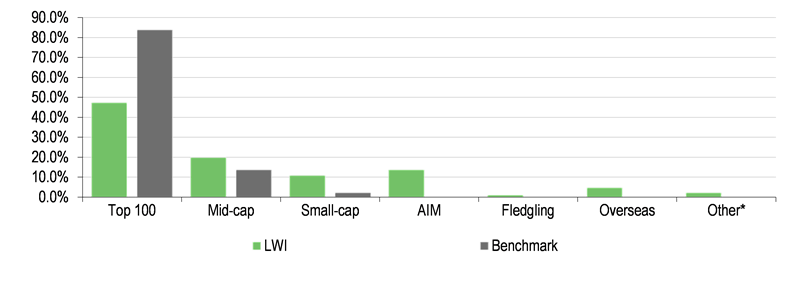
Exhibit 1: LWI versus market by segments |
|
|
Source: LWI. Note: At 31 March 2023 (last full data published). *Other includes unlisted. |
Exhibit 1 shows LWI’s positioning by market cap segment at 31 March 2023 as disclosed in the H123 interim report. We do not believe the position has changed materially since, although the managers are selectively recycling capital from larger stocks to smaller stocks, where they identify what they believe to be stronger growth opportunities and highly attractive valuations. LWI’s largest exposure is to the top 100 UK listed companies, which at c 50% is around the top of the range that the managers would normally expect and above its medium-term level of c 30–35%. The weighting is nonetheless well below the c 84% weighting of its broad UK market benchmark. Conversely, broadly half the portfolio is invested in mid- and small-cap stocks, well ahead of the benchmark weight.
LWI’s multi-cap approach has negatively affected recent performance
Given LWI’s multi-cap approach, marked divergence in the trust’s net asset value (NAV) total return performance compared with the chosen broad market benchmark is inevitable over shorter time periods. Mid- and small-cap stocks have generally outperformed over the long term, although this is not the case over the past 10 years despite their having outperformed for much of the period (Exhibit 2). Following a strong correction as the COVID-19 pandemic unfolded in early 2020, they rallied strongly as uncertainty began to subside. However, since inflation and interest rates have spiked sharply higher, raising concerns about the domestic UK economy, performance has been very weak versus larger companies, often in more defensive sectors, with more global business activities. While global investors have been selective buyers of these larger companies, domestic institutions, such as pension funds, and private investors have been net sellers of domestic equities.
Three key issues that have negatively affected the recent performance of mid- and small-cap companies are:
■
The impact of rising interest rates on the valuations attached by investors to their expected future earnings growth.
■
Uncertainty about the UK economy, to which they are typically more exposed than larger, more international companies.
■
An investor shift towards more liquid, generally larger companies, significantly reflecting current uncertainties but also a shift in risk management, most especially in the open-ended funds sector.
|
Exhibit 2: Mid- and small-cap stocks have given up outperformance… (10-year data) |
Exhibit 3: …especially since interest rates and economic uncertainty have risen (five-year data) |
|
|
|
Source: Refinitiv. Note: The NSCIAEX is the Numis Smaller Companies Index, including AIM but excluding investment companies. |
|
Exhibit 2: Mid- and small-cap stocks have given up outperformance… (10-year data) |
|
|
Source: Refinitiv. Note: The NSCIAEX is the Numis Smaller Companies Index, including AIM but excluding investment companies. |
|
Exhibit 3: …especially since interest rates and economic uncertainty have risen (five-year data) |
|
|
Source: Refinitiv. Note: The NSCIAEX is the Numis Smaller Companies Index, including AIM but excluding investment companies. |
It is not unusual for investors to favour larger, more liquid and more defensive stocks in times of uncertainty but the recent sell-off of mid- and small-cap stocks has been acute. The volatility that these swings in sentiment bring to LWI’s absolute and relative performance can best be seen on a discrete financial year basis. We note the tendency for LWI to outperform the benchmark when investor sentiment is positive and the broad market is rising strongly.
Exhibit 4: LWI’s 10-year performance on a financial year basis relative to its broad market benchmark
Year to 30 September |
FY23 YTD* |
FY22 |
FY21 |
FY20 |
FY19 |
FY18 |
FY17 |
FY16 |
FY15 |
FY14 |
FY13 |
NAV total return |
17.2% |
-14.8% |
51.0% |
-24.8% |
-9.6% |
2.7% |
17.0% |
12.2% |
0.8% |
5.7% |
29.1% |
Benchmark total return |
14.6% |
-4.0% |
27.9% |
-16.6% |
2.7% |
5.9% |
11.9% |
16.8% |
-2.3% |
6.1% |
17.3% |
Versus benchmark |
2.6pp |
-10.8% |
23.1% |
-8.2% |
-12.3% |
-3.2% |
5.1% |
-4.6% |
3.1% |
-0.4% |
11.8% |
Source: LWI data to 31 July 2023
During the five years to September 2017 (FY17), LWI delivered an NAV total return of c 87%, c 16% ahead of the benchmark. However, in market conditions that have been unfavourable to its multi-cap strategy, in the five years to end-FY22 the trust’s total return was c -10%, trailing the index by c 21%.
During the first 10 months of FY23 (to 31 July 2023) LWI’s NAV total return of 17.2% was 2.6 percentage points ahead of the benchmark return of 14.6%, although due to timing impacts this is not apparent in the three, six and 12-month data in Exhibit 5. Reflecting the low company valuations highlighted by the managers, takeover activity has benefited performance, including Devro and K3 Capital in Q123 and Numis in Q323, and in July 2023 the law firm DWF received an offer, recommended by the board, at a substantial premium.
Although LWI’s performance is strongly ahead of the benchmark over three years (which captures the very strong performance in FY21 shown above) it is below the benchmark over five years and 10 years, reflecting the market conditions described above.
Exhibit 5: Cumulative 10-year performance to 31 July 2023
|
1 m |
3 m |
6 m |
1 y |
3 y |
5 y |
10 y |
LWI share price total return |
5.3 |
-1.5 |
0.1 |
3.7 |
50.0 |
1.1 |
40.7 |
LWI NAV total return |
3.1 |
-3.1 |
-2.9 |
4.5 |
53.7 |
0.7 |
52.4 |
Broad UK Index |
2.6 |
-1.2 |
0.7 |
6.0 |
41.6 |
17.8 |
70.5 |
NSCIAEX* |
2.9 |
-1.6 |
-4.2 |
-4.6 |
20.5 |
1.9 |
61.7 |
Source: Refinitiv. Note: *Numis Smaller Companies Index including AIM and excluding investment companies.
The investment managers see a strong opportunity to benefit from a broadening of market performance
The investment managers firmly believe that the UK equity market remains attractive, and mid- and small-cap companies, in particular. This is based on several of their observations and expectations, including:
■
As explained further below (Exhibits 6 and 7), UK equities trade at low valuations (JHI estimates the lowest in three decades), and smaller stocks lower still. Despite market uncertainty limiting market-wide M&A activity, the managers expect that recent take-over activity in the mid- and small-cap space will continue unless stocks re-rate.
■
The UK economy has remained more robust than had been generally expected. Stubborn inflation is yet to signal a peak in interest rates although recent data suggest that further increases may be less than previously expected.
■
Weakness outside of the largest companies has generally been broadly based, while the investment managers note that for many economically sensitive companies, earnings performance has outstripped low expectations. Meanwhile, valuations already appear to be signalling a very significant economic downturn. For many smaller companies, growth is driven by capturing market share within large end-markets or creating new markets, mitigating any impact from general economic conditions. The managers speak of investing in companies and not the economy.
■
As negative investor sentiment turns, the same liquidity constraints that are currently working against smaller company valuations will work in their favour. While the timing of this is difficult to predict, LWI’s permanent capital base allows it to take a patient, long-term view.
UK valuations are very low in absolute and relative terms
The UK equity market has been strongly out of favour with investors since Brexit and, across a wide range of measures, the valuation of the market relative to global markets is at an unusually low level, both in absolute and historical terms.
|
Exhibit 6: UK forward P/E ratio versus World |
Exhibit 7: UK P/book value versus World |
|
|
|
Source: Refinitiv |
Source: Refinitiv |
|
Exhibit 6: UK forward P/E ratio versus World |
|
|
Source: Refinitiv |
|
Exhibit 7: UK P/book value versus World |
|
|
Source: Refinitiv |
Small-cap valuations have also been de-rating relative to large-cap valuations since Brexit and, taking the LWI portfolio as a whole, its P/sales ratio is well below its 10-year average and close to the low point reached at the height of pandemic uncertainty.
|
Exhibit 8: UK small-cap P/sales low versus large cap |
Exhibit 9: LWI portfolio P/sales |
|
|
|
Source: Refinitiv |
Source: JHI |
|
Exhibit 8: UK small-cap P/sales low versus large cap |
|
|
Source: Refinitiv |
|
Exhibit 9: LWI portfolio P/sales |
|
|
Source: JHI |
While international investors have been selective buyers of UK equities, driven by relatively low valuations, this has been focused on large, global companies and has been met by UK institutional sales while domestic funds continue to see outflows. Within open funds, exposures to less liquid investments have been reduced to protect investors in periods of stress.
A re-assessment of UK prospects would particularly benefit LWI
While the low level of equity valuations provides some measure of protection against share price weakness across the UK market, this is especially the case for mid- and small-cap holdings. However, a positive reassessment of the prospects for the UK economy, most immediately from a further moderation in inflation, should be beneficial for LWI in absolute terms and relative to peers.
The LWI managers have identified some of the most attractive opportunities within mid- and small-cap companies that are domestically focused, often with more cyclical business exposures. While this is clearly a contrarian view, they note that, on average, these have underperformed strongly since Brexit, including many well-managed, growing businesses, now trading at very low valuations that are far from recognising their potential, even compared with the lowly valued broader market. The managers highlight Cranswick, Johnsons Service and Halfords.
Morningstar data show that domestic sales exposure for companies in the LWI portfolio is roughly 40%, double that of the benchmark and peers, and that cyclical exposure is roughly 50%, 40% above benchmark exposure and higher still versus peers.
|
Exhibit 10: LWI is overweight domestic exposure… |
Exhibit 11: …and cyclical exposure |
|
|
|
Source: JHI |
Source: Morningstar |
|
Exhibit 10: LWI is overweight domestic exposure… |
|
|
Source: JHI |
|
Exhibit 11: …and cyclical exposure |
|
|
Source: Morningstar |
While the large company sector includes more international facing companies, often in defensive sectors, the managers suggest that investing in mid- and small-cap stocks with a high reliance on UK revenues does not in itself indicate ‘an investment in the UK economy’. Many of these companies are substantially driven by their own growth dynamics, including creating new markets or market share gains from exploiting existing large markets. In many more cases, they believe that current valuations are over-discounting the potential cyclical and other risks.
Progressive long-term dividend growth supports returns
LWI aims to provide shareholders with better-than-average dividend growth and has maintained a progressive dividend policy since its inception more than 50 years ago. Its current yield of 5.0% is one of the highest in its peer group. In more recent years, with the benefits of revenue smoothing, this policy has withstood Brexit, the COVID-19 pandemic and thus far the challenges posed by the war in Ukraine and sharply increased inflation and interest rates. During the pandemic and its aftermath, the trust was able to flex its revenue reserves to maintain the dividend policy with only modest support from distributable capital reserves (c £1.5m or 0.6p per share).
Full dividend cover was again achieved in FY22, with revenue earnings of £16.5m (FY21: £11.5m) versus aggregate dividends of £16.4m. End-FY22 revenue reserves of £8.3m were sufficient to pay the third and final quarterly dividends declared. Distributable capital reserves amounted to £235m.
Over 25 years to end-FY22, DPS has grown by an average 6.8% pa. Ten-year growth, shown in Exhibit 12, is 7.2% pa and, despite the pandemic, DPS has increased by an average 4.5% pa over the past five years. In H123 aggregate quarterly DPS declared of 3.05p was unchanged on H122. This was ahead of revenue earnings (2.03p per share), reflecting the seasonality of the trust’s dividend income, with typically c 70% falling into H2.
|
Exhibit 12: Revenue smoothing supports stable, progressive dividends |
|
|
Source: LWI data, Edison Investment Research |
The investment managers are optimistic about portfolio income growth in the current financial year, despite the non-repeat of FY22 special dividends and the uncertain economic outlook.
Increased gearing will have a positive impact but, more fundamentally, the factors that underly the managers’ dividend optimism include improved company balance sheets and moderate payout ratios, in part reflecting pandemic caution. In particular, they note:
■
The scope for portfolio companies to flex payout ratios higher should earnings decline, from an average c 40% currently.
■
Low average indebtedness across portfolio companies is reflected in an average net debt/EBITDA2 ratio of c 1.8x. They believe that despite the increase in interest rates, this should alleviate any pressure on companies to restrict distributions in order to pay down debt. The investment process is bottom up, with a strong underlying valuation discipline.
1 Earnings before interest, tax, depreciation and amortisation.
Long-term, bottom-up stock selection with a strong valuation overlay
The portfolio managers are focused on long-term returns, with investment decisions driven by a selective, bottom-up approach with a strong valuation overlay. Using a range of valuation metrics, they seek to invest in companies that are trading at a discount valuation, in some cases compared with their trading history, and in others compared with their peer group. There can be many reasons for a valuation discount, including disappointing recent financial performance, balance sheet or management concerns, and this alone is insufficient reason to invest. This requires the managers to be able to identify a route to recovery from whatever issues the company is facing, with the prospect of delivering sales, earnings and dividend growth. The managers firmly believe that company management is one of the most important factors in making this judgement, noting that a good management team can navigate a difficult economic backdrop, while poor management can get it wrong even in the good times. As a result, they meet with hundreds of companies every year (virtually or in person).
Portfolio positioning
At 30 June 2023 there were 109 holdings in LWI’s portfolio, in the middle of its expected 100–120 range. Eight of the top 10 holdings were top 100 companies, with a focus on higher yielding financials and oil and gas producers. Also within the top 10 holdings were Irish non-life insurer FBD and mid-cap Vanquis Banking Group.3 In aggregate, the top 10 represented 23% of the portfolio, with the top 20 holdings accounting for 39%. The other 89 holding represented 61% of the portfolio, underlining the diversification in the portfolio, particularly in the case of small-cap holdings.
2 Following disappointing results announced in late July the share price has weakened significantly, taking Vanquis out of the top 10 holdings.
The trust has the flexibility to invest up to 20% in non-UK stocks but in practice it is typically less than 5%. In addition to FBD, at 30 June 2023 it was invested in Irish Continental, Ireland’s leading maritime transport group with a market cap of more than £700m, reflecting a total non-UK weighting of 4%.
Exhibit 13: Top 10 holdings (%)
|
Portfolio weight as at: |
Change in portfolio weight since: |
||||
Company |
Industry |
30-Jun-23 |
31-Mar-23 |
30-Sep-22 |
31-Mar-23 |
30-Sep-22 |
Shell |
Oil & gas |
3.3 |
3.1 |
3.5 |
0.2 |
(0.2) |
BP |
Oil & gas |
2.9 |
3.1 |
3.0 |
(0.3) |
(0.2) |
HSBC |
Banks |
2.7 |
2.3 |
2.2 |
0.4 |
0.5 |
Standard Chartered |
Banks |
2.3 |
2.0 |
2.2 |
0.3 |
0.1 |
National Grid |
Utilities |
2.2 |
2.2 |
2.2 |
(0.1) |
(0.1) |
FBD |
Non-life insurance (Ireland) |
2.1 |
2.2 |
1.9* |
(0.1) |
(0.2) |
GlaxoSmithKline |
Pharma & biotech |
2.1 |
2.1 |
2.2 |
(0.0) |
(0.1) |
Vanquis Banking Group |
Finance & credit services |
2.0 |
2.3 |
N/A |
(0.3) |
2.0 |
Aviva |
Life insurance |
2.0 |
2.0 |
1.7* |
(0.0) |
(0.3) |
M&G |
Asset management |
1.9 |
1.9 |
1.6* |
0.0 |
(0.3) |
Top 10 (% of holdings) |
23.3 |
23.2 |
23.5** |
0.1 |
(0.2) |
|
Top 20 (% of holdings) |
38.9 |
39.8 |
40.9 |
(0.9) |
(2.0) |
|
Other holding (% of portfolio)*** |
61.1 |
60.2 |
59.1 |
0.9 |
2.0 |
|
Total portfolio |
100.0 |
100.0 |
100.0 |
|||
Source: LWI data, Edison Investment Research. Note: Totals may differ due to rounding. *Held at 30 September 2022 but not in top 10 at 31 March or 30 June. **Actual top 10 weighting at 30 September and does not equal sum of holdings above. ***There were a total 109 holdings at 30 June 2023 (31 March 2023: 109 and 30 September 2022: 112).
With stock selection being bottom-up, sector weightings are substantially an output rather than a deliberate target. However, sector trading conditions and valuations will nonetheless have an impact on where the managers identify the best opportunities. Financials and industrials account for c 57% of the portfolio, more than 26% than the benchmark. The financials holdings are skewed towards large-cap banks and insurers, whereas the industrials holdings have a larger exposure to a broad range of mid- and small-cap companies.
Exhibit 14: Sector exposure versus the broad UK equity market (%)
ICB Industry |
Portfolio weight as at: |
Benchmark |
Active weight vs benchmark |
Trust weight/ benchmark weight |
||
30 June 2023 |
31 March 2023 |
30 September 2022 |
30 June 2023 |
|||
Financials |
35.8 |
34.5 |
33.4 |
23.2 |
12.6 |
1.5 |
Industrials |
25.8 |
25.3 |
23.6 |
11.9 |
13.9 |
2.2 |
Consumer discretionary |
8.8 |
8.6 |
7.5 |
12.0 |
(3.2) |
0.7 |
Energy |
8.3 |
8.0 |
9.5 |
10.7 |
(2.4) |
0.8 |
Basic materials |
4.7 |
5.0 |
5.1 |
7.2 |
(2.5) |
0.7 |
Utilities |
3.5 |
3.8 |
3.7 |
3.6 |
(0.2) |
1.0 |
Healthcare |
2.7 |
3.6 |
5.4 |
11.6 |
(9.0) |
0.2 |
Telecommunications |
2.2 |
2.6 |
3.2 |
1.3 |
1.0 |
1.8 |
Consumer staples |
3.9 |
4.0 |
4.5 |
15.0 |
(11.2) |
0.3 |
Real estate |
2.8 |
2.9 |
2.6 |
2.3 |
0.5 |
1.2 |
Technology |
1.5 |
1.7 |
1.5 |
1.2 |
0.3 |
1.3 |
Total |
100.0 |
100.0 |
100.0 |
100.0 |
||
Source: LWI data, Edison Investment Research
Current opportunities and portfolio activity
Particularly among domestic earners within the mid- and small-cap market segments, the managers indicate that they continue to identify good-quality companies, with sound long-term business plans, trading at very undemanding valuations. New investment in these areas is being part funded by a reduction in large company holdings but is also reflected in the steady increase in gearing from 12.5% at 30 September 2022 (end-FY22) to 13.1% at 31 March 2023 (end-H123) and most recently, at 30 June 2023, 16%.
Investment has been across a diverse range of companies, in many cases reinforcing existing holdings. This may be where share price performance has been weak while the investment case remains intact or in stronger performers where conviction in the investment case has increased.
A new position was established in AIM-listed Strix, which designs, manufactures and supplies kettle safety controls and water filtration technology on a global basis. The managers note the low valuation and that the business has regained momentum after being negatively affected by China’s COVID-19 lockdowns.
Positions in commercial news publisher Reach, law firm DWF (prior to receiving a recommended takeover offer4) and specialist bakery food manufacturer Finsbury Food have all been increased. The managers say that the common thread running through these investments is that the companies have the potential to be substantially larger businesses in the future without this being recognised in the valuation.
3 The offer represents a 72% premium to the three-month moving average share price prior to the approach first being announced on 10 July 2023.
Capital has been recycled from holdings where the investment case has fundamentally changed (eg Direct Line) or where valuations now appear relatively high, according to the managers. This is the case with some defensive companies, such as consumer goods manufacturers Reckitt Benckiser and Haleon, and pharmaceutical major AstraZeneca.
Peer group comparison
The AIC’s UK Equity Income sector, of which LWI is a member, is one of the largest AIC peer groups and encompasses funds with a wide range of investment approaches within the overall remit of providing income and capital growth from a portfolio at least 80% made up of UK equities.
LWI’s multi-cap investment policy and significant exposure to mid- and small-cap stocks differentiates it from most peers. Aberdeen Standard Equity Income and The Diverse Income Trust are perhaps the closest comparators. We have also pointed to LWI’s greater exposure to domestic UK earnings and cyclicals, areas where it aims to identify attractive investment opportunities, and which are more highly represented within the mid- and small-cap sectors.
While LWI’s NAV total return is ahead of peers over one and three years (fifth out of 17 trusts), its multi-cap investment policy and value-oriented approach has affected returns over five years, feeding through to 10-year performance. Despite this, 20-year relative performance remains strong (third out of 17 trusts).
Costs are moderate and below the peer group average. Gearing is above the sector average and has recently increased as a reflection of the managers’ optimism. In part benefiting from gearing and an above-average discount to NAV (c 10% vs the peer average c 5%5), LWI’s dividend yield of 5.2% is among the highest in the peer group.
4 As at the date of this report.
Exhibit 15: Selected peer group as at 14 August 2023*
% unless stated |
Market cap £m |
NAV TR |
NAV TR |
NAV TR |
NAV TR |
NAV TR |
Ongoing |
Discount |
Net |
Dividend |
Lowland |
316.1 |
0.9 |
37.5 |
(0.9) |
45.3 |
396.9 |
0.62 |
(9.9) |
115 |
5.2 |
Aberdeen Standard Equity Income |
149.5 |
(8.8) |
24.9 |
(13.3) |
29.5 |
240.1 |
0.86 |
0.8 |
116 |
7.2 |
BMO Capital & Income |
302.6 |
(4.6) |
31.0 |
10.0 |
71.9 |
290.1 |
0.59 |
(4.2) |
108 |
4.1 |
BMO UK High Income Units |
101.9 |
(2.9) |
17.1 |
2.7 |
42.9 |
|
1.02 |
(7.7) |
115 |
5.1 |
City of London |
1,975.5 |
1.0 |
34.0 |
15.9 |
67.9 |
367.7 |
0.37 |
1.6 |
107 |
5.3 |
Diverse Income Trust (The) |
262.2 |
(12.3) |
7.2 |
3.6 |
82.4 |
|
1.09 |
(7.2) |
96 |
4.9 |
Dunedin Income Growth |
406.2 |
5.4 |
22.3 |
26.8 |
69.5 |
276.5 |
0.62 |
(10.0) |
109 |
4.8 |
Edinburgh Investment Trust |
1,062.6 |
9.0 |
43.8 |
10.0 |
69.9 |
353.1 |
0.53 |
(9.0) |
109 |
4.0 |
Finsbury Growth & Income |
1,819.6 |
5.6 |
19.9 |
24.5 |
132.0 |
839.6 |
0.60 |
(4.9) |
101 |
2.1 |
Invesco Select UK Equity |
108.6 |
(0.8) |
37.3 |
18.5 |
86.2 |
|
0.81 |
(12.3) |
107 |
4.5 |
JPMorgan Claverhouse |
386.8 |
3.0 |
29.5 |
8.3 |
69.2 |
338.2 |
0.70 |
(5.0) |
112 |
5.3 |
Law Debenture Corporation |
1,044.5 |
4.3 |
47.8 |
32.6 |
117.6 |
663.0 |
0.49 |
1.6 |
113 |
3.8 |
Merchants Trust |
787.1 |
(0.3) |
62.2 |
26.9 |
73.3 |
346.8 |
0.56 |
0.3 |
113 |
5.1 |
Murray Income Trust |
931.2 |
2.2 |
25.1 |
26.0 |
74.1 |
348.1 |
0.48 |
(8.1) |
111 |
4.5 |
Schroder Income Growth |
195.2 |
0.7 |
36.9 |
15.6 |
75.0 |
344.2 |
0.74 |
(4.7) |
113 |
4.7 |
Temple Bar |
690.1 |
7.7 |
54.7 |
7.1 |
47.1 |
385.1 |
0.53 |
(5.7) |
110 |
4.0 |
Troy Income & Growth |
169.8 |
(1.7) |
8.2 |
6.4 |
62.8 |
217.2 |
0.90 |
(1.8) |
101 |
2.9 |
Simple average (17 funds) |
630.0 |
0.5 |
31.7 |
13.0 |
71.6 |
386.2 |
0.68 |
(5.1) |
109 |
4.6 |
LWI rank in peer group |
10 |
9 |
5 |
16 |
15 |
3 |
8 |
15 |
2 |
4 |
Source: Morningstar, Edison Investment Research. Note: *Latest performance data as at 10 August 2023 based on ex-par NAV. TR is total return. Net gearing is total assets less cash and equivalents as a percentage of net assets (100=ungeared).
LWI’s approach to ESG
LWI’s managers view responsible investing as a long-term process that depends not just on businesses meeting current legislative standards but also operating with an understanding of changing societal attitudes towards issues such as climate change, pollution and working conditions. While ESG risks do not preclude ownership of a stock, they are a key consideration in arriving at an appropriate valuation and position size. Where evidence of poor practice emerges, the managers will engage with the company to discover how the problem is being addressed and will monitor progress to assess evidence of improvements. Specifically on governance, LWI always votes at the AGMs of investee companies, and the managers seek to work constructively with firms on appropriate executive remuneration structures to ensure the best alignment of the interests of management and shareholders.
Rather than relying on external ratings, which may be absent in the case of smaller companies, or based on flawed, outdated or incomplete data, the managers review each new investment idea for potential ESG shortcomings. Any material issue they discover is discussed with JHI’s governance and sustainable investing team and/or the company itself before an investment is made.
Additional company details
Fees and charges
Management fees are paid on a sliding scale, reducing as net assets increase and allowing investors to benefit from the growth in the size of the fund and economies of scale. Fees are calculated at a rate of 0.5% on the first £325m of net assets and 0.40% thereafter, split equally between the capital and revenue account. There is no performance fee. Ongoing charges for FY22 were 0.60%, which compares favourably with the AIC UK Equity Income sector simple average of 0.67% and is similar to the weighted average 0.57%.
Gearing
Henderson and Foll are keen to maximise the benefits of LWI’s investment trust structure, one of which is the ability to use gearing. The board has set a limit of c 30% of the fund’s value at the point of drawing, although in practice gearing fluctuates at a level significantly below this. Gearing allows the fund to continue to be a net investor during periods of market volatility when the managers may not wish to sell other holdings. As income investors, there is often an immediate ‘carry’ in using borrowings at relatively low rates of interest to invest into higher yielding assets.
Net gearing as defined by the company6 was 16% at end-June compared with 13.1% at 31 March 2023 (end-H123), with the increase reflecting the increasing number of investment opportunities identified by the managers.
5 The excess of investments held at fair value through the profit and loss account, or ‘the investment portfolio’ (A) over net assets (B). Thus gearing equals (A/B -1)%.
The trust’s borrowings are a mix of long-term fixed rate notes and floating rate medium-term bank facilities. The £30m loan notes do not mature until 2037 and the 3.15% pa cost is highly attractive in current market conditions. The bank facilities, with BNP, allow LWI to draw up to £40m, priced at a lending margin of 0.9% plus the SONIA base lending rate, and mature in October 2025. The company has an option (conditional on lender approval) to increase the facility by £20m.
At end-FY22, total borrowing, net of cash, amounted to £38.9m.
Capital structure and ownership
LWI is a conventional investment trust with a single share class and an unlimited life. Following a 10 for one share split in February 2022, there are 270.2m shares in issue and there has been no issuance nor repurchases during the past five years.
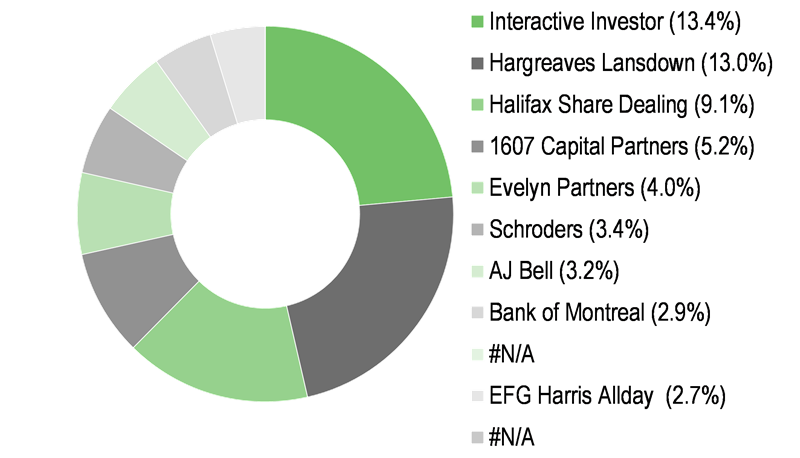
In February 2022 a 10 for one share split was implemented to increase the ease of trading and reinvestment of dividends for smaller holdings. LWI has a strong retail following with c 40% of shares held on retail share-dealing platforms such as Interactive Investor, Hargreaves Lansdown, AJ Bell and Halifax Share Dealing. Traditional wealth managers are modestly represented in the top 10 investors and 1607 Capital Partners, a US investor with a specialism in UK investment companies, is a relatively new entrant to the register.
The volume of shares traded daily has averaged c 370k over the past 12 months, with c 30% of LWI’s shares changing hands.
|
Exhibit 16: Major shareholders |
Exhibit 17: Average three-year trading volume |
|
|
|
Source: Bloomberg, as at 11 August 2023 |
Source: Refinitiv. Note: Data to 11 August 2023 |
|
Exhibit 16: Major shareholders |
|
|
Source: Bloomberg, as at 11 August 2023 |
|
Exhibit 17: Average three-year trading volume |
|
|
Source: Refinitiv. Note: Data to 11 August 2023 |
Discount management
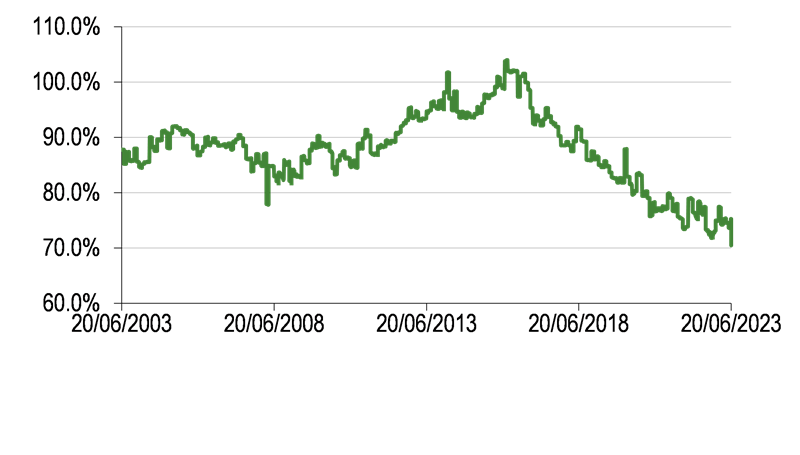
The current c 10% discount to NAV is not materially larger than the c 7% average of the past five years (within an effective range of a c 13% discount to a c 8% premium7) or the c 5% average discount for LWI’s peer group. LWI’s board does not favour the use of share buybacks as a means of discount control, seeing these as negating some of the benefits of the closed-end structure, as well as potentially shrinking the size of the trust, reducing the audience of potential investors, increasing the ongoing charges ratio and reducing liquidity in the shares.
6 The c 8% premium shown in the chart for March 2023 reflects a temporary anomaly during peak market volatility.
|
Exhibit 18: 10-year discount to NAV |
|
|
Source: Refinitiv |
The board
The board numbers five with an average tenure of a little under seven years and meets five times a year. Members collectively bring a range of relevant experience including senior management in the public and private corporate world, investment management expertise and investment trust management.
Exhibit 19: LWI’s board of directors
Board member |
Date of appointment |
FY22 remuneration (£) |
FY21 remuneration (£) |
End-FY22 shareholding |
Robert Robertson (chair) |
May 2011 |
40,000 |
39,000 |
592,250* |
Gaynor Coley (chair of audit committee) |
November 2016 |
31,500 |
30,500 |
10,450 |
Duncan Budge |
July 2014 |
26,250 |
25,500 |
97,790 |
Helena Vinnicombe |
May 2021 |
26,250 |
10,648** |
10,000 |
Thomas Walker |
July 2019 |
26,250 |
25,500 |
40,000 |
Source: LWI. Note: *Additionally, Robert Robinson had a non-beneficial interest in 120,000 shares. **For period from May 2021.
Chairman Robert Robertson has extensive senior experience in a range of quoted and private companies including industrial and materials companies globally as well as other investment companies. Duncan Budge is a former chief operating officer at RIT Capital Partners, a chairman of two investment companies and a non-executive director at a further three trusts. Gaynor Coley is a chartered accountant and has worked at senior levels in the public and private sectors across a range of industries. She sits on the board of three other investment companies. Thomas Walker is a chartered accountant and former fund manager with Martin Currie, managing open- and closed-ended funds. He sits on the board of a further two investment trusts. Helena Vinnicombe brings senior investment experience from Evelyn Partners (formally Smith & Williamson), is on the advisory board of M&G Charity Multi Asset Fund and is chief investment officer for Child Health Research.
JHI provides long experience and deep resources
James Henderson and Laura Foll are supported in the management of LWI by the deep resources of JHI, with its long and broad-ranging experience in active equity management. JHI has c £150bn of equity assets under management, with investment and research capabilities across a wide range strategies, sectors and styles. The investment team comprises more than 150 equity investment professionals, with an average of approximately 20 years’ financial industry experience, including specialist teams focusing on key sectors including healthcare, technology and energy. All JHI’s investment professionals, whatever their particular focus, combine insights gleaned from company meetings, generating the proprietary knowledge that enables them to generate the original, independent views that shape investment strategy across the company. Specifically in relation to LWI, Henderson joined the industry in 1982 and the company in 1984, and Foll joined the industry and the company in 2009. They are both members of the JHI global equity team and work closely with the UK smaller and mid-sized companies teams.
|
|
Research: Energy & Resources
Canacol Energy released its Q223 results on 10 August, which were in line with our full year expectations. Adjusted Q2 EBITDAX increased to US$60.7m, which represents a 10% increase year on year. This was driven primarily by a rise in netbacks, which increased to US$3.94/mcf in the quarter, compared to US$3.66/mcf in Q222. We are not changing our forecasts after these numbers.