Last close As at 05/08/2026
EUR0.73
— 0.00 (−0.54%)
Market capitalisation
EUR58m
Research: Industrials
Thus far, FY23 has marked a year of successful advancement for Amoéba: (1) the development of its biocontrol plant is ongoing, poised to achieve production of 40 tonnes per annum of W. magna lysate; (2) a third scientific article has been published, which highlights the efficacy of its biocontrol product; and (3) the company has announced a potential further application for W. magna lysate in cosmetic skincare. The new application will not hinder advancement of the biological fungicide product. H123 saw the widening of EBIT losses by €1.0m y-o-y to €3.9m, primarily attributable to increased industrial deployment costs and financing fees; Amoéba plans to seek €45m financing to support its expansion and operations.
Written by
Amoéba |
Biocontrol plant paves path to commercialisation |
H123 results |
Industrial engineering |
16 November 2023 |
Share price performance
Business description
Next events
Analysts
Amoéba is a research client of Edison Investment Research Limited |
|||||||||||||||||||||||||||||||||||||||||||||||
Thus far, FY23 has marked a year of successful advancement for Amoéba: (1) the development of its biocontrol plant is ongoing, poised to achieve production of 40 tonnes per annum of W. magna lysate; (2) a third scientific article has been published, which highlights the efficacy of its biocontrol product; and (3) the company has announced a potential further application for W. magna lysate in cosmetic skincare. The new application will not hinder advancement of the biological fungicide product. H123 saw the widening of EBIT losses by €1.0m y-o-y to €3.9m, primarily attributable to increased industrial deployment costs and financing fees; Amoéba plans to seek €45m financing to support its expansion and operations.
Year end |
Revenue |
EBITDA |
PBT* |
EPS* |
DPS |
P/E |
12/20 |
0.0 |
(4.4) |
(8.0) |
(0.49) |
0.00 |
N/A |
12/21 |
0.0 |
(4.0) |
(7.4) |
(0.42) |
0.00 |
N/A |
12/22 |
0.0 |
(4.7) |
(7.7) |
(0.23) |
0.00 |
N/A |
12/23e |
0.0 |
(7.7) |
(9.1) |
(0.18) |
0.00 |
N/A |
Note: *PBT and EPS are normalised, excluding amortisation of acquired intangibles, exceptional items and share-based payments.
Accelerated progress towards commercialisation
Amoéba is rapidly advancing its operations with the ongoing construction of its USIBIAM biocontrol plant, which when completed will have the capacity to treat 100,000 hectares annually of agricultural crops, with commercialisation expected in 2025. H123 saw the widening of EBIT losses by €1.0m y-o-y to €3.9m, primarily attributable to increased industrial deployment costs and financing fees. Net cash (including leases) decreased from €3.2m at end-FY22 to €2.5m in H123, largely due to a €1.3m cash outflow for the acquisition of tangible assets related to the biocontrol plant and increased opex, offsetting reductions in debt and financial interest costs. Our FY23 estimates remain unchanged.
Potential new application for W. magna lysate
In addition to W. magna lysate’s efficacy in crop protection (with the formulated product now branded AXPERA), Amoéba has presented a potential further application for the active substance in cosmetic skincare, validated by two studies, with next steps involving compatibility tests on human volunteers. This application will not hinder the advancement of AXPERA, as existing industrial facilities have ample capacity for the cosmetics application. A third scientific article has also been published, further highlighting AXPERA’s effectiveness as a biological fungicide, a clear endorsement of the industry.
Valuation: High-margin market potential
We are not attempting to calculate a valuation at present. As mentioned in our initiation note, the extended production plant could be capable of manufacturing sufficient volumes of AXPERA to treat 200,000 hectares of crops, which could represent annual revenues in the order of €26–35m and gross profit of c €20–25m at full utilisation. Further production facilities could follow to cater for what is expected to be a fast-growing industry.
H123 balance sheet and cash flow
The first half of the year was characterised primarily by the ongoing progression of the biocontrol application and the new financing obtained. Amoéba’s net cash decreased modestly to €2.5m from €3.2m at the end of FY22. The primary reason for this was substantial opex of €3.9m combined with a €1.4m outflow from the acquisition of tangible and intangible assets (H122: €0.04m) related to the biocontrol plant. This more than offset a substantial reduction in debt from €2.4m in FY22 to €0.7m in H123 and the resultant near elimination of gross financial interest compared to €1.5m in H122.
Exhibit 1: Comparison of H123 performance versus H122 and H222
€m |
H122 |
H222 |
H123 |
Revenue |
0.000 |
0.000 |
0.000 |
Grants |
0.251 |
0.210 |
0.380 |
Industrial deployment costs |
(0.516) |
(0.594) |
(0.958) |
R&D costs |
(1.306) |
(1.219) |
(1.224) |
General and admin costs |
(1.097) |
(1.183) |
(1.852) |
Sales and marketing costs |
(0.192) |
(0.197) |
(0.227) |
Reported EBIT |
(2.860) |
(2.983) |
(3.882) |
Net finance costs |
(1.531) |
(0.314) |
(0.008) |
Change in fair value of derivatives and other exceptional items |
(0.335) |
0.000 |
(0.112) |
Reported profit before tax |
(4.726) |
(3.297) |
(4.002) |
Reported tax |
0.000 |
0.000 |
0.000 |
Reported profit after tax |
(4.726) |
(3.297) |
(4.002) |
Source: Amoéba data
Working capital increased marginally by €0.08m versus end-FY22, reflecting an increase in other receivables, which offset increased trade and tax payables. Inventory levels, which relate to the consumables required to make both the active substance used in the biocontrol product and the biocide, decreased modestly by €0.06m and there were minimal trade receivables because the company is not yet revenue generating. Because the R&D costs related to obtaining regulatory approvals rather than technology developments, they were expensed rather than capitalised. The company spent €1.4m on tangibles and intangibles (H122: €0.04m) of which €1.1m related to the new site in Cavaillon and €0.2m to laboratory equipment.
Net assets decreased from €8.2m in FY22 to €6.6m in H123. This was primarily attributable to a reduction in cash and cash equivalents from substantial opex and the acquisition of tangible assets, which more than offset the substantial reduction in debt that coincided with largely reduced finance costs. Amoéba’s financial debt totalled €667,307, comprising liabilities relating to lease obligations and repayable advances.
Actively seeking funding for expansion and operations
Amoéba had €3.1m cash (gross) on its balance sheet at end-June 2023 compared to €5.5m at the end of December. Excluding working capital movements, operating cash burn during H123 was €3.0m. Assuming cash burn continues at H123 levels, this gives a cash runway into H124. The company will need to secure additional funding to support its development until H125, when revenue generation is expected to begin.
Following the cancellation of the eighth optional tranche of 80 convertible bonds with Nice & Green, the company has signed a contract with independent advisory firm Redbridge Debt & Treasury Advisory to assist it in securing €45m financing to fund operations and site expansion over the next three years. Of this, €23m is allocated to capex and the remainder for funding field trials, supporting the regulatory approvals process, registering products, establishing sales channels and adding production staff. Management is considering constructing an extension to the Cavaillon facility, which would double output and cost another €10m. We note there is no certainty in the company’s ability to secure this funding.
Because it will take time for Redbridge to secure this funding, Amoéba has agreed a new bond financing agreement with Nice & Green that will generate up to €8.4m net cash through the issue of three equal tranches of bonds between 30 June 2023 and 1 March 2024. Interest will be payable at six-month EURIBOR plus 600bp at the date of each drawing. The bonds mature 30 months after the issue date and the earliest date at which Amoéba will start repaying the loan is 31 March 2024. The arrangement has enabled the company to start its manufacturing scale-up programme; the first tranche of 100 straight bonds has been drawn down for a net amount of €2.8m, paid in July/August 2023.
In addition, the French public investment bank, BPI France, will provide Amoéba with a €3.6m grant and a €2.4m recoverable advance to support the expansion programme. We understand that €1.5m has already been received (of which €0.9m related to the grant and €0.6m related to recoverable advances). The timing of remaining payments has not yet been announced.
Management has carried out a specific review of the company’s liquidity risk and states that Amoéba has sufficient net working capital to meet its obligations until end-July 2024.
FY23: A year of progress so far
To date, 2023 has been a dynamic year for the company, with construction of the new production plant, dedicated to its biocontrol product against pathogenic fungi, commencing. This facility is expected to be capable of manufacturing sufficient finished product to treat 100,000 hectares of crop annually (or 200,000 hectares when extended) and production is slated to start in early 2025. The plant is designed to operate a single eight-hour shift, seven days a week. Sustainability remains deeply embedded in Amoéba’s activities, with 65% of the biocontrol plant’s roofs set to feature photovoltaic panels, and energy-conserving systems such as geothermal regulation and organic sludge recovery (biomethane) to be included. As part of its pre-commercialisation strategy, Amoéba has introduced an international brand for its biocontrol solution, which will be known as AXPERA.
|
Exhibit 2: 3D representation of USIBIAM biocontrol plant, Cavaillon |
|
|
Source: Amoéba |
With construction well under way, we expect revenue generation to commence in 2025, subject to product approval. We note that the gross margins likely to be achievable for the company are relatively high, with management targeting at least 75%. The high level is attributable to a combination of the use of its proprietary production facility, with no outsourcing, and high sector-wide margins. In 2022, Eden Research generated a 45% gross margin and Plant Health Care 61%, both comparable peers at later stages (although both outsource production). As mentioned in our initiation note, we estimate that at full utilisation the extended USIBIAM production plant could produce enough biological fungicide to generate annual revenues in the order of €26–35m and gross profit of c €20–25m at full utilisation, with a gross margin target in the region of 75%.
Publication of third scientific research article
Since 2019, Amoéba has engaged in over 620 field trials, including 200 partner tests, evaluating the efficacy of lysate of the Willaertia magna C2c Maky amoeba as a biological fungicide over a range of different climates/conditions and on a variety of different targets. Results thus far have been highly encouraging, including the data demonstrated in a recently published scientific article.
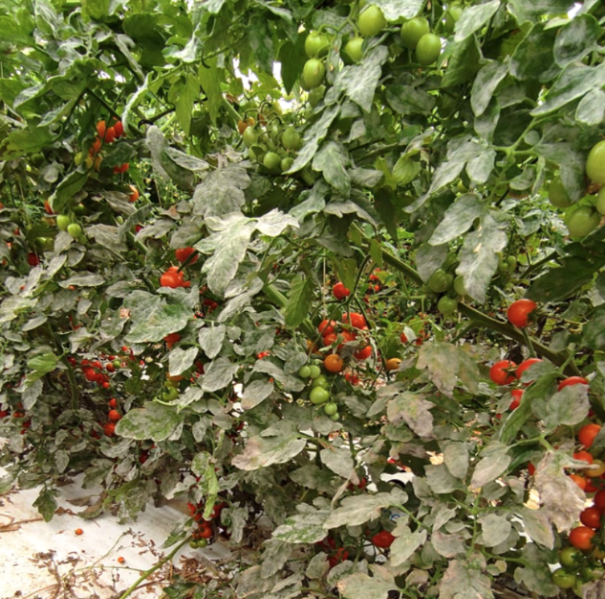
This marks the third peer-reviewed scientific article on Amoéba’s biocontrol application in the special ‘Biological Control of Plant Diseases II’ issue of Plants. Specifically, this article presents the efficacy of the active substance and formulated product (AXPERA) on late blight and powdery mildew on tomato plants, demonstrating statistically significant protection of up to 97% and 100% on the leaves and fruit, respectively. This is attributable to the product’s ability to stimulate tomato genes involved in the plant defence pathways.
|
Exhibit 3: Trial in 2022 showing untreated powdery mildew on tomato plants |
Exhibit 4: Trial in 2022 showing powdery mildew on tomato plants treated with AXPERA |
|
|
|
Source: Amoéba |
Source: Amoéba |
|
Exhibit 3: Trial in 2022 showing untreated powdery mildew on tomato plants |
|
|
Source: Amoéba |
|
Exhibit 4: Trial in 2022 showing powdery mildew on tomato plants treated with AXPERA |
|
|
Source: Amoéba |
Publications, such as the one mentioned above, substantiate the effectiveness of Amoéba’s formulated product as a biological fungicide. If granted approval, it could offer a compelling substitute for widely employed chemical fungicides. Notably, certain countries are in the process of banning chemical fungicides due to their adverse impact on the environment, including risks to pollinators such as bees. This is exemplified in the case of Bordeaux mixture, an organic fungicide made from copper sulphate and calcium hydroxide, used to treat downy mildew and sulphur powdery mildew. Prolonged use of this mixture can lead to copper accumulation in the soil, harming organisms such as worms, and restricting cattle grazing. In response, the European Commission imposed a copper application limit of 4kg per hectare per year in 2018, with a review scheduled for 2026. Moreover, microorganisms are evolving to be resistant to commonly used conventional fungicides.
Using biological fungicides to replace or complement conventional ones gives growers an option of maintaining crop yield while reducing the use of substances that are harmful to human health and the environment.
Potential new application for W. magna lysate
The company, in its efforts to explore new applications of Willaertia magna C2c Maky lysate, made an unexpected discovery regarding its potential anti-ageing cosmetic properties. Two laboratory studies were conducted to validate this potential application. The first study demonstrated the lysate’s stimulation of various genes in lab-grown human skin cells. Notably, it moderately enhanced the expression of genes associated with wound healing, hyaluronic acid synthesis and anti-infectious immunity (FBL5, HAS and TLR2 genes) while displaying strong stimulation of genes involved in cell preservation, cell renewal and protection against UV radiation, oxidative stress and photoaging (BCL2, PIWIL1, FOXO1 and SGK1 genes).
The second study was carried out by a reputable biotech company, LabSkin Creations. The lysate was applied every two to three days for a month to a 3D reconstructed skin model and results showed increased epidermal thickness, improved cell differentiation and an enhanced extracellular matrix (which plays an essential role in skin cohesion), all associated with anti-ageing properties. The company has filed a patent and further tests on 30–50 volunteers are planned for early 2024.
This breakthrough opens a potentially lucrative avenue for Amoéba; according to Statista, the global anti-ageing market was estimated to be worth c $63bn in 2021 and is projected to grow at a CAGR of 7% from 2022 to 2027. Furthermore, facial anti-ageing products were the second most sought after skin care treatment in the US in 2022, with sales amounting to over $1bn (c 25% of aggregate skin care sales). The next phase, which involves conducting trials on volunteers and further development, holds significant potential for the company. However, it is important to note that entering the anti-ageing cream market presents challenges primarily due to its competitiveness and the need for differentiation. The importance of labels is vital in influencing purchasing decisions of consumers.
This application does not compromise advancement of AXPERA, as according to management estimates, very small amounts of active product could be sufficient to generate commercial volumes of anti-ageing cream. Thus the ingredient can be mass produced using the company’s existing industrial facilities.
FY23/24 outlook
|
Exhibit 5: Timetable for securing regulatory approval |
|
|
Source: Amoéba |
Amoéba remains on track for approval of its formulated product, AXPERA, in both the US and EU in 2024, bolstered by the continuing positive efficacy results from trials. Furthermore, in Brazil, following field trials on soybean carried out over winter 2022/23, Amoéba plans to submit an application for active substance approval and marketing authorisation for products containing this active substance this year, potentially leading to marketing authorisation in 2025.
Field tests continue to make progress, including those testing efficacy and selectivity on new targets (eg arboriculture, aromatic and ornamental plants, strawberry, garlic).
Exhibit 6: Financial summary
Year end 31 December |
€m |
FY20 |
FY21 |
FY22 |
FY23e |
|
INCOME STATEMENT |
||||||
Revenue |
|
|
0.0 |
0.0 |
0.0 |
0.0 |
EBITDA |
|
|
(4.4) |
(4.0) |
(4.7) |
(7.7) |
Operating profit (before amort. and excepts.) |
|
|
(5.9) |
(4.9) |
(5.8) |
(8.8) |
Amortisation of acquired intangibles |
0.0 |
0.0 |
0.0 |
0.0 |
||
Exceptionals |
0.0 |
0.0 |
0.0 |
0.0 |
||
Share-based payments |
(0.3) |
(0.7) |
(0.0) |
(0.0) |
||
Reported operating profit |
(6.2) |
(5.6) |
(5.8) |
(8.8) |
||
Net Interest |
(2.1) |
(2.5) |
(1.9) |
(0.3) |
||
Exceptionals |
0.1 |
0.2 |
(0.3) |
0.0 |
||
Profit Before Tax (norm) |
|
|
(8.0) |
(7.4) |
(7.7) |
(9.1) |
Profit Before Tax (reported) |
|
|
(8.2) |
(7.8) |
(8.0) |
(9.1) |
Reported tax |
0.0 |
0.0 |
0.0 |
0.0 |
||
Profit After Tax (norm) |
(8.0) |
(7.4) |
(7.7) |
(9.1) |
||
Profit After Tax (reported) |
(8.2) |
(7.8) |
(8.0) |
(9.1) |
||
Discontinued operations |
0.0 |
0.0 |
0.0 |
0.0 |
||
Net income (normalised) |
(8.0) |
(7.4) |
(7.7) |
(9.1) |
||
Net income (reported) |
(8.2) |
(7.8) |
(8.0) |
(9.1) |
||
Average Number of Shares Outstanding (m) |
16.2 |
17.8 |
33.6 |
49.1 |
||
EPS - normalised (€) |
|
|
(0.49) |
(0.42) |
(0.23) |
(0.18) |
EPS - normalised fully diluted (€) |
|
|
(0.49) |
(0.42) |
(0.23) |
(0.18) |
EPS - basic reported (€) |
|
|
(0.50) |
(0.44) |
(0.24) |
(0.19) |
Dividend (€) |
0.00 |
0.00 |
0.00 |
0.00 |
||
Revenue growth (%) |
N/A |
N/A |
N/A |
N/A |
||
EBITDA Margin (%) |
N/A |
N/A |
N/A |
N/A |
||
Normalised Operating Margin |
N/A |
N/A |
N/A |
N/A |
||
BALANCE SHEET |
||||||
Fixed Assets |
|
|
6.9 |
6.1 |
5.3 |
9.7 |
Intangible Assets |
2.5 |
2.5 |
2.5 |
2.5 |
||
Tangible Assets |
4.3 |
3.5 |
2.7 |
7.1 |
||
Investments & other |
0.1 |
0.1 |
0.1 |
0.1 |
||
Current Assets |
|
|
6.2 |
8.4 |
7.1 |
2.2 |
Stocks |
0.1 |
0.3 |
0.3 |
0.3 |
||
Debtors |
0.0 |
0.0 |
0.0 |
0.0 |
||
Cash & cash equivalents |
5.0 |
7.3 |
5.5 |
1.1 |
||
Other |
1.1 |
0.9 |
1.3 |
0.9 |
||
Current Liabilities |
|
|
(2.1) |
(13.8) |
(4.2) |
(13.2) |
Creditors |
(1.1) |
(1.0) |
(1.3) |
(1.9) |
||
Short term borrowings including lease liabilities |
(0.4) |
(12.2) |
(2.3) |
(10.7) |
||
Other |
(0.6) |
(0.5) |
(0.6) |
(0.6) |
||
Long Term Liabilities |
|
|
(9.0) |
(0.5) |
(0.1) |
(0.1) |
Long term borrowings |
(8.2) |
(0.3) |
(0.1) |
(0.1) |
||
Other long term liabilities |
(0.7) |
(0.3) |
(0.0) |
(0.0) |
||
Net Assets |
|
|
2.0 |
0.2 |
8.2 |
(1.3) |
Minority interests |
0.0 |
0.0 |
0.0 |
0.0 |
||
Shareholders' equity |
|
|
2.0 |
0.2 |
8.2 |
(1.3) |
CASH FLOW |
||||||
EBITDA |
(4.4) |
(4.0) |
(4.7) |
(7.7) |
||
Working capital |
0.9 |
(0.4) |
0.3 |
0.6 |
||
Exceptional & other |
0.2 |
0.2 |
(0.0) |
0.0 |
||
Tax |
0.0 |
0.0 |
0.0 |
0.0 |
||
Operating Cash Flow |
|
|
(3.3) |
(4.3) |
(4.4) |
(7.1) |
Capex (including capitalised R&D) |
(0.1) |
(0.1) |
(0.2) |
(5.5) |
||
Acquisitions/disposals |
0.0 |
0.0 |
0.0 |
0.0 |
||
Net interest |
(0.2) |
(1.6) |
(1.0) |
(0.3) |
||
Equity financing |
0.0 |
0.0 |
(0.2) |
0.0 |
||
Dividends |
0.0 |
0.0 |
0.0 |
0.0 |
||
Other |
4.5 |
10.1 |
10.6 |
0.0 |
||
Net Cash Flow |
1.0 |
4.1 |
4.8 |
(12.8) |
||
Opening net debt/(cash) |
|
|
2.7 |
3.6 |
5.2 |
(3.2) |
FX |
0.0 |
0.0 |
0.0 |
0.0 |
||
Other non-cash movements |
(1.9) |
(5.7) |
3.6 |
0.0 |
||
Closing net debt/(cash) |
|
|
3.6 |
5.2 |
(3.2) |
9.7 |
Lease liabilities |
0.7 |
0.5 |
0.3 |
0.3 |
||
Closing net debt/(cash) excluding property lease liabilities |
|
|
2.9 |
4.7 |
(3.5) |
9.4 |
Source: company accounts, Edison Investment Research
|
|
Research: Financials
With indexed rental growth continuing and rent collection recovering, Triple Point Social Housing REIT’s (SOHO’s) Q323 dividend was fully covered, and we expect this to continue. Meanwhile, while the board continues its focus on closing the share price discount to NAV, it has concluded that any further capital return is dependent on significant additional liquidity being generated through property sales.