Last close As at 05/08/2026
CHF50.80
▲ −0.10 (−0.20%)
Market capitalisation
CHF2,802m
Research: Investment Companies
BB Biotech (BION) offers investors exposure to the innovative, rapidly expanding biotech sector. It is the largest biotech investor among its investment company peers, focused on high-quality biotech assets that target substantial market opportunities. BION’s performance has picked up in recent months, supported by an improvement in the market environment. Its managers are optimistic about the outlook as declines in interest rates, whenever they eventuate, begin to boost investor sentiment towards the sector, especially the mid- and small-cap companies that BION favours. The fund’s managers also expect ongoing progress by portfolio holdings, as several reach key milestones over the coming months. Unlike most of its peers, BION pays an attractive 5% dividend, calculated on average share price over December each year.
BB Biotech |
A recovering sector with a healthy prognosis |
Investment companies |
20 May 2024 |
Analyst
|
|||||||||||||||||||||||||||||||||||||||||||||||||||||||||||||||||||||||||||||||||||||||||||||||||||||||||||||||
BB Biotech (BION) offers investors exposure to the innovative, rapidly expanding biotech sector. It is the largest biotech investor among its investment company peers, focused on high-quality biotech assets that target substantial market opportunities. BION’s performance has picked up in recent months, supported by an improvement in the market environment. Its managers are optimistic about the outlook as declines in interest rates, whenever they eventuate, begin to boost investor sentiment towards the sector, especially the mid- and small-cap companies that BION favours. The fund’s managers also expect ongoing progress by portfolio holdings, as several reach key milestones over the coming months. Unlike most of its peers, BION pays an attractive 5% dividend, calculated on average share price over December each year.
|
BION’s performance relative to the Nasdaq Biotech Index (CHF) over 10 years |
|
|
Source: LSEG, Edison Investment Research. Note: Total returns in Swiss francs. |
The analyst’s view
■
The biotech industry ranks among the most attractive of all fast-growing sectors, with an estimated annual growth rate of more than 10%. According to BION’s managers, sector revenues are forecast to reach around $290bn this year and they expect demographic trends and lifestyle changes to sustain this growth momentum in the longer term, to the extent that by 2026, more than half of the 100 bestselling drugs, and almost 40% of total global drug sales, will come from biotech labs.
■
BION is the largest fund among its peer group (see Exhibit 4) operating in this space and offers investors a rare chance to access exposure to the investment opportunities created by leading technologies and innovative drugs.
■
BION’s long-term track record of outright gains and outperformance of its benchmark, and most of its peers, is likely to appeal to investors seeking exposure to this sector (see below for details).
■
As most biotech companies do not pay substantial dividends, preferring to invest cash flows in further growth, BION’s 5% dividend policy may be welcomed by investors seeking regular income.
■
BION’s shares are currently trading at a small discount to NAV. With performance improving and the sector outlook brightening, this may represent an opportunity for investors to acquire BION shares in this vibrant industry at an especially attractive level.
BION: Accessing an exciting growth sector
A good start to 2024
After a couple of challenging years, the biotech sector started 2024 on a positive note. Biotech is a growth sector, and as such it was hurt over the past couple of years by the aggressive interest rate policies implemented by the US Federal Reserve and other central banks, as they tried to quash persistent inflation. The rapid rise in rates was particularly detrimental to mid- and small-cap biotech companies, which together comprise more than 80% of BION’s portfolio.
However, as inflation peaked in H223, investors at the time expected that central banks would begin easing monetary policy in H124. Global equity markets strengthened accordingly and investor sentiment regarding the biotech sector improved markedly at the end of 2023. Biotech stocks have rallied, and the tone remains positive, even though expectations about the pace of monetary easing were wound back in Q124, as US inflation proved more sticky than previously anticipated. This rally was given impetus by solid earnings announcements and the sustained momentum of companies’ focus on obesity drugs. Capital market conditions for biotech have also improved, with funding activity on the rise, although the sector has seen few IPOs so far this year.
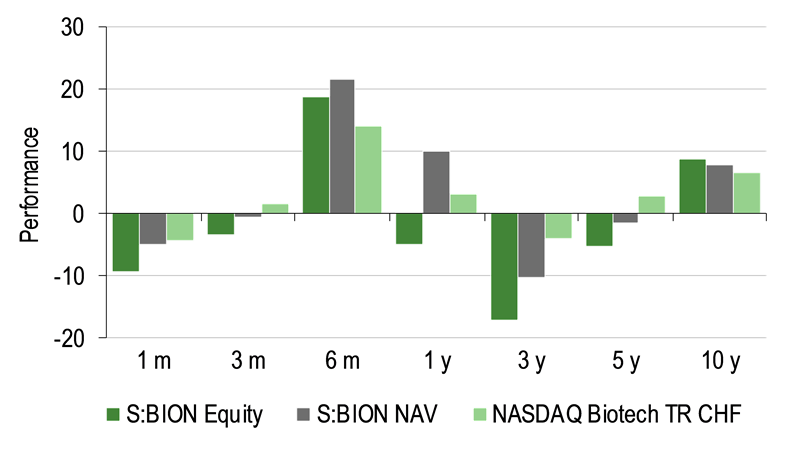
BB Biotech has done well in this supportive environment, thanks to positive developments in several of BION’s holdings this year, and the depreciation in the Swiss franc (see details in the Performance section below). Over the six months ended 30 April 2024, it returned 21.5% (in CHF terms), comfortably ahead of the return of 14.0% for its benchmark, the Nasdaq Biotech Index (NBI). The company has also outperformed over the one-year period. While the weakness in growth stocks and rising rates has adversely affected relative returns over three years, longer-term performance remains robust in absolute and relative terms. In the 10 years to end-April 2024, BION made an average annual return of 8.0% (in CHF terms), compared to the benchmark return of 6.7%. The company has also outpaced the average return of selected peers, as illustrated in Exhibit 4.
Outlook favourable, with lots to look forward to
BION’s managers are very positive about the outlook for their portfolio. They believe that the financial strength and resilience of the companies they hold are ‘exceptional’ and ‘clearly better’ than before the COVID-19 pandemic. At the end of Q124, more than 80% of portfolio holdings, mostly mid-cap companies, were either profitable or financed to reach profitability, making good progress and offering a ‘highly attractive risk/return profile’, according to the managers. The remaining holdings are earlier- and mid-stage pipeline companies requiring additional financing in coming years.
During 2023, BION’s managers stopped making new investments and have earmarked available funds for existing portfolio holdings, to give them more working capital to invest in their growth potential. As a result, BION’s lead portfolio manager, Dr Daniel Koller, believes the portfolio has never been more solidly financed and the company is now ready to enter a new cycle of investments, to add and build out fresh positions. The team has added three new names to the portfolio over the past six months (see details below in the Portfolio allocation section). Likely areas of further new investment include obesity treatments, immunology, targeted oncology products and neuropsychiatry, where diagnoses of depression and anxiety are increasing.
The BION team expects the market environment to remain supportive. Developments on the interest rate front will remain the key influence on biotech investments and given that mid- and small-cap companies were worst hit by rising rates, the managers’ expectations that declining rates will drive further recovery and outperformance of this area of the market seem reasonable.
They also foresee other fundamental factors likely to provide a further boost to investor sentiment, including important clinical trial results, M&A and potentially IPO activity, licensing deals and product launches. Indeed, the sector is eagerly anticipating several major milestones that Koller predicts will be ‘really transformative’, and more significant for the sector than developments in recent years. Foremost among these is an update on Alnylam Pharmaceuticals’ late-stage clinical trial of vutrisiran in patients with TTR cardiomyopathy, expected in the summer. Alnylam is one of BION’s largest holdings. Vutrisiran is already approved for smaller sectors of the market and positive news would represent a multi-million-dollar opportunity for Alnylam, as it could potentially give the company access to more common diseases and thus to a larger patient population, in addition to the market for extremely rare diseases. Favourable results should also benefit the broader sector in Koller’s view, notably Ionis Pharmaceuticals, BION’s largest position, which has a similar technology and commercial path and is targeting a broader spectrum of diseases in the coming years.
Other forthcoming key milestones for BION portfolio holdings include:
■
Agios Pharmaceuticals’ ENERGIZE-T Phase III results for the treatment of alpha- and beta-thalassemia patients
■
Moderna’s RSV vaccine mRNA-1345, which is expected to receive approval during Q224, in time for the autumn flu vaccination season;
■
Alnylam’s HELIOS-B update, which will also impact Ionis;
■
Immunocore’s update on the PRAME programme; and
■
Annexon’s Phase III Guillain-Barré Syndrome data publication.
Taking a slightly longer-term view, mid- and small-cap biotech companies are also likely to see increasing interest from large pharmaceutical companies, which the team believes will play a crucial role in driving growth in the sector and hence delivering value to investors. These big pharma companies are cash rich (according to a recent study by EY) and facing a so-called ‘patent cliff’ as numerous patented products are due to lose their licence protection by 2028, allowing them to be replicated and sold at much cheaper prices by competitors. This will result in sharp declines in revenues for the pharmaceutical companies over the next few years, which they need to replace with new patented products. Big pharma companies are thus in the market to make strategic acquisitions of smaller companies to expand their drug pipelines and access innovative technologies. BION’s managers expect the focus of these efforts will be on treatments for obesity, autoimmune disorders and cancer. In their view, almost all BION’s portfolio holdings are potential acquisition targets, however, they are not in any discussions at this point.
The managers’ confidence in the outlook is manifest in the current level of portfolio gearing, which stood at 14.1% at end-Q124. This is at the high end of the company’s defined range.
In terms of potential risks to this generally positive outlook, the pharmaceutical sector may experience some volatility this year related to the first decisions on drug pricing under President Joe Biden’s Inflation Reduction Act. This legislation includes initiatives aimed at reducing the cost of drugs used by people in the US government’s Medicare scheme. These measures are scheduled to take effect in 2026 and it is estimated they will save the US government $237bn over the following 10 years, so drug manufacturers and investors in the sector will be watching these decisions closely. However, any such rulings will not have a direct impact on any of BION’s portfolio holdings.
Investment process enhanced by AI
BION’s search for new investment opportunities is supported by the work of its team of three data scientists, who all have experience working for large pharmaceutical companies. The team is focused on using AI and big data to enhance BION’s investment process. To this end, the team has developed proprietary analytical systems to synthesise a broad range of data published by pharmaceutical companies and other sources, to monitor and analyse the global medical landscape and industry trends across the 8,000 or so companies developing new drugs. Patient-centred intelligence is a key input into their work. For example, anonymised US health insurance company data going back eight years provide detailed medical profiles of 30 million people, amounting to 10% of the US population, a vast database that can be interrogated in myriad ways to assess treatment efficacies and patient journeys.
The team’s work helps characterise the complex and rapidly evolving biotech sector, giving BION’s managers greater insight into their investment universe. The team is forward looking, aiming to identify new investment opportunities and help the managers better assess risks associated with existing positions. Their work also provides the managers with independent second opinions on the results published by biotech companies, and information that feeds into company valuation estimates. The team continues to develop its system capabilities to further enhance the quality of its inputs into BION’s investment process.
BION’s managers believe the team’s work is unique among its European competitors, and among the global leaders in the field, giving BION a valuable competitive advantage over its peers.
Dividend payments well ahead of competitors
As well as providing exposure to a rapidly growing, innovative sector, BION pays a dividend equivalent to 5% of the average share price during December each year. A dividend of CHF2.00 per share was paid with respect to the year ended 31 December 2023 (2022: CHF2.85 per share, 2021: CHF3.85 per share). This payment was made in March 2024.
Although the dividend has declined in the past two years, it still compares favourably with BION’s peers in the biotech and healthcare sectors, as all other investment companies in this group pay no, or very low, dividends. This is the case because many biotech companies are at a relatively early stage of development and thus prefer to reinvest cash to fund future growth. However, BION’s directors recognise shareholders’ appetite for income and BION has accordingly adopted a different approach to that of its peers. This high distribution policy, which was introduced in 2013, appears to be appreciated by shareholders – it is arguably one of the factors underlying the share price move from discount to premium over the past seven years. However, it is important for shareholders to be aware that the company’s dividend payments may in part represent a return of their capital.
Small discount offers a rare buying opportunity
|
Exhibit 1: Premium/discount over five years |
|
|
Source: LSEG, Bloomberg, Edison Investment Research |
For the last seven years or so, BION’s shares have traded at an average premium of around 10%, arguably underpinned by strong investor interest in the biotech sector, buying by passive investors following index inclusion and BION’s high distribution policy (discussed above). BION reached a record-high premium to NAV of c 40% in January 2022, but the share price subsequently dipped briefly into discount territory in 2023. It has since fluctuated relatively close to parity with the NAV and is currently trading at a small discount (Exhibit 1).
The narrowing trend in BION’s premium over the past couple of years should not be perceived as a reflection of BION individually. On the contrary, most investment companies have seen their premiums narrow or discounts widen, for broader reasons that we discussed in our last note. However, with BION’s shares now trading well below their longer-term average premium, performance improving, and the sector set to benefit as and when interest rates eventually fall, investors may see an opportunity to gain or add exposure to the company, and this rapidly growing sector, at a relatively attractive level.
Performance
Exhibit 2: Five-year discrete performance data
|
Source: LSEG, Bloomberg. Note: All % on a total return basis in Swiss francs.
Recent returns supported by positive news in several holdings
BION’s good performance over the past six months has been supported by a number of factors, including the success of mid-stage trials and proof-of-concept studies for several portfolio holdings, although the outcomes of late-stage trials were varied. The Phase II trial results for Vertex’s VX-548 for treating painful diabetic peripheral neuropathy supported Vertex’s stock price in December 2023, while Arvinas revealed positive results for vepdegestrant, its breast cancer treatment, which encouraged the company to broaden its development profile for this drug. The company also raised funds via a US$350m private placement, in which BION participated. Arvinas’ stock price tripled in value in a few weeks in late 2023, but it has since given back some of these gains. In January 2024, Black Diamond confirmed important clinical milestones for its treatment for lung cancer, and the stock has since doubled in value. The company has sufficient cash and investments to fund milestone achievements and operations until mid-2025. In mid-April, Intra-Cellular Therapies’ Phase III trial for Caplyta for patients with major depression fuelled a recovery in the share price. MacroGenics has also been performing well, perhaps due to anticipation about its forthcoming Phase II update on its prostate cancer treatment.
|
Exhibit 3: Investment company performance to 30 April 2024 |
|
Price, NAV and benchmark total return performance, 10-year rebased |
Price, NAV and benchmark total return performance (%) |
|
|
|
Source: LSEG, Bloomberg, Edison Investment Research. Note: Three-, five- and 10-year performance figures annualised. |
|
Regulatory decisions have also bolstered returns. In December 2023, Crispr Therapeutics received approval from US regulators to market Casgevy, a ground-breaking gene editing therapy for treating severe genetic diseases. This is a personalised gene therapy jointly developed with Vertex. Administration is still complex, and the treatment is very expensive, but the therapy’s one-time administration is transformative, significantly reducing long-term treatment costs. The European Commission (EC) granted similar approval in February this year. Elsewhere, Ionis received FDA approval for Wainua, a treatment for polyneuropathy of hereditary transthyretin-mediated amyloidosis, while the EC approved Argenx’s treatment for general myasthenia gravis.
Peer group comparison
BION is not included in the AIC’s Biotechnology & Healthcare sector as its primary listing is in Switzerland, but in Exhibits 4 and 5 we present it and another Swiss company, HBM Healthcare Investments (HBMN), alongside members of the AIC peer group, to provide a relevant comparison. The tables include four funds (BION, Biotech Growth Trust, International Biotechnology Trust and the relatively recently launched RTW Biotech Opportunities) that focus primarily on biotech stocks, and four funds (BB Healthcare, HBMN, Polar Capital Global Healthcare and Worldwide Healthcare Trust) that focus on healthcare more broadly and generally include some biotech stocks alongside stocks from other sectors. Syncona is a venture capital/growth capital investor focused on backing and building early-stage companies, mainly in the biotech space.
Exhibit 4: Selected peer group at 17 May 2024 (in CHF terms)*
% unless stated |
Market cap £m |
NAV TR |
NAV TR |
NAV TR |
NAV TR |
Price TR |
Price TR |
Price TR 5 year |
Price TR |
Prem/(Dis (cum fair % |
BB Biotech |
2,335.1 |
10.1 |
(27.0) |
(1.6) |
138.4 |
(5.0) |
(43.3) |
(20.4) |
129.5 |
(3.4) |
BB Healthcare |
774.7 |
(4.6) |
(22.4) |
12.5 |
- |
(2.6) |
(28.2) |
3.3 |
- |
(3.6) |
Biotech Growth |
389.0 |
20.7 |
(34.4) |
19.9 |
70.9 |
24.4 |
(40.1) |
19.2 |
66.0 |
(7.4) |
HBM Healthcare Investments |
1,327.4 |
(4.1) |
(15.6) |
39.8 |
211.1 |
(6.6) |
(36.7) |
33.3 |
288.3 |
(16.8) |
International Biotechnology |
275.4 |
5.8 |
(5.8) |
18.3 |
117.8 |
(0.7) |
(14.1) |
3.9 |
138.5 |
(9.5) |
Polar Capital Glb Healthcare |
501.1 |
13.2 |
22.3 |
55.9 |
115.5 |
12.6 |
28.1 |
58.1 |
106.5 |
(6.5) |
RTW Biotech Opportunities |
457.8 |
18.9 |
3.2 |
- |
- |
11.6 |
(38.0) |
- |
- |
(32.6) |
Syncona |
893.9 |
0.3 |
(11.8) |
(24.2) |
42.1 |
(16.4) |
(52.0) |
(57.1) |
(11.2) |
(36.0) |
Worldwide Healthcare |
2,130.0 |
9.7 |
(7.2) |
32.3 |
144.7 |
10.2 |
(15.9) |
19.3 |
127.1 |
(10.0) |
Simple average (nine funds) |
843.7 |
7.5 |
(9.0) |
22.1 |
117.0 |
4.1 |
(24.6) |
11.4 |
119.2 |
(15.6) |
BION rank in peer group |
1 |
4 |
8 |
7 |
3 |
7 |
8 |
7 |
3 |
1 |
Source: Morningstar, Bloomberg, Edison Investment Research. Note: *Performance at 30 April 2024 based on ex-par NAV. TR, total return. Net gearing is total assets less cash and equivalents as a percentage of net assets.
Exhibit 5: Selected peer group at 17 May 2024 (in CHF terms)*
% unless stated |
Ongoing charge |
Perf fee |
Net gearing |
Dividend yield |
No of holdings |
Average daily volume * |
BB Biotech |
1.10 |
No |
114 |
5.0 |
29 |
3,601 |
BB Healthcare |
1.01 |
No |
100 |
0.0 |
28 |
1,908 |
Biotech Growth |
1.08 |
Yes |
109 |
0.0 |
65 |
823 |
HBM Healthcare Investments |
1.03 |
Yes |
103 |
0.0 |
208 |
923 |
International Biotechnology |
1.44 |
Yes |
109 |
0.0 |
87 |
359 |
Polar Capital Glb Healthcare |
0.94 |
Yes |
107 |
0.6 |
41 |
N/A |
RTW Biotech Opportunities |
1.97 |
Yes |
99 |
0.0 |
49 |
515 |
Syncona |
0.92 |
No |
100 |
0.0 |
19 |
994 |
Worldwide Healthcare |
0.83 |
Yes |
101 |
0.8 |
55 |
4,940 |
Simple average (nine funds) |
1.20 |
103.5 |
0.2 |
69.0 |
1,758 |
|
BION rank in peer group |
7 |
1 |
1 |
7 |
2 |
Source: Morningstar, LSEG, Edison Investment Research. Note: *Average daily volume in CHF000 over last twelve months
BION is the largest fund in this grouping. Like BION, most members of the group have made outright gains over the past year and sentiment within the broader sector has improved. BION’s recent performance has lagged due to its mid- and small-cap bias, as these sectors have underperformed the market, but its long-term performance remains strong – BION ranks third among its peers and has outperformed the average over 10 years on both an NAV and share price total return basis. One key differentiator for BION is that it is the only company among its peers to pay a substantial dividend, which is set at 5% of the average share price over December each year. The company’s ongoing charge is below the average of its peers and, unlike most of its peers, it is not subject to a performance fee. BION is currently trading at the narrowest discount among its peers and it has the highest level of gearing among this cohort.
Portfolio allocation
BION is differentiated from its NBI benchmark by its concentrated portfolio of c 30 stocks. At end-March 2024, the company’s top 10 holdings comprised c 73% of its NAV (Exhibit 5). The company also differs from the NBI by being able to hold up to 10% of its assets in private equity, although at present it only holds a small position in one unlisted company, Rivus Pharmaceuticals.
During the past six months the team has added three new names to the portfolio:
■
Biohaven works in the fields of neurology and neuropsychiatry. Among the company’s various clinical assets, the managers view its MoDE drug platform and BHV-7000, a Kv7 modulator for treatment of epilepsy, as ‘transformational’, with scope to become the best in class. BHV-7000 has a better safety profile than alternatives and is in Phase II/III development. Biohaven launched on the Nasdaq in October 2023 and its shares have since performed well. The company raised $200m cash in H223 and a further $265m in April 2024, and it has the potential to develop multiple products from its platform.
■
Immunocore is an immune oncology company focused on transforming the body’s natural immune response to solid tumours through a T-cell receptor (TCR) bispecific platform, which allows the patient’s own T cells to recognise and kill cancerous cells. The company is a pioneer in the TCR field. Its sales are already strong at $250m, up from $174m in 2022, and it is testing its therapy for wider use, with more products likely in future. Immunocore has added to performance since acquisition.
■
Annexon is a clinical-stage company focused on developing therapeutic candidates to tackle severe autoimmune disorders.
BION’s managers have also added to existing positions including Arvinas, Celldex Therapeutics, Sage Therapeutics, Generation BIO and Beam Therapies and the company participated in capital raises for Celldex and Esperion Therapeutics.
These transactions were funded by the Q4 sale of Mersana Therpaeutics, whose investment case had deteriorated, and profit-taking to trim positions in successful long-term investments in Vertex, Ionis Pharmaceuticals, Argenx, Intra-Cellular, Moderna, Neurocrine Biosciences, and Crispr Therapeutics.
Exhibit 6: Top 10 holdings
Company |
Country |
Main clinical focus |
Portfolio weight % |
Change (pp) |
|
30 April 2024 |
31 September 2023* |
||||
Ionis Pharmaceuticals |
US |
Genetic diseases |
11.4 |
13.3 |
(1.9) |
Argenx (ADR) |
Netherlands |
Orphan diseases |
9.7 |
11.7 |
(2.0) |
Neurocrine Biosciences |
US |
Neurological diseases/women's health |
9.0 |
8.5 |
0.5 |
Vertex Pharmaceuticals |
US |
Orphan diseases |
7.7 |
10.4 |
(2.7) |
Intra-Cellular Therapies |
US |
Neurological diseases |
6.2 |
6.9 |
(0.7) |
Moderna Therapeutics |
US |
mRNA platform |
5.8 |
6.2 |
(0.4) |
Revolution Medicines |
US |
Oncology |
5.2 |
4.4 |
0.8 |
Macrogenics |
US |
Oncology |
4.7 |
N/A |
N/A |
Alnylam Pharmaceuticals |
US |
Genetic diseases |
4.3 |
5.8 |
(1.5) |
Incyte |
US |
Oncology |
3.9 |
5.7 |
(1.8) |
Top 10 (% of holdings) |
67.9 |
78.0 |
(10.1) |
||
Source: BB Biotech, Edison Investment Research, Bloomberg, Morningstar. Note: *N/A where not in end-September 2023 portfolio.
|
Exhibit 7: Portfolio breakdown by technology |
Exhibit 8: Portfolio breakdown by market cap |
|
|
|
Source: BB Biotech, at 30 April 2024 |
Source: BB Biotech, at 31 March 2024 |
|
Exhibit 7: Portfolio breakdown by technology |
|
|
Source: BB Biotech, at 30 April 2024 |
|
Exhibit 8: Portfolio breakdown by market cap |
|
|
Source: BB Biotech, at 31 March 2024 |
These portfolio changes have not had a dramatic impact on portfolio structure. The company still has relatively large, core holdings in around eight companies (Exhibit 6), with diversification provided by a number of smaller positions. At the end of Q124, the portfolio comprised 29 holdings, up from 27 at end-December 2023. BION’s top 10 holdings are largely unchanged over the six months since our last note, a strong indicator of the managers’ high conviction in the portfolio’s key positions.
As shown in Exhibit 7, BION’s portfolio exposure by technology is still led by the small molecule category, followed by RNA, antibody and gene and cell therapy. There has been some change to the portfolio in terms of investments by market capitalisation. Mid-cap stocks ($5–30bn) still dominate the portfolio, comprising 47.3%, however this allocation is down from 54.0% in September 2023. Smaller-cap stocks (up to $5bn) have been the main beneficiary of this reallocation. They now comprise 39.2% of the portfolio, up from 29% in September last year. Large-cap stocks (>$30bn) make up the remaining 13.5%, down from 17.0% (Exhibit 8).
Investment process: Backing biotech innovation
BION’s lead portfolio manager, Daniel Koller, heads a team including six other investment professionals – based in New York and Zurich – with a variety of scientific and medical specialities, along with three data scientists. Koller is the joint longest-serving member of the management team, having been involved with the fund since 2004. The scientific backgrounds of the managers are fundamental to their understanding of the clinical landscape, and they keep their knowledge up to date by virtual or in-person meetings with clinicians and biotech company executives, monitoring medical journals and attending industry conferences. The managers are supported in their work by a three-strong team of data scientists, whose work is discussed above.
The universe of established and developing biotech companies globally, from which BION’s managers construct the portfolio, has grown to more than 1,000 stocks, so a variety of filters are employed to arrive at the final concentrated portfolio of c 30–35 companies. The team begins by focusing on clinical areas where advances in science and technology coexist with strong market potential, looking at factors such as indication and mechanism of action. This brings the opportunity set down to c 300–400 companies, which is further refined to a ‘long list’ of c 100 stocks by applying a variety of quantitative and qualitative screens. These candidate stocks are modelled and analysed by the investment team, assessing factors such as innovation, quality of company management, intellectual property (the team prefers wholly owned assets), potential commerciality and company financials. The team also conducts an extensive dialogue with the management of target companies to assess the quality of the target’s management team. This dialogue is maintained after investment.
The team concentrates its efforts on identifying truly novel products, which, while they may initially come with a high price tag, essentially reduce healthcare costs over the long term because of their greater efficiency or better safety profile. While the clinical side is the main driver of investment decisions, companies considered for inclusion in the portfolio should also have the potential to achieve above-average sales and profit growth.
The investment team produces an investment proposal for each potential holding that passes through the due diligence process, which is then presented to BION’s executive board. The proposal includes a financial model, clinical data, recommendations on purchase price and position size (new positions tend to come into the portfolio at 0.5–4.0% of NAV) and estimates of potential upside and downside. The executive board signs off on all new positions, complete exits and major changes in weightings.
While the investment universe is global, BION has a bias towards the US, as this is where the majority of the world’s biotech companies are based. The portfolio tends to focus away from the large-cap ‘evergreen’ stocks that dominate the Nasdaq Biotechnology Index, preferring mid-cap companies that have greater growth potential but are not necessarily higher risk, as many already have products on the market and may be less exposed to the expiry of patents.
The team actively manages the fund, trimming positions to lock in gains and keep them from becoming too large, and topping up underperforming holdings. Complete exits may occur where a stock has reached its valuation target, or if poor clinical data or regulatory outcomes call the original investment thesis into question.
Environmental, social and governance issues
BB Biotech has a business-driven approach to sustainability. It has a more than 30-year history of acting as an engaged and responsible investment company, focused on delivering long-term value to investors and society as a whole. The company has strict exclusion criteria related to activities that violate universal norms regarding the environment, human rights and good corporate governance practices, and ESG factors are integrated into the fundamental analysis of every company. ESG ratings compiled by MSCI ESG Research, a global leading ESG research provider, are referenced in this process. The managers also strive to have an active and constructive dialogue with the management and other stakeholders of portfolio companies regarding ESG considerations.
BION has a sustainability and governance committee and at its behest BION continues to evolve its ESG processes, gradually introducing new and meaningful ESG initiatives. Most recently the team has implemented new policies regarding diversity, human rights, data privacy, political involvement, responsible marketing, anti-bribery and corruption, tax, health and safety and anti-money laundering.
BION’s manager, Bellevue Asset Management is a signatory of the UN Principles for Responsible Investment. In 2023 BB Biotech was selected by the Swiss Stock Exchange to be included in the SPI ESG Index. The index measures the development of Swiss equities based on an ESG rating metric provided by ratings agency Inrate. BION strives to keep all board members updated on recent developments regarding ESG and to this end Deloitte conducted an ESG training session at BION’s November 2023 board meeting.
Fund profile: Focused portfolio with high conviction
Launched in 1993, BION is one of the largest specialist funds investing in the fast-growing sector of biotechnology. It is managed by Bellevue Asset Management, a healthcare investment manager headquartered in Switzerland, and has an executive board of industry experts who oversee major investment decisions. BION has a strong focus on innovation and primarily aims to achieve capital growth for its investors, with a total return target of c 15% pa. Although returns can be volatile, as biotech companies’ share prices can move significantly following positive or negative clinical developments, the fund’s long-term track record vindicates its approach, with sector-beating NAV total returns. BION is incorporated and listed in Switzerland and has listings on German and Italian exchanges. The fund measures its performance against the Nasdaq Biotechnology Index (in Swiss franc terms), although its concentrated portfolio (c 30–35 stocks, with an official range of 20–35) and greater focus on mid-cap companies means its performance is likely to differ significantly from that of the benchmark. The portfolio blends earlier-stage biotech companies with those that already have products on the market and are profitable. BION’s managers have scope to use gearing to enhance returns.
Capital structure
BION is a Switzerland-incorporated, closed-end investment company with one class of share. Its primary Swiss franc-denominated stock market listing is on the SIX Swiss Exchange, and it also has euro-denominated listings in Germany and Italy.
Since September 2018 it has been a constituent of the SMIM Index in Switzerland, made up of the 50 largest and most liquid companies after the 20 blue-chip constituents of the Swiss Market Index (SMI). There are currently 55.4m shares in issue.
Following the expiry of its previous three-year share buyback authority (which was not used), BION has authority to repurchase up to 10% of its shares (5,540,000 shares) over a period of 36 months from April 2022. Until 31 March 2024, no shares had been repurchased under this share buyback programme.
The shareholder base is broadly diversified with few significant holders. Trading liquidity is reasonably consistent, with an average daily traded volume (based on the Switzerland listing) of CHF 3.55m over the past 12 months (Exhibit 5).
The board
BION’s board members are all renowned and highly experienced practitioners within the biotech sector. At the AGM held on 21 March 2024, Dr Thomas von Planta, former member of the board of directors, was elected as the new chairman of the board, succeeding Dr Erich Hunziker, who did not stand for re-election. In addition, Camilla Soenderby was elected as a new director of the board. Current members of the board Dr Clive Meanwell, Laura Hamill, Dr Pearl Huang and Professor Mads Krogsgaard Thomsen were re-elected for a further one-year term.
For more Edison research on the life sciences sector, please see our Outlook for 2024: Life sciences – Where has the conviction gone?
|
|
Research: Investment Companies
Gresham House Energy Storage Fund (GRID) invests in utility-scale battery energy storage systems (BESS) in Great Britain. GRID and its peers saw sharp share price falls in H223 and early 2024, due mostly to an unexpected decline in revenues and the slower-than-expected utilisation of BESS by the UK’s Electricity System Operator (see our last note). In response to these events, GRID’s manager, Ben Guest, and its board have refocused the company’s use of capital and are now concentrating on maximising cash generation, completing GRID’s near-term project pipeline and reducing debt. GRID’s revenues have already begun to rise and are expected to improve further as new and extended projects come on line and structural changes within the sector play out. Investors may need to be patient while these measures, and improvements to the National Grid’s energy trading platform, take full effect, but the fundamentals of the BESS market are strong, suggesting GRID’s longer-term prospects remain positive.