Last close As at 06/08/2026
SEK6.94
▲ 0.23 (3.43%)
Market capitalisation
SEK435m
Research: Healthcare
Immunicum’s updated results from the Phase II MERECA trial with ilixadencel delivered a positive surprise. The company was selected for an oral presentation at the ASCO-SITC Clinical Immuno-Oncology Symposium yesterday. The maturing data (24-month follow up) confirmed the separation of the Kaplan-Meier curves, which was projected in September 2019 at the time of the release of the final MERECA results (18-month follow up). In addition, Immunicum found that a stricter definition of tumour response, the confirmed objective response rate (ORR; vs best ORR), showed a clear difference between the active and control arms. We view these new data as positive, even though the statistical analysis is not available due to the relatively small number of patients. Our valuation has increased to SEK2.4bn or SEK25.8 per share (from SEK21.6 per share).
Written by
Immunicum |
Updated Phase II MERECA data positive |
R&D update |
Pharma & biotech |
7 February 2020 |
Share price performance
Business description
Next events
Analyst
Immunicum is a research client of Edison Investment Research Limited |
|||||||||||||||||||||||||||||||||||||||||||||||
Immunicum’s updated results from the Phase II MERECA trial with ilixadencel delivered a positive surprise. The company was selected for an oral presentation at the ASCO-SITC Clinical Immuno-Oncology Symposium yesterday. The maturing data (24-month follow up) confirmed the separation of the Kaplan-Meier curves, which was projected in September 2019 at the time of the release of the final MERECA results (18-month follow up). In addition, Immunicum found that a stricter definition of tumour response, the confirmed objective response rate (ORR; vs best ORR), showed a clear difference between the active and control arms. We view these new data as positive, even though the statistical analysis is not available due to the relatively small number of patients. Our valuation has increased to SEK2.4bn or SEK25.8 per share (from SEK21.6 per share).
Year end |
Revenue (SEKm) |
PBT* |
EPS* |
DPS |
P/E |
Yield |
12/17 |
0.0 |
(80.3) |
(3.09) |
0.0 |
N/A |
N/A |
12/18 |
0.0 |
(97.9) |
(1.90) |
0.0 |
N/A |
N/A |
12/19e |
0.0 |
(119.9) |
(1.34) |
0.0 |
N/A |
N/A |
12/20e |
0.0 |
(121.6) |
(1.32) |
0.0 |
N/A |
N/A |
Note: *PBT and EPS are reported.
Updated OS show visible KP curves separation
The overall survival (OS) at the 18-month follow up (cut-off date June 2019) was 63% in the ilixadencel arm and 66% in the control arm. Updated data (24-month check) showed that OS was 54% in the ilixadencel arm and 37% in the control group. The latest Kaplan-Meier (KP) curves confirm the visible separation and project the gap will increase. The next check is at 30-month follow up and should be available mid-2020.
Stricter confirmed ORR is better in ilixadencel’s arm
Immunicum also presented new tumour response data using the stricter confirmed ORR instead of best ORR. The difference was striking: 42% of patients in the ilixadencel arm vs 24% of patients in the sunitinib arm (best ORR was similar in the previously released analysis). Confirmed ORR requires the patient to respond to treatment for a longer period of time, so this is in line with the generalisation that if patients respond to immunotherapies, it tends to be longer and more profound.
Valuation: SEK2.4bn or SEK25.8 per share
Our valuation is increased to SEK2.4bn or SEK25.8/share from SEK2.0bn or SEK21.6/share mainly due to the increased success probability (25% in RCC and 20% in other indications). In our last report published in October 2019 on the 18-month follow up results, we said that more mature data were needed before making any conclusions on the MERECA results, as there were clearly interesting signals even though technically the primary endpoints were missed (for several reasons as discussed below the design of the MERECA trial was challenging). The 30-month follow up in mid 2020 and progress with the Phase Ib/II ILIAD trial (ilixadencel plus CPI in various cancers) are the key near-term catalysts.
Phase II MERECA study update
Study design reminder
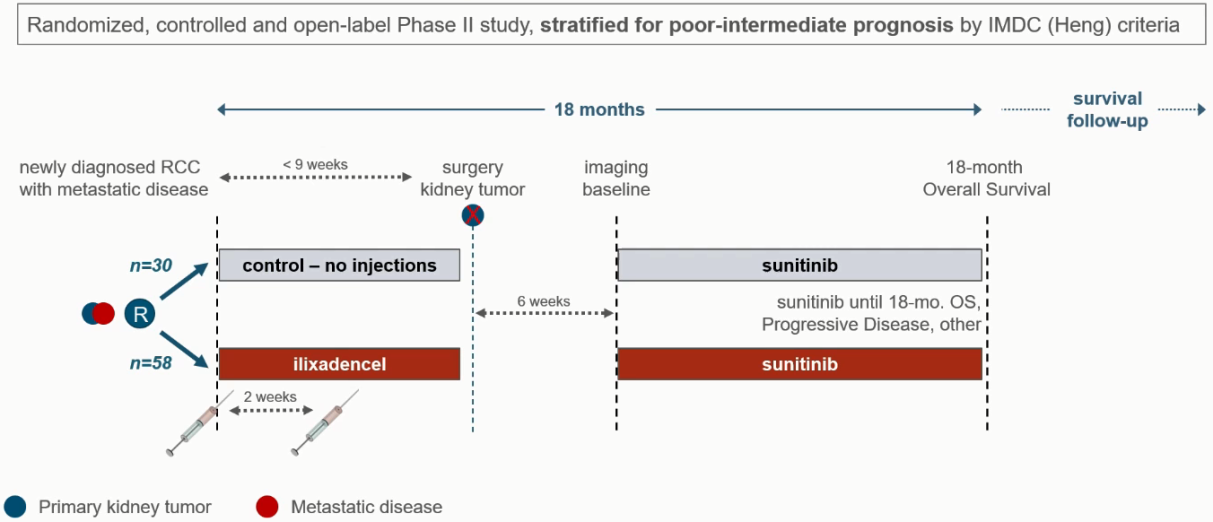
The Phase II MERECA study is the most advanced trial in the R&D pipeline. As a reminder, Immunicum presented detailed results from its Phase II MERECA study in September 2019. Patients enrolled in it (n=88, control arm n=30, active arm n=58) were newly diagnosed and had metastatic renal cell carcinoma (RCC), so this was a severely ill group of subjects. Patients in the active arm received two injections of ilixadencel (on day 1 and day 14), then all patients in both arms underwent kidney tumour surgery. The patients were allowed to recover for six weeks after the surgery before the treatment with Sutent; this gap is mandatory due to Sutent’s toxicity. In total, the patients were followed for 18 months (from the first injection of ilixadencel) according to the trial design. Survival follow-ups are being conducted every six months thereafter. The cut-off date of June 2019 (18-month follow up) for the evaluation of the trial endpoints was in the original design of the trial. The current update includes the additional six months of follow up (cut-off date of December 2019) and the next cut-off is June 2020.
The primary endpoints of the study are the hard clinical endpoints of median overall survival (mOS) and overall survival (OS) after 18 months in addition to other secondary endpoints, such as objective response rate (ORR), median progression-free survival (mPFS), time-to-progression (TTP), safety and various exploratory endpoints.
|
Exhibit 1: Phase II MERECA study design |
|
|
Source: Immunicum |
Results update
The updated results were presented at the ASCO-SITC Clinical Immuno-Oncology Symposium on 6 February 2020. Since the trial is exploratory and not powered to detect predefined efficacy measures, p values were not provided to indicate the statistical significance of the results. Therefore, we can only evaluate the numerical differences and trends.
Kaplan-Meier survival curves and OS
The OS at the 18-month check (cut-off date June 2019) was 63% in the ilixadencel arm and 66% in the control group. Updated data as of December 2019 showed that the OS was 54% in the ilixadencel arm and 37% in the control group. As mentioned before, we can only assess trends rather than statistical significance due to the nature of the trial. There was no visible separation at the 18-month cut-off point (Exhibit 2A); however, the curves started to separate after that point. The updated curves now confirm the visible separation after the original 18-month follow up. So, although technically the primary OS endpoint at 18 months was missed (which caused significant volatility in the share price), the KP curves were already showing a potential survival benefit over the long term. One of the key new findings from the updated results is that patients in the respective arms have continued to follow the projections and at 24 months the OS rates have started to differ.
|
Exhibit 2: Kaplan-Meier plots: A – at 18-month follow up; B – at 24-month follow up |
|
|
Source: Immunicum |
The median OS has still not been reached and will be reassessed during the next check (June 2020). This is one of the last remaining interesting data points and could be a potential catalyst for the share price.
Immunicum also presented a subgroup analysis at the ASCO-SITC Symposium. Patients were stratified into two groups based on IMDC (International Metastatic RCC Database Consortium) criteria: intermediate risk and poor risk. The KP curves appeared significantly different in these subgroups. It appears that the likely potential benefit from ilixadencel is mainly experienced by patients in better health (Exhibit 3). However, due to low patient numbers Immunicum noted that it will still evaluate all possible designs of the next study and will not rush to focus solely on intermediate risk patients. For example, there is one patient in the poor risk group who achieved complete response and is still alive. This corresponds to the notion that many patients do not respond to immunotherapies, but for those who do, the response can be profound.
|
Exhibit 3: IMDC intermediate risk RCC patient survival vs IMDC poor risk patient survival |
|
|
Source: Immunicum |
ORR update
ORR update was the other key data point in the Immunicum presentation at ASCO-SITC. In September 2019, Immunicum used the ‘best ORR’ measure ie if a tumour response is observed during any of the visits, it is called best ORR. Where a tumour response is observed on one visit, but the disease has progressed on the next visit, the patient would still be considered with a partial response. ‘Confirmed ORR’ is a measure used when the patient is considered to be responding to treatment for at least two subsequent visits. Confirmed ORR is therefore a stricter assessment and a higher hurdle for the drug.
In September 2019, Immunicum reported best ORR of 44% in the ilixadencel arm vs 48% in the sunitinib arm. The difference was striking when using confirmed ORR: 42% of patients in ilixadencel arm compared to 24% of patients in sunitinib arm. Confirmed ORR requires a patient to respond to treatment for a longer period of time. This again is in line with the generalisation that if patients respond to immunotherapies, it tends to be a longer and more profound response. Admittedly, the confirmed ORR analysis was done ad hoc (best ORR was in the original trial design). However, due to the fact that it is a more restrictive measure, we find the result clearly positive.
Exhibit 4: Tumour response
Ilixadencel-sunitinib |
Sunitinib |
|
Best ORR |
44% (20/45) |
48% (n=12/25) |
|
• Complete response |
11% |
4.0% |
|
• Partial response |
33% |
44% |
Confirmed ORR |
42% (n=19/45) |
24% (n=6/25) |
|
• Complete response |
6.7% |
0% |
|
• Partial response |
36% |
24% |
Source: Immunicum
Confirmed ORR has been used in a few high profile, large clinical trials in RCC. Exhibit 4 shows how the confirmed ORR in the MERECA trial compares to other trials. Nivolumab (Opdivo; anti-PD-1) plus ipilimumab (Yervoy; anti-CTLA-4) and pembrolizumab (Keytruda; anti-PD-1) plus axitinib (Inlyta; TKI) are recently approved combinations for RCC. These novel treatment options include checkpoint inhibitors (CPIs) and demonstrated improved overall survival against sunitinib in their respective clinical trials. Judging from the patient characteristic data, the nivolumab plus ipilimumab data are more comparable to MERECA, as the trial enrolled a mix of intermediate and poor risk patients. Patients with a favourable outlook were also included in the pembrolizumab plus axitinib trial. The 42% response rate seen in the MERECA trial was in line with that achieved by nivolumab plus ipilimumab.
|
Exhibit 5: Confirmed ORR in Phase II MERECA trials vs other late stage trial in RCC |
|
|
Source: Immunicum |
Our view
In our last report, published in September 2019 after the release of the MERECA 18-month follow up results, we highlighted our view that more mature data were needed to draw any firm conclusions, as there were clearly interesting signals even though technically the primary endpoints were missed. The MERECA study was designed and initiated several years ago, when immunotherapies were either in late stage trials or just emerging. Ilixadencel itself is an off the shelf, immune priming, activated dendritic cell therapy with no comparable therapies in practice. For all these reasons, the design of the MERECA trial was challenging. As the understanding of how immunotherapies work and their outcomes improves, there will be more factors to consider when planning the next stage of ilixadencel clinical development. For example, it is now widely recognised that a lot of patients do not respond to CPIs, but those who do have a profound and durable response. Such treatment dynamics are very different from classical chemotherapy or targeted therapies, which made it difficult to design controlled, clinical efficacy trials for new immunotherapies.
The 24-month follow up confirmed the KP curves and the separation is becoming clear. The next key date to watch will be the next follow up at 30 months due in June 2020. In addition to more mature OS data, there is a possibility that Immunicum will have median OS data; this is not certain, but is the last unknown interesting data point and a potential catalyst for the share price.
Next steps
In addition to 30-month follow up due by mid-2020, Immunicum noted that it will be submitting its materials to the FDA and EMA to request meetings for their feedback about possible design of the next trial in RCC. For a long time, TKIs such as sunitinib (Sutent) were a mainstay of the standard of care in RCC, but with the approval of the first CPIs, the practice is changing. CPIs are becoming the standard of first line treatment, while the former front-line TKIs, like sunitinib, could be pushed to the second line. Immunicum now has data with ilixadencel plus sunitinib and the Phase Ib/II with ilixadencel plus CPI trial is ongoing. The company has not presented any preliminary design so far, but we understand that all options are on the table (ilixadencel triple combo with CPI and TKI for front line treatment or ilixadencel with TKI for second line treatment). Immunicum believes that the regulatory authorities could revert with an official response around mid 2020 as well.
Phase II ILIAD testing combo with CPIs for the first time
We described the ongoing Phase Ib/II ILIAD study in detail in our last report. ILIAD is expected to recruit 150 patients in total in three solid tumour indications: gastric adenocarcinoma in combination with CPIs, non-small cell lung cancer (NSCLC) and head and neck squamous cell carcinoma (HNSCC). In the Phase Ib part of the trial, ilixadencel will be combined with Keytruda and in the larger Phase II part with Keytruda in NSCLC and Bavencio (avelumab, Merck KGaA and Pfizer) in the other indications. As per the supply agreement, Immunicum will acquire Bavencio at no cost. The interim safety results from the first cohort were announced in October 2019 with no concerns raised. Full safety and efficacy data from the Phase Ib of ILIAD should be released in 2020 and controlled efficacy data from the Phase II of ILIAD should be released in 2022.
The ILIAD trial is important because it will be the first study to test ilixadencel in combination with CPIs. As well as safety and efficacy data, it is also designed to gather data to demonstrate the proof of mechanism of action by showing that ilixadencel generates a systemic tumour-specific immune response.
Valuation and financials
Our valuation of Immunicum is increased to SEK2.4bn or SEK25.8 per share from SEK2.0bn or SEK21.6/share. This is mainly due to an increased success probability in our model and rolling it forward. As previously, our valuation is based on ilixadencel in multiple indications (described in detail in our last outlook report), which are supported by Immunicum’s ongoing R&D programme. The Phase II MERECA trial focused on RCC, but we believe there is some degree of read-across to other indications. Immunicum is yet to confirm further development plans for ilixadencel in RCC, we therefore increased the probability to 25% from 17.4% in RCC, which is roughly the mid-point between historical success probabilities (to reach the market) for oncology assets in Phase II and Phase III. We increased the probabilities for other assets to 20% from 17.4% in other indications.
Immunicum’s Q319 operating loss of SEK29.6m was higher than the SEK23.5m loss in Q318 and in line with our estimate of SEK29.7m. As expected, R&D costs accounted for the majority of the increase and were SEK23.7m (vs SEK23.5m reported in Q318). The increase in R&D costs was mainly due to the more intensive clinical R&D programme. We keep our estimates unchanged. Immunicum had cash of SEK334m at the end of Q319. Management has guided that its cash runway is to the end of 2021, which is in line with our model.
Exhibit 6: Sum-of-the-parts Immunicum valuation
Product |
Launch |
Peak sales |
Probability |
rNPV |
rNPV/share |
Ilixadencel – RCC |
2026 |
1730 |
25.0% |
657.9 |
7.1 |
Ilixadencel – HCC |
2029 |
880 |
20.0% |
242.6 |
2.6 |
Ilixadencel – NSCLC |
2027 |
1370 |
20.0% |
643.8 |
7.0 |
Ilixadencel – HNSCC |
2028 |
1900 |
20.0% |
378.4 |
4.1 |
Ilixadencel – gastric adenocarcinoma |
2028 |
1480 |
20.0% |
295.1 |
3.2 |
Unallocated costs |
100% |
(205.0) |
(2.2) |
||
Net cash, end Q319 |
100% |
363.4 |
3.9 |
||
Valuation |
2,376.2 |
25.8 |
Source: Edison Investment Research. Note: WACC = 12.5% for product valuations. RCC: renal cell carcinoma; HCC: hepatocellular cancer; NSCLC: non-small cell lung cancer; HNSCC: head and neck squamous cell carcinoma.
Exhibit 7: Financial summary
|
|
|
SEK ('000) |
2017 |
2018 |
2019e |
2020e |
2021e |
Year end 31 December |
|
|
IFRS |
IFRS |
IFRS |
IFRS |
IFRS |
|
INCOME STATEMENT |
|
|
|
|
|
|
|
|
Revenue |
|
|
|
0 |
0 |
0 |
0 |
0 |
EBITDA |
|
|
|
(80,629) |
(97,845) |
(119,898) |
(121,625) |
(123,383) |
Operating expenses |
|
|
(80,847) |
(98,029) |
(120,101) |
(121,848) |
(123,627) |
|
Depreciation |
|
|
|
(71) |
0 |
(5) |
(2) |
(1) |
Operating income |
|
|
218 |
184 |
202 |
223 |
245 |
|
Reported operating profit |
|
|
(80,700) |
(97,845) |
(119,904) |
(121,627) |
(123,383) |
|
Net Interest |
|
|
|
362 |
(15) |
12 |
(1) |
13 |
Profit before tax (reported) |
|
|
(80,338) |
(97,860) |
(119,891) |
(121,628) |
(123,370) |
|
Reported tax |
|
|
|
0 |
0 |
0 |
0 |
0 |
Profit after tax (reported) |
|
|
(80,338) |
(97,860) |
(119,891) |
(121,628) |
(123,370) |
|
Minority interests |
|
|
0 |
0 |
0 |
0 |
0 |
|
Net income (reported) |
|
|
(80,338) |
(97,860) |
(119,891) |
(121,628) |
(123,370) |
|
Basic average number of shares outstanding |
|
25,959 |
51,387 |
89,710 |
92,258 |
92,258 |
||
EPS - basic reported (SEK) |
|
|
(3.09) |
(1.90) |
(1.34) |
(1.32) |
(1.34) |
|
BALANCE SHEET |
|
|
|
|
|
|
|
|
Non Current Assets |
|
|
105,309 |
10 |
5 |
2 |
2 |
|
Property Plant and equipment, net |
|
69 |
9 |
4 |
1 |
1 |
||
Other financial assets |
|
|
1 |
1 |
1 |
1 |
1 |
|
Other Non Current Assets |
|
|
105,239 |
0 |
0 |
0 |
0 |
|
Current Assets |
|
|
140,837 |
450,362 |
307,793 |
176,709 |
53,368 |
|
Cash and cash equivalents |
|
|
128,883 |
443,798 |
301,064 |
169,807 |
46,283 |
|
Accounts receivable |
|
|
0 |
3,307 |
3,472 |
3,646 |
3,828 |
|
Marketable securities and short-term investments |
0 |
0 |
0 |
0 |
0 |
|||
Prepaid expenses |
|
|
8,454 |
3,257 |
3,257 |
3,257 |
3,257 |
|
Current Liabilities |
|
|
55,740 |
43,482 |
20,799 |
11,342 |
11,369 |
|
Accounts payable |
|
|
11,714 |
31,266 |
10,369 |
912 |
939 |
|
Accrued other liabilities |
|
|
43,694 |
11,378 |
6,836 |
6,836 |
6,836 |
|
Other current liabilities |
|
|
331 |
838 |
3,594 |
3,594 |
3,594 |
|
Non Current Liabilities |
|
|
850 |
850 |
850 |
850 |
850 |
|
Long term debt |
|
|
850 |
850 |
850 |
850 |
850 |
|
Equity |
|
|
|
189,556 |
406,041 |
286,150 |
164,521 |
(80,477) |
Retained earnings start of period |
|
(151,447) |
(231,785) |
(329,645) |
(449,536) |
(692,793) |
||
Total Shareholder's Equity |
|
|
189,556 |
406,041 |
286,150 |
164,521 |
(80,477) |
|
CASH FLOW |
|
|
|
|
|
|
|
|
Cash Flow from Operations |
|
|
|
|
|
|
|
|
EBIT (Operating profit) |
|
|
(80,700) |
(97,845) |
(119,904) |
(121,627) |
(123,383) |
|
Depreciation |
|
|
|
71 |
58 |
5 |
2 |
1 |
Income Tax paid |
|
|
0 |
0 |
0 |
0 |
0 |
|
Other Working Capital changes |
|
34,455 |
(6,867) |
(22,848) |
(9,631) |
(155) |
||
Cash interest paid |
|
|
(274) |
(14) |
(26) |
(26) |
0 |
|
Cash interest received |
|
|
0 |
0 |
38 |
25 |
13 |
|
Net cash used in Operating activities |
|
(46,447) |
(104,668) |
(142,734) |
(131,257) |
(123,524) |
||
Cash Flow from Investing |
|
|
|
|
|
|
|
|
Purchase of fixed assets |
|
|
0 |
0 |
0 |
0 |
0 |
|
Sale of Investments |
|
|
10,162 |
0 |
0 |
0 |
0 |
|
Net cash used in investing activities |
|
10,162 |
0 |
0 |
0 |
0 |
||
Cash Flow from Financing |
|
|
|
|
|
|
|
|
Change in Capital Stock |
|
|
62,269 |
419,584 |
0 |
0 |
0 |
|
Net cash from Financing activities |
|
62,269 |
419,584 |
0 |
0 |
0 |
||
Net Changes in Cash and Cash Equivalent |
|
25,984 |
314,916 |
(142,734) |
(131,257) |
(123,524) |
||
Cash and Cash Equivalents - Beginning |
|
102,899 |
128,883 |
443,799 |
301,065 |
169,808 |
||
Cash and Cash Equivalents - End |
|
128,883 |
443,799 |
301,065 |
169,808 |
46,284 |
||
Net cash/(debt) |
128,033 |
442,948 |
300,214 |
168,957 |
45,433 |
|||
Source: Immunicum’s account, Edison Investment Research
|
|
Research: Energy & Resources
Hurricane Energy has announced an operational update with a programme focused on maximising the Aoka Mizu FPSO’s oil throughput capacity. In the Greater Warwick Area (GWA), partners concluded that it will not be possible to tie back the Lincoln Crestal Well to the FPSO in 2020. However, they are seeking regulatory consent to delay the abandonment of the Lincoln Crestal Well to obtain interference data during well testing in 2020 from one or more sub-vertical wells that are planned to be drilled and tested, to determine the maximum vertical extent of the Lincoln field. In the Greater Lancaster Area (GLA), an accelerated work programme is planned with an additional production well in 2020, in addition to drilling one or more sub-vertical wells in 2021 to determine the maximum extent of the Lancaster field. If successful, and subject to regulatory consents, the well would be tied back to the FPSO in 2021, with provisional first oil in Q122.