Last close As at 05/08/2026
—
— 0.00 (0.00%)
Market capitalisation
—
Research: Investment Companies
Gresham House Strategic (GHS) describes itself as a ‘strategic public equity’ fund, meaning it takes a private equity-style approach to investing mainly in listed companies, buying significant stakes and engaging proactively with holdings to create and unlock value through operational, strategic and management initiatives. It currently has 18 holdings (15 equities and three convertible loan notes) spread across a range of industries, but all based in the UK. Performance has been strong in the past year (NAV TR +22.6% and share price TR +52.5% over 12 months to 31 January 2020), with a large contribution from top holding Augean (share price +224% in 2019). The management team at Gresham House argues that this validates the strategy, and the narrowing in the discount over the past 12 months (from c 25% to 2.3% in late 2019) suggests the market is beginning to appreciate what GHS offers.
Written by
Gresham House Strategic |
Strategic public equity investing |
Investment companies |
24 February 2020 |
Initiation of coverage |
Share price/discount performance
Three-year performance vs index
Gearing
Analyst
|
|||||||||||||||||||||||||||||||||||||||||||||||||||||||||||||||||||||||||||||||||||||||||||
Gresham House Strategic (GHS) describes itself as a ‘strategic public equity’ fund, meaning it takes a private equity-style approach to investing mainly in listed companies, buying significant stakes and engaging proactively with holdings to create and unlock value through operational, strategic and management initiatives. It currently has 18 holdings (15 equities and three convertible loan notes) spread across a range of industries, but all based in the UK. Performance has been strong in the past year (NAV TR +22.6% and share price TR +52.5% over 12 months to 31 January 2020), with a large contribution from top holding Augean (share price +224% in 2019). The management team at Gresham House argues that this validates the strategy, and the narrowing in the discount over the past 12 months (from c 25% to 2.3% in late 2019) suggests the market is beginning to appreciate what GHS offers.
The market opportunity
While stock markets have performed strongly over the past year, equities still look reasonably valued on a global basis versus negative-yielding bonds. Meanwhile, the UK stands at a significant valuation discount to the US, and within the UK, smaller companies still look inexpensive versus the broader market. Furthermore, value investing as a style remains out of favour, so a fund with a value-creating approach to investing in unloved UK smaller companies may prove attractive, given political uncertainty has arguably peaked and the government is expected to take a pragmatic approach to Brexit negotiations in order to minimise the economic impact.
Why consider investing in Gresham House Strategic?
■
Differentiated, high-conviction approach to the UK small-cap opportunity, underpinned by significant due diligence.
■
GHS invests on a three- to five-year horizon, and after four-and-a-half years under the current manager, results are now coming through at both the operational and share price level of underlying holdings.
■
Highly experienced, well-resourced management team and investment committee, backed up by a network of industry experts to help drive turnarounds.
■
The portfolio is concentrated with fewer than 20 equity holdings, broadly diversified by industry and investment stage.
■
Board commitment to growing dividends at least 15% year-on-year.
Narrowing discount and growing yield
At 19 February 2020, GHS’s shares traded on a 10.0% discount to NAV. This compares with an average discount of 14.9% over the past year, ranging from a high of 24.7% in March 2019 to a low of 3.4% in December. Over three years and since inception of the current strategy, GHS’s discount has averaged c 21.0%, so the current level represents a material narrowing relative to history. The managers have ambitions to see the shares trading at NAV, allowing them to raise cash through share issuance to fund further investments. GHS has paid a dividend since FY17 and now pays out twice yearly, with a commitment to growing the dividend by at least 15% a year. The shares currently have a yield of 1.6%.
Fund profile: Strategic public equity
Gresham House Strategic (GHS) began life in 1999 as the technology and media-focused private equity fund New Media SPARK, which itself became SPARK Ventures in 2007. Gresham House was appointed investment adviser to SPARK Ventures in August 2015 (at which point the fund adopted its current strategic public equity [SPE] investment strategy), becoming investment manager of the newly renamed Gresham House Strategic in November 2015. GHS invests mainly in smaller UK public companies, applying private equity style techniques to construct a focused portfolio. The investment management team is made up of Tony Dalwood (fund manager, over 20 years of SPE investing), Richard Staveley (fund manager, 20 years of small cap investing), Laurence Hulse (investment manager, six years of SPE investing) and Paul Dudley (corporate finance, over 20 years’ corporate advisory experience). The strategy incorporates an investment committee (IC), which is fully integrated in the investment process. Dalwood chairs the IC, which also incorporates considerable investing and private equity experience through the other four members: Ken Wotton (20 years’ investing experience; manager of the Gresham House UK Micro-Cap fund); Graham Bird (25 years in public and private equity, industry and advisory); Bruce Carnegie-Brown (35 years’ experience in private equity; chairman of Lloyd’s of London); and Tom Teichman (30 years’ experience in venture capital and banking). The IC approves all significant investments and regularly discusses the management of the portfolio.
The GHS team focuses on taking significant stakes in profitable, cash-generative companies that it believes are intrinsically undervalued, aiming for significant engagement with investee company stakeholders in support of a clear equity value creation plan over the long term. The strategic public equity team at Gresham House has managed five consecutive funds since 2003, including GHS, following the same strategy.
The fund manager: Gresham House
The manager’s view: ‘Primed for further outperformance’
The team says it is excited about the current investment environment. Staveley says that UK small-caps below £200m market cap are clearly out of favour, adding: ‘Furthermore, the team’s “value” philosophy is driving an ever-increasing pipeline of new investment.’ He argues that GHS’s private equity-style approach to public markets is clearly differentiated from the broader small-cap space, and adds that the team sees the current portfolio as cheap, and ‘primed for further outperformance’.
Asset allocation
Investment philosophy: Focus on value creation
GHS Fund Manager Richard Staveley explains that strategic public equity investing has much in common with private equity and relatively little with mainstream listed smaller company funds. Some of the techniques the GHS team deploys are similar to those used by private equity managers, such as undertaking up to six months’ due diligence on investments, and having a dedicated investment committee that agrees all significant new stakes and exits. Staveley says: ‘Strategic public equity usually means a concentrated portfolio of fewer than 20 companies – we have 15; the mainstream small-cap funds tend to have 50–120 holdings. But at the other extreme, private equity usually has 100% stakes and controls the board. We look for 5–25% of a company, and we work with all stakeholders to unlock and create value. We have influence, a voice and engagement on an ongoing basis.’ The manager adds: ‘We are not “unicorn hunters”; we are very much a traditional private equity-type fund focused on cash-generative companies, or those that should be cash-generative but for some reason are troubled. We don’t do pre-revenue or concept companies, and we have a value bias to our holdings.’
At the heart of the GHS investment philosophy is value creation. Staveley explains that this is measured in four principal ways: profit recovery and accelerating earnings growth; opportunities for re-rating; de-gearing and accelerated cash generation; and catalysts for de-risking. He says the result of this fourfold focus is that, at a portfolio level, it has no net debt, trades on a valuation discount (measured on EV/sales and EV/EBITDA) to the UK small-cap indices, yet has higher earnings and sales growth than the index average.
Examples of how GHS seeks to enhance value creation include the following:
■
Capital restructuring, such as through the issue of convertible debt. This gives GHS a valuable income stream (c 8% coupons) as well as providing financing for the investee company to strengthen its balance sheet or fund growth opportunities, for example Northbridge Industrial Services.
■
Board changes, such as proposing the recent appointment of British industry champion Sir Roy Gardner (chairman of Serco and ex-CEO of Centrica) as chairman of Pressure Technologies, bringing depth and expertise to the board of the £25m company.
■
Corporate advisory, for example influencing corporate strategy and advising on M&A.
■
Advisory network, helping to identify and approach industry specialists and sector experts to assist investee companies.
■
IR and PR improvements, for example through helping to build positive media coverage or introducing additional corporate brokers and analysts.
Investment process: Check the exit on your way in
The four principal stages of GHS’s investment process are summarised in Exhibit 1. However, underpinning the strategy is a process of qualifying investment opportunities. Investment manager Laurence Hulse explains: ‘To justify our level of conviction, we qualify everything through our “circle of confidence”. Firstly, we look for a smart entry point. Because we want a strategic stake, that means we need to own a lot of shares, so perhaps we will act as cornerstone in a new issue.’ Staveley adds that a secondary effect of the collapse of Woodford Investment Management last year has been a conscious or subconscious impact on people’s perception of smaller companies, the size of positions and liquidity: ‘Our eyes light up if an institution is a seller for liquidity reasons. Non-investment-driven selling helps us.’ He adds that many potential opportunities arise as a result of the management group’s strong existing relationships in the market.
The second pillar is a clearly identified investment thesis. Hulse says: ‘We want real detail on the initiatives a company will put in place to achieve what they say they will; we agree a plan and ensure they stick with it.’ As part of this step, the team evaluates a range of valuation metrics, such as spot multiples relative to history, leveraged buyout free cash flow models, and comparable private equity transactions. However, says Staveley: ‘Our assessment of intrinsic value is not driven by relative value measures; we are thinking about how much money we can make with downside protection: an asymmetric return outlook.’
The third step, engagement and influence, is about risk mitigation and return maximisation, through regular dialogue with the board and management of investee companies to ensure the thesis remains on track, and by deploying the kind of value creation initiatives listed above. The final step – which begins before an investment is made – is identifying catalysts and a route to exit. ‘We have a view on day one as to our exit point,’ Hulse explains.
Looking at the process as illustrated in Exhibit 1, Staveley explains that stage one (sourcing) is mainly desktop-based. Stage two (due diligence) produces a 20–30 page report, which goes to the investment committee: ‘they will pick it apart and feed back questions for us to answer’. While an initial investment of up to 2% of the GHS portfolio can be made at the first stage, investment committee (IC) approval is needed to make a larger investment, which can be up to 10% at the end of the third stage of the process. Gresham House CEO and IC chairman Tony Dalwood says: ‘The IC is a key piece of oversight and risk management in the process. Theses are challenged, insight is offered, and often relevant introductions are made.’ The fourth stage is ongoing monitoring of the thesis and progress towards a potential exit. ‘We have a six-monthly review of each investment versus the original thesis, which ensures we don’t fall in love with a stock, as well as whether it needs any action,’ says Staveley. On average, portfolio turnover is c 20% a year, underlining the three- to five-year time horizon on which GHS invests.
|
Exhibit 1: Gresham House’s strategic public equity investment process |
|
|
Source: Gresham House Strategic, Edison Investment Research |
Current portfolio positioning
At 31 December 2019, GHS had 18 holdings, made up of 15 investments in listed equity and three in convertible loan notes, one of which is in unlisted whisky distiller The Lakes Distillery Company. By far the largest holding was in hazardous waste specialist Augean; although this was also the largest holding at end-H120 (30 September 2019), it has risen from 17.9% to 31.9% of the GHS portfolio as a result of its share price doubling (from 111.5p to 222.0p) during the last quarter of 2019 following a positive trading update. It is worth noting that IMImobile (10% of the portfolio at 31 December 2019) was also at one point a very large position, exceeding 40% of GHS NAV, and has been successfully reduced by the team taking profits in the secondary market. Below we summarise GHS’s investment thesis for Augean, as well as two other favoured holdings, Pressure Technologies and Centaur Media.
Case study: Augean (31.9% of GHS NAV)
GHS first invested in Augean after the announcement of an HMRC investigation into the company’s tax affairs caused a c 50% fall in the share price. Augean was already on the team’s watch list and the fall in valuation was considered to represent a more attractive entry point. After three months’ due diligence and meetings with management, GHS made an initial investment, and having analysed the potential impact of the investigation and Augean’s response to it, this allowed greater conviction in the investment thesis. The team’s view was that Augean’s balance sheet was underpinned by tangible assets in the shape of its waste sites, and that the conclusion of the HMRC investigation would allow the business once again to be valued on an enterprise value basis. Augean’s margins and earnings growth improved as it reduced costs and sold or mothballed loss-making divisions, and the company is now generating significant levels of cash. While Augean’s recent strong performance (up more than 220% in 2019) has contributed to the majority of GHS’s own returns in the past 12 months, the managers concede that their investment case is maturing, although the valuation remains at a discount to comparable transactions in the waste management sector.
Exhibit 2: GHS top 10 portfolio holdings at 31 December 2019
Company |
Sector |
£m |
% of company equity |
% of GHS NAV |
Augean |
Waste & disposal services |
15.8 |
7.0 |
31.9 |
Northbridge Industrial Services* |
Industrial engineering |
6.1 |
11.8 |
12.2 |
IMImobile |
Software & computer services |
5.0 |
2.0 |
10.1 |
Pressure Technologies |
General industrials |
3.3 |
15.1 |
6.6 |
Be Heard* |
Media |
2.5 |
10.6 |
5.0 |
Centaur Media |
Media |
2.5 |
4.9 |
5.0 |
MJ Hudson* |
Investment banking & brokerage |
2.3 |
2.4 |
4.7 |
The Lakes Distillery Company** |
Beverages |
2.2 |
N/A |
4.4 |
Universe Group |
Industrial support services |
1.5 |
11.6 |
3.1 |
Brand Architekts Group |
Personal goods |
1.4 |
5.4 |
2.8 |
Others |
N/A |
3.6 |
N/A |
7.2 |
Cash and working capital |
N/A |
3.5 |
N/A |
7.1 |
49.6 |
100.0 |
Source: Gresham House Strategic, Edison Investment Research. Note: *Includes convertible loan notes. **Convertible loan note held in unlisted company.
Case study: Pressure Technologies (6.6% of GHS NAV)
Pressure Technologies (PT), a specialist engineering business manufacturing precision machine components and pressurised gas cylinders, entered the GHS portfolio in April 2019. The stock had suffered as a result of a downturn in the oil and gas market, to which PT has significant operational exposure. The GHS team had monitored the company for two years, including six months of engagement and due diligence, before acquiring 20% of the stock via a block placing at 80p a share following the disposal of PT’s non-core biogas division. Upon investment, GHS began its process of implementing value creating initiatives, including the appointment of new brokers, advising on the recruitment of a new sales team and overhauling PT’s sales process and strategy, and working with the company to restructure the management and board, culminating in the appointment of Sir Roy Gardner as PT’s chairman in January 2020. The investment thesis – targeting an internal rate of return (IRR) of 20% – rests on re-rating as a result of the restructuring of the business, and cash generation through improved earnings growth on the back of the more focused strategy. GHS expects its exit to come either through a sale of the position in the market, or via a trade sale of the business. Since the fund’s initial investment, PT’s share price has risen by c 88%.
Case study: Centaur Media (5.0% of GHS NAV)
GHS’s most recent large investment was a doubling of its position in business-to-business publishing and events company Centaur Media. Centaur has recently sold its financial services division to EMAP, refocusing on two core areas of legal (The Lawyer) and marketing (Marketing Week and associated titles). Under new, experienced leadership, the business is driving out central costs and is focused on returning margins to sector levels. Net cash is a strong position to be in and GHS’s managers say further special dividends are possible. The legal division is performing very well and may prove attractive to other market participants, which in the managers’ view could be worth the majority of the current enterprise value.
Performance: Strong stock-level returns drive re-rating
Exhibit 3: Five-year discrete performance data
12 months ending |
Share price |
NAV |
Numis Smaller Cos ex-ICs (%) |
CBOE UK All Cos (%) |
CBOE UK Smaller Cos (%) |
31/01/17 |
2.7 |
12.3 |
18.6 |
20.9 |
15.4 |
31/01/18 |
5.3 |
3.8 |
15.1 |
11.3 |
19.6 |
31/01/19 |
8.5 |
6.4 |
(7.4) |
(3.9) |
(7.6) |
31/01/20 |
52.5 |
22.6 |
13.7 |
10.5 |
13.7 |
Source: Refinitiv, Morningstar. Note: All % on a total return basis in pounds sterling.
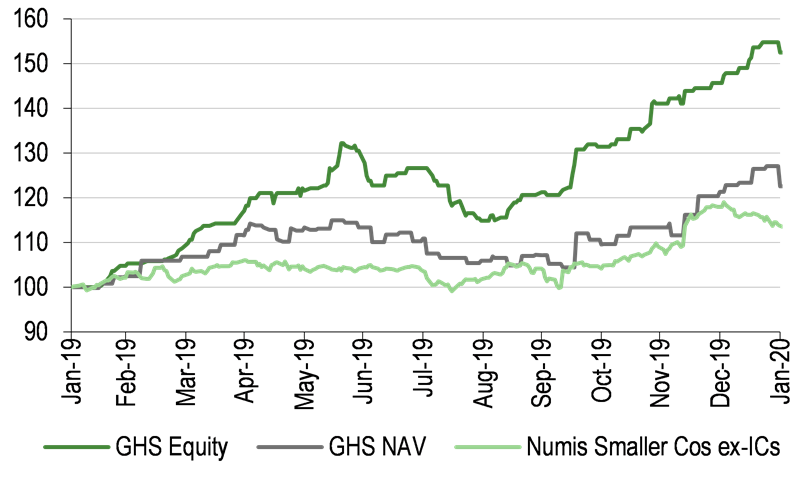
As shown in Exhibits 3 and 4, GHS’s share price has performed very strongly in the past 12 months to 31 January (up c 50%), underpinned by solid NAV growth of c 20%, well in excess of broad listed smaller company indices and the UK market as a whole (as represented by the CBOE UK All Companies Index). This compares with annualised NAV growth over three years and since the adoption of the Gresham House SPE strategy (August 2015) of c 10%, again ahead of small-cap indices. GHS’s relative returns are shown in Exhibit 5. The longer-term track record of SPE investing led by Dalwood on other SPE funds is also strong, including driving the returns of Strategic Equity Capital from launch in 2005 until 2014; see Exhibit 7.
|
Exhibit 4: Investment company performance to 31 January 2020 |
|
Price, NAV and index total return performance, one-year rebased |
Price, NAV and index total return performance (%) |
|
|
|
Source: Refinitiv, Morningstar, Edison Investment Research. Note: Three-year and since inception (SI, 14 August 2015, the first published NAV date after GHAM became investment adviser) performance figures annualised. |
|
Exhibit 5: Share price and NAV total return performance, relative to indices (%)
|
One month |
Three months |
Six months |
One year |
Three years |
SI |
Price relative to Numis Smaller Cos ex-ICs |
8.6 |
6.2 |
9.7 |
34.0 |
43.6 |
39.9 |
NAV relative to Numis Smaller Cos ex-ICs |
4.8 |
2.5 |
0.7 |
7.8 |
11.6 |
14.7 |
Price relative to CBOE UK All Cos |
8.5 |
14.1 |
20.8 |
38.0 |
47.3 |
38.4 |
NAV relative to CBOE UK All Cos |
4.7 |
10.0 |
10.9 |
11.0 |
14.6 |
13.5 |
Price relative to CBOE UK Smaller Cos |
2.9 |
3.7 |
5.2 |
34.0 |
38.5 |
31.1 |
NAV relative to CBOE UK Smaller Cos |
(0.7) |
(0.0) |
(3.4) |
7.8 |
7.7 |
7.5 |
Source: Refinitiv, Morningstar, Edison Investment Research. Note: Data to end-January 2020. Geometric calculation.
As shown in Exhibit 6, GHS’s discount to NAV narrowed sharply throughout 2019 on the back of strong share price performance. Hulse points out that with an investment horizon of three to five years, there is something of a ‘J curve’ effect at play in the portfolio, whereby companies may initially perform poorly, but can ramp up significantly as the effect of operational improvements comes through. He argues that GHS’s recent positive NAV performance shows that the strategy is working as expected, while the narrowing in the discount underlines the gradual recognition of this in the wider market.
|
Exhibit 6: Share price discount to NAV (including income) over three years (%) |
|
|
Source: Refinitiv, Edison Investment Research |
Dividend policy and record
GHS began paying dividends in 2017, with a maiden FY17 final dividend of 15p. The FY18 dividend of 17.25p was 15% higher, and in the H119 interim results, the board announced its intention of providing a minimum 15% level of year-on-year dividend growth, with both an interim and a final dividend being paid. The 19.85p total dividends for FY19 again represented a 15.0% increase on the prior year. So far in FY20 (ending 31 March) an interim dividend of 10.1p has been announced, a 15.4% increase on H119. It would be reasonable to expect a final dividend for FY20 of at least 12.7p, bringing total dividends for the year to a minimum of 22.8p. We also note that GHS has over £100m of historical tax losses carried forward from before the adoption of its current strategy. Based on the current share price and the last two dividends, GHS offers a dividend yield of 1.6%.
Peer group comparison
In Exhibit 7 we show a selection of funds in the AIC UK Smaller Companies sector that follow a more or less similar approach to GHS in investing strategically in a relatively small number of mainly listed holdings. We have excluded mainstream UK Smaller Companies funds from the table, but have included averages for the whole sector to aid comparison.
Exhibit 7: Selected peer group as at 19 February 2020*
% unless stated |
Market |
NAV TR |
NAV TR |
NAV TR |
NAV TR |
Ongoing |
Perf. |
Discount |
Net |
Dividend |
Gresham House Strategic |
46.5 |
26.0 |
40.4 |
-- |
-- |
2.9 |
Yes |
(10.0) |
100 |
1.6 |
Crystal Amber |
99.3 |
(30.6) |
(31.0) |
11.4 |
38.5 |
1.9 |
Yes |
(27.9) |
100 |
4.7 |
Downing Strategic Micro-Cap IT |
41.1 |
4.8 |
-- |
-- |
-- |
1.8 |
No |
(4.8) |
100 |
1.7 |
Marwyn Value Investors |
59.4 |
(13.8) |
(17.1) |
(34.8) |
76.9 |
2.0 |
Yes |
(39.5) |
120 |
0.0 |
Odyssean Investment Trust |
100.2 |
20.2 |
-- |
-- |
-- |
1.6 |
Yes |
(1.5) |
100 |
0.0 |
Oryx International Growth |
139.1 |
28.2 |
50.5 |
114.2 |
431.4 |
1.7 |
No |
(17.7) |
100 |
0.0 |
Strategic Equity Capital |
156.3 |
22.4 |
26.3 |
51.7 |
354.6 |
1.1 |
Yes |
(16.1) |
100 |
0.6 |
Peer group average (7 funds) |
91.7 |
8.2 |
13.8 |
35.6 |
225.3 |
1.9 |
(16.8) |
103 |
1.4 |
|
Whole sector average (25 funds) |
243.3 |
15.2 |
23.7 |
63.9 |
271.4 |
1.8 |
(11.2) |
107 |
1.6 |
|
GHS rank in peer group |
6 |
2 |
2 |
N/A |
N/A |
1 |
3 |
2= |
3 |
Source: Morningstar, Edison Investment Research. Note: *Performance to 18 February 2020 based on cum-fair NAV. TR=total return. Net gearing is total assets less cash and equivalents as a percentage of net assets (100 = ungeared).
The board
GHS has four directors, all non-executive and independent of the manager. The chairman, David Potter, spent his executive career in investment banking and has served on the board (initially as a director of New Media SPARK) since 2002. He has been chairman (initially of SPARK Ventures) since 2009 and was appointed chairman of GHS in 2015. Charles Berry became a director of New Media SPARK in 2004 and is chair of the GHS audit committee. Helen Sinclair was appointed to the board of SPARK Ventures in 2009, while the most recent appointment was Kenneth Lever, who joined the GHS board at the start of 2016. Following a long and varied executive career, Lever is also chairman of RPS and a non-executive director of Biffa, Blue Prism and Vertu. The directors have professional backgrounds in investment banking, TMT/fintech, accountancy, industry and private equity.
|
|
Research: Healthcare
SymBio reported sales of $25.8m (¥2.838bn) for 2019 and an operating loss of $39.1 (¥4.301bn). Sales were down from 2018 due to the previously announced quality control issue for the supply of Treakisym from Astellas. We forecast sales of $31.2m (¥3.433bn) in 2020 as the company winds down its sales to Eisai in anticipation of the launch of its own internal salesforce and marketing effort for the drug in 2021.