Last close As at 05/08/2026
—
— 0.00 (0.00%)
Market capitalisation
—
Research: Energy & Resources
Canacol Energy is guiding to FY20 realised natural gas sales of 170–197mmscfd (cf 143mmscfd in FY19) as gas demand is picking up in Colombia while quarantine measures are lifted. The low case scenario assumes that spot sales (normally c 20% of the total) are not reactivated in 2020, and the high case scenario assumes they are reactivated in August 2020. We estimate a mid-case scenario of realised natural gas sales of 183mmscfd for the year, with sales in line with the last two weeks of May 2020 as reported by the company. Drilling operations have also resumed and the 2020 programme remains Canacol’s largest ever, despite a slimmed down programme from 12 to nine wells and lower capex for the year of US$108m. The company recently announced that it is maintaining its quarterly dividend of C$0.052/share. Our 2P + risked exploration NAV has decreased by 7% to C$6.55/share, reflecting the impact of lower gas sales demand in Colombia due to the COVID-19 pandemic.
Written by
Canacol Energy |
Realised gas sales support dividend |
Operational update |
Oil & gas |
23 June 2020 |
Share price performance
Business description
Next events
Analysts
Canacol Energy is a research client of Edison Investment Research Limited |
|||||||||||||||||||||||||||||||||||||||||||||||
Canacol Energy is guiding to FY20 realised natural gas sales of 170–197mmscfd (cf 143mmscfd in FY19) as gas demand is picking up in Colombia while quarantine measures are lifted. The low case scenario assumes that spot sales (normally c 20% of the total) are not reactivated in 2020, and the high case scenario assumes they are reactivated in August 2020. We estimate a mid-case scenario of realised natural gas sales of 183mmscfd for the year, with sales in line with the last two weeks of May 2020 as reported by the company. Drilling operations have also resumed and the 2020 programme remains Canacol’s largest ever, despite a slimmed down programme from 12 to nine wells and lower capex for the year of US$108m. The company recently announced that it is maintaining its quarterly dividend of C$0.052/share. Our 2P + risked exploration NAV has decreased by 7% to C$6.55/share, reflecting the impact of lower gas sales demand in Colombia due to the COVID-19 pandemic.
Year-end |
Revenue* (US$m) |
Adj EBITDAX** |
Cash from |
Net debt*** |
Capex**** |
Yield |
12/18 |
204.5 |
138.6 |
94.0 |
288.1 |
(75.5) |
N/A |
12/19 |
219.5 |
162.8 |
108.4 |
300.3 |
(84.3) |
1.9 |
12/20e |
255.7 |
214.9 |
200.5 |
265.8 |
(108.0) |
7.4 |
12/21e |
289.6 |
245.3 |
204.8 |
228.3 |
(110.7) |
7.4 |
Note: *Revenue net of transport expense and royalty. **Adjusted EBITDAX is before non-recurring or non-cash charges and exploration expense. ***Cash and equivalents minus short- and long-term debt. ****Forecasts based on 2P production profile.
Gas demand increasing
Canacol expects FY20 production to reach 197mmscfd, assuming spot demand increases and stabilises through July and August 2020. Even if demand does not return at this pace, management still guides to full year production of 170mmscfd based on its take or pay contracts. Realised contractual gas sales for the latter half of May were 181mmscfd. Meanwhile, an unusually dry winter and low reservoir conditions have increased demand for gas for thermoelectric power plants.
Exploration drilling from July 2020
After drilling the Nelson-14 and Clarinete-5 development wells, quarantine measures resulted in a two-month delay to the 2020 drilling programme. Drilling is due to restart in June with Pandereta-8, while a second rig is now expected to begin drilling in July at the first exploration well in the 2020 programme, Porro Norte-1.
Valuation: RENAV at C$6.55/share
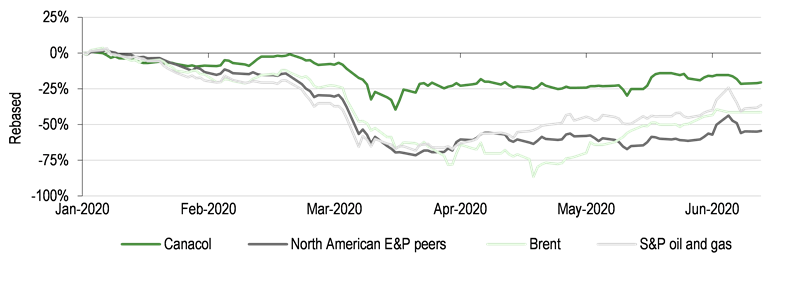
Our base case valuation of Canacol stands at C$6.55/share. The company trades on an FY20e P/CF of 2.5x, lower than its Canadian peers on 3.3x and its peer group of North American E&Ps with South American operations on 2.8x. Canacol’s share price has only decreased by c 20% since January 2020, while its peer group with South American operations fell by 55%. The company has proved resilient due to its limited exposure to commodity price volatility, low levels of debt and high netbacks, and recently announced that it is maintaining its quarterly dividend at C$0.052 per share.
Colombian demand returns: FY20 guidance 197mmscfd
In Q120, Canacol realised record natural gas sales of 201.5mmscfd, up from 122mmscfd in Q119, primarily due to completion of the Jobo to Cartagena 100mmscfd pipeline in July 2019. This was interrupted by a country-wide shutdown between 26 March and 27 April in Colombia due to COVID-19, during which period there were virtually no gas sales.
Manufacturing and construction activities resumed on 27 April across the whole country and all remaining sectors re-opened on 1 June, except in Bogota, Cali and Cartagena where restrictions were lifted on 15 June 2020. Demand is therefore expected to increase and stabilise during July and August 2020 and under this scenario Canacol is guiding to full year production of 197mmscfd, with guidance of 170mmscfd in the event of spot demand not returning. Around 80% of Canacol’s annual sales are on take or pay contracts, with management estimating that these volumes account for c 162mmscfd. The balance is interruptible or spot sales. In the near term, gas demand is expected to rise, due to hydroelectric reservoirs being at a 20-year low following an unusually dry winter.
The company is planning to increase capacity further, with a 100mmscfd pipeline to Medellin expected on-line by H224 subject to signing the negotiated sales contract with a major utility, EPC contractor selection and financing. Potential future growth projects include the requirement for 30mmscfd from December 2021, subject to revision due to COVID-19, at the El Tesorito power plant, 7km south of Canacol’s facilities, and c 25mmscfd capacity in the Jobo/Cartagena/ Barranquilla pipeline between 2020 and 2022 if interruptible market demand is strong.
|
Exhibit 1: Pipeline schematic |
|
|
Source: Canacol Energy |
2020 drilling programme resumes
Canacol had been planning to drill 12 wells in 2020, including nine exploration wells. However, having successfully completed drilling of the Nelson-14 and Clarinete-5 development wells, the remainder of the drill programme had to be put on hold on 26 March as a result of the quarantine measures taken to limit the COVID-19 pandemic. This also meant that the anticipated arrival of a second rig was delayed until July 2020 and, taken together, these measures resulted in a downward revision to the 2020 programme, with Canacol now expecting to drill nine wells in 2020, five of which will be exploration wells. Despite this, the exploration programme is still the largest exploration investment in Canacol’s history.
The company’s success rate remains high, with an ongoing exploration and appraisal success rate of 83% delivered through the continued application of its amplitude versus offset (AVO) methodology.
|
Exhibit 2: Canacol map with 2020 drill targets |
|
|
Source: Canacol Energy |
The Pioneer 53 drilling rig was reactivated on 24 May 2020. It has since completed the Clarinete-5 development well and is now being mobilised to the Pandereta-8 development location, where it is expected to spud in the third week of June 2020, taking around five weeks to drill and complete. Clarinete-5 encountered 309ft of net gas pay in the primary Cienaga de Oro (CDO) reservoir and was tested at a rate of 43mmscfd. The well has now been tied into permanent production.
Exhibit 3: 2020 planned wells
Well |
Well-type |
|
Rig 1 |
Nelson-14* |
Development |
Clarinete-5* |
Development |
|
Pandereta-8 |
Development |
|
Pandereta-4 |
Appraisal |
|
Flauta-1 |
Exploration |
|
Milano-1 |
Exploration |
|
Rig 2 |
Porro Norte-1 |
Exploration |
Fresa-1 |
Exploration |
|
Piccolo-1 |
Exploration |
Source: Canacol Energy. Note: *Wells already drilled.
The first well to be drilled by the second rig is expected to be exploration well Porro Norte-1 in VIM-5. The well will target a four-way anticline with fault dependent upside and will assess the presence of gas in multiple stacked targets including the CDO but also the Porquero and Tubara sandstones.
Prospective resources audit: 4.7tcf
In April 2020, Canacol provided an update to its prospective resources, based on an independent audit carried out by Gaffney, Cline & Associates (GCA) as of 31 December 2019. The report evaluated and estimated conventional natural gas prospective resources for 162 prospects and leads across all six of the company’s Lower Magdalena Valley exploration blocks and the recently acquired VMM-45 and VMM-49 exploration blocks in the Middle Magdalena Valley basin. The company aggregated the individual prospective resources to a gross unrisked mean of 4.7tcf, up from 2.6tcf as of 31 December 2017. Risked mean resources increased from 0.95tcf to 1.38tcf.
Valuation
Our 2P valuation incorporates discounted cash flows, reflecting monetisation of the company’s existing reserve base, adjusting for overheads, net debt and decommissioning provisions to arrive at a NAV. We also look at two additional valuation scenarios that include incremental reserves over and above 2P. Here we include ‘maintenance’ capex (largely 3D seismic, exploration and development wells and tie-in costs) required to add reserves to sustain a production plateau. Our DCFs utilise a standardised discount rate of 12.5%, but we provide sensitivities to this key assumption later in this note. Key model inputs for our valuation scenarios can be found in our initiation note published on 14 May 2019.
We have updated our forecasts to reflect Q120 results and incorporated the impact of COVID-19 on Canacol’s realised gas sales. As the company announced on 3 June 2020, realised contractual gas sales from January to May 2020 averaged c 180mmscfd, with Q120 sales of 201.5mmscfd, April 2020 sales of 136mmscfd and May 2020 sales of 158mmscfd. We assume a conservative 2020 annual sales scenario of c 183mmscfd, a mid-case scenario compared to the company’s guidance range of 170–197mmscfd. We assume that realised gas sales will remain in line with the second half of May of 181mmscfd, resulting in average realised gas sales of c 186mmscfd for Q320 and Q420. Given current uncertainty and a possible second wave of COVID-19, we decided to take a conservative view for our base case as we continue monitoring the market. Changes to our valuation also include management’s updated 2020 capex to US$108m to reflect the interruption in drilling activities during Colombia’s quarantine period. We also decrease our natural gas price assumption, net of transportation, from US$4.80/mcf to US$4.58/mcf to reflect lower demand for spot cargoes. The Q120 realised price net of transportation stood at US$4.54/mcf. Our base case valuation currently stands at C$6.55/share, reflecting a 7% decrease on our previous valuation of C$7.02/share.
Exhibit 4: Base case NAV breakdown
Recoverable reserves |
Net risked value @ 12.5% |
|||||||
Asset |
Country |
Diluted WI |
CoS |
Gross |
Net |
NPV per mcf |
NPV |
2P |
% |
% |
bcf |
bcf |
US$/mcf |
US$m |
C$/share |
||
Net debt at end 2019 |
(300) |
(2.03) |
||||||
SG&A – NPV of 5 years |
(90) |
(0.61) |
||||||
Decommissioning provisions |
(16) |
(0.11) |
||||||
Cash from assumed exercise of options |
56 |
0.38 |
||||||
Producing assets |
||||||||
Esperanza |
Colombia |
100% |
100% |
199 |
199 |
1.62 |
323 |
2.18 |
VIM-21 |
Colombia |
100% |
100% |
56 |
56 |
2.08 |
117 |
0.79 |
VIM-5 |
Colombia |
100% |
100% |
368 |
368 |
1.43 |
527 |
3.56 |
Core NAV |
624 |
624 |
616 |
4.17 |
||||
Exploration/development upside |
||||||||
Five-year programme (800bcf gross) |
Colombia |
100% |
45% |
800 |
800 |
0.98 |
353 |
2.39 |
Total NAV |
1,424 |
1,424 |
969 |
6.55 |
||||
Source: Edison Investment Research. Note: Number of shares = 180.9m + 16.0m = 196.9m (includes dilution from all share options)
The market appears to be undervaluing Canacol’s 2P reserve base and its prospective resource, despite historically high exploration and appraisal (E&A) success rates, currently at 83%. Exhibit 5 below shows the impact of our different valuation scenarios versus the current share price.
|
Exhibit 5: Edison valuation scenarios versus share price (base case at 12.5% WACC) |
|
|
Source: Edison Investment Research. Note: Priced at 19 June 2020. |
Discount rate sensitivity
We have used a generic discount rate of 12.5% in our valuation. This is in line with that used for funded, cash-generative E&Ps with operations in emerging markets, resulting in a valuation of C$6.55/share. At a 10% discount rate, it would increase to C$7.30/share. We provide a sensitivity to this key input below.
Exhibit 6: 2P and risked exploration NAV sensitivity (C$/share) to WACC
8.0% |
10.0% |
12.5% |
15.0% |
|
2P NAV |
5.62 |
4.91 |
4.17 |
3.54 |
Risked NAV (800bcf risked @ 45%) |
8.00 |
7.30 |
6.55 |
5.93 |
Source: Edison Investment Research
Relative valuation
Canacol currently trades at a c 40% discount to our NPV12.5 base case scenario valuation of the company’s 2P reserve base plus prospective resources. Relative to Canacol’s peer group, the free cash flow yield in FY20e is high at 18.5%, supporting shareholder cash returns. Canacol trades at a P/CF multiple of 2.5x in FY20e, compared to its Canadian E&P peers on 3.3x and its North American E&P peers with South American operations on 2.8x. North American E&P peers with South American operations include Frontera Energy, Gran Tierra, Parex Resources, PetroTal and GeoPark. Since January 2020, Canacol’s share price has decreased by c 20%, while its peer group of North American E&Ps with South American operations has declined by 55%.
|
Exhibit 7: Share price performance of Canacol and its peers since January 2020 |
|
|
Source: Edison Investment Research, Refinitiv. Note: Prices as at 19 June 2020 |
We believe that Canacol’s outperformance relative to its peers is due to Canacol’s limited exposure to current commodity price volatility, its low levels of debt and high netbacks, which could help justify a lower cost of capital than our assumed 12.5%. We provide a sensitivity to this driver in Exhibit 6.
Exhibit 8: Peer group valuation table
Row Labels |
Market cap |
EV |
P/CF |
P/CF |
EV/EBITDA |
EV/EBITDA |
FCF yield |
FCF yield |
Net debt/EBITDA |
Net debt/EBITDA |
Div yield FY20e (%) |
Production |
Prod growth |
EV/kboed |
Edison estimates - Canacol |
501 |
802 |
2.50 |
2.45 |
3.94 |
3.43 |
18.5% |
18.8% |
1.30 |
0.98 |
7.4% |
32.1 |
51.4% |
25.0 |
Canacol peer group |
566 |
731 |
3.26 |
3.03 |
4.31 |
2.90 |
5.5% |
25.2% |
0.81 |
0.71 |
1.7% |
33.4 |
12.3% |
21.5 |
Frontera Energy |
279 |
458 |
1.25 |
1.10 |
1.60 |
1.26 |
15.5% |
27.3% |
0.26 |
0.20 |
7.5% |
50.3 |
-5.1% |
9.1 |
GeoPark |
606 |
945 |
11.87 |
3.58 |
7.15 |
4.64 |
-12.6% |
9.7% |
2.57 |
1.67 |
0.9% |
40.7 |
5.2% |
23.2 |
Gran Tierra Energy |
148 |
872 |
2.27 |
1.54 |
5.19 |
4.35 |
-23.6% |
-24.4% |
3.58 |
3.00 |
0.0% |
23.2 |
22.8% |
37.6 |
Parex Resources |
1,709 |
1,312 |
7.27 |
4.70 |
6.94 |
3.76 |
4.0% |
9.2% |
(2.09) |
(1.13) |
0.0% |
44.6 |
12.2% |
29.4 |
PetroTal |
89 |
69 |
(6.37) |
4.24 |
0.68 |
0.48 |
44.0% |
104.3% |
(0.26) |
(0.18) |
0.0% |
8.3 |
26.5% |
8.0 |
Canada |
1,270 |
2,635 |
2.88 |
2.00 |
6.12 |
4.44 |
-3.8% |
5.4% |
3.76 |
2.75 |
2.0% |
123.0 |
0.3% |
16.0 |
Junior E&P<30kboed |
110 |
301 |
2.75 |
1.92 |
6.39 |
4.97 |
-5.8% |
-6.2% |
4.50 |
3.52 |
1.5% |
19.2 |
0.1% |
16.0 |
Crew Energy |
37 |
280 |
1.60 |
1.32 |
7.47 |
6.09 |
1.7% |
-34.7% |
7.20 |
5.88 |
0.0% |
20.7 |
-7.2% |
13.5 |
Pipestone Energy |
72 |
230 |
2.98 |
2.53 |
8.54 |
6.87 |
-29.3% |
-18.5% |
5.38 |
4.33 |
0.0% |
16.0 |
7.9% |
14.4 |
Storm Resources |
120 |
214 |
3.34 |
1.93 |
4.52 |
2.83 |
-0.3% |
17.8% |
2.03 |
1.27 |
0.0% |
24.3 |
8.2% |
8.8 |
Surge Energy |
91 |
400 |
2.72 |
2.33 |
7.74 |
6.64 |
7.3% |
-6.6% |
6.44 |
5.52 |
7.0% |
17.2 |
0.4% |
23.2 |
Tamarack Valley Energy |
130 |
291 |
1.54 |
1.54 |
3.26 |
3.37 |
3.3% |
-3.3% |
1.77 |
1.83 |
0.0% |
19.7 |
-0.3% |
14.7 |
TORC Oil & Gas |
279 |
510 |
5.14 |
2.61 |
5.98 |
4.40 |
-8.1% |
0.8% |
2.80 |
2.06 |
3.2% |
25.4 |
-0.3% |
20.1 |
Yangarra Resources |
42 |
185 |
1.95 |
1.15 |
7.23 |
4.56 |
-15.3% |
1.2% |
5.87 |
3.71 |
0.0% |
10.9 |
-7.8% |
17.0 |
Intermediate E&P>30kboed |
361 |
783 |
2.68 |
1.78 |
5.44 |
3.72 |
-5.9% |
12.5% |
3.36 |
2.16 |
1.9% |
55.8 |
0.4% |
14.6 |
Advantage Oil & Gas |
226 |
468 |
2.72 |
1.68 |
5.19 |
2.94 |
6.3% |
3.4% |
2.43 |
1.38 |
0.0% |
45.1 |
0.7% |
10.4 |
Africa Oil |
374 |
509 |
0.87 |
1.50 |
1.17 |
1.64 |
109.8% |
130.2% |
(0.75) |
(1.05) |
0.0% |
33.7 |
-2.2% |
15.1 |
Baytex Energy |
269 |
1,695 |
1.70 |
1.54 |
6.90 |
5.39 |
-13.6% |
-18.7% |
5.77 |
4.51 |
0.0% |
73.8 |
3.5% |
23.0 |
Birchcliff Energy |
209 |
745 |
2.06 |
1.01 |
6.95 |
2.98 |
-46.4% |
21.8% |
4.87 |
2.09 |
8.2% |
78.4 |
3.3% |
9.5 |
Bonavista Energy |
42 |
665 |
0.68 |
0.50 |
8.01 |
5.08 |
-17.2% |
21.8% |
7.50 |
4.76 |
0.0% |
61.9 |
-9.3% |
10.7 |
Canacol Energy |
493 |
812 |
3.55 |
2.98 |
3.62 |
3.15 |
10.0% |
11.3% |
1.46 |
1.27 |
2.2% |
32.3 |
12.1% |
25.1 |
Enerplus |
648 |
1,064 |
3.25 |
2.84 |
5.14 |
4.37 |
-1.8% |
-0.6% |
1.89 |
1.61 |
2.7% |
87.0 |
-3.2% |
12.2 |
Frontera Energy |
279 |
458 |
1.25 |
1.10 |
1.60 |
1.26 |
15.5% |
27.3% |
0.26 |
0.20 |
7.5% |
50.3 |
-5.1% |
9.1 |
Kelt Exploration |
216 |
511 |
3.68 |
2.14 |
7.34 |
5.83 |
-15.8% |
-7.5% |
4.18 |
3.32 |
0.0% |
30.6 |
3.7% |
16.7 |
Nuvista Energy |
148 |
686 |
1.50 |
1.38 |
5.79 |
4.91 |
-19.2% |
-13.9% |
4.18 |
3.54 |
0.0% |
50.8 |
-1.9% |
13.5 |
Painted Pony Energy |
56 |
324 |
3.07 |
1.20 |
3.06 |
1.07 |
-31.0% |
12.5% |
5.80 |
2.02 |
0.0% |
47.9 |
-8.3% |
6.8 |
Paramount Resources |
148 |
644 |
4.54 |
1.37 |
7.63 |
4.78 |
-80.4% |
-38.6% |
6.00 |
3.76 |
0.0% |
66.4 |
-3.0% |
9.7 |
Parex Resources |
1,709 |
1,312 |
7.27 |
4.70 |
6.94 |
3.76 |
4.0% |
9.2% |
(2.09) |
(1.13) |
0.0% |
44.6 |
12.2% |
29.4 |
Peyto Exploration & Development |
239 |
1,072 |
1.41 |
0.97 |
6.81 |
4.90 |
-3.1% |
17.2% |
5.49 |
3.95 |
5.5% |
78.4 |
3.4% |
13.7 |
Large E&P>100kboed |
4,742 |
9,678 |
3.48 |
2.60 |
7.37 |
5.51 |
3.7% |
2.1% |
3.82 |
3.22 |
3.1% |
401.0 |
0.4% |
19.2 |
ARC Resources |
1,240 |
1,985 |
3.49 |
2.73 |
8.96 |
4.21 |
3.4% |
7.4% |
3.18 |
1.49 |
5.7% |
152.0 |
2.5% |
13.1 |
Canadian Natural Resources |
20,371 |
37,387 |
9.34 |
5.06 |
14.43 |
8.05 |
-1.8% |
2.8% |
6.66 |
3.71 |
5.0% |
1,124.8 |
2.9% |
33.2 |
Crescent Point Energy |
868 |
2,824 |
1.60 |
1.91 |
4.87 |
7.85 |
13.0% |
-10.0% |
4.02 |
6.48 |
2.7% |
112.7 |
-0.5% |
25.1 |
Ovintiv |
2,788 |
9,782 |
1.55 |
1.88 |
4.42 |
5.33 |
0.9% |
5.5% |
3.16 |
3.81 |
2.4% |
529.7 |
-4.5% |
18.5 |
Seven Generations Energy |
804 |
2,424 |
1.55 |
1.41 |
6.54 |
4.00 |
3.9% |
-4.5% |
4.20 |
2.57 |
0.0% |
180.0 |
-1.3% |
13.5 |
Tourmaline Oil |
2,380 |
3,665 |
3.33 |
2.58 |
4.99 |
3.62 |
2.8% |
11.2% |
1.71 |
1.24 |
2.9% |
306.8 |
3.3% |
11.9 |
US |
5,481 |
10,142 |
3.96 |
3.45 |
6.61 |
6.45 |
4.3% |
-1.6% |
3.09 |
3.15 |
1.6% |
294.5 |
-3.5% |
33.2 |
RoW |
3,172 |
4,853 |
3.21 |
5.08 |
5.35 |
4.06 |
15.4% |
26.2% |
2.05 |
1.68 |
0.3% |
89.1 |
6.7% |
64.8 |
Average |
3,439 |
6,268 |
3.44 |
3.22 |
6.08 |
5.19 |
3.8% |
6.9% |
2.98 |
2.61 |
1.6% |
189.0 |
0.9% |
32.2 |
Source: Edison Investment Research, Refinitiv. Note: Prices as at 19 June 2020
Financials
Canacol announced that it will invest an estimated c US$108m in capex in 2020 (versus US$114m in our previous note), which will be fully funded from existing cash and 2020 cash flow. We expect an EBITDAX of c US$210m for the year (vs our previous estimate of US$260m). Canacol’s budget also allows for a minimum of US$7m in quarterly dividends, as well as debt reduction in 2020. The company recently announced that it is maintaining its dividend for the quarter, demonstrating that despite lower realised sales in April and May 2020, free cash flow generation is resilient and allows for dividend maintenance. Even though we are taking a more conservative approach on average natural gas sales for the year of 183mmscfd (versus company guidance of 197mmscfd), as well as a lower realised price net of transportation of US$4.58/mcf (versus the company’s estimate of US$4.80/mcf), under our current assumptions the FY20 cash dividend stands at 45% of FCF, decreasing to c 42% in 2021 and 2022.
The company also expects a decrease in net debt/EBTIDA in the coming years, guiding to 1.3x net debt/EBITDA for year-end 2020, compared to 2.1x in December 2019. Our estimated net debt/EBITDA is in line with company guidance at 1.3x.
|
Exhibit 9: Free cash flow waterfall in FY20 |
Exhibit 10: Free cash flow forecast |
|
|
|
Source: Edison Investment Research |
|
Exhibit 9: Free cash flow waterfall in FY20 |
|
|
Source: Edison Investment Research |
|
Exhibit 10: Free cash flow forecast |
|
|
Source: Edison Investment Research |
We also tested the impacts of Canacol’s low realised sales scenario of 170mmscfd. Under this assumption, and our pricing assumptions, FY20 EBITDAX would stand at c US$196m for the year. Our estimated net debt/EBITDA would be 1.5x and the FY20 cash dividend would stand at 64% of FCF. Free unlocated cash flow, post-annual cash dividend of US$28m, would remain positive at US$16m, showing that the company has some headroom if spot sales do not reactivate in 2020. Meanwhile, the company is well positioned to pursue its stated capital allocation programme of paying a dividend (no plans to reduce) and potential share buybacks.
Exhibit 11: Financial summary
|
US$m |
|
2017 |
2018 |
2019 |
2020e |
2021e |
Year-end December |
|
|
IFRS |
IFRS |
IFRS |
IFRS |
IFRS |
PROFIT & LOSS |
|||||||
Revenue* |
|
|
156.6 |
204.5 |
219.5 |
255.7 |
289.6 |
Cost of sales (opex) |
(25.0) |
(28.9) |
(17.1) |
(16.6) |
(19.6) |
||
Gross profit |
131.6 |
175.6 |
202.4 |
239.0 |
270.0 |
||
General & admin |
(26.5) |
(28.2) |
(29.0) |
(24.2) |
(24.8) |
||
Share based payments |
(11.6) |
(8.5) |
(7.9) |
(8.1) |
(8.3) |
||
Exploration expense |
(27.1) |
(13.7) |
(3.0) |
(3.0) |
(3.1) |
||
EBITDA |
|
|
130.2 |
138.6 |
162.8 |
214.9 |
245.3 |
Depreciation |
(35.8) |
(44.2) |
(54.3) |
(65.3) |
(73.2) |
||
Operating Profit (before amort. and except.) |
|
|
(90.0) |
41.9 |
97.6 |
138.4 |
160.7 |
Intangible amortisation |
- |
- |
- |
- |
- |
||
Exceptionals |
- |
- |
- |
- |
- |
||
Other |
- |
- |
- |
- |
- |
||
EBIT |
(90.0) |
41.9 |
97.6 |
138.4 |
160.7 |
||
Net interest |
(26.3) |
(34.5) |
(32.9) |
(29.4) |
(27.7) |
||
Profit Before Tax (norm) |
|
|
(116.4) |
7.3 |
64.7 |
109.1 |
133.0 |
Profit Before Tax (FRS 3) |
|
|
(116.4) |
7.3 |
64.7 |
109.1 |
133.0 |
Tax |
(32.4) |
(29.2) |
(30.5) |
(15.0) |
(41.3) |
||
Profit After Tax (norm) |
(148.8) |
(21.8) |
34.2 |
94.1 |
91.6 |
||
Profit After Tax (FRS 3) |
(148.8) |
(21.8) |
34.2 |
94.1 |
91.6 |
||
Average Number of Shares Outstanding (m) |
175.2 |
177.2 |
178.3 |
180.9 |
180.9 |
||
EPS - normalised (c) |
|
|
(84.95) |
(12.32) |
19.21 |
51.98 |
50.67 |
EPS - normalised fully diluted (c) |
|
|
(84.95) |
(12.32) |
19.21 |
51.98 |
50.67 |
EPS - (IFRS) (US$) |
|
|
(0.85) |
(0.12) |
0.19 |
0.52 |
0.51 |
Dividend per share (c) |
- |
- |
- |
- |
- |
||
Gross margin (%) |
84.01 |
85.87 |
92.19 |
93.49 |
93.24 |
||
EBITDA margin (%) |
84.01 |
85.87 |
92.19 |
93.49 |
93.24 |
||
Operating margin (before GW and except.) (%) |
(57.49) |
20.48 |
44.48 |
54.13 |
55.47 |
||
BALANCE SHEET |
|||||||
Non-current assets |
|
|
499.8 |
580.3 |
620.8 |
660.4 |
694.8 |
Intangible assets |
43.9 |
39.6 |
53.9 |
116.8 |
181.3 |
||
Tangible assets |
383.4 |
480.4 |
506.1 |
482.8 |
452.7 |
||
Investments |
72.5 |
60.3 |
60.8 |
60.8 |
60.8 |
||
Current assets |
|
|
196.7 |
124.7 |
133.3 |
152.8 |
190.4 |
Stocks |
0.6 |
0.3 |
- |
- |
- |
||
Debtors |
50.4 |
68.2 |
69.6 |
69.6 |
69.6 |
||
Cash |
39.1 |
51.6 |
41.2 |
60.8 |
98.3 |
||
Other/ restricted cash |
106.6 |
4.6 |
22.4 |
22.4 |
22.4 |
||
Current liabilities |
|
|
(86.3) |
(69.3) |
(97.8) |
(97.8) |
(97.8) |
Creditors |
(86.3) |
(69.3) |
(89.6) |
(89.6) |
(89.6) |
||
Short-term borrowings |
- |
- |
(8.2) |
(8.2) |
(8.2) |
||
Long-term liabilities |
|
|
(371.0) |
(430.3) |
(413.5) |
(398.5) |
(398.5) |
Long-term borrowings |
(294.6) |
(339.7) |
(333.4) |
(318.4) |
(318.4) |
||
Other long-term liabilities (including decommissioning) |
(76.4) |
(90.6) |
(80.1) |
(80.1) |
(80.1) |
||
Net assets |
|
|
239.1 |
205.4 |
242.7 |
316.9 |
388.9 |
CASH FLOW |
|||||||
Operating cash flow |
|
|
65.3 |
94.0 |
108.4 |
200.5 |
204.8 |
Capex inc acquisitions** |
(106.0) |
(75.5) |
(84.3) |
(108.0) |
(110.7) |
||
Financing expenses |
(21.2) |
(36.0) |
(29.5) |
(30.0) |
(28.6) |
||
Equity issued |
(1.9) |
(3.7) |
2.1 |
- |
- |
||
Dividends |
- |
- |
(7.1) |
(28.0) |
(28.0) |
||
Net cash flow |
(63.8) |
(21.2) |
(10.4) |
34.5 |
37.6 |
||
Opening net debt/(cash) |
|
|
184.4 |
255.5 |
288.1 |
300.3 |
265.8 |
HP finance leases initiated |
- |
- |
- |
- |
- |
||
Other |
(7.4) |
(11.4) |
(1.9) |
0.0 |
- |
||
Closing net debt/(cash) |
|
|
255.5 |
288.1 |
300.3 |
265.8 |
228.3 |
Source: Edison Investment Research, Canacol Energy accounts. Note: *Edison revenue forecast net of royalties and transport expenses; Canacol reports revenues net of royalties before transport expenses. **215mmscfd and 315mmscfd plateau scenarios include materially higher capex.
|
|
Research: Healthcare
ReNeuron has changed its focus to concentrate on cell therapy for retinal disorders. The Phase I/II has FDA clearance to use a higher dose and a new UK trial site in Oxford has been added. A pivotal study may start in H221. The CTX cell line for stroke will now be out-licensed. Internally, it will be used to produce exosomes, an emerging new area. Preclinical exosome technology might be used for therapeutic delivery to the brain and in vaccination or treatment of SARS-CoV-2 infections. Our indicative value is adjusted to £107m, formerly £197m, pending full FY20 results due in July.