“Edison is the go-to for a new investor to get full understanding of the investment case and business. Edison’s distribution reaches investors that we want to connect with directly.”
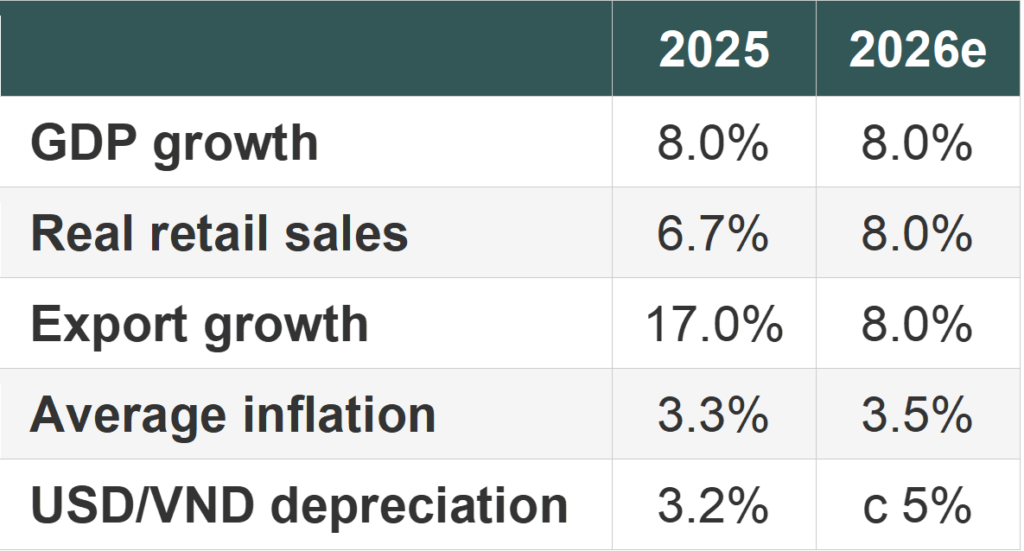
Emerging markets shaped by rapid urbanisation, a young workforce and rising consumer spending sit at the heart of the society and lifestyle megatrend. Vietnam is a standout example. With GDP growth of 8% in 2025 and a government targeting 10% in 2026, the country is undertaking sweeping economic reforms, while benefiting from the global shift in manufacturing supply chains. For investors seeking exposure to frontier-to-emerging-market transition stories, Vietnam offers a compelling (if complex) proposition.
Where does Vietnam sit in Asia’s economic league table?
Vietnam is rapidly climbing the Association of Southeast Asian Nations rankings. According to the International Monetary Fund, Vietnam’s GDP is expected to reach roughly $490–511bn by 2025, closing the gap on Thailand and overtaking the Philippines to become the bloc’s third-largest economy. By 2029, Vietnam is projected to surpass both Thailand and Singapore in total GDP. The country attracted $18.5bn in foreign direct investment (FDI) in 2023 (4.3% of GDP), significantly outpacing its neighbours, while exports at 87% of GDP give it one of the highest trade ratios globally. GDP per capita is expected to rise to approximately $4,783 in 2025, putting Vietnam on track for upper-middle-income status. A young workforce (median age of roughly 33, compared to 40 in Thailand) and high educational attainment (Vietnam consistently ranks above many developed nations in Programme for International Student Assessment maths and science scores) underpin its growth story. Strong manufacturing investment from firms such as Samsung has propelled export growth, while trade liberalisation and deeper integration into global supply chains continue to widen the opportunity set for investors.
Why is Vietnam’s economy growing so fast?
Vietnam’s 2025 growth was powered by three engines. First, exports to the US surged 28%, driven by an 80% jump in shipments of laptops and other high-tech products linked to AI-related demand. Second, infrastructure spending leapt around 40% as part of a deliberate government push to raise investment from roughly 6% of GDP to 10%. Third, tourism bounced back strongly, with Chinese and Indian visitor numbers both up over 40%. Domestic consumption, however, remained subdued as households continued to rebuild savings depleted during the COVID-19 pandemic.
Exhibit 1: Vietnam’s growth
Source: VinaCapital, National Statistics Office of Vietnam
What are the Doi Moi 2.0 reforms?
Vietnam’s original Doi Moi (renovation) reforms in 1986 transformed the country from a centrally planned to a market-oriented economy. The current Doi Moi 2.0 agenda goes further, promoting the private sector through deregulation. VinaCapital estimates these changes could add two percentage points to long-term GDP growth. A key catalyst is unblocking stalled real estate projects; regulatory changes around land clearance and rezoning could unlock up to 80% of previously stalled developments. Infrastructure investment is feeding into real estate through a transit-oriented development strategy similar to Japan’s in the 1960s. Government debt remains well below 40% of GDP, providing fiscal room for further investment.
How resilient are exports despite US tariffs?
Despite the imposition of 20% reciprocal tariffs in 2025, Vietnam’s exports held up well. Exemptions and carve-outs on electronics reduced the effective tariff rate to levels comparable to or below those of regional competitors. Vietnam’s lower labour costs provide a further buffer – factory wages are roughly a third of those in China. FDI flows remained robust, up 9% in 2025, and companies including Apple continue to expand manufacturing operations there. The new export orders sub-index of Vietnam’s Purchasing Managers’ Index hit a 15-month high in late 2025, suggesting momentum is intact heading into 2026.
What does the stock market offer?
The VN Index trades on around 13x forward earnings versus 18% expected earnings growth, implying a price-per-earnings-growth (PEG) ratio of 0.7x. Most sectors are forecast to deliver 10–20% earnings growth in 2026. An anticipated upgrade to FTSE’s emerging market classification could attract fresh foreign capital after two years of net selling totalling around $9bn. A growing pipeline of IPOs, including Vietnam’s leading electronics retailer, adds to the opportunity set. However, investors should note that the index is heavily influenced by Vingroup, whose family of companies accounts for nearly a quarter of the VN Index by weight.
What are the key risks?
The primary domestic risk is tight banking liquidity. Credit growth of 19% outpaced deposit growth of 15% in 2025, driving bank deposit rates up by around 100bp. A further 50–100bp rise is expected in 2026. If 12-month deposit rates exceed 7–8%, history suggests retail investors withdraw money from the stock market. Externally, a US recession would be the most damaging scenario as Vietnam is the third-most economically intertwined country with the US after Canada and Mexico. However, the State Bank of Vietnam retains powerful policy tools, including central bank balance sheet expansion and the redeployment of $30bn in government deposits held at the central bank.
Edison insight
Vietnam’s economy grew by 8% in 2025 and the government is targeting 10% growth in 2026. Three pillars support this ambition: surging infrastructure spending (up 40% in 2025), resilient high-tech exports to the US and a recovery in domestic consumption. Structural reforms under Doi Moi 2.0 are promoting private enterprise and unlocking stalled real estate projects.
The VN Index trades on 13x forward earnings versus 18% expected growth, which is a PEG ratio of just 0.7x. An imminent FTSE upgrade to emerging market status could draw fresh foreign capital.
The main risks centre on tight banking liquidity, with deposit rates rising as credit growth outpaces savings. However, policymakers retain powerful tools to manage this, including central bank balance sheet expansion.
Megatrends: society and lifestyle, transformative technologies
This website uses cookies so that we can provide you with the best user experience possible. Cookie information is stored in your browser and performs functions such as recognising you when you return to our website and helping us understand which section of the website you find more interesting and useful. See our Cookie Policy for more information.
Strictly necessary and functional
These cookies are used to deliver our website and content. Strictly necessary cookies relate to our hosting environment, and functional cookies are used to facilitate social logins, social sharing and rich-media content embeds.
Advertising
Advertising Cookies collect information about your browsing habits such as the pages you visit and links you follow. These audience insights are used to make our website more relevant.
Please enable Strictly Necessary Cookies first so that we can save your preferences!
Performance
Performance Cookies collect anonymous information designed to help us improve the site and respond to the needs of our audiences. We use this information to make our site faster, more relevant and improve the navigation for all users.
Please enable Strictly Necessary Cookies first so that we can save your preferences!