Market opportunity and business strategy
Addressing the leading cause of disability worldwide
The Lancet Public Health estimates that the total global economic burden of neurological disorders reached $1.7tn in
2019, growing 3.5% annually since 2000. The World Health Organization reports that more than three billion people are living with a neurological condition, now
the leading cause of ill health and disability worldwide. In the US alone, there are
over 800,000 new stroke cases per year, 2.8m new instances of TBI, and 90,000 new cases of PD (total PD prevalence is projected to reach 1.2m by 2030). Best practices for these
conditions recommend high-dose, high-intensity (eg more than three hours daily for
stroke), function-specific and impairment-specific training to be delivered consistently
across inpatient, outpatient and home settings (AHA/ASA, 2016 and NICE, 2023). These standards reinforce clear, measurable targets and feedback loops between
the patient and care team to optimise neurological recovery.
In the US and the EU5 countries (France, Germany, Italy, Spain and the UK), the standard
care pathway for a stroke or TBI patient is well-established and follows a progressive
continuum of care that starts in the hospital, then transitions through post-acute
inpatient rehabilitation centres and then often to outpatient centres.
However, in real-life settings, and specifically post-discharge (from inpatient facilities),
delivery of care can be fragmented and resource-constrained and frequently fails to
meet the rigour of such guidelines. Effectively, the disjointed structure of healthcare
systems and lack of sufficient intensity or monitoring in the latter stages leads
to wide gaps in care, leaving millions of patients with suboptimal recovery. This
results in a massive economic burden due to effects of prolonged disability and loss
of productivity. Digital neurotherapeutics offer a truly scalable solution.
Integrated platform spanning the continuum of care
MindMaze operates three interoperable product families that are collectively designed
to seamlessly bridge the entire continuum of care. The ability to integrate the care
model and enable home-based therapy empowers both providers and patients to increase
delivered therapy dose, while maintaining clinical oversight, and gather substantial
clinical data on patient progress.
MindMaze’s interoperable portfolio, spanning immersive inpatient systems (MindPod
Dolphin), outpatient and home-based therapy platforms (MindMotion GO), precision hand
therapy devices (Izar) and objective digital biomarker sensor devices (Physilog and
Census), comprises:
- MindPod Dolphin for intensive inpatient treatment to initiate the rehab process post
the event/injury and deliver impairment reduction through immersive virtual-reality
environments and full-body motion tracking;
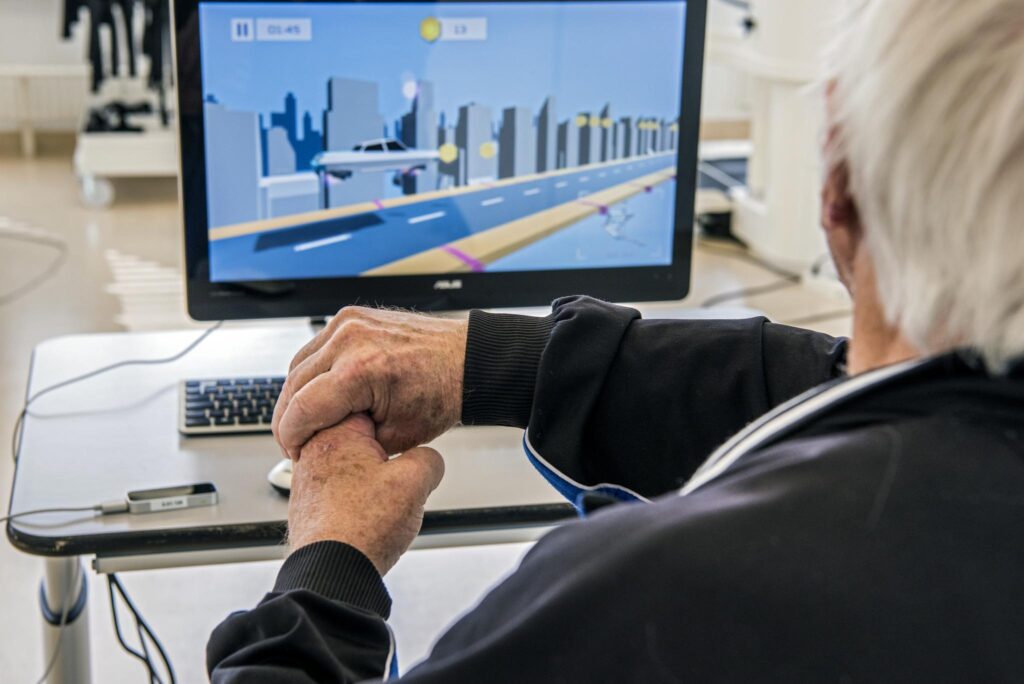
- MindMotion GO for flexible outpatient and home therapy with c 80% patient self-training,
c 20% remote therapist oversight, plus the Izar hand therapy device; and
- Physilog monitoring platform (including the Census software) with wearable sensors
for objective digital assessments of gait, balance and cognition.
| Exhibit 1: End-to-end neurotherapeutics platform |
 |
| Source: MindMaze presentation, November 2025 |
The company monetises its offering through SaaS subscriptions for healthcare providers
(primarily inpatient and outpatient rehabilitation facilities) and per-patient fees
for home therapy (CPT codes 0733T and 0734T). MindMaze is also seeking revenue sources
through pharmaceutical partnerships via up to three separate channels:
- Data Play (leveraging its sensors and data collection capabilities to enhance clinical
trial data gathering and analysis for potential pharma companies developing proprietary
drugs for neurological indications);
- Pill+ (portfolio integration, whereby a Pharma partner would market MindMaze’s portfolio
along its own neurological drug products); and
- Beyond the Pill (combination therapy, where Mindmaze neurotherapeutics could be combined
with drug candidates in controlled trials) models.
The company expects to finalise a distribution partnership in the coming months with
a major pharma company for 2026 launch (reflecting its Pill+ platform viability) in
a large developed market that it is currently not actively commercially operating
in (meaning outside the EU5 countries and the US). MindMaze expects to report progress
on this partnership in H126.
Competitive advantages
MindMaze differentiates itself through: end-to-end integration (not point solutions)
in the care continuum for neurological events, multi-disease clinical evidence accumulated
since c 2012 (50+ studies), continuum-of-care workflows (not isolated treatment),
a proprietary dataset (collecting more than 1bn data points monthly from an established
patient base, with c 97% consenting to data collection) and regulatory infrastructure
(12 FDA clearances/CE marks, CPT code, 25+ patents, ISO 13485).
AI growth pillar provides an additional lever and optionality
MindMaze’s AI-enabled platform is constantly collecting additional data, which provides
multiple added growth levers. The datasets can be used to refine treatment algorithms
and develop more personalised treatments for patients (eg by using generative AI to
customise environments for patients’ preferences), which can strengthen engagement
and possibly boost outcomes. The collected data and resulting analytics can also embed
information on co-morbidities and concurrent treatments to potentially discover optimal
combinations of specific pharmaceuticals with the MindMaze platform, resulting in
the exploration of drug/neurotherapeutics dual therapies with potential pharma partners
(eg Beyond the Pill). The AI platform can also improve workflow automation in in-clinic
environments, potentially further boosting efficiencies for healthcare systems. Altogether,
the data collection, analytics and resulting capabilities can extend and compound
MindMaze’s product differentiation and competitive advantage over time.
Robust data generated to date
MindMaze’s portfolio has shown meaningful benefits across multiple trials and we highlight
three key studies of the neurotherapeutics platform:
- The SMARTS-2 randomised study (n=24), conducted at Johns Hopkins University, compared a novel
neuroanimation experience (a high-dose, high-intensity protocol delivered through
MindPod Dolphin) to dose-matched (thus, also high intensity) conventional occupational
therapy (COT) in subacute stroke patients. The results showed that the immersive neuroanimation therapy (NAT) can feasibly deliver comparable
efficacy to in-person therapist delivered therapy, while providing an enjoyable, efficient
and scalable way to deliver high-dose and intensive upper-limb therapy. NAT was found
to be equal to dose-matched COT (no significant difference) at reducing impairment
versus baseline, as measured with the Fugl-Meyer Upper Extremity motor score, and
also at improving arm activity, measured with the Action Research Arm Test. The authors
concluded that NAT can help increase the dose and intensity of upper limb training
early after stroke, with a focus on movement quality, which can lead to gains beyond
those seen with usual care.
- A retrospective analysis of home-based neurorehabilitation in chronic stroke patients (at more than six months post-stroke, n=17) was completed in collaboration with Mount
Sinai Hospital. Participants on average participated in c 39.7 hours of gamified training
using MindMotion GO, 82% of which was delivered asynchronously with remote therapist
oversight. Statistically significant gains were shown in upper-limb (Fugl-Meyer Upper
Extremity, mean 6.4, p<0.001) and gait and balance measures (Functional Gait Assessment,
mean 3.1, p<0.001; Berg Balance Scale, mean 6.1, p<0.001). Importantly, study subjects
who completed the programme reported high satisfaction in a post-programme survey,
with c 74% of respondents being satisfied or very satisfied, with c 63% reporting
subjective improvements in physical abilities. The study demonstrated that a resource-efficient
high dose of therapy can be delivered remotely, requiring much less direct therapist
time than one-on-one in person sessions. The study authors suggested cost savings
of 82% versus standard one-on-one therapy with a therapist ($338 per patient vs $1,903
per patient). This supports the viability of MindMaze’s home-based treatment model.
- An ongoing, large-scale implementation across multiple Vibra Healthcare rehabilitation
facilities involving c 500 patients (300 inpatients and 200 home/outpatients), mostly
stroke survivors, and assessing MindMaze’s full continuum of care (MindPod Dolphin,
MindMotion GO and Izar) across rehab centres in Kentucky, California and South Dakota
is underway. Preliminary data reported by Vibra Healthcare shows consistent improvements
for the inpatient group in functional outcomes including mobility and self-care domains
(as measured by the Centers for Medicare & Medicaid Services’ Section GG: Functional
Abilities and Goals, GG scores) and walking capacity. Notably GG scores were reported
as improving by 29% on combined patient self-care and mobility clinical outcomes versus
the standard-of-care group, supporting earlier discharge potential from inpatient
facilities (up to $1,500 per day in savings per patient estimated). While the clinical
outcomes of the outpatient home programme are still being analysed, adherence rates
suggest that the outcomes may be comparable to those reported in the Mount Sinai study.
This real-world evidence may be more persuasive for further commercial adoption and
reimbursement than controlled trials, demonstrating that the platform works in the
imperfect reality of busy healthcare facilities with diverse patient populations,
and supporting the value proposition (ie cost savings).