Last close As at 05/08/2026
GBP1.76
— 0.00 (0.00%)
Market capitalisation
—
Research: Investment Companies
Henderson International Income Trust (HINT) aims to provide UK-based investors with a unique, diversified source of income by investing in overseas markets. It is the only global equity income investment trust to totally exclude the UK market, which has high dividend concentration compared to global markets (see chart below). The manager, Ben Lofthouse, adopts a value-driven approach that targets fundamentally good businesses, with high barriers to entry, sustainable cash flows, solid growth prospects and scope to deliver rising returns over time. The manager has recently purchased some (mainly) investment-grade bonds to further diversify HINT’s income sources. The trust has an established track record of rising income delivery and solid total returns over the longer term. It has also outperformed the UK market since inception.
Henderson International Income Trust |
Rising overseas income and solid total returns |
Investment trusts |
9 September 2020 |
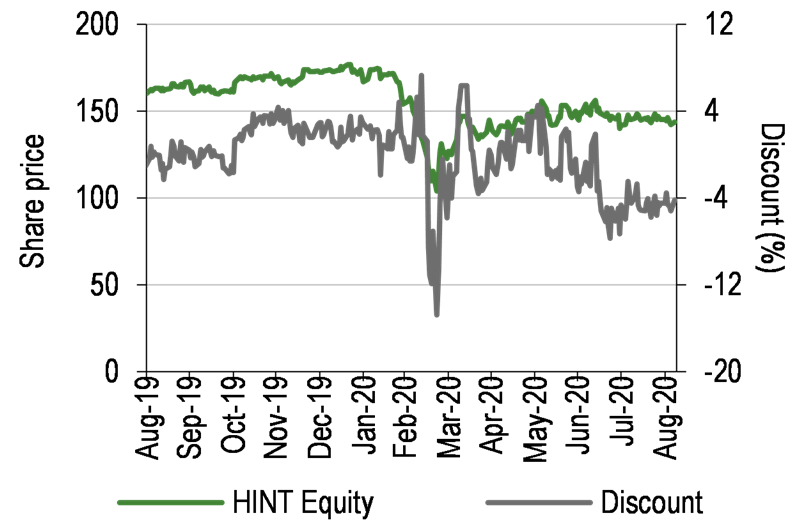
Share price/discount performance
Three-year performance vs index
Gearing
Analysts
|
|||||||||||||||||||||||||||||||||||||||||||||||||||||||||||||||||||||||||||||||||||||||||||||
Henderson International Income Trust (HINT) aims to provide UK-based investors with a unique, diversified source of income by investing in overseas markets. It is the only global equity income investment trust to totally exclude the UK market, which has high dividend concentration compared to global markets (see chart below). The manager, Ben Lofthouse, adopts a value-driven approach that targets fundamentally good businesses, with high barriers to entry, sustainable cash flows, solid growth prospects and scope to deliver rising returns over time. The manager has recently purchased some (mainly) investment-grade bonds to further diversify HINT’s income sources. The trust has an established track record of rising income delivery and solid total returns over the longer term. It has also outperformed the UK market since inception.
|
Dividend concentration reduced by investing outside the UK |
|
|
Source: Janus Henderson Investors, Edison Investment Research Note: At 31 December 2019. |
The market opportunity
In the prevailing climate of dividend uncertainty, diversification by country, sector and yield source is an effective way for income investors to reduce risk and ensure a balanced return from companies around the world. With value stocks historically very cheap compared to growth and momentum strategies, value-focused investors may benefit as and when these companies return to fashion.
Why consider investing in HINT?
■
A unique source of income diversification away from the UK market, via a portfolio of c 75 stocks, invested across 20 countries.
■
The board has a long-term commitment to high and rising dividends, using revenue reserves where necessary, as well as capital appreciation.
■
An experienced manager, with an established track record, supported by Janus Henderson’s extensive global research capacities.
Long-term premium and a competitive yield
HINT has traded at an average premium of 1.6% since its inception in April 2011. This reflects its unique investment mandate and investors’ appetite for high and rising income. As at 7 September 2020, the trust was trading at a 5.1% discount to NAV. It currently offers a dividend yield of 4.2%, above that of most of its peers.
Exhibit 1: Trust at a glance
Investment objective and fund background |
Recent developments |
|||||||||||||||||||||||||||||||||||||||||||||||||||||||||||||||||||
Henderson International Income Trust (HINT) seeks to provide shareholders with a growing total annual dividend, as well as capital appreciation, by investing in a focused and internationally diversified portfolio of c 60–80 stocks that are either listed in, registered in, or whose principal business is in countries that are outside the UK. The portfolio is made up of shares and fixed interest assets (maximum 25%) that are diversified by factors such as geography, industry and investment size. |
■ 1 September 2020: Lucy Walker appointed to board, with immediate effect. ■ 28 August 2020: Third interim dividend of 1.5p/share for FY ending 31 August 2020 (FY20) paid. ■ HY results: TR 6 months ended 29 Feb 2020, - 4.3% NAV basis, -1.7% price basis vs benchmark -3.4%. ■ 29 May 2020: Second interim dividend of 1.5p/share for FY20paid. ■ 28 February 2020: First interim dividend of 1.5p/share for FY20 paid. |
|||||||||||||||||||||||||||||||||||||||||||||||||||||||||||||||||||
Forthcoming |
Capital structure |
Fund details |
||||||||||||||||||||||||||||||||||||||||||||||||||||||||||||||||||
AGM |
December 2020 |
Ongoing charges |
0.84% |
Group |
Janus Henderson Investors |
|||||||||||||||||||||||||||||||||||||||||||||||||||||||||||||||
Interim results |
April 2020 |
Net gearing |
14.0% |
Manager |
Ben Lofthouse |
|||||||||||||||||||||||||||||||||||||||||||||||||||||||||||||||
Year end |
31 August |
Annual mgmt fee |
Tiered (see page 11) |
Address |
201 Bishopsgate, London, EC2M 3AE |
|||||||||||||||||||||||||||||||||||||||||||||||||||||||||||||||
Dividend paid |
Feb, Apr, Aug, Nov |
Performance fee |
None |
|||||||||||||||||||||||||||||||||||||||||||||||||||||||||||||||||
Launch date |
28 April 2011 |
Trust life |
Indefinite (subject to vote) |
Phone |
+44 (0)20 7818 1818 |
|||||||||||||||||||||||||||||||||||||||||||||||||||||||||||||||
Continuation vote |
Three-yearly, next 2020 |
Loan facilities |
See page 10 |
Website |
||||||||||||||||||||||||||||||||||||||||||||||||||||||||||||||||
Dividend policy and history (financial years) |
Share buyback policy and history (financial years) |
|||||||||||||||||||||||||||||||||||||||||||||||||||||||||||||||||||
Dividends paid quarterly in February, May, August and November |
HINT may buy back up to 14.99% of shares to manage a discount and will issue shares (up to 10%) to manage a premium. FY16 issuance includes the rollover of investments in Henderson Global Trust, while FY19 includes the rollover of investments in Establishment Investment Trust. |
|||||||||||||||||||||||||||||||||||||||||||||||||||||||||||||||||||
|
|
|||||||||||||||||||||||||||||||||||||||||||||||||||||||||||||||||||
Shareholder base (as at 30 June 2020) |
Portfolio exposure by country (as at 31 July 2020) |
|||||||||||||||||||||||||||||||||||||||||||||||||||||||||||||||||||
|
|
|||||||||||||||||||||||||||||||||||||||||||||||||||||||||||||||||||
Top 10 holdings (as at 31 July 2020) |
||||||||||||||||||||||||||||||||||||||||||||||||||||||||||||||||||||
|
||||||||||||||||||||||||||||||||||||||||||||||||||||||||||||||||||||
Source: Henderson International Income Trust, Edison Investment Research, Bloomberg, Morningstar. Note: *N/A where not in end-July 2019 top 10.
Market outlook: Clouded by near-term uncertainties
It is particularly difficult to assess the global economic and market outlook at the moment. The world is probably still in the early stages of its battle with the coronavirus. The virus’s impact differs from country to country, and most are responding in different ways and at different speeds. While national lockdowns have lifted in most developed countries – with the notable exception of ongoing border closures in Australia and New Zealand – economic activity has by no means returned to normal. In China and South Korea, the first countries to be hit by the virus, manufacturing is back to almost full capacity, but as in many other countries, service-orientated businesses such as tourism, restaurants, sporting events, cinemas and theatres are operating at reduced levels, if at all. The virus is still spreading across the US and India as well as many developing countries in Africa and Latin America. Given the piecemeal and highly politicised nature of the US’s response to the virus, it is likely to take longer than its developed world peers to stabilise the situation and pull through the crisis. Recent news on the development of a vaccine has been positive, but the testing required to confirm early indications of the efficacy of particular drugs will take months. Even once a vaccine is found, national vaccination programs will take yet more time, so it is likely to be at least another year, and much longer in poorer countries, until the virus is defeated.
|
Exhibit 2: Market performance and valuation |
|||||||||||||||||||||||||||||||||||||
UK and ex-UK index performance over five years |
12m forward P/E ratios of Datastream indices |
||||||||||||||||||||||||||||||||||||
|
|
||||||||||||||||||||||||||||||||||||
|
Source: Refinitiv, Edison Investment Research. Note: Valuation data as at 7 September 2020. |
|||||||||||||||||||||||||||||||||||||
The uncertainties facing investors do not end with the virus alone. Massive government programmes to support employment and businesses during the lockdown will be winding down in coming months, and there are concerns that, in many cases, this support has only delayed job losses and company bankruptcies. Large-scale redundancy announcements and business closures feature daily in the news. Localised lockdowns and travel limitations are being imposed in many places, often at short notice, to deal with virus hotspots. These are disrupting the efforts of businesses, governments and individuals to return to some version of the ‘new normal’ and undermining the capacity of the economy to build any momentum. The EU has recently implemented additional assistance measures, and the UK and the US are under pressure to do more to counter the deepening recession. The International Monetary Fund expects advanced economies to be hit hardest, contracting by 8% in 2020 and growing at 4.8% in 2021. China is set to lead the way, with growth of 1% in 2020 and 8.2% in 2021, while emerging markets and developing economies as a whole are forecast to contract by 3% this year, before growth rebounds at a rate of 5.9% in 2021.
Political considerations are also weighing on investor sentiment. Tensions between the US and China have risen in the run-up to the US presidential election in November and the UK’s negotiations with the EU over its future relationship with the Union at the end of the Brexit transition period have so far failed to deliver the breakthrough necessary to reassure investors.
For equity investors, especially those focused on income, one of the key challenges since the onset of the pandemic has been the impact it has had on dividend payments. Many companies, especially those that have received government support in one form or another, have been under political pressure to pause dividend payments. Other companies are cutting dividends to protect their balance sheets. The sharp fall in energy prices meant oil and gas companies were among the first to cut payouts. For the banking sector, banks in France, the UK and Australia have cancelled or cut payments in response to demands from regulators, while other countries with different corporate cultures regarding distributions to shareholders have escaped more lightly. US and Asian companies have largely maintained or in some cases increased dividend payments, and even within Europe, Swiss and German companies – including banks and insurers – have continued to pay out.
According to research by Janus Henderson, by late May 2020, 21% of global companies monitored for the firm’s Global Dividend Index had already cut dividends for 2020, and more are expected to follow. In all, Janus Henderson expects global dividends to fall by between 15% and 34% in 2020, more than they did during the global financial crisis. Investors have been particularly frustrated by the failure of some companies to give any guidance as to their intentions regarding future dividend payments.
With the exception of the Nasdaq, which has rebounded from the virus-related sell-off in Q120 to record new highs, most equity markets have made only a partial recovery, and are trading more or less sideways as investors await further insight into how all these factors will play out.
Fund profile: Unique ‘one-stop shop’ for global income
When HINT was launched almost 10 years ago, in April 2011, it was specifically designed as a complementary fund for UK income-driven investors wishing to diversify their portfolios outside the UK. HINT is the only trust in the Association of Investment Companies’ (AIC) Global Equity Income sector to invest only in companies listed or operating mainly in countries outside the UK. This approach is intended to take advantage of the fact that global equity dividends are much less concentrated than dividends for the 100 largest UK companies (see chart on page 1). HINT’s objective is to provide a high and rising level of income, as well as capital appreciation over the long term, from a focused and internationally diversified portfolio of non-UK securities. The strategy leverages off Janus Henderson’s broad and deep regional market expertise, to build a diversified international portfolio.
Ben Lofthouse of Janus Henderson Investors has managed the trust since inception. He adopts a bottom-up, value-driven, income-seeking approach to build a portfolio of around 60–80 stocks, diversified by geographical region and industry sector. HINT invests in North and South America, Europe, Asia and the Middle East and Africa, with a maximum 50% of portfolio value in any one region, to ensure global diversification. The mandate is flexible but targets companies with good fundamentals and high barriers to entry, that can pay dividends of more than 2% of the share price and have potential to grow over time. The trust also has the capacity to invest up to 25% in bonds. HINT is benchmarked against the MSCI World ex-UK Index, but its objective of geographical diversity means that its composition usually differs to a significant degree from the index, which is dominated (c 67%) by the US.
The trust informally targets a yield close to that of the UK stock market, although its current yield of 4.2% is probably above the yield of the broad UK stock market index, which Lofthouse estimates to be around 3.6% following the dividend cuts since the onset of the pandemic. Gearing is permitted up to 25% of net assets, and net gearing was 14% at end July 2020. The trust has scope to use option-writing to enhance income, which it does sparingly. Currency exposure may be hedged.
The fund manager: Ben Lofthouse
The manager’s view: Income diversification key in tough times
HINT’s manager, Ben Lofthouse, acted quickly to protect the portfolio by reducing exposure to areas likely to be directly hurt by the onset of the pandemic. The largest changes in the portfolio in recent months have been the closure of all positions in the energy sector and a reduction in financials via the sale of several banks. He also took profits in February in several tourism-orientated stocks before the worst of the sell-off. He says that these were ‘the right decisions, made early’.
Lofthouse is keen to stress that despite the many uncertainties clouding the investment horizon, it is very much ‘business as usual’ for him and his team, as he continues the search for sustainable growing yields and undervalued opportunities with growth potential. He has observed the emergence of several themes as the world adjusts to the pandemic. Perhaps the most notable of these is the new ascendency of technology companies. The manager believes that people have had to adapt very quickly to new circumstances and new technologies, including products that companies have been trying to persuade consumers to adopt for some time. A good example of this is the rising use of Microsoft Teams and other virtual conferencing facilities for commercial and social meetings. Allied to this is the increased demand for data storage and cloud services.
Another theme that Lofthouse has monitored very closely is the politicisation of dividends (as discussed in the ‘Market outlook’ section). However, he stresses that with current holdings of 75 stocks spread across 20 countries, HINT’s portfolio has not been greatly affected by dividend cuts, which have mainly been focused on financial companies in the UK and France. Taking a broader view, Lofthouse believes that a temporary halt in dividends does not change the fundamental value of a company, which is driven more by its ability to prosper and grow over the longer term. Once the crisis has passed and retained or newly issued capital is no longer needed, Lofthouse expects this capital to find its way back to shareholders. In the meantime, he views diversification as an effective way to reduce risk and provide a balanced income from companies around the world – ‘the very reason HINT exists’, he says. Lofthouse also notes HINT’s capacity, as an investment trust, to retain income for a rainy day, allowing it to pay dividends that are less volatile than the market in challenging times.
Lofthouse’s desire to maintain the diversification of the portfolio’s income sources, as well as its sector and geographical weightings, is also reflected in the fact that for the first time since HINT’s launch, he has recently purchased some bonds. The manager took advantage of the recent extreme volatility in global bond markets and the associated widening of credit spreads to acquire several mainly investment-grade bonds, a sector Lofthouse feels will benefit from the US Federal Reserve’s overt support for the corporate bond market. All are issued by US companies and denominated in dollars. The bonds have similar yields to the portfolio and the manager views their coupon payments as a means of increasing the certainty of portfolio income over the next one to two years, while the current health and economic crises play out.
In summary, Lofthouse believes the current macroeconomic environment – stimulus, low rates, central bank support and low oil and commodity prices – is very supportive of the portfolio, and he is hopeful that HINT’s holdings will rise in value over the coming year. ‘But we’ll keep watching to see what other opportunities may emerge for the future to generate additional capital and income returns for the fund,’ he concludes.
Asset allocation
Investment process: Targeting diversified income and value
HINT’s manager is a member of Janus Henderson’s global equity team, and as such he has the support of a large pool of in-house analysts based around the world. The team screens the c 1,500 constituents of the MSCI World ex-UK Index, which includes 22 developed stock markets, to identify companies that meet HINT’s investment criteria: a dividend yield within a c 2–6% range, an attractive free cash flow yield and strong free cash flow growth. Each potential investment is then subject to fundamental analysis to determine its competitive positioning, its ability to generate sustainable cash flows, profits and dividends, and its intrinsic value. To meet HINT’s objective to achieve capital appreciation as well as pay a growing dividend, Lofthouse seeks to maximise potential returns by investing in companies that are presently out of favour with investors and thus undervalued, but that have scope to rise in value over time.
The manager sets the geographical allocation across five regions – North and South America, Europe, Asia, and the Middle East and Africa. No single region can comprise more than 50% of the portfolio, so HINT is always likely to be underweight the US, as US companies currently comprise c 67% of the benchmark. Once regional allocations have been set, the manager uses Janus Henderson’s regional expertise to choose stocks within each region. Individual country and sector weightings are therefore the result of bottom-up stock selection. Lofthouse combines higher-yielding holdings with others with a lower current yield but better dividend growth prospects over time. In all, the portfolio usually comprises around 70 stocks. Holding periods stretch from a few months to several years or more; the average portfolio turnover is currently c 25% pa, having declined from c 40% in the previous two financial years. Each holding is assigned a price target; once this target is reached, the holding will either be sold or assigned a new, higher target price if the manager believes there is scope for further upside. Positions will also be sold swiftly – as some were during the onset of the pandemic – if fundamentals deteriorate. Stocks will not be sold automatically if their yield drops below 2%, either due to capital appreciation or a dividend cut, but such a fall would trigger a review of the holding.
The trust can invest up to 25% in bonds and has recently taken this step for the first time, buying several dollar-denominated US names, totalling c 8% of the portfolio value. The transactions were overseen by Janus Henderson’s credit team, led by John Pattullo and Jenna Barnard. The manager also has scope to use option-writing to enhance income, although such positions tend to be opportunistic and small. In practice this usually involves writing put options on existing holdings at levels close to their price target, when the manager would be happy to take some profit.
As mentioned above, the coronavirus crisis has not interrupted HINT’s investment process. Lofthouse and his team are working remotely but remain in close, regular contact, and interactions with companies continue. In fact, Lofthouse believes companies are more accessible than usual thanks to virtual road shows and industry conferences. Where possible, he seeks access to companies’ trading statements as a source of additional information on how they are coping with the crisis.
Janus Henderson is proud of its long history of responsible investing, and environmental, social and governance (ESG) principles are integral to HINT’s investment process. Janus Henderson was a founding member of the UN’s Principles of Responsible Investing and the UK Stewardship Code (Tier 1). It launched its first specialist sustainable and responsible investment funds 28 years ago. Janus Henderson’s Responsible Investment Committee comprises senior representatives from equities, fixed income and distribution, who oversee the integration of ESG principles across all investment strategies, although the practical approach to ESG integration is determined by investment teams. In addition, a specialist in-house unit supports investment teams on voting, company engagement and ESG research, and ESG risk scoring is incorporated into portfolio risk analytics.
Current portfolio positioning
The most significant change in HINT’s sectoral allocations since the onset of the COVID-19 pandemic has been the closure of all oil & gas positions (Exhibit 3). Concerns about excess oil supply caused the manager to begin reducing oil & gas holdings early in 2020, before the virus took hold. Positions were trimmed further on the collapse of the OPEC+ agreements in March, and subsequently reduced to zero as aviation demand collapsed and oil prices plummeted. Positions in ENI, Chevron, Total and Vermillion Energy were closed.
At the onset of the pandemic, Lofthouse also reduced exposure to other sectors adversely affected by the virus. Holdings in Royal Caribbean Cruises, casino operator Las Vegas Sands and Chinese toll road company Jiangsu Expressway were sold as soon as it became apparent that COVID-19 would severely curtail travel and tourism. Lofthouse made outright sales of several banks including JP Morgan, Bawag and Swedbank, and trimmed holdings of ING and BNP Paribas as banks came under regulatory pressure to cut dividends. (The Swedbank sale also closed the portfolio’s exposure to Sweden.) Although these sales mean the portfolio’s overall allocation to financials has declined to 17.2% at end-July 2020, from 20.2% at end-July 2019, exposure to the sector has been augmented by the recent purchase of several life and non-life insurance names. This area was hit very hard in the March sell-off and appeared particularly cheap given the manager’s view that the virus would ultimately increase demand for insurance generally, and life insurance especially. He opened positions in Zurich Re, Swiss Re and Muenchener Rueckver. The price of these stocks has since recovered to some degree, and their yields remain attractive, as most have continued to pay dividends.
Exhibit 3: Portfolio sector exposure (% unless stated)
Portfolio end-July 2020 |
Portfolio end-July 2019 |
Change (pp) |
|
Financials |
17.2 |
20.2 |
(3.0) |
Consumer goods |
17.0 |
13.6 |
3.4 |
Technology |
16.0 |
11.5 |
4.5 |
Healthcare |
15.0 |
10.1 |
4.9 |
Telecommunications |
9.7 |
9.1 |
0.6 |
Industrials |
9.2 |
7.4 |
1.8 |
Real Estate |
7.0 |
6.0 |
1.0 |
Utilities |
3.5 |
2.6 |
0.9 |
Basic materials |
3.0 |
7.6 |
(4.6) |
Consumer services |
2.4 |
3.0 |
(0.6) |
Oil & gas |
0.0 |
8.8 |
(8.8) |
100.0 |
100.0 |
Source: Henderson International Income Trust, Edison Investment Research
HINT’s healthcare weighting has seen the biggest increase over the past year, rising to 15.0% at end-July 2020 from 10.1% at end-July last year. Lofthouse began adding to healthcare holdings prior to the onset of the pandemic on the view that the sector was undervalued. HINT’s holdings of Roche, Novartis, Sanofi and Bristol-Myers Squibb have performed strongly due to the need for widespread coronavirus testing and the race for a vaccine. Technology stocks represent 16.0% of the portfolio, up from 11.5%, including Microsoft, which has retained it number one ranking in HINT’s top 10 holdings. The tech giant has been a particular beneficiary of the recent surge in home working and resultant demand for cloud and data storage services. This trend has also motivated acquisitions of REITs owning data centres and telecom towers, and some US gaming companies, all of which have continued to pay their rent during the crisis. In all, HINT’s real estate exposure currently amounts to 7% of the portfolio, up from 6% at the same time last year. However, it has no holdings of shopping centre REITs, which have suffered from rent reductions forced on landlords by struggling retailers. The trust’s holdings in communication services have risen due to the recent addition of names such as Tencent and Vivendi, which Lofthouse views as having particularly strong future growth prospects thanks to consumer trends fostered by lockdown. The portfolio’s current defensive tilt is evidenced by the recent purchases of stocks such as healthcare company Johnson & Johnson and US confectionery company Mondelēz.
At the end of July 2020, the portfolio held 78 stocks, compared to 70 at end-July 2019. As a result of recent transactions, HINT’s top 10 holdings have changed significantly over this period (Exhibit 1). In addition to Microsoft in top position, there are now two other tech names in the top 10 – Taiwan Semiconductor Manufacturing and ABB. Healthcare companies also feature more heavily. The concentration of the portfolio within its top 10 holdings has increased to 28.8% from 26.4% at the same time the previous year, thanks in part to the strong recent performance of these names.
In terms of the portfolio’s geographical exposure (Exhibit 4), US investments represent the largest country exposure (31.8% at end-July 2020, from 29.5% at end-July 2019). The recent US corporate bond purchases – which, as discussed above, were made to increase the diversification of the portfolio’s income sources – also served to reduce the US underweight. The weighting to Switzerland increased the most over the past year (to 16.0% from 10.1%), due in part to the strong performance of healthcare stocks Roche and Novartis, along with consumer goods company Nestlé – most of which are top ten holdings. This increased weighting also reflects Lofthouse’s decision to skew the portfolio in favour of Swiss companies, which have not been subjected to pressure to cut dividends. HINT’s weighting to China has risen to 9.5% from 6.2%. In the manager’s view, China had been undervalued for some time before the pandemic. Two years of credit tightening had distracted global investors from China’s very favourable long-term growth prospects, which are underpinned by rising demand from its massive middle-class. Lofthouse used the virus-related sell-off to buy several Chinese companies, including Citic Securities (a broker) and hygiene company Hengan at attractive entry levels. However, he is wary of Hong Kong due to the political uncertainties surrounding this market, so HINT has no exposure to Hong Kong banks or property. The trust has added new exposures to South Korea via the acquisition of Samsung, and in Australia thanks to a holding in Macquarie Bank. A reduction in exposure to France (to 6.4% from 11.8%) was the most significant cut in country exposure over the period, due in part to the disposal of French bank BNP Paribas, on concerns about the risk of dividend cuts.
The portfolio is currently overweight euro against sterling. Its euro-denominated borrowings (see page 10) serve as a partial hedge to this exposure. Aside from this, the manager does not use hedges as he believes that in such a diversified portfolio, gains and losses from currency exposures tend to balance out over time. At present, HINT does not have any option positions.
Exhibit 4: Portfolio geographic exposure (% unless stated)
Portfolio end-July 2020 |
Portfolio end-July 2019 |
Change (pp) |
|
United States |
31.8 |
29.5 |
2.3 |
Switzerland |
16.0 |
10.1 |
5.9 |
China |
9.5 |
6.2 |
3.3 |
France |
6.4 |
11.8 |
(5.4) |
Germany |
6.1 |
6.2 |
(0.1) |
Australia |
3.9 |
N/A |
N/A |
Netherlands |
3.9 |
5.2 |
N/A |
Italy |
3.4 |
3.8 |
(0.4) |
Taiwan |
3.3 |
3.7 |
(0.4) |
South Korea |
3.0 |
N/A |
N/A |
Other |
12.7 |
23.5 |
(10.8) |
100.0 |
100.0 |
Source: Henderson International Income Trust, Edison Investment Research
Performance: Long-term outperformance versus UK
Exhibit 5: Five-year discrete performance data
12 months ending |
Share price |
NAV |
MSCI World ex-UK (%)) |
CBOE UK All Companies % |
MSCI World |
MSCI World ex-UK HDY (%) |
31/08/16 |
24.0 |
26.9 |
27.7 |
12.7 |
26.0 |
33.9 |
31/08/17 |
19.3 |
18.9 |
20.0 |
14.3 |
18.8 |
15.0 |
31/08/18 |
5.6 |
5.9 |
11.5 |
4.3 |
12.7 |
7.7 |
31/08/19 |
(1.4) |
(0.0) |
7.3 |
0.3 |
7.6 |
11.9 |
31/08/20 |
(5.2) |
(1.9) |
7.6 |
(13.5) |
6.8 |
(6.0) |
Source: Refinitiv. Note: All % on a total return basis in pounds sterling.
HINT’s performance was mixed in the three months to end-August 2020, returning -2.0% on a share price basis, but 6.1% in NAV terms (Exhibit 6). It underperformed its benchmark index, which saw returns of 6.9% over this period. However, in NAV terms HINT outperformed the MSCI World ex-UK High Dividend Yield Index, which returned -1.1% over the three months to end-August, as well as UK equities, as represented by the CBOE UK All Companies Index, which was flat. Over five years and since inception, HINT’s returns have been creditable in absolute terms; however, it has underperformed its benchmark. This is partly because of the trust’s long-standing underweight to the US, and its unfashionable value-orientated investment style, both of which have hurt relative performance as US growth and momentum stocks have outperformed dramatically. HINT has, however, outperformed the UK market in price and NAV terms over one, three and five years and since inception (Exhibit 7). This shows that HINT shareholders have enjoyed consistently superior returns over time by investing abroad, as well as diversifying their sources of income away from the highly concentrated UK market (see chart on first page).
HINT’s strongest performing stocks since the onset of the pandemic have come from a wide range of sectors. Investor optimism about the long-term growth prospects for technology-related stocks have driven gains in Microsoft, Lam Research and BE Semiconductor Industries. Associated demand for data storage and cloud services has boosted the trust’s holdings in CyrusOne (data centres) and Crown Castle (telecoms towers). Healthcare holdings including Roche, Bristol-Myers Squibb and Sanofi are at the forefront of coronavirus testing and the search for a vaccine and have benefited from recent positive developments. Energy utility Enel has also performed strongly due to an increasing focus on renewable energy. Food companies such as Mondelēz are doing well as consumers are eating at home more, increasing the size of the weekly shop.
|
Exhibit 6: Investment trust performance to 31 August 2020 |
|
Price, NAV and benchmark total return performance, one-year rebased |
Price, NAV and benchmark total return performance (%) |
|
|
|
Source: Refinitiv, Edison Investment Research. Note: Three- and five-year and since inception (SI, 28 April 2011) performance figures annualised. |
|
The main adverse impacts on recent performance have included oil stocks still held at the onset of the crisis. Although the manager was quick to reduce HINT’s exposure to oil & gas after the pandemic hit, some holdings were nonetheless affected by the sharp drop in demand for oil. Occidental Petroleum and Vermillion both sold off prior to disposal. European financial names have also been hit by a lack of regulatory clarity and fears that the looming global recession will severely damage these businesses.
Exhibit 7: Share price and NAV total return performance, relative to indices (%)
|
One month |
Three months |
Six months |
One year |
Three years |
Five years |
SI |
Price relative to MSCI World ex-UK |
(1.6) |
(8.3) |
(13.2) |
(11.9) |
(23.3) |
(26.1) |
(27.2) |
NAV relative to MSCI World ex-UK |
(1.8) |
(0.7) |
(7.7) |
(8.8) |
(19.3) |
(20.6) |
(20.0) |
Price relative to CBOE UK All Companies |
0.6 |
(1.9) |
5.2 |
9.6 |
9.2 |
25.2 |
32.4 |
NAV relative to CBOE UK All Companies |
0.4 |
6.2 |
11.8 |
13.4 |
14.9 |
34.5 |
45.5 |
Price relative to MSCI World |
(2.1) |
(7.6) |
(12.9) |
(11.2) |
(23.8) |
(24.7) |
(29.7) |
NAV relative to MSCI World |
(2.2) |
0.1 |
(7.4) |
(8.1) |
(19.8) |
(19.2) |
(22.7) |
Price relative to MSCI World ex-UK HDY |
1.1 |
(0.8) |
(4.2) |
0.9 |
(12.8) |
(16.3) |
(18.3) |
NAV relative to MSCI World ex-UK HDY |
0.9 |
7.4 |
1.8 |
4.4 |
(8.3) |
(10.1) |
(10.2) |
Source: Refinitiv, Edison Investment Research. Note: Data to end-August 2020. Geometric calculation.
Capital structure and fees
HINT is structured as an investment trust with one class of share. It has 196.0m shares in issue as at 7 September 2020. This represents a rise of 1.9% since early 2020, due to regular share issuance in response to investor demand, in line with the board’s intention to limit the premium to NAV.
Gearing is permitted up to 25% of net assets. HINT has a £30m overdraft facility with HSBC and in April 2019, it issued €30m of 25-year loan notes with a coupon of 2.43%. In total HINT thus has access to c £56m of available gearing, which amounts to c 19% of net assets. The trust also has scope to use derivatives as a further means of gearing. However, the overdraft is largely undrawn and net gearing stood at 14.0% at end-July 2020, up from 7.6% at end-FY19.
Janus Henderson Investors is paid an annual management fee of 0.65% on net assets up to £250m, falling to 0.60% above this level. There is no performance fee. Ongoing charges at end-FY19 were 0.84% (versus 0.83% in FY18).
Dividend policy and record
In HINT’s half-year report, issued on 29 April 2020, the chairman reiterated the trust’s long-term objective to achieve high and rising dividends, as well as capital appreciation. To date it has delivered on this aim, despite an almost fivefold increase in the number of shares in issue since launch, while building up revenue reserves to supplement dividends in difficult years. Revenue reserves amounted to £8.1m at end-August 2019 and £5.0m (unaudited) at end-February 2020.
A first interim dividend of 1.5p per share for FY20 (ending 31 August), was paid on 28 February 2020. A second interim dividend, also of 1.5p, was paid on 29 May and HINT has just announced its third interim dividend, again of 1.5p, to be paid in August 2020. The board has indicated that it intends to maintain the same level of dividend in the remaining quarter of FY20. If this intention is realised, it would take the full-year dividend payment to 6.0p, a 5.3% year-on-year increase on the 5.7p dividend paid in FY19 – the ninth successive year in which dividends have increased. Based on the current share price, a 6.0p total dividend represents a prospective yield of 4.2%.
In the half-year report, HINT’s chairman acknowledged the importance of dividend income to its shareholders and indicated the board’s willingness, if required, to use reserves to cover any temporary shortfall between income generated and paid out, thereby smoothing future dividend payments.
Peer group comparison
Exhibit 9: AIC Global Equity Income sector as at 7 September 2020*
% unless stated |
Market |
NAV TR |
NAV TR |
NAV TR |
NAV TR |
Ongoing charge |
Perf fee |
Discount (cum-fair) |
Net |
Dividend |
||
Henderson International Income |
281.7 |
(4.0) |
2.9 |
56.4 |
|
0.8 |
No |
(5.1) |
114 |
4.2 |
||
Invesco Perp Select Glo Eq Inc |
49.1 |
(6.3) |
0.3 |
47.4 |
130.3 |
0.9 |
Yes |
(2.9) |
107 |
3.9 |
||
JPMorgan Global Growth & Income |
496.7 |
6.8 |
22.0 |
97.5 |
174.8 |
0.6 |
Yes |
2.7 |
100 |
3.8 |
||
Murray International |
1,237.1 |
(12.0) |
(9.7) |
49.5 |
89.0 |
0.6 |
No |
(4.5) |
111 |
5.6 |
||
Scottish American |
667.0 |
6.5 |
30.9 |
111.9 |
185.0 |
0.8 |
No |
3.0 |
112 |
2.8 |
||
Securities Trust of Scotland |
189.1 |
(1.1) |
17.6 |
72.7 |
158.3 |
0.9 |
No |
(7.1) |
108 |
3.5 |
||
Average (6 funds) |
486.8 |
(1.7) |
10.7 |
72.6 |
147.5 |
0.8 |
(2.3) |
109 |
4.0 |
|||
HINT rank in sector |
4 |
4 |
4 |
4 |
3= |
5 |
1 |
2 |
||||
Source: Morningstar, Edison Investment Research. Note: *Performance to 4 September 2020 based on cum-fair NAV. TR=total return. Net gearing is total assets less cash and equivalents as a percentage of net assets.
HINT is a member of the AIC’s Global Equity Income sector, which currently comprises six funds. It is the only trust in the sector to totally exclude the UK from its investment universe. In performance terms, HINT consistently rates fourth out of six over periods of one, three and five years. (It does not yet have a 10-year track record.) This lag in performance may be at least a partial reflection of its bias towards value and income at a time when growth and momentum strategies are driving global markets. HINT’s ongoing charge is in line with the average for the sector and it does not have a performance fee. Its share price discount to NAV is currently the second widest in its sector and its gearing is the highest. HINT’s dividend yield of 4.2% is the second highest in the group.
The board
HINT’s board usually comprises five independent, non-executive directors. Simon Jeffreys has been chairman since December 2017 and, along with William Eason, he has served on the board since the trust’s launch in 2011. Richard Hill and Aidan Lisser were both appointed to the board in April 2016 on the rollover of Henderson Global Trust. Kasia Robinski joined in November 2017 and took over from Jeffreys as head of the audit committee when Jeffreys became chairman.
In October 2019, the board announced its intention to phase in new directors over the coming three years. Eason and Robinski will step down at the 2020 AGM in December this year. Eason will be replaced by Lucy Walker, who joined the board on 1 September 2020 and a search is underway for a replacement for Robinski. Jeffreys plans to retire from the board at the 2022 AGM. The directors have professional backgrounds in business and investment management, accounting and marketing.
|
|
Investment Companies
Diversified Gas & Oil (DGO) has announced its H120 production, which averaged 95.1kboed. DGO’s Smarter Well Management programme continues to offset the natural declines in its legacy assets, delivering average production of 69.4kboed during the period. The financial results were not vastly affected by COVID-19 since DGO’s strong hedging programme protects cash flows. Historically low commodity prices led to a decline in unhedged revenues; however, derivative contract settlements stood at $84m, leading to an adjusted EBITDA increase of 11% in H120 vs H119 and free cash flow (FCF) of $119m. Given FCF headroom, the board increased the quarterly dividend to 3.75c. We update our valuation to 139.8p/share (+11%) to reflect the H120 results, updated commodity price estimates and revised operating metrics. DGO will shortly be admitted to the FTSE 250 and the FTSE All-Share indices, effective 21 September, which will increase the company’s market exposure and investor access.