Last close As at 05/08/2026
GBP6.14
— 0.00 (0.00%)
Market capitalisation
GBP898m
Research: Investment Companies
abrdn Private Equity Opportunities Trust (APEO) achieved a 5.4% NAV total return (TR) in FY23 (to end-September 2023) despite muted private equity (PE) deal activity and foreign exchange headwinds (its portfolio value was up 9.4% excluding fx). We believe that APEO’s expansion into direct investments since 2019 has shown promising results so far, with a rise in value by a strong 18.5% in FY23. APEO’s balance sheet remains solid with a coverage ratio of c 33% at end-January 2024, as net capital calls from its fund investments were offset by the partial exit of Action (at 100% of NAV). APEO recently launched a buyback programme, which was well received by the market (share price up c 10% since the announcement). Still, APEO trades at a 29% discount to NAV versus a 10-year average of 23%.
abrdn Private Equity Opportunities Trust |
Returns and buyback help narrow the discount |
Investment trusts |
22 March 2024 |
Analyst
|
|||||||||||||||||||||||||||||||||||||||||||||
abrdn Private Equity Opportunities Trust (APEO) achieved a 5.4% NAV total return (TR) in FY23 (to end-September 2023) despite muted private equity (PE) deal activity and foreign exchange headwinds (its portfolio value was up 9.4% excluding fx). We believe that APEO’s expansion into direct investments since 2019 has shown promising results so far, with a rise in value by a strong 18.5% in FY23. APEO’s balance sheet remains solid with a coverage ratio of c 33% at end-January 2024, as net capital calls from its fund investments were offset by the partial exit of Action (at 100% of NAV). APEO recently launched a buyback programme, which was well received by the market (share price up c 10% since the announcement). Still, APEO trades at a 29% discount to NAV versus a 10-year average of 23%.
|
APEO has consistently delivered a strong NAV TR over the last 10 years |
|
|
Source: APEO |
Mid-market private equity remains attractive
While higher interest rates may somewhat dilute PE returns, we note the industry’s growing focus on driving operational change (based on in-house value creation teams) and value-accretive, bolt-on M&A activity, In particular, the PE mid-market (which APEO focuses on) offers several potential advantages: (1) many of the acquired companies have not been owned by PE before and are low-hanging fruit in terms of value creation; (2) portfolio exits are less dependent on the IPO market (with more trade sale and sponsor-to-sponsor opportunities); and (3) deals are less reliant on funding via syndicated loans (which has been muted recently) and also often involve less leverage versus large/mega buyouts. European mid-market deal value was up c 12% in 2023, according to PitchBook, despite the muted PE markets.
Benefiting from the expertise of top GPs
APEO offers quality exposure to the PE mid-market through a portfolio of investments managed by carefully selected, top-tier European general partners (GPs) with solid sector expertise (the 12 ‘core’ GPs make up 57% of APEO’s NAV). This strategy has proved successful, with APEO’s five- and 10-year NAV TR to end-January 2024 at c 15% pa, ahead of both the MSCI Europe Small Cap Index and the UK All-Share index, and broadly in line with its close PE peers. Moreover, its combined 51% exposure to less cyclical sectors such as technology (typically profitable B2B software), healthcare and consumer staples, together with the wide discount to NAV, may offer some downside protection in the current environment.
APEO’s value proposition
Long-term relationships with high-conviction GPs
APEO invests in a diversified portfolio of leading PE buyout funds (or alongside them through co-investments). It targets around 50 ‘active’ PE fund investments, which in turn have exposure to over 700 underlying portfolio companies. While doing so, it pursues a concentrated, high-conviction strategy of partnering with top-tier European GPs, with a strong emphasis on sector expertise, an important advantage in the increasingly competitive PE space. Its ‘core’ GPs include names such as Advent International, Altor, Hg, IK, Nordic Capital, PAI, Archimed, Triton and Vitruvian, with which APEO has long-term relationships (over a decade).
Its covered investment universe includes c 800 institutional-grade PE funds, with 100–150 funds screened for investment each year, of which typically c 20 are shortlisted and reviewed in detail. Consequently, APEO typically makes around four to eight primary fund commitments each year, coupled with secondary market transactions and direct investments alongside its ‘core’ managers.
Focus on the PE mid-market
APEO is focused mainly on the European upper mid-market (defined as companies with enterprise values (EVs) between €0.5bn and €1.0bn) and lower mid-market (EVs of €100–500m). It also invests in selective adjacent and complementary PE strategies in Europe and North America, most notably large/mega buyouts (EVs of more than €1.0bn), focused primarily on mid-market core managers that ‘graduated’ to the large market (eg Advent International), as well as mid-sized growth equity. We note that the portfolio does not have any meaningful exposure to higher-risk early-stage venture capital investments. The mid-market (including the lower mid-market) offers several potential advantages, as discussed above.
|
Exhibit 1: APEO’s investment focus |
|
|
Source: APEO |
High share of less cyclical sectors
APEO’s investment manager highlights that the trust’s portfolio is skewed towards sectors with typically lower cyclicality (making up 51% of the end-September 2023 portfolio in total, see Exhibit 2), namely IT (mostly profitable B2B businesses, such as Access Group, a provider of ERP and payroll solutions), healthcare (eg NAMSA, a contract research organisation for preclinical and clinical device companies), with little exposure to higher-risk biotech, and consumer staples (eg Spanish food distributor Uvesco). APEO highlights that while the other part of the portfolio (consisting of sectors such as industrials, consumer discretionary and financials) is more cyclical, it includes some sub-sectors that offer a combination of good growth opportunities and a valuable product/essential service with a strong digital component. These include environmental B2B services business ACT, provider of funeral services Funecap, specialist insurer CFC and payments company Planet. In the coming years, APEO’s manager expects a further portfolio shift towards sectors benefiting from structural, long-term drivers (such as IT and healthcare), at the expense of more cyclical sectors.
|
Exhibit 2: APEO’s portfolio by sector |
|
|
Source: APEO |
Expansion of the direct investments portfolio
Strong long-term relationships with its top GPs support APEO’s deal flow in terms of co-investments and single-asset secondaries. APEO’s manager introduced co-investments (minority direct investments made alongside the lead sponsor) to the portfolio in 2019 and, together with selected single-asset secondaries (continuation funds), the direct portfolio has grown to 26 investments, representing 19.4% of APEO’s total portfolio by value at end-September 2023 (see Exhibit 3).
Co-investments offer greater flexibility in terms of capital deployment (as they are done on a case-by-case basis and capital is deployed faster), leading to higher capital efficiency and easier balance sheet management. Moreover, unlike limited partner (LP) positions, GPs normally do not charge fees on co-investments, translating into a one-layer fee structure and allowing APEO to blend down its look-through ongoing charges ratio. That said, we note that a co-investor has limited control over the timing of the exit (as this is up to the lead sponsor). We believe APEO’s results in terms of the value appreciation of its co-investment portfolio have been encouraging so far (see below for details).
|
Exhibit 3: APEO’s portfolio by type of investment |
|
|
Source: APEO; Note: *Company guidance |
APEO’s manager targets a 27% portfolio share of direct investments by end-FY25 (subject to its board approving the increase in its co-investment upper limit beyond the current 25%), which would be closer to the current share of co-investments in the portfolios of its close peers (see Exhibit 4). That said, primary fund investments with its high-conviction GPs will remain the core part of the portfolio, with a share in total portfolio higher than APEO’s peers. It is worth noting that, unlike its close peers, APEO does not charge a performance fee, and therefore any returns from APEO’s co-investment portfolio are fully NAV-accretive.
|
Exhibit 4: APEO’s portfolio by investment type versus peers |
|
|
Source: Company data. Note: Based on last available data: APEO – end-September 2023, ICG Enterprise Trust – end-October 2023, CT Private Equity Trust – end-September 2023, HarbourVest Global Private Equity – end-December 2023, Pantheon International – end-December 2023. *Secondary investments of Pantheon International include fund secondaries (12%) and GP-led secondaries (21%). |
Above-average discount to NAV despite resilient performance
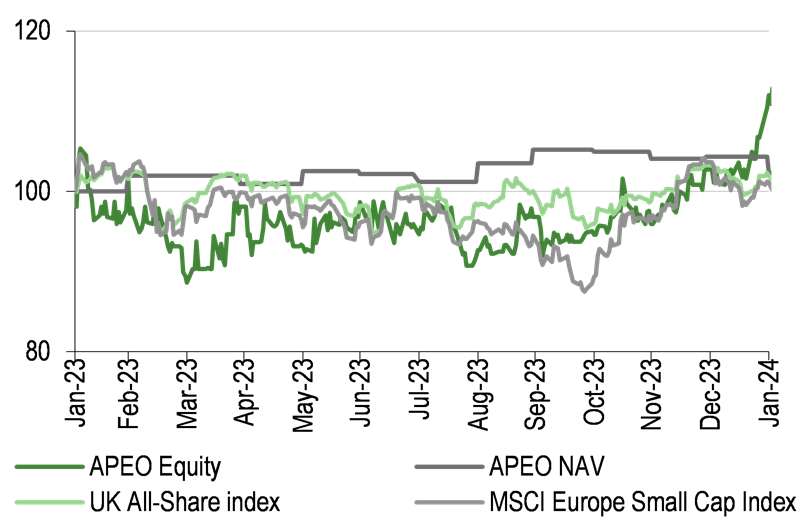
APEO’s NAV TR in sterling terms in FY23 (to end-September 2023) was a moderate 5.4% (vs 14.1% in FY22), which we still consider a good result amid the tepid PE markets and fx headwinds (portfolio value growth was 9.4% in constant currency terms). APEO is ahead of the one-year horizon pooled return of the Cambridge Associates LLC US Private Equity Index to end-September 2023, which stood at 7.26% in US dollar terms (c -1.8% in sterling terms). After accounting for the post-balance sheet NAV movements (largely related to fx changes), APEO’s 12-month NAV TR to end-January 2024 stood at 4.5% (with 99.6% of the portfolio valuations excluding new investments dated end-September 2023). This is slightly ahead of the total returns of the UK All-Share index and MSCI Europe Small Cap Index of 1.9% and 1.2%, respectively. Despite the more muted performance recently, APEO visibly outperformed public markets over the last three, five and 10 years (see Exhibit 5). APEO’s one-year NAV TR is slightly ahead of its listed PE peers, while its performance over five and 10 years is broadly in line with peers (see Exhibit 6).
|
Exhibit 5: APEO’s performance to 31 January 2024 in sterling terms |
|
Price, NAV and benchmark total return performance, one-year rebased |
Price, NAV and benchmark total return performance (%) |
|
|
|
Source: Refinitiv, Edison Investment Research. Note: Three-, five- and 10-year performance figures annualised. |
|
Exhibit 6: Selected peer group at 1 March 2024*
% unless stated |
Market cap £m |
NAV TR |
NAV TR |
NAV TR |
NAV TR |
Ongoing charges ratio (%)** |
Perf |
Discount |
Net |
Dividend |
Abrdn Private Equity Opp Trust |
813 |
4.5 |
66.4 |
105.9 |
278.3 |
1.1 |
No |
(29.2) |
106.9 |
3.0 |
CT Private Equity Trust |
338 |
1.6 |
98.4 |
125.9 |
284.7 |
1.2 |
Yes |
(33.2) |
111.9 |
6.0 |
HarbourVest Global Private Equity |
1,759 |
(0.9) |
48.9 |
113.0 |
345.8 |
1.2 |
No*** |
(42.1) |
100.0 |
0.0 |
ICG Enterprise Trust |
822 |
3.8 |
65.4 |
104.5 |
250.8 |
1.5 |
Yes |
(37.2) |
108.4 |
2.7 |
Pantheon International |
1,492 |
3.3 |
53.4 |
86.1 |
263.5 |
1.3 |
Yes |
(33.4) |
100.0 |
0.0 |
Simple average |
1,103 |
2.0 |
66.5 |
107.4 |
286.2 |
1.3 |
- |
(36.5) |
105.1 |
2.2 |
APEO’s rank in peer group |
4 |
1 |
2 |
3 |
3 |
1 = lowest |
- |
1 |
3 |
2 |
Source: Morningstar, Edison Investment Research. Note: Net gearing is total assets less cash and equivalents as a percentage of net assets. *NAV performance in sterling terms based on end-January 2024 NAV, or latest earlier available NAV (end-September 2023 for CT Private Equity Trust, end-October for ICG Enterprise Trust). **Excluding other expenses charged by the underlying investments held in the portfolio. ***No performance fee is charged at the HVPE level, but it is charged on the HarbourVest secondary and direct funds.
Exhibit 7: APEO’s discrete performance versus selected indices in total return, sterling terms (%)
12 months ending |
APEO’s NAV |
APEO’s share price |
MSCI Europe Small Cap Index |
UK All-Share index |
31/01/20 |
8.0 |
22.0 |
14.7 |
10.7 |
31/01/21 |
14.6 |
1.2 |
12.9 |
(7.5) |
31/01/22 |
39.0 |
47.9 |
9.0 |
18.9 |
31/01/23 |
14.6 |
(11.2) |
(5.2) |
5.2 |
31/01/24 |
4.5 |
12.0 |
1.2 |
1.9 |
Source: Refinitiv, Edison Investment Research
We also note that APEO’s share price increased by c 12% in TR terms to end-January 2024, with a strong appreciation more recently on the back of the launch of a share buyback programme (see below for details). Consequently, its discount to NAV narrowed from 38% prior to the announcement to c 29% currently. That said, it remains wider than its 10-year average of around 23% (see Exhibit 8). This reflects a broader trend across listed PE companies (and UK investment trusts in general) and likely illustrates investor concerns in the current uncertain macroeconomic environment around the following three factors (which we discuss in more detail below): (1) PE valuations; (2) holding-level liquidity given the muted exit environment; and (3) leverage across portfolio companies.
|
Exhibit 8: APEO’s historical discount to NAV |
|
|
Source: Refinitiv |
Deal activity resilient in the European PE mid-market
APEO’s performance needs to be examined in the context of the continued slowdown of deal activity across the global PE sector in 2023, with deal volumes at c US$1,323.3bn, down 25% y-o-y and down 40% from the 2021 peak, though close to 2019 levels (based on PitchBook data). Similarly, PE exit volumes fell by 27% and 66%, respectively. However, PE fund-raising remained quite robust, with US$556.1m raised in 2023, slightly ahead of 2022 and only c 10% below 2021, which suggests sustained strong interest in the asset class.
While deal activity in the European PE markets declined by 27% from 2022 levels (which were close to 2021 deal volumes), we note that it was still c 13% above the 2018–20 average, according to PitchBook data (see Exhibit 9). Furthermore, deal count in 2023 was up 4.4% from 2022, with a high share of bolt-on acquisitions to execute ‘buy-and-build’ strategies (54.7%). The higher interest rate environment had a particularly pronounced impact on megadeal activity (requiring higher debt volumes to complete), which fell from €192.3bn in 2022 to €105.1bn in 2023, while the European mid-market (APEO’s core focus) was resilient with 12.1% y-o-y growth in deal value. Interestingly, the average share of debt in buyout financing dropped from 54.8% in 2021 to 42.6% in 2023, according to PitchBook.
|
Exhibit 9: European PE deal activity |
|
|
Source: PitchBook. Note: *Estimate based on data available at 31 December 2023. |
European exit volumes were broadly stable year-on-year at €263.6m, though this was skewed by a few large deals (eg the Arm IPO), adjusted for which, exit value was down by 24.5% y-o-y, according to PitchBook. Finally, PE fund-raising in Europe was strong at €117.8bn in 2023, c 45% ahead of 2022 and broadly in line with 2021. This amount was raised across 117 funds (down from 158 in 2022), the lowest number in the last 10 years, as investors focused on experienced and well-established GPs.
While there have been some initial signs of a revival in PE exit activity in recent months, we remain cautious with respect to the extent of the rebound in 2024. Moreover, a potential increase in activity may at least partly come from the willingness of sellers to accept lower prices for their assets, which could reduce the average uplifts upon exit across the PE sector in the near term.
Maintaining good portfolio earnings momentum
APEO continues to exhibit solid last 12-month revenue and EBITDA growth of 15.6% and 23.4%, respectively, across its top 50 holdings (representing 40% of portfolio) to end-September 2023. This has assisted APEO’s unrealised valuation gains in an environment characterised by softening valuations and muted PE exit activity. In particular, APEO’s direct investments saw a robust valuation uplift of 21.1% excluding fx (or 18.5% net of fx) in FY23.
The median net debt to EBITDA across APEO’s top 50 underlying companies (making up c 40% of portfolio value) stood at 4.3x at end-September 2023 (unchanged versus end-September 2022), which is below the average gross debt/EBITDA multiple of 5.9x in Q323 across US leveraged loan and high yield financings as disclosed by Partners Group in the Q323 presentation of Princess Private Equity. APEO highlighted that around 64% of the debt across its portfolio (98.6% of which is floating rate) is hedged and that most does not mature until 2027 (see Exhibit 10).
|
Exhibit 10: Debt maturity profile across APEO’s top 50 holdings |
|
|
Source: APEO |
Cautious approach to capital deployment in FY23
Given the limited activity in global M&A markets and exit volumes in the PE markets, APEO’s manager was quite cautious with respect to capital deployment in FY23, with committed capital of £174.7m (15% of opening NAV), compared to an FY18–22 average of c £220.6m (c 28% of opening NAV) (see Exhibit 11). APEO allocated £147.5m to seven primary commitments in FY23, three of which were to lower mid-market funds, three to mid-market funds and one to a growth-focused fund. This is in line with the manager’s investment philosophy outlined above.
|
Exhibit 11: APEO’s new investment commitments FY14–23 |
|
|
Source: APEO, Edison Investment Research |
After the reporting date, APEO’s new investments so far have been moderate, and in terms of primaries have included a £30m commitment to the IK X fund, which focuses on investing in lower mid-market businesses in Northern Continental Europe across business services, consumer/food, healthcare and industrials, and a £25m commitment to Bowmark VII, a mid-market manager focused on the UK software and services sector. APEO’s secondary investments in FY23 were limited to a Capital Quantum continuation fund, into which it rolled a €4.5m position in two underlying private companies it held through Capiton V (with an additional €0.7m commitment for further M&A opportunities). We understand that APEO’s modest secondary market activity was partly due to limited opportunities to buy assets from distressed sellers at a wide discount to NAV (see below).
Direct investment portfolio performing well so far
The restrained approach to new investments was also evident in APEO’s new direct investments. It invested and committed £22.6m in total in FY23 in three new co-investments (HRworks, an undisclosed Europe-based healthcare technology company and an undisclosed US-based consumer business) and made two follow-on investments in existing companies: European Camping Group (ECG) and Funecap. This compares to £66.1m of capital deployed and committed into nine new co-investments in FY22 and £76.9m into 10 new co-investments in FY21.
After reporting date, APEO made a further three new direct investments: €6m in GoodLife, a European manufacturer of frozen snacks, €6.9m re-investment in Procemsa (a contract development and manufacturing organisation active in vitamins and food supplements) through a single-asset vehicle, and €4.4m in European Digital Group (an integrated services provider in the digital transformation and digital marketing segments). APEO also made two follow-on direct investments: €6m in Visma and €4.4m in an undisclosed European-headquartered healthcare technology business.
While the share of co-investments in APEO’s portfolio increased only slightly from 19.1% at end-September 2022 to 19.4% at end-September 2023, we note that this was partly due to the partial disposal of its largest co-investment in Action (which reduced its share in APEO’s NAV from 5.1% to 2.2% during the financial year). The deal was carried out through a liquidity window offered by the lead sponsor (3i) at a price equal to 100% of Action’s carrying value in APEO’s books and translated into €60.6m (c £53.0m) of proceeds to APEO in CY23. The remaining stake in Action was valued at £26.2m at end-September 2023, implying a strong 3.5x net multiple on invested capital (MOIC).
The partial sale of Action was the only major exit from APEO’s co-investment portfolio to end-January 2024, as most its holdings are yet to mature and reach the usual PE holding period of three to five years. These holding periods may in many cases be extended due to the muted global M&A activity (even if we see some indications of a possible uptick in deal activity). As a rule of a thumb, an investment valued at 2.0x cost or more and held over the usual investment period for a PE investor (ie three to five years) could be ripe for an exit. Several of APEO’s 2019–21 co-investments are approaching or have already reached the threshold. This does not mean necessarily that the lead sponsor for these deals is looking to sell these immediately, but indicates a certain maturity of the investment. Importantly, only one investment is held below cost.
While it is still quite early to evaluate the success of APEO’s expansion into direct investments, we believe that these results have been quite promising so far (despite the weak recent PE market environment). That said, further profitable realisations (beyond Action) would represent the ultimate validation of the strategic portfolio shift.
Balance sheet headroom remains intact
The muted PE exit activity, coupled with continued capital calls from APEO’s fund investments, resulted in slightly positive net capital calls for APEO during FY23 at £4.3m (£154.2m drawdowns vs £149.9m distributions). A further £39.0m was deployed by APEO into direct and secondary investments in FY23. That said, this was more than offset by the above-mentioned partial realisation of Action, bringing APEO’s total distributions to £202.9m in FY23 (vs £210.2m in FY22) compared to total drawdowns of £193.2m (vs £253.6m in FY22). Post balance sheet date, APEO’s total distributions continued to outpace drawdowns (see Exhibit 12). Encouragingly, APEO highlighted that trade buyers remained active and were the main exit route for APEO’s portfolio companies in FY23.
|
Exhibit 12: APEO’s historical drawdowns and distributions |
|
|
Source: APEO, Edison Investment Research |
APEO’s balance sheet headroom, as measured by its commitment coverage ratio (ie available liquid resources divided by outstanding commitments), declined only slightly over the 12 months to end-January 2024 from 35% to 33%. We also note that the coverage ratio improved from c 25% at end-September 2022, following the upsizing of APEO’s credit facility in October 2022 from £200m to £300m (around £206.2m of the facility remained undrawn at end-January 2024). Consequently, APEO’s overcommitment ratio (outstanding commitments in excess of cash and equivalents and undrawn credit facility divided by portfolio NAV) stood at 37% at end-January 2024 and remains closer to the lower end of the manager’s target range of 30–75% (see Exhibit 14). Therefore, we believe that the holding-level liquidity risk remains limited at present.
|
Exhibit 13: APEO’s coverage ratio |
Exhibit 14: APEO’s overcommitment ratio remains at the lower end of the target range |
|
|
|
Source: APEO, Edison Investment Research. Note: *As at end-January 2024. |
|
Exhibit 13: APEO’s coverage ratio |
|
|
Source: APEO, Edison Investment Research. Note: *As at end-January 2024. |
|
Exhibit 14: APEO’s overcommitment ratio remains at the lower end of the target range |
|
|
Source: APEO, Edison Investment Research. Note: *As at end-January 2024. |
Historically, a decline in fund drawdowns used to lag the fall in distributions across the PE market. If this was to repeat in the current market cycle, it would ease the liquidity pressure on primary PE fund investors such as APEO. However, we also note that the current high level of PE dry powder that needs to be deployed may keep drawdowns across the market at a higher level, even as PE exit activity remains relatively muted. Nevertheless, we note that APEO’s total available liquidity of £220.1m at end-January 2024 is higher than its total (gross) drawdowns in FY23.
Buyback launched, progressive dividend maintained
APEO’s comfortable balance sheet position, coupled with the persistent wide discount to NAV, encouraged APEO’s board to launch a share repurchase programme, earmarking part of the €34.6m proceeds from the partial sale of Action. The board has the authority, provided by APEO’s shareholders during the March 2023 AGM, to buy back up to c 8.06m shares (or c 5.2% of APEO’s issued capital), and plans to renew the authority during the March 2024 AGM. Investors responded positively to the share buyback announcement, with APEO’s share price up c 10% to date. We estimate that, all else being equal, a full use of the €34.6m would result in a commitment coverage ratio of 28% and an overcommitment ratio of 38%. So far, APEO has bought back c 368k shares from the market.
The board also continues to pursue a progressive dividend policy, aiming to maintain the value of dividends in real terms. APEO’s four interim dividends for FY23 of 4.0p each represent a c 11% yoy increase (above the FY17–22 dividend per share CAGR of c 4%). Based on the total annual distribution of 16.0p per share, APEO’s shares now offer a dividend yield of c 3.0%.
|
Exhibit 15: APEO’s dividend payments |
|
|
Source: APEO |
Patria Investments to become APEO’s new manager
We note that abrdn announced in October 2023 that it had reached a conditional agreement to sell abrdn Private Equity, including APEO’s investment manager, to Patria Investments (Nasdaq: PAX). Patria is a leading alternative investment business in Latin America, with more than 30 years of experience in private equity, infrastructure, real estate and credit. It has a global presence with 10 offices across four continents. Upon a successful deal closure, we anticipate Patria would have around US$38.4bn in assets under management, including US$10.3bn in the new vertical Patria Global Private Markets, for which abrdn Private Equity would be a cornerstone platform. APEO’s board has received assurances from abrdn and Patria that APEO’s investment team will remain unchanged upon deal closure (now expected by the board in H124).
Fees and charges
In FY23, APEO’s expense ratio remained on a par with the FY22 level of 1.06%, and consisted of a management fee of 0.95% of average NAV pa plus administrative expenses. APEO’s investment manager does not charge any performance fees. We note these figures do not capture the look-through fees charged at the underlying funds level to APEO, which amounted to 1.78% in FY23 and 1.67% in FY22, bringing the total ongoing charges ratio to 2.84% and 2.73%, respectively. These look-through expenses exclude performance-related fees such as carried interest and are calculated based on a five-year rolling average. We understand that the year-on-year increase in the look-through ratio in FY23 was due to the full recognition of expenses for APEO’s investments from 2021 and 2022 (when deal activity and fund commitments were particularly high), as well as the higher use of debt at APEO’s holding-level and by its GPs. This was partially offset by the higher share of co-investments. APEO’s manager expects that a more normalised level of commitments and growing share of co-investments will bring the ratio down over the long term.
APEO’s approach to ESG
APEO is an indirect investor in private companies controlled by the PE managers that APEO partners with. However, APEO’s manager believes that, through direct engagement and legal negotiations, APEO can play an important role in ensuring that its GPs are focused and committed to implementing ESG improvements across their portfolios. It is noteworthy that the manager has been a signatory of the United Nations-supported Principles for Responsible Investment (PRI) since 2007. In its FY23 report, the company highlighted that it scored the highest mark in PRI’s indirect private equity category. APEO was recently also included in the first products qualified as Article 8+ under the Sustainable Finance Disclosure Regulation, that is as a fund that promotes environmental and/or social characteristics with a minimum commitment to making sustainable investments.
APEO’s ESG assessment depends on the type of investment:
■
Primary investments – the GP’s ESG cultural buy-in, its ESG process, procedures and reporting, its engagement with underlying portfolio companies, its score in APEO’s ESG survey and an operational due diligence review of the manager and the fund.
■
Co-investments – a detailed review of the underlying company’s ESG due diligence documents, sector and company analysis using RepRisk (a third-party ESG database) and leveraging the expertise on specific ESG issues via APEO’s manager’s central ESG & Stewardship team or a third-party expert.
■
Secondary investments – leveraging the process for primary investments and/or co-investments depending on the transaction profile. If a secondary represents a small number of underlying holdings, then it may follow the co-investment process. The primary ESG assessment of the PE manager will be taken into account where possible.
Capital structure
APEO’s share capital consists of 153.7m ordinary shares (including treasury shares). The largest shareholder is Phoenix Group Holdings with a c 55.4% stake held through its 100% subsidiary Phoenix Life Limited (PLL). PLL has irrevocably undertaken to APEO that, at any time when the PLL group is entitled to exercise or control 30% or more of voting rights at APEO’s general meetings of shareholders, it will refrain from (1) nominating directors who are not independent of PLL and its associates, (2) entering any transaction/arrangement with APEO that is not conducted at arm’s length and on normal commercial terms, (3) taking any action that would prevent APEO from carrying out an independent business or from complying with its listing rules, and (4) proposing or procuring any proposal of any shareholder resolution with the intent to circumvent the proper application of listing rules.
|
Exhibit 16: Major shareholders |
Exhibit 17: Average daily volume |
|
|
|
Source: Refinitiv, at 4 March 2024 |
Source: Refinitiv. Note: 12 months to 1 March 2024. |
|
Exhibit 16: Major shareholders |
|
|
Source: Refinitiv, at 4 March 2024 |
|
Exhibit 17: Average daily volume |
|
|
Source: Refinitiv. Note: 12 months to 1 March 2024. |
The board
APEO’s board consists of five independent non-executive directors:
Alan Devine joined the board in May 2014 and assumed the role of chairman in March 2022. Alan was formerly CEO of the Royal Bank of Scotland Shipping Group and has a wide background of knowledge and over 40 years’ experience in both commercial and investment banking. He is a non-executive director of Capitalflow Holdings, where he is chairman of the remuneration, audit and risk committees. Alan is also chairman of the PE-owned cash logistics company GSLS. He holds an MBA and is a fellow of the Institute of Bankers in Scotland. The AGM in March 2024 follows the ninth anniversary of his appointment. While the trust’s policy is for a chair to step down after nine years, the board has asked Alan to remain on for an additional year to oversee the transition of APEO’s manager to Patria.
Diane Seymour-Williams worked at Deutsche Asset Management Group (previously Morgan Grenfell) for 23 years where she held various senior positions, including CIO and CEO of Asia. More recently, she spent nine years at LGM Investments, a specialist global emerging and frontier markets equities manager, where she was the global head of relationship management. She is a non-executive director of Mercia Asset Management and PraxisIFM Group and a director of Acorn Capital Advisers. She is also a pro-bono member of the investment committees of Newnham College, Cambridge and the Canal & River Trust.
Calum Thomson assumed the role of a senior independent director (SID) in March 2022. Calum is a qualified chartered accountant and was an audit partner with Deloitte for over 21 years. He is a non-executive director and the audit committee chair of the Diverse Income Trust, the AVI Global Trust and Baring Emerging EMEA Opportunities, BLME Holdings, Bank of London and The Middle East.
Dugald Agble started his career in PE investments over 20 years ago at Nomura Principal Finance Group (now Terra Firma Capital Partners). In 2006, he moved to investing in emerging and frontier markets at Helios Investment Partners and became a co-founding partner at 8 Miles in 2010. He is a supervisory board member at FMO, a Dutch entrepreneurial development bank.
Yvonne Stillhart has over 30 years’ senior executive experience in business building, transformational leadership, PE and infrastructure investment, finance, banking and risk and investment management across broad industries and geographic regions. This includes a co-founding senior partner position and member of the Investment Committee of Akina, a Swiss-based specialised PE manager that merged in 2017 with Unigestion. She is a non-executive director and member of the audit and risk committee at UBS Asset Management Switzerland and chairperson and member of the social and ethics committee of EPE Capital (an investment company listed on the Johannesburg Stock Exchange). She is also a non-executive director of Integrated Diagnostics Holdings.
Exhibit 19: APEO’s board of directors
Board member |
Date of appointment |
Remuneration in FY23 (£) |
Shareholdings at end-FY23 |
Alan Devine (chair) |
28 May 2014 |
74,000 |
14,264 |
Diane Seymour-Williams |
7 June 2017 |
47,000 |
31,500 |
Calum Thomson (SID) |
30 November 2017 |
54,000 |
13,700 |
Yvonne Stillhart |
1 September 2021 |
47,000 |
4,000 |
Dugald Agble |
1 September 2021 |
47,000 |
1,400 |
Source: Company data
|
|
Research: Investment Companies
UIL Limited (UIL) is managed by Charles Jillings and his highly experienced team at value-based specialist investor ICM. It is a unique portfolio of undervalued assets, which is illustrated by the fund’s differentiated exposures. In terms of geography, the largest weightings are Australia (c 42%) and the UK (c 21%), while the largest sector allocations are financial services (c 51%) and technology (c 21%). The majority of the portfolio, around 75%, is held in platforms (collective investment companies), with the balance in direct investments. UIL’s dividends have remained steady for the last three financial years and the board anticipates that the annual distribution will at least be maintained, using revenue reserves when required. The company offers a very attractive above-market 7.1% dividend yield.