Last close As at 05/08/2026
USD9.54
▲ 0.21 (2.25%)
Market capitalisation
USD520m
Research: Healthcare
Immix Biopharma is continuing its strategic pivot towards exploring non-traditional indications for its CAR-T asset, NXC-201, leading with relapsed/refractory (r/r) amyloid light chain amyloidosis (ALA). This tactical approach targets opportunities with a potential first mover advantage and the strategy is expected to be consolidated in 2024 with the initiation of the Phase Ib NEXICART-2 study in the US and the selection of the first autoimmune indication for NXC-201. Readouts in ALA are expected in Q424, with a potential Biologics License Application (BLA) in 2025, both key catalysts for Immix. Pro forma cash of $33.5m includes the February 2024 $15.5m (net) raise and is expected to support operations to Q225, past several key readouts. We adjust our assumptions for the latest updates, which results in resetting our valuation to $142.2m or $5.4 per share (from $86.6m or $4.0/share previously).
Written by
Immix Biopharma |
Reaffirmed long-term focus on outpatient CAR-T |
FY23 results |
Pharma and biotech |
3 April 2024 |
Share price performance
Business description
Next events
Analysts
Immix Biopharma is a research client of Edison Investment Research Limited |
|||||||||||||||||||||||||||||||||||||||||||||||||||||
Immix Biopharma is continuing its strategic pivot towards exploring non-traditional indications for its CAR-T asset, NXC-201, leading with relapsed/refractory (r/r) amyloid light chain amyloidosis (ALA). This tactical approach targets opportunities with a potential first mover advantage and the strategy is expected to be consolidated in 2024 with the initiation of the Phase Ib NEXICART-2 study in the US and the selection of the first autoimmune indication for NXC-201. Readouts in ALA are expected in Q424, with a potential Biologics License Application (BLA) in 2025, both key catalysts for Immix. Pro forma cash of $33.5m includes the February 2024 $15.5m (net) raise and is expected to support operations to Q225, past several key readouts. We adjust our assumptions for the latest updates, which results in resetting our valuation to $142.2m or $5.4 per share (from $86.6m or $4.0/share previously).
Year |
Revenue |
PBT* |
EPS* |
DPS |
P/E |
Yield |
12/22 |
0.0 |
(7.60) |
(0.55) |
0.0 |
N/A |
N/A |
12/23 |
0.0 |
(13.00) |
(0.75) |
0.0 |
N/A |
N/A |
12/24e |
0.0 |
(21.44) |
(0.93) |
0.0 |
N/A |
N/A |
12/25e |
0.0 |
(26.55) |
(1.01) |
0.0 |
N/A |
N/A |
Note: *PBT and EPS are normalized, excluding amortization of acquired intangibles, exceptional items and share-based payments.
NXC-201 expected to drive Immix 2024 newsflow
Driven by the positive initial data from the NEXICART-1 trial in ALA (100% ORR for the first 10 patients), we expect the primary focus in 2024 to be on the US NEXICART-2 study, with patient enrollment to commence by mid-2024 following finalization of the first trial site. The NEXTCART-2 study (open label, single arm) will evaluate c 40 patients. Data readouts from the studies (including for US patients) are expected in Q424, with a potential BLA filing in 2025, provided data continue to be encouraging. Investors will also be interested in the first target autoimmune indication and we believe systemic lupus erythematosus is a front runner, among others such as myasthenia gravis and multiple sclerosis.
Cash runway: Funded into Q225
Immix ended FY23 with net cash of $17.5m, with a leg-up from the $15.5m net proceeds from the February 2024 equity issue and another c $426k from the July 2023 ATM facility. Given the expected rise in R&D expenses in FY24–25, we expect the pro forma funds ($33.5m) to provide headroom to Q225 and estimate Immix will require external funding of $15m in Q225 and another $15m in FY26 (reflected as illustrative debt in our model) before our projected launch of NXC-201 in ALA in 2027.
Valuation: $142.2m or $5.4 per share
We upgrade our valuation of Immix to $142.2m or $5.4/share (from $86.6m or $4.0/share previously) as we adjust our underlying assumptions for the target indications. The biggest value uplift comes from NXC-201 in ALA, where we bring forward our launch timeline to 2027 (from 2030) and increase the PoS to 25% (previously 17.5%), taking guidance from the NXC-201 clinical plans and regulatory timelines for the other approved BCMA-directed CAR-Ts Abecma and Carvykti. The valuation also benefits from an improved post-raise cash position.
Active clinical pipeline led by CAR-T asset in ALA
The most recent communications from Immix’s management highlight the company’s increased emphasis on inflammatory/autoimmune disease with its novel, B-cell maturation antigen (BCMA) targeting CAR-T asset, NXC-201 (Exhibit 1). Management is positioning the drug as a potential ‘out-patient’ CAR-T treatment due to its low neurotoxicity (nearly zero vs 23–28% for Abecma and Carvykti) and short cytokine release syndrome (CRS) duration to date (median one day vs four to seven days for peers), potentially saving the healthcare system significant hospitalization costs.
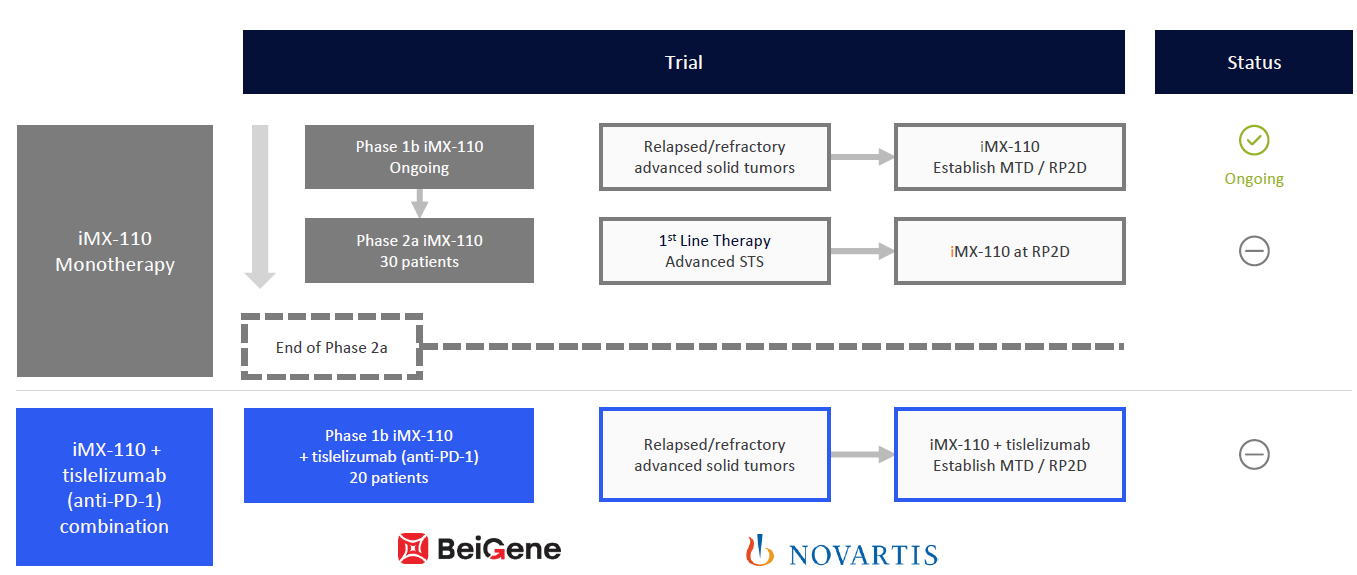
NXC-201 is being investigated in the Phase Ib/IIa NEXICART-2 trial in ALA (patient dosing is expected to commence by mid-2024) as a US extension study to the ongoing NEXICART-1 trial, which has been evaluating NXC-201 in both ALA and multiple myeloma (MM) patients. Immix intends to submit a BLA to the FDA for ALA once 40 patients have been treated (expected in 2025). It has indicated its intention to target disease areas where there are no approved CAR-T treatments, as part of which it is gearing up to evaluate NXC-201 in selected autoimmune indications, with the first targeted indication to be announced in 2024. The clinical development of NXC-201 is being undertaken by Nexcella (Immix’s majority-owned subsidiary, in which it owns a 91.6% stake on a fully diluted basis as of 31 December 2023). The company’s pipeline also includes its TSTx asset, IMX-110, which is being evaluated in the Phase Ib/IIa IMMINENT-01 trial, a combination study with the investigational monoclonal anti-PD-1 antibody, tislelizumab, for the treatment of solid tumors (expected n=20). The other indication Immix is pursuing for IMX-110 is r/r soft tissue sarcoma (STS), for which Phase Ib/IIa clinical trials are ongoing in the US and Australia.
|
Exhibit 1: Immix’s clinical development pipeline |
|
|
Source: Immix corporate presentation (March 2024) |
Current CAR-T landscape and FDA stance
While CAR-T therapies have the potential to provide an effective treatment option for certain challenging indications, current FDA-approved CAR-T therapies are not classed as out-patient treatments due to the risk of serious side effects. For example, high-grade CRS is an acute inflammatory syndrome characterized by fever and dizziness (due to low blood pressure) and difficulty breathing. The release of cytokines from T-cells is a natural process of the immune system, but since CAR-T therapies stimulate the immune system to increase cytokine production, excessive production leading to CRS is an inherent risk. Another frequently observed side effect with current CAR-T therapies is neurotoxicity, which is characterized by severe confusion, seizure-like activity and impaired speech (akin to Parkinson’s disease-like symptoms). While the precise cause of these neurological risks has not been fully elucidated, they represent a significant barrier to the wider uptake of this type of therapy.
Consequently, patients receiving approved CAR-T therapies require monitoring for at least two weeks after treatment. Immix is focused on making this treatment more convenient and cost-effective with NXC-201, aiming to develop it as the first out-patient CAR-T therapy. Clinical data to date appear supportive, with no cases of high-grade CRS (only low-grade CRS observed with median onset of one day) and no observed neurotoxicity reported. According to management, safety concerns about currently approved CAR-T therapies mean that only c 5% of US medical sites have the capabilities to administer CAR-T therapies (limited to large hospitals in metropolitan regions). However, NXC-201’s safety profile potentially mitigates the need for intensive monitoring. This could lead to improved accessibility for such treatments (Exhibit 2).
|
Exhibit 2: NXC-201 safety profile could lead to increased CAR-T therapy accessibility |
|
|
Source: Immix company presentation (January 2024) |
CAR-T therapies remain in the headlines due to the FDA’s investigation of the risk of T-cell malignancies in patients who have received BCMA- or CD19-directed autologous CAR-T therapies. As a result of the investigation, black box warnings are now required. The FDA has communicated this in notification letters, issued in January 2024, to Bristol Myers Squibb (for Abecma and Breyanzi), Kite Pharma (for Yescarta and Tecartus), Johnson & Johnson (for Carvykti) and Novartis (Kymriah). Despite this class-wide warning, the FDA continues to communicate the overall benefits for the challenging indications that these therapies target (MM, large B-cell lymphoma, mantle cell lymphoma and acute lymphoblastic leukemia). In March 2024, an FDA advisory committee voted in favor of using Carvykti and Abecma in earlier lines of treatment in MM (currently approved in the fifth line). On 20 March, the European Commission approved Abecma as a third-line treatment for r/r MM, marking a key step forward for this category of treatments. We also understand that such warnings do not appear to be a significant deterrent for clinicians when considering the use of CAR-T therapies, as secondary malignancies are not uncommon in challenging conditions.
Big pharma, investors and regulators back the future of CAR-Ts
Despite the headwinds for CAR-T therapies following the FDA requirement for black box warnings, investors and big pharma appear to remain engaged, as reflected in recent news:
■
In December 2023, AstraZeneca announced the acquisition of Gracell, a clinical-stage biotechnology company focused on the development of novel CAR-T therapies.
■
In February 2024, Kyverna Therapeutics (a biotech focused on CAR-T therapies) announced the successful closure of its IPO, raising more than $350m (gross).
Overall, Allied Market Research estimates that CAR-T therapies will reach a market value of c $36bn by 2032. The supportive outcome of the advisory committee meeting provided clarity on the FDA’s stance on the future of CAR-T therapies, which could lead to both Abecma and Carvykti being shifted to earlier lines of treatment for MM (update expected from the FDA by 5 April 2024). in our view, the encouraging outcome of this meeting demonstrates that the field remains alive and ripe for future clinical innovations.
NXC-201: Lead CAR-T asset with out-patient potential
In focus: ALA
ALA is a serious autoimmune disease affecting organs like the heart, liver and kidneys, and is caused by non-functional plasma cells that continuously produce misfolded amyloid light chain fibrils (Exhibit 3). As ALA is a rare multisystem condition, diagnosis is challenging, but it is estimated that there are c 4,000 new cases diagnosed in the US each year. ALA patients are typically treated with a four-drug combination of subcutaneous daratumumab with bortezomib, cyclophosphamide and dexamethasone. BCMA-targeted CAR-T therapy is believed to be a viable treatment option for ALA patients but, given the fragility of this patient population, side effects (CRS and neurotoxicity) are a key concern. We therefore believe that NXC-201’s desirable safety profile to date represents a promising opportunity for Immix. The company has recently reaffirmed its focus on addressing the unmet medical need in this space with its ‘Be Proactive in AL’ awareness initiative. In reference to the class-wide warnings for CAR-T therapies, Immix has assured the market that it has not observed any secondary T-cell malignancies in its clinical data to date. While we acknowledge that NXC-201 has so far only been tested in a low population of r/r ALA patients (n=10), we look forward to following the progress of this asset and note that management has communicated that clinical updates will be reported periodically in the year ahead.
|
Exhibit 3: ALA is a rare but serious multisystem condition |
|
|
Source: Immix company presentation (January 2024) |
NEXICART-1: Encouraging clinical data reported to date
The latest clinical data for NXC-201 correspond to 73 patients treated (as of February 2024) in the Phase Ib/IIa NEXICART-1 trial (reported in December 2023), including 10 patients with ALA with a median of six prior lines of therapy (63 patients in MM) that the ALA patients were infused with CAR-T cells at doses of either 150m cells (n=1), 450m cells (n=2) or 800m cells (n=7 at the recommended Phase II dose, RP2D). As of the data cut-off of 10 December 2023, the results were as follows:
■
For all 10 r/r ALA patients:
•
Overall response rate (ORR) was 100% (10/10 patients).
•
Complete response (CR) and very good partial response rate was 90% (9/10 patients).
•
CR rate was 70% (7/10 patients; six out of seven had MRD1 of 10-5).
MRD refers to measurable residual disease, in this case indicating that the ratio of cancer cells to healthy cells was as low as 10-5:1.
•
Organ response rate was 60% (6/10 patients).
•
The best duration of response was reported as 23.7 months and it was noted that the response is ongoing.
•
Zero cases of immune effector cell-associated neurotoxicity syndrome (ICANS).
•
Zero cases of high-grade CRS (>grade 3). Median CNS duration was one day (range 1–4); 2/10 patients experienced no CRS; 2/10 patients experienced grade 1 CRS; 4/10 patients experienced grade 2 CRS; 2/10 patients experienced grade 3 CRS.
■
For the eight r/r ALA patients at the RP2D of 800m cells with cardiac involvement:
•
ORR was 100% (8/8 patients).
•
CR rate was 63% (5/8 patients; four out of five had MRD of 10-5).
•
Organ response rate was 63% (5/8 patients).
■
For the four t(11;14) r/r patients (translocation of chromosomes 11 and 14 found in c 50% of ALA patients) at the RP2D of 800m cells:
•
ORR was 100% (4/4 patients).
•
CR rate was 75% (3/4 patients had MRD of 10-5).
•
Organ response rate was 50% (2/4 patients).
We highlight that a key feature of NXC-201 as a potential treatment for r/r ALA is the apparent ability to eliminate disease-causing amyloid plasma cells (CD38 and CD138) rapidly (see Exhibit 4). The data demonstrate clearance within c 30 days after administration, which management attests could reduce the risk, onset and/or duration of certain side effects (eg neurotoxicity and CRS), potentially supporting NXC-201 as the first out-patient CAR-T therapy. We believe the opportunity for Immix in this space is particularly notable, given there are currently only limited treatment options and no standard of care for this fragile patient population, as discussed in the company’s Q423 KOL event.
|
Exhibit 4: Data demonstrating the rapid elimination of aberrant plasma cells by NXC-201 |
|
|
Source: Immix press release (December 2023) |
In MM, the most recent clinical data were reported in October 2023, for which 63 patients were dosed at either 150m cells (n=6), 450m cells (n=7) or 800m cells (n=50 at the RP2D). As discussed in our prior update note, as of the data cut-off of 17 July 2023, the results were as follows:
■
Of the patient population without prior BCMA-targeted therapy (PBTT), the ORR was 95% (36/38 patients).
•
This was associated with median progression-free survival of 12.9 months.
■
Of the patient population with or without PBTT, the ORR was 90% (45/50 patients at the RP2D).
•
CR or stringent CR rate was 58% (29/50 patients).
•
Very good partial response rate was 20% (10/50 patients).
•
Partial response rate was 12% (6/50 patients).
The data in MM patients appear to support NXC-201 as a potential treatment for MM patients, with particularly promising outcomes for patients without PBTT (IMMIX plans to target patients ineligible for commercial CAR-Ts). Across both indications, we note that NXC-201 has been recognized with various regulatory designations. Immix recently announced the receipt of Orphan Drug Designation (ODD) from the European Medicines Agency (February 2024) for ALA. It also received ODD from the FDA for ALA (September 2023) and MM (August 2023). Collectively, these regulatory designations should provide several years of market exclusivity (seven years in the US; 10 years in the EU), provided the therapy is approved. We believe the move to the US in ALA (NEXICART-2) and other select autoimmune indications will mark an important milestone, with upcoming quarterly data updates communicated by management potentially representing key catalysts for Immix.
NEXICART-2: A move to the US for ALA
In November 2023, Immix announced that the FDA had accepted its Investigational New Drug Application for NXC-201. While the NEXICART-1 trial has been operating in Israel, the FDA clearance enables the dosing of r/r ALA patients in the US, with this trial being referred to as NEXICART-2 (NCT06097832). At present, management has not communicated any material updates regarding the dosing of MM patients in the US. We understand that Immix is planning to expand into additional autoimmune indications, for which precise indications are yet to be disclosed. Management plans to share these details in 2024, targeting a market segment it estimates at $25bn (combined across all potential indications) where there are currently limited available treatment options. Given the encouraging safety profile of NXC-201 data to date, we believe this could represent a potentially sizeable commercial opportunity. We will consider the potential upside from including additional indications for NXC-201 when more material plans have been announced.
More to come for IMX-110
Immix’s legacy asset IMX-110 utilizes the company’s tissue-specific therapeutics (TSTx) technology for specific drug delivery to the sites of tumors. The candidate is involved in two Phase Ib/IIa clinical programs for the treatment of STS and for solid tumors (Exhibit 5). Although newsflow has been quieter on this front, we understand that the Phase I arm (IMX-110 as a monotherapy, with plans to progress to Phase II in STS) is ongoing and we expect data readouts through the year. The second clinical trial is assessing IMX-110 in combination with BeiGene’s/Novartis’s tislelizumab (an anti-PD-1 antibody) for solid tumors. Interim data from this trial (IMMINENT-01, NCT05840835) was presented in July 2023. The data demonstrated that three out of four patients with metastatic colorectal cancer showed tumor shrinkage, and one of the four experienced tumor control. We note that all patients had stage IV r/r metastatic colorectal cancer (mCRC) and had received a median eight lines of prior therapy, highlighting the challenging nature of the disease among the recruited patients. In addition to the encouraging early signs of efficacy, IMX-110 was found to be safe and well tolerated with no severe adverse events reported to date. We anticipate additional data readouts for this study through 2024.
|
Exhibit 5: IMX-110 clinical programs |
|
|
Source: Immix corporate presentation (March 2024) |
Valuation
We continue to value Immix using a risk-adjusted net present value (NPV) approach (individually valuing its programs for the two assets, NXC-201 and IMX-110), although we have made certain adjustments to our underlying assumptions for the assets. The biggest change has been made to NXC-201 in ALA, where we have adjusted several of our assumptions. The first change relates to the target patient population. We had previously assumed that NXC-201 would be positioned as a dual treatment for MM patients who develop ALA (c 15% of MM patients). However, given the company’s recent focus on targeting ALA as a standalone indication, we have adjusted our target patient population to include all r/r ALA cases (4,000 newly diagnosed cases of ALA in the US per year, of which c 75% are r/r). This results in our peak sales estimate for ALA rising to $370.6m, from $143.7m previously (assuming a peak penetration rate of 15%), The second relates to the launch date, which we have brought forward to 2027 from 2030 previously. This is based on our observations that given their complexity, high trial costs and indications targeted (such as MM, an orphan indication), CAR-T therapies could be eligible for accelerated approval, based on data from smaller, open-label, single-arm studies. A case in point is the approval of Abecma in 2021 (the first CAR-T to be approved in r/r MM), which received the FDA nod based on a 127-patient Phase II KarMMa open-label, single-arm trial that demonstrated an ORR of 72% and CR of 28%. Approved in 2022 in r/r MM, Carvykti was given the thumbs up based on a 97-patient Phase Ib/II CARTITUDE-1 trial, an open-label, single-arm study. The ORR from the study was 97.9%. MM has an annual incidence of c 36,000 in the US, roughly 10x the incidence of ALA (c 4,000). Given these statistics, we believe that data from a patient population of 40 in the NEXICART-2 trial could be sufficient to file for regulatory approval in r/r ALA should the data show a compelling efficacy and benefit profile. Management plans to file for a BLA in 2025, which we estimate could lead to an approval and subsequent launch by 2027 at the latest. We have also increased the probability of success (PoS) to 25% from 17.5% previously, following IND approval from the FDA and recent selection of the first trial site in the US, but believe that this continues to reflect the risk inherent in the CAR-T development space. Note that the data would have to be sufficiently robust (a high ORR) to support the company’s application for accelerated approval and therefore our timeline assumptions are subject to change based on the quality of the clinical data generated.
For NXC-201 in MM, we have slightly tweaked our target population assumptions, but keep the launch estimate and PoS unchanged at 2030 and 17.5%, respectively, as we believe this program is a lower priority in the company’s clinical development pipeline. We estimate non risk-adjusted peak sales for NXC-201 of c $660m (across ALA and MM), which we believe is conservative compared to Abecma (worldwide sales of $472m in 2023; peak sales estimate of $2–3bn in the US alone) and Carvykti (worldwide sales of $500m in 2023; peak sales estimate of more than $5bn). We assume an out-licensing deal in 2026 for NXC-201, worth $500m in upfront payments and milestones, with $50m in an upfront payment in FY25 and a flat 15% royalty on sales.
For IMX-110, we keep our underlying assumptions broadly unchanged for now (except for STS, where we have extended the launch and peak sales timeline by a year to 2029 and 2034, respectively), but await further clarity from management on clinical progress and future development and commercialization plans. We will revisit our assumptions for this asset when we have more information).
We also note that selection and subsequent clinical entry of the target autoimmune indications for NXC-201 could add to the valuation upside for the company.
The changes to our enterprise value are reflected in Exhibit 6. The equity value also benefits from an increase in pro forma net cash following the recent equity raises. We adjust our overall valuation to $142.2m from $86.6m previously. We amend our per share valuation to $5.4/share (from $4.0/share), although we highlight that this is affected by the higher number of shares outstanding following the recent raises (26.4m shares vs 21.8m at the time of the last update).
Exhibit 6: Immix Biopharma rNPV
Product |
Indication |
Launch |
Peak |
Peak sales (US$m) |
Value |
Probability |
rNPV |
rNPV/ |
NXC-201 |
ALA |
2027 |
2033 |
370.6 |
190.7 |
25.0% |
44.8 |
1.7 |
NXC-201 |
MM |
2030 |
2035 |
288.7 |
130.1 |
17.5% |
29.6 |
1.1 |
IMX-110 |
STS |
2029 |
2034 |
452.9 |
138.9 |
15.0% |
21.9 |
0.8 |
IMX-110 |
Solid tumours |
2029 |
2034 |
451.2 |
161.4 |
10.0% |
12.4 |
0.5 |
Pro forma net cash on 31 December 2023 |
|
|
|
33.5 |
100% |
33.5 |
1.27 |
|
Valuation |
|
|
|
|
654.6 |
|
142.2 |
5.4 |
Source: Edison Investment Research
Financials
Immix’s growing focus on advancing its clinical program for NXC-201 was reflected in its operating performance through the year, with expenses ramping up with the pace of clinical activity. The Q423 operating loss was reported at $5.4m, a c 42% increase over Q422 ($3.8m). R&D costs ($3.1m) constituted c 58% of total operating expenses during the quarter (60% in Q422). For the full year, operating expenses nearly doubled to $16.1m ($8.2m in FY22), driven by substantial increases in both R&D and G&A expenses. This was ahead of our estimate of $14.4m. R&D expense for the year came in at $8.7m (+108% over FY22), which can be attributed to additional expenses related to the ongoing NEXICART-1 Phase Ib/IIa study for NXC-201. Immix’s majority-owned subsidiary Nexcella entered into a licensing agreement with Hadasit Medical Research Services & Development and BIRAD in December 2022 for their BCMA-targeting CAR-T asset (renamed NXC-201) for $1.5m in upfront consideration, quarterly payments totaling $13m through September 2026 (c $0.87m/quarter), an annual licence fee of $50k and royalty payments of 5% on net sales. Nexcella will also be obligated to pay $20m in sales-related milestones and will be in charge of funding the NEXICART-1 clinical trial in Israel (trial cost of c $13m across four years from 2023 to2026). SG&A expenses increased materially to $7.4m (up 84% y-o-y), primarily due to higher stock-based compensation (+$1.4m), professional fees (+$516k), salaries (+203k) and payment for investor relation services (+1.0m). Reflecting the increased opex, cash outflow from operations rose to $11.4m (up 54% y-o-y from $7.4m in FY22). These increased expenses were funded through equity proceeds: $9.9m in net proceeds from a private placement in August 2023 and $5.4m from net proceeds pursuant to the company’s March 2023 and July 2023 at-the-market (ATM) facilities.
Based on the FY23 results and available disclosures on the company’s clinical plans, we have made certain adjustments to our FY24 estimates. Clinical trial costs in the US are typically significantly higher than other geographies and we therefore anticipate a sharp rise in R&D expenses in FY24. We now estimate R&D expenses of $13.4m during the year vs $10.1m previously. We also increase our estimate of SG&A expenses to $8.5m from $7.7m previously. We introduce FY25 estimates, projecting R&D and SG&A expenses of $16.8 and $9.4m, respectively. Overall, our revised operating loss estimates for FY24 and FY25 stand at $22.0m and $26.2m, respectively.
Immix ended FY23 with a net cash balance of $17.5m and remains debt free as of the current date. Post-period, the company strengthened its balance sheet with an equity raise of $15.5m (in net proceeds) in February 2024 and another $426k against an issue of 68.3k shares under the July 2023 ATM facility in January 2024 (note that the July 2023 ATM facility was subsequently suspended in February 2024). Based on our operating cash burn projections for FY24 and FY25 ($21.5m and $26.6m, respectively), we estimate that the pro forma funds at hand (c $33.5m) are sufficient to fund operations into Q225. We forecast that Immix will need to raise another $15m in 2025, prior to filing the BLA for NXC-201 in ALA (provided data from the NEXICART studies are supportive). For our model, we build in a licensing deal for NXC-201 worth $500m in 2026, with $50m in an upfront payment. However, should such a deal not materialize, we calculate the need to raise another $15m in FY26, before breaking even in FY27 following the expected launch of NXC-201 in ALA. If Immix were to raise these funds (total $30m across FY25 and FY26) through an equity issue, it would have to issue 10.3m shares (assuming a conversion price of $2.92, based on the last closing price), resulting in our per-share valuation reducing to $4.7/share (from $5.4/share currently). The number of shares outstanding would increase to 36.7m from 26.4m currently.
Exhibit 7: Financial summary
Accounts: IFRS, year-end: 31 December, US$’000s |
2022 |
2023 |
2024e |
2025e |
PROFIT & LOSS |
||||
Total revenues |
0 |
0 |
0 |
0 |
Cost of sales |
0 |
0 |
0 |
0 |
Gross profit |
0 |
0 |
0 |
0 |
Total operating expenses |
(8,219) |
(16,141) |
(21,963) |
(26,159) |
Research and development expenses |
(4,196) |
(8,735) |
(13,446) |
(16,790) |
SG&A |
(4,023) |
(7,406) |
(8,517) |
(9,369) |
EBITDA (normalized) |
(8,217) |
(16,136) |
(21,958) |
(26,155) |
Operating income (reported) |
(8,219) |
(16,141) |
(21,963) |
(26,159) |
Finance income/(expense) |
(0) |
572 |
525 |
(390) |
Exceptionals and adjustments |
0 |
0 |
0 |
0 |
Profit before tax (reported) |
(8,219) |
(15,569) |
(21,438) |
(26,549) |
Profit before tax (normalised) |
(7,595) |
(13,003) |
(21,438) |
(26,549) |
Income tax expense (includes exceptionals) |
(10) |
(26) |
(36) |
(45) |
Net income (reported) |
(8,230) |
(15,596) |
(21,474) |
(26,594) |
Net income (normalised) |
(7,606) |
(13,030) |
(21,474) |
(26,594) |
Basic average number of shares, m |
13.9 |
17.3 |
23.2 |
26.4 |
Basic EPS (US$) |
(0.59) |
(0.90) |
(0.93) |
(1.01) |
Adjusted EPS (US$) |
(0.55) |
(0.75) |
(0.93) |
(1.01) |
Dividend per share (US$) |
0.00 |
0.00 |
0.00 |
0.00 |
BALANCE SHEET |
|
|
|
|
Property, plant and equipment |
4 |
50 |
45 |
41 |
Other non-current assets |
7 |
87 |
87 |
87 |
Total non-current assets |
10 |
137 |
132 |
128 |
Cash and equivalents |
13,437 |
17,510 |
11,990 |
400 |
Current tax receivables |
256 |
1,172 |
1,172 |
1,172 |
Other current assets |
1,205 |
1,106 |
1,106 |
1,106 |
Total current assets |
14,898 |
19,788 |
14,268 |
2,678 |
Other non-current liabilities |
475 |
0 |
0 |
0 |
Long term debt |
0 |
0 |
0 |
15,000 |
Total non-current liabilities |
475 |
0 |
0 |
15,000 |
Accounts payable |
1,273 |
3,722 |
3,722 |
3,722 |
Other current liabilities |
0 |
0 |
0 |
0 |
Total current liabilities |
1,273 |
3,722 |
3,722 |
3,722 |
Equity attributable to company |
13,160 |
16,203 |
10,678 |
(15,916) |
CASH FLOW STATEMENT |
|
|
|
|
Net Income |
(8,230) |
(15,596) |
(21,474) |
(26,594) |
Depreciation and amortisation |
2 |
5 |
5 |
5 |
Share based payments |
624 |
2,566 |
0 |
0 |
Other adjustments |
0 |
0 |
0 |
0 |
Movements in working capital |
195 |
1,653 |
0 |
0 |
Cash from operations (CFO) |
(7,408) |
(11,371) |
(21,469) |
(26,590) |
Capex |
0 |
(52) |
0 |
0 |
Acquisitions & disposals net |
0 |
0 |
0 |
0 |
Other investing activities |
0 |
0 |
0 |
0 |
Cash used in investing activities (CFIA) |
0 |
(52) |
0 |
0 |
Capital changes |
2,914 |
15,521 |
15,947 |
0 |
Debt Changes |
0 |
0 |
0 |
15,000 |
Other financing activities |
318 |
(57) |
2 |
0 |
Cash from financing activities (CFF) |
3,232 |
15,464 |
15,949 |
15,000 |
Cash and equivalents at beginning of period |
17,644 |
13,437 |
17,510 |
11,990 |
Increase/(decrease) in cash and equivalents |
(4,176) |
4,040 |
(5,520) |
(11,590) |
Effect of FX on cash and equivalents |
(32) |
33 |
0 |
0 |
Cash and equivalents at end of period |
13,437 |
17,510 |
11,990 |
400 |
Net (debt)/cash |
13,437 |
17,510 |
11,990 |
(14,600) |
Source: Company reports, Edison Investment Research
|
|
Research: TMT
Cordel’s Q324 update shows progress towards the group’s FY24 revenue expectation and other objectives, supporting our forecasts. Doubling the customer base by year-end is a key milestone, which encouragingly looks set to come in part from tier-one US railroads, offering the greatest scope for large seven-figure contracts from its target markets. Developments with Amtrak, as Cordel moves to the five-year service phase, and Angel Trains in the UK provide positive indicators for stable recurring revenue and upsell opportunities. Top-line progress is supported by investments already made in sales and delivery, underpinning forecast margin expansion.