Last close As at 05/08/2026
—
— 0.00 (0.00%)
Market capitalisation
—
Research: Healthcare
Quantum Genomics announced the results from the 34-patient Phase IIa study of QGC001 for the treatment of mild to moderate arterial hypertension. It showed a 2.7 mmHg placebo-adjusted reduction in the primary endpoint of ambulatory systolic blood pressure (SBP, p=0.16) and a 4.7 mmHg reduction in in-office SBP (p=0.15). The p value improved to p=0.06 using a multivariate analysis, which is encouraging given the trial size, albeit slightly non-significant. Data from this study will be used in the design of the US-based Phase IIb hypertension trial, starting in H217.
Written by
Quantum Genomics |
QGC001 clinical results |
Clinical update |
Pharma & biotech |
27 June 2017 |
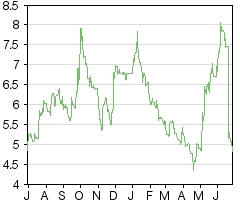
Share price performance
Business description
Next events
Analysts
|
||||||||||||||||||||||||||||||||||||||||||||||||||
Quantum Genomics announced the results from the 34-patient Phase IIa study of QGC001 for the treatment of mild to moderate arterial hypertension. It showed a 2.7 mmHg placebo-adjusted reduction in the primary endpoint of ambulatory systolic blood pressure (SBP, p=0.16) and a 4.7 mmHg reduction in in-office SBP (p=0.15). The p value improved to p=0.06 using a multivariate analysis, which is encouraging given the trial size, albeit slightly non-significant. Data from this study will be used in the design of the US-based Phase IIb hypertension trial, starting in H217.
Year end |
Revenue (€m) |
PBT* |
EPS* |
DPS |
P/E |
Yield |
12/15 |
0.1 |
(4.5) |
(0.55) |
0.0 |
N/A |
N/A |
12/16 |
0.0 |
(6.2) |
(0.60) |
0.0 |
N/A |
N/A |
12/17e |
0.0 |
(7.2) |
(0.69) |
0.0 |
N/A |
N/A |
12/18e |
0.0 |
(12.5) |
(1.15) |
0.0 |
N/A |
N/A |
Note: *PBT and EPS are normalised, excluding amortisation of acquired intangibles, exceptional items and share-based payments.
Potential signal of efficacy despite suboptimal design
Although it is based on historical data and not head-to-head comparisons, the effect sizes seen in this clinical study were relatively low compared to those reported for approved hypertension medications, which produce placebo-adjusted changes in SBP in the range of 9-14 mmHg. However, the data on QGC001 are suggestive of activity and could potentially be improved with a more optimised clinical trial design.
Positive correlation with disease severity
Multivariate analysis of the trial data identified baseline hypertension as the strongest contributing factor to efficacy (p=0.01), suggesting that patients with more severe disease respond more strongly to treatment. The upcoming 250-person Phase IIb hypertension trial will enrol patients with “complicated hypertension” or those with elevated cardiac risk, and these criteria may improve effect size.
Potential to focus on patients with the highest need
One of the core premises of QGC001 is that it targets the brain renin-angiotensin system, which is specifically implicated in certain forms of resistant primary hypertension. One such class is the so-called low renin subtype, which is present in 25% of American hypertensive patients and 52% of hypertensive African Americans. The Phase IIb trial will have the potential to select exclusively for these patients who are expected to respond and have the highest unmet medical need.
Valuation: €180m or €20.61 per share
We are maintaining our valuation of €180m or €20.61 per share. We believe the lack of statistical significance seen in this trial can be addressed in the Phase IIb, with improved clinical trial design, including enrichment of low renin sub-type patients and those with higher baseline blood pressure levels. We expect to update our valuation with the release of data from the Phase IIa heart failure trial in H118.
QGC001 Phase IIa results at long last
In June 2017, Quantum Genomics reported the results from the Phase IIa pilot study of QGC001 for the treatment of patients with mild to moderate essential hypertension. QGC001 is a brain aminopeptidase A inhibitor (BAPAI), a novel class of potential anti-hypertensives targeting the brain renin-angiotensin pathway. The study was previously completed in mid-2016, however the results were released as part of a presentation of the study’s lead investigator at the 27th annual European Meeting on Hypertension and Cardiovascular Protection.
The trial was a randomised, double-blind, crossover study that measured the change in systolic blood pressure (SBP) in 34 patients over four weeks. Patients were dosed with 250mg of QGC001 twice a day for a one-week lead-in period, followed by 500mg per day. The primary outcome of the study was the reduction in ambulatory SBP measured over daytime hours using a blood pressure monitor. Patients showed a 2.7 mmHg improvement in this measure when compared to placebo, although the difference fell short of statistical significance (p=0.16). The patient’s supine in-office blood pressure, measured by a clinician, improved more compared to placebo at 4.7 mmHg, although this measure also failed to reach significance (p=0.15). Other blood pressure measurements, including diastolic blood pressure (DBP) were generally insignificant (Exhibit 1).
Exhibit 1: Effect of QGC001 on different blood pressure measurements.
Measurement |
Period |
Placebo adjusted change (mmHg) |
|||
SBP |
p |
DBP |
p |
||
Ambulatory |
Daytime |
-2.70 |
0.16 |
-1.80 |
0.24 |
Night-time |
-0.51 |
0.85 |
0.64 |
0.67 |
|
24h |
-2.00 |
0.31 |
-1.04 |
0.48 |
|
Office |
-4.65 |
0.15 |
-0.71 |
0.75 |
|
Source: Quantum Genomics
The study was small for a blood pressure study at only 34 patients (which can often reach into the thousands). It is therefore unfortunate, but not necessarily surprising, that statistical significance was missed. Also, approved blood pressure medications typically show an improvement in SBP (after placebo adjustment) from 9-14 mmHg. This effect size is seen across a range of classes treating patients with similar baseline SBP (Exhibit 2). We should note that there is potential for the treatment effect to increase with increased treatment duration, and this effect has been shown for instance with Diovan (valsartan).
Exhibit 2: Improvement in SBP from a selection of drugs*
Drug |
Class |
Measurement |
Duration |
Baseline SBP (mmHg) |
Reduction in SBP, placebo adjusted** (mmHg) |
QGC001 |
BAPAI |
Daytime ambulatory |
4 weeks |
150 |
2.7 |
QGC001 |
BAPAI |
Supine |
4 weeks |
148 |
4.7 |
Vasotec (enalapril) |
ACE inhibitor |
Seated |
4 weeks |
147 |
14 |
Norvasc (amlodipine) |
Calcium channel blocker |
Standing |
24 hours |
N/R |
12 |
Diovan (valsartan) |
ARB |
Supine or Seated |
8 weeks |
151 |
9 |
Tekturna (aliskiren) |
Renin inhibitor |
Seated |
8 weeks |
151 |
12 |
Source: Quantum Genomics, FDA labels, FDA review documents. Note: *For illustrative purposes using historical data and not head-to-head comparisons. **Maximum effective dose reported. BAPAI = brain aminopeptidase A inhibitor. ARB = angiotensin receptor blocker. ACE = angiotensin converting enzyme. N/R = not reported in available documents.
Quantum Genomics did a multi-variate analysis that gives some insight into the variables contributing to drug response. The variable with the highest significance was the patient’s baseline daytime SBP prior to entering treatment (p=0.01), because patients with the highest blood pressure when entering the study had the highest response. This is consistent with previous data in rats and humans that suggests that the response correlates with disease severity. In previous studies, the drug had no effect on subjects with normal blood pressure.
The second most significant variable was the difference between patients during treatment and while on placebo at p=0.06, which is much better than in the more naive primary analysis. This suggests that other confounding imbalances between patients worsened the significance of the primary outcome. These issues can at least in part be addressed through future trial design, in particular a larger patient sample size enabling better randomisation.
The adverse event profile was similar between QGC001 and placebo and largely benign (Exhibit 3). Two patients discontinued from the trial due to adverse events, and one withdrew (during the placebo portion) due to severe hypertension. Importantly, the company also did bloodwork on participants and demonstrated that the treatment did not affect any hormones implicated in hypertension (such as renin or aldosterone, among others), suggesting that the drug’s effect is the on-target action on BAPA.
|
Exhibit 3: QGC001 adverse events |
|
|
Source: Quantum Genomics |
The next clinical step for the company is to initiate its planned Phase IIb hypertension study in the US, which is slated to begin in autumn 2017. The trial will build on the findings of this study and include 250 patients with so-called “complicated hypertension,” or those with increased cardiovascular risk. There is potential for the company to enrich the study population for patients with low renin forms of hypertension. These patients are typically unresponsive to angiotensin receptor blockers (ARBs) and angiotensin converting enzyme (ACE) inhibitors, but are expected to respond to BAPAIs like QGC001. The company was previously unable to selectively enrol patients with this disease subtype due to restrictions on racial bias in clinical studies in France. Approximately 25% of hypertensive Americans have a low renin form, and up to 52% of the African American community. The company has stated that it will release the full details of the trial design on 27 June 2017. We currently forecast the trial costing between €5m and €6m, although we may adjust this based on these details. The company is also currently enrolling a European Phase IIa heart failure study, with a primary completion date around the end of 2017 and data expected in H118.
Valuation
We are maintaining our valuation of €180m or €20.61 per share. We believe the lack of statistical significance seen in this trial can be addressed in the Phase IIb trial, with improved clinical trial design, including enrichment of low renin sub-type patients and those with higher baseline blood pressure levels. We expect to update our valuation with the release of data from the Phase IIa heart failure trial in H118.
Exhibit 4: Quantum Genomics valuation
Product |
Main Indication |
Local |
Status |
Prob. of success |
Launch |
Peak sales ($m) |
Patent protection |
rNPV |
QGC001 |
HT |
US |
Phase Ila complete |
15% |
2023 |
1,110 |
2031 |
105.13 |
QGC001 |
HT |
Europe |
Phase Ila complete |
15% |
2023 |
959 |
2031 |
89.18 |
QGC001 |
Development costs |
|
|
|
|
(110.90) |
||
QGC101 |
HF |
US |
Phase IIa |
15% |
2023 |
574 |
2031 |
66.91 |
QGC101 |
HF |
Europe |
Phase IIa |
15% |
2023 |
687 |
2031 |
79.39 |
QGC101 |
Development costs |
(60.64) |
||||||
Total |
|
|
|
|
|
|
|
169.07 |
Cash and cash equivalents (YE16) (€m) |
11.20 |
|||||||
Total firm value (€m) |
180.26 |
|||||||
Total shares (m) |
8.75 |
|||||||
Value per basic share (€) |
20.61 |
|||||||
Source: Edison Investment Research, Quantum Genomics reports
Financials
We are not making significant updates our financial forecasts at this time, but have made small adjustments to the timing of items on the balance sheet. We expect that the company will need €20m in additional financing to complete the Phase II trials for both programmes, at which time we expect the company to out-license the programme for further development. We may adjust our financing schedule with more details of the Phase IIb US hypertension study, if the scope of the trial exceeds our current estimates.
Exhibit 5: Financial summary
€000s |
2014 |
2015 |
2016 |
2017e |
2018e |
||
Year end 31 December |
IFRS |
IFRS |
IFRS |
IFRS |
IFRS |
||
PROFIT & LOSS |
|||||||
Revenue |
|
|
324 |
144 |
0 |
0 |
0 |
Cost of Sales |
0 |
(0) |
0 |
0 |
0 |
||
Gross Profit |
324 |
144 |
0 |
0 |
0 |
||
EBITDA |
|
|
(2,418) |
(4,310) |
(6,216) |
(7,172) |
(10,948) |
Operating Profit (before GW and except.) |
|
(2,418) |
(4,310) |
(6,216) |
(7,172) |
(10,948) |
|
Intangible Amortisation |
0 |
0 |
0 |
0 |
0 |
||
Other |
0 |
0 |
1 |
0 |
0 |
||
Exceptionals |
0 |
0 |
0 |
0 |
0 |
||
Operating Profit |
(2,418) |
(4,310) |
(6,216) |
(7,172) |
(10,948) |
||
Net Interest |
(20) |
(222) |
0 |
(2) |
(1,601) |
||
Other |
(105) |
54 |
18 |
0 |
0 |
||
Profit Before Tax (norm) |
|
|
(2,537) |
(4,503) |
(6,216) |
(7,174) |
(12,549) |
Profit Before Tax (FRS 3) |
|
|
(2,542) |
(4,479) |
(6,198) |
(7,174) |
(12,549) |
Tax |
335 |
714 |
958 |
933 |
1,631 |
||
Deferred tax |
0 |
0 |
0 |
0 |
0 |
||
Profit After Tax (norm) |
(2,202) |
(3,789) |
(5,258) |
(6,241) |
(10,917) |
||
Profit After Tax (FRS 3) |
(2,207) |
(3,765) |
(5,240) |
(6,241) |
(10,917) |
||
Average Number of Shares Outstanding (m) |
4.8 |
6.9 |
8.7 |
9.1 |
9.5 |
||
EPS - normalised (€) |
|
|
(0.46) |
(0.55) |
(0.60) |
(0.69) |
(1.15) |
EPS - FRS 3 (€) |
|
|
(0.46) |
(0.54) |
(0.60) |
(0.69) |
(1.15) |
Dividend per share (€) |
0.0 |
0.0 |
0.0 |
0.0 |
0.0 |
||
BALANCE SHEET |
|||||||
Fixed Assets |
|
|
623 |
520 |
701 |
711 |
719 |
Intangible Assets |
66 |
108 |
142 |
142 |
142 |
||
Tangible Assets |
32 |
54 |
60 |
70 |
78 |
||
Other |
525 |
358 |
500 |
500 |
500 |
||
Current Assets |
|
|
4,129 |
10,020 |
13,809 |
7,558 |
16,633 |
Stocks |
0 |
14 |
1,011 |
1,011 |
1,011 |
||
Debtors |
811 |
1,354 |
1,599 |
1,599 |
1,599 |
||
Cash |
3,318 |
8,652 |
11,198 |
4,946 |
14,021 |
||
Other |
0 |
0 |
1 |
1 |
1 |
||
Current Liabilities |
|
|
(4,604) |
(2,128) |
(3,481) |
(3,481) |
(3,481) |
Creditors |
(1,296) |
(2,128) |
(3,480) |
(3,480) |
(3,480) |
||
Short term borrowings |
(3,308) |
(1) |
(1) |
(1) |
(1) |
||
Long Term Liabilities |
|
|
(279) |
(390) |
(506) |
(506) |
(20,506) |
Long term borrowings |
(6) |
(78) |
(18) |
(18) |
(20,018) |
||
Other long term liabilities |
(273) |
(312) |
(488) |
(488) |
(488) |
||
Net Assets |
|
|
(130) |
8,022 |
10,524 |
4,282 |
(6,635) |
CASH FLOW |
|||||||
Operating Cash Flow |
|
|
(2,791) |
(3,142) |
(5,531) |
(6,227) |
(10,901) |
Net Interest |
0 |
0 |
0 |
0 |
0 |
||
Tax |
0 |
0 |
0 |
0 |
0 |
||
Capex |
(304) |
(72) |
(66) |
(25) |
(25) |
||
Acquisitions/disposals |
0 |
0 |
0 |
0 |
0 |
||
Financing |
3,699 |
12,150 |
7,744 |
0 |
0 |
||
Dividends |
0 |
0 |
0 |
0 |
0 |
||
Other |
116 |
(296) |
399 |
0 |
0 |
||
Net Cash Flow |
719 |
8,640 |
2,546 |
(6,252) |
(10,925) |
||
Opening net debt/(cash) |
|
|
(724) |
(5) |
(8,573) |
(11,179) |
(4,927) |
HP finance leases initiated |
0 |
0 |
0 |
0 |
0 |
||
Exchange rate movements |
0 |
0 |
0 |
0 |
0 |
||
Other |
(1438) |
(71) |
60 |
0 |
0 |
||
Closing net debt/(cash) |
|
|
(5) |
(8,573) |
(11,179) |
(4,927) |
5,998 |
Source: Edison Investment Research, Quantum Genomics reports
|
|
Research: Investment Companies
ScotGems (SGEM) has commenced dealing on the London Stock Exchange today, having raised £50.3m via an initial placing and offer for subscription. A new global smaller companies investment trust, managed by Ashish Swarup and Tom Allen at Stewart Investors, SGEM will seek capital growth from a concentrated portfolio of 20-30 stocks with market capitalisations below $2.5bn, initially at least with a bias towards Asia-Pacific and emerging markets. Stewart Investors focuses on stewardship and seeks to invest in small-cap companies with strong franchises and balance sheets. The investment manager is known for closely managing capacity in its investment strategies, with many of its popular funds closed to new investment. A placing programme will allow SGEM to issue up to a further 49.7m shares at a premium to NAV, giving maximum total assets of c £100m at the IPO price.