Last close As at 05/08/2026
SEK1.39
▲ −0.01 (−0.43%)
Market capitalisation
SEK197m
Research: Healthcare
IRLAB has reported its Q223 results, including a recap of clinical activities and financials. IRLAB shared a full analysis of the mesdopetam Phase IIb trial data, and noted the company’s focus on preparing for its FDA end-of-Phase II meeting after securing full rights to the project (previously out-licensed to Ipsen). In addition to the FDA preparations, IRLAB will maintain a flurry of clinical activity, including the anticipated release of top-line results for the Phase IIb pirepemat trial (H124) and potential promotion of up to three preclinical assets (to Phase I-ready status) from H223–FY24. At the end of the quarter, IRLAB had a net cash position of SEK156.4m, supporting a runway through H124. Based on net cash and the anticipated activities, we value IRLAB at SEK4.47bn or SEK86.1/share.
Written by
IRLAB Therapeutics |
Numerous clinical platform activities under way |
Q223 results |
Pharma and biotech |
4 September 2023 |
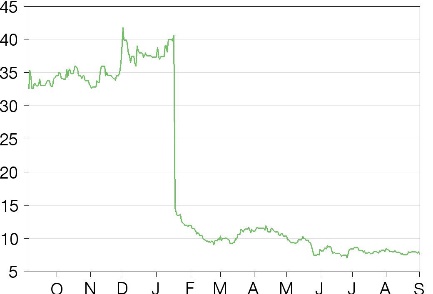
Share price performance
Business description
Next events
Analysts
IRLAB Therapeutics is a research client of Edison Investment Research Limited |
|||||||||||||||||||||||||||||||||||||||||||||||||||||||
IRLAB has reported its Q223 results, including a recap of clinical activities and financials. IRLAB shared a full analysis of the mesdopetam Phase IIb trial data, and noted the company’s focus on preparing for its FDA end-of-Phase II meeting after securing full rights to the project (previously out-licensed to Ipsen). In addition to the FDA preparations, IRLAB will maintain a flurry of clinical activity, including the anticipated release of top-line results for the Phase IIb pirepemat trial (H124) and potential promotion of up to three preclinical assets (to Phase I-ready status) from H223–FY24. At the end of the quarter, IRLAB had a net cash position of SEK156.4m, supporting a runway through H124. Based on net cash and the anticipated activities, we value IRLAB at SEK4.47bn or SEK86.1/share.
Year |
Revenue |
PBT* |
EPS* |
DPS |
P/E |
Yield |
12/21 |
207.9 |
91.1 |
1.76 |
0.0 |
N/A |
N/A |
12/22 |
61.3 |
(113.1) |
(2.18) |
0.0 |
N/A |
N/A |
12/23e |
6.9 |
(168.4) |
(3.25) |
0.0 |
N/A |
N/A |
12/24e |
0.2 |
(183.9) |
(3.55) |
0.0 |
N/A |
N/A |
Note: *PBT and EPS are normalised, excluding amortisation of acquired intangibles, exceptional items and share-based payments.
Awaiting FDA guidance to advance mesdopetam
Most notable in IRLAB’s recent news flow was the announcement that the company had secured full ownership of the mesdopetam project. This was previously out-licensed to Ipsen, with preclinical studies and Phase I, Ib, IIa and IIb trials completed as part of this collaboration. In August 2023, management shared additional details of the Phase IIb data (details below), which showed dose-dependent anti-dyskinetic and anti-Parkinsonian effects. Now, with full global rights and this comprehensive data package, management believes the mesdopetam project is Phase III ready, and has emphasised the support Ipsen has provided to prepare for Phase III. This has included production of the drug for Phase III, as well as DMPK and safety studies that have been completed. Ipsen is also helping IRLAB with the preparation for the end-of-Phase II meeting with the FDA. While this does not yet have a set timeline, we believe the outcome from such a meeting could represent a major catalyst. We note that, as part of this new arrangement, IRLAB will pay low single-digit royalties to Ipsen based on future product sales.
Valuation: SEK4.47bn or SEK86.1 per share
We value IRLAB at SEK4.47bn or SEK86.1 per share (vs SEK4.90bn or SEK94.7 per share previously). The revised valuation for IRLAB incorporates the roll forward effect, an updated FX rate and the net cash balance at end-June 2023, along with our revised licensing assumptions for mesdopetam and pirepemat following the announcement that IRLAB secured full ownership of the mesdopetam project. We have also made some adjustments to our FY23 and FY24 estimates based on recent developments and management guidance on operating expenses. Reported net cash was SEK156.4m at end-Q223, which we forecast will provide a runway through H124. We estimate that IRLAB will need to raise SEK750m to fund operations to end-FY27 before reaching operating profitability in FY28.
A clinical pipeline focused on Parkinson’s disease
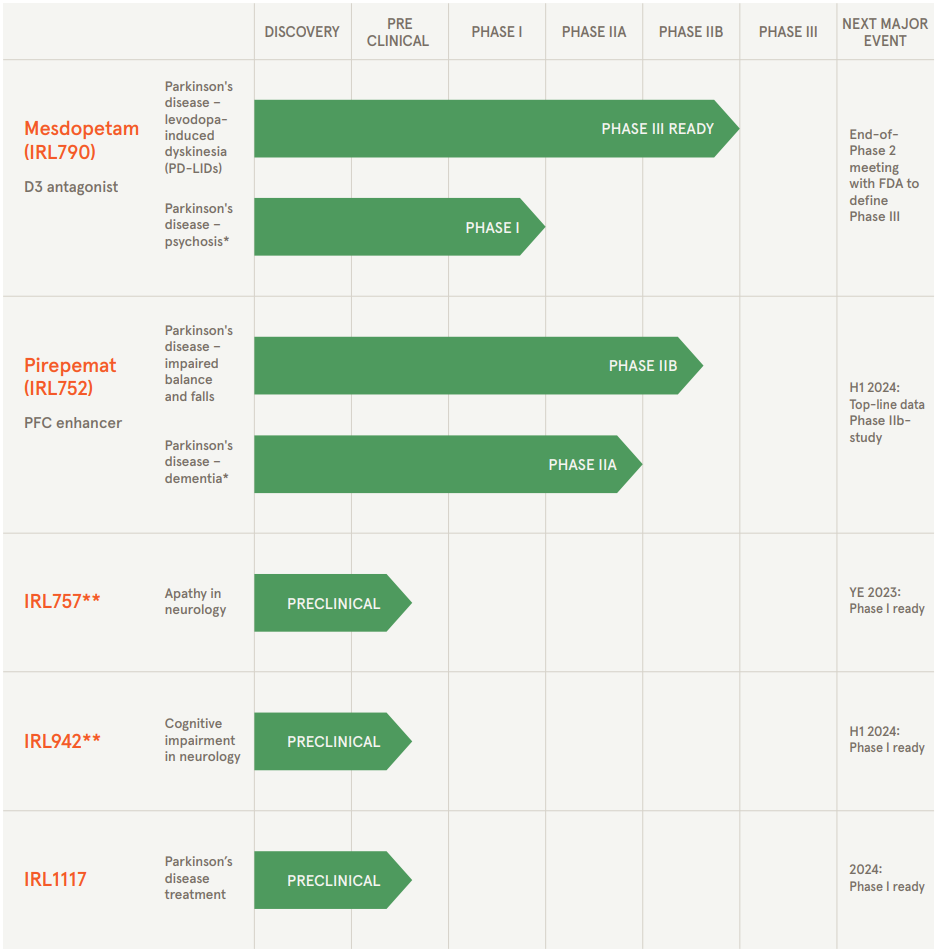
IRLAB focuses on developing treatments for the symptoms of Parkinson’s disease (PD), and has assets aiming to cover all the major aspects of the condition, as reflected in its active project portfolio (Exhibit 1). This pipeline is headed by two lead candidates: mesdopetam (a D3 antagonist for the treatment of levodopa-induced dyskinesias, PD-LIDs) and pirepemat (a prefrontal cortex enhancer for the treatment of impaired balance and falls, PD-Falls). The combination of these therapies seeks to address many of the areas of concern in PD.
|
Exhibit 1: IRLAB’s portfolio of projects |
|
|
Source: IRLAB Q223 report |
ISP platform powers progress of preclinical portfolio
The Integrative Screening Process (ISP) research platform is central to IRLAB’s strategy for drug development. The comprehensive approach, involving systems biology, chemistry and AI-based machine learning methods, is designed to expedite the discovery of novel drugs for central nervous system (CNS)-related diseases. The platform contains a growing database of c 1,400 CNS drug-like compounds developed over 25 years, and each compound has been profiled in various assays and in vivo models to capture dose-dependent data on a range of biological responses. This has generated a wealth of information, ranging from pharmacokinetics and receptor binding to chemical properties and safety. By drawing comparisons across these data sets, the machine learning capabilities provide a comprehensive map of the CNS drug property space, comprising c 600–700 dimensions, enabling IRLAB to focus on what it views as higher-quality drug candidates with a greater probability of success. We believe that this multifactorial approach is well matched for the complexity of CNS-related diseases:
■
IRL757 is being developed for the treatment of apathy, for which there are currently no approved therapies; management expects this to be Phase I ready by end-2023.
■
IRL942 is being developed as a treatment to improve cognitive function, designed to activate frontal cortical neurotransmission; management expects this to be Phase I ready in H124.
■
IRL1117 is being developed as a PD treatment that can be taken once daily, either as a monotherapy with the potential to replace levodopa, or as an add-on therapy; management expect this to be Phase I ready by end-2024.
During Q223, IRLAB saw developments in its preclinical portfolio, with the announcement of an agreement with the McQuade Center for Strategic Research and Development (MSRD), which is in the process of evaluating neuropsychiatric programmes: IRL757 (apathy) and IRL942 (cognitive function). We are currently awaiting an update on the company’s discussions with MSRD regarding potential R&D collaborations for these assets; we believe that the external interest in IRL757 and IRL942 is encouraging for the company’s preclinical portfolio.
Full data suggest a brighter future for mesdopetam
The Phase IIb mesdopetam trial was a randomised, double-blind, placebo-controlled study aimed at assessing the safety and tolerability of three different doses of the drug, as well as evaluating anti-dyskinetic effects. Patients (n=156) taking anti-PD medication and experiencing troublesome dyskinesia were randomised to receive either placebo or mesdopetam at 2.5, 5.0 or 7.5mg twice daily (bid) for 12 weeks. Importantly, we note that the trial protocol allowed patients to change their dose at one point during the study. The primary endpoint was changes in daily hours of ‘ON time’ (the length of time a patient does not have symptoms) without troublesome dyskinesia based on Hauser standardised 24-hour patient-reported diaries, with the Unified Dyskinesia Rating Scale (UDysRS) and subscales as secondary efficacy measures.
Top-line data were reported in January 2023, showing that the study did not meet its primary endpoint (change in daily hours of ON-time without troublesome dyskinesia, as assessed with patient diaries). However, the results confirmed the safety and tolerability of mesdopetam, and demonstrated that the drug has significant anti-dyskinetic effects as measured by the UDysRS. While we caution direct read-across between clinical studies, we note that UDysRS measurements formed the basis of Adamas’ Gocovri approval, the only FDA-approved treatment for PD-LIDs, highlighting the clinical relevance of the scale. Further, we note that Gocovri is associated with a multitude of side effects (eg hallucinations, peripheral edema, falls, suicidality and depression), giving mesdopetam the opportunity to provide a competitive edge, in our view.
In August 2023, IRLAB shared a detailed analysis of the Phase IIb trial data. In accordance with the dose adjustment, the analysis was conducted on both the actual doses that participants received (protocol-compliant adjusted dose set, PS), as well as the randomised dose assigned (full analysis set, FAS), providing a comprehensive understanding of dose dependency and corresponding treatment effects and guiding dose selection for Phase III. In the FAS, the effect of mesdopetam on good ‘ON time’ based on Hauser diary entries was not statistically significant. However, in the PS, patients taking the highest tested dose of mesdopetam (7.5mg b.i.d.) saw a significant and clinically meaningful increase in good ‘ON time’ (1.75h vs placebo, p=0.05). Furthermore, in the FAS, the effect of mesdopetam based on UDysRS (sum of parts 1, 3 and 4) measured a notable reduction in dyskinesia (6.2 points vs placebo, p=0.026) at 7.5mg, but this was more significant in the PS (9.2 points vs placebo, p=0.011). There was also a greater reduction in the UDysRS disability score (parts 1b and 4) at 7.5mg (3.5 points vs placebo in the FAS, and 5.5 points vs placebo in the PS), highlighting that both patients and physicians observed a reduction in disability caused by dyskinesia with mesdopetam treatment.
This update on the Phase IIb trial data has confirmed the safety and tolerability of mesdopetam and shown that the dug has dose-dependent anti-dyskinetic and anti-Parkinsonian effects. It has also provided a guided dose of 7.5mg b.i.d. for Phase III. We are currently awaiting further communication from IRLAB regarding the end-of-Phase II meeting with the FDA, and believe that its outcome will shine light on whether the company’s plans for Phase III will come to fruition.
Next catalyst: Pirepemat in PD-Falls
Pirepemat is in clinical development as a potential treatment to improve balance and reduce PD-Falls, serious consequences of the condition that currently lack treatment options. The ongoing Phase IIb trial is a randomised, double-blind, placebo-controlled study aiming to recruit 165 patients across five European countries. Patients are randomised to receive either:
■
Pirepemat 300mg (100mg thrice daily), n=55
■
Pirepemat 600mg (200mg thrice daily), n=55
■
Placebo, n=55
The primary outcome measure is a change in the frequency of falls with pirepemat when compared to placebo, assessed with the fall diary from the baseline period to the end of the planned 12 weeks of treatment.
In June 2023, IRLAB announced that it had activated all 38 trial sites, and management continues to expect a steady recruitment pace with enrolment completed by end-2023. In July 2023, the independent data and safety monitoring board for the study reviewed interim data from the first 25 participants completing the study, and recommended that the trial continue according to the approved protocol without any modifications. It is our understanding that the study is progressing as anticipated, and we believe that top-line data expected in H124 could represent the next major clinical catalyst for the company.
Financials
In Q223, operating loss accelerated to SEK44.9m compared to SEK27.0m in Q222, mainly due to lower revenue recognised during the quarter, at SEK6.9m (vs SEK23.4m in Q222). We note that IRLAB received total upfront payment of SEK239.6m as part of IRLAB’s licensing agreement with Ipsen in July 2021, of which SEK61.2m was recognised as FY22 revenue, consisting of SEK42.6m of deferred income (spread over the quarters) and SEK18.6m in other services provided to Ipsen. No such revenue was received in Q223. Total operating expenses in Q223 were higher by a nominal 2.2% y-o-y, at SEK51.7m, driven by one-off costs associated with exit of the former CEO, however, this was partially offset by lower R&D expenses due to conclusion of the Phase IIb mesdopetam study. As the company prepares for the end-of-Phase II meeting with the FDA, we expect IRLAB to incur lower R&D expenses in H223 as compared to H123 (in line with management guidance of lower operating expenses in the quarter), and these will likely be related to the pirepemat Phase II study and preclinical activities for IRL757 and IRL942. Hence, we reduce our operating expenses estimates to SEK175.4m in FY23 (SEK208.4m previously) and SEK184.0m in FY24 (SEK190.3m previously), assuming the Phase III trial gets the go-ahead from the US FDA and the anticipated initiation of the Phase I trials of IRL757 and IRL942. As we adjust Q223 revenue and incorporate the above-mentioned changes in operating expenses in our FY23 estimates, our revised operating loss forecasts for FY23 and FY24 stand at SEK168.3m (SEK208.2m previously) and SEK183.9m (SEK190.2m previously).
Operating cash outflows for Q223 amounted to SEK52.8m and IRLAB ended Q223 with a net cash position of SEK156.4m, which we estimate should fund operations through H124. We continue to estimate that IRLAB will need to raise SEK750m before becoming self-sustainable in FY28 with the projected launches of mesdopetam and pirepemat. We account for this funding as illustrative debt in our model and have distributed the raise (SEK250m per year) across three consecutive years (FY24–26). Alternatively, if funding is realised through an equity issue instead (assuming at the current trading price of SEK7.66/share), IRLAB would need to issue 94.9m shares, resulting in our per-share valuation decreasing to SEK35.5 from SEK86.1 currently (the number of shares outstanding would increase from 51.9m to 146.8m).
Valuation
As IRLAB recently secured full ownership rights of the mesdopetam to project, we have made some changes in our valuation assumptions to reflect the impact. With the company planning to go ahead with further clinical development, we now project that the company will fund the Phase III trial for mesdopetam in PD-LID. Hence, we have assumed additional R&D expenses for both PD-LID and PD-Psychosis until the projected conclusion of the Phase III clinical trial for PD-LID in FY26. We anticipate clinical study expenses for mesdopetam to take priority in the near-to-medium term and the R&D spend on other preclinical assets to slow down. Assuming favourable results are achieved in Phase III, we project that the company would secure an out-licensing deal for the drug’s commercialisation by the end of 2026 or early 2027, when the company would file for a New Drug Application. Hence, the anticipated cash inflows from the new licensing deal would get pushed out to 2027 versus previously expected development milestones from the Ipsen deal, starting in 2024. As part of new out-licensing deal, we assume a total deal value of $240m (vs previously assumed licensing deal value of $290m), including $25m upfront payment and $215m in developmental milestones, relating to PD-LIDs and PD-Psychosis. We keep the assumed royalty rate as flat 20% on net sales unchanged. Additionally, we have included royalties payable to Ipsen (assumed at 3%) in the event of commercialisation, as per the latest agreement.
We note that the company is exploring all available options to finance the Phase III programme for mesdopetam, including potential partnering/licensing deals as well as discussions with capital markets. Post evaluating these options, the company might decide the best way forward, hence, we are not excluding the possibility of securing a deal for mesdopetam before or during Phase III trials. Hence, we believe our assumptions are subject to this variability and we plan to reassess in case of any positive development in this regard.
Exhibit 2: Recent licensing deals in PD
Deal date |
Company |
Product |
Deal partner |
Status on deal date |
Upfront payment ($m) |
Deal value ($m) |
30/09/2021 |
Otsuka Holdings |
Ulotaront |
Sumitomo Pharma |
Phase III |
270 |
890 |
02/07/2021 |
GSK |
latozinemab |
Alector |
Phase III |
700 |
2,200 |
05/04/2012 |
Zambon |
Xadago |
Newron Pharmaceuticals |
Phase III |
20 |
27 |
15/05/2011 |
Zevra Therapeutics |
Miplyffa |
LadRx Corporation |
Phase III |
0 |
87 |
04/05/2009 |
Bausch Health Companies |
BVF-036 |
ACADIA Pharmaceuticals |
Phase III |
30 |
395 |
30/05/2006 |
Lundbeck |
Northera |
Sumitomo Pharma |
Phase III |
0 |
4 |
Average (median) |
25 |
241 |
||||
Source: Edison Investment Research, EvaluatePharma
We continue to forecast the launch of mesdopetam for PD-LID in 2028 and unchanged peak sales of $1.3bn in the US/EU5 in 2034 for PD-LID. For PD-Psychosis, we project launch in 2029 and unchanged peak sales of $494m in the US/EU in 2035. In light of current development, we note that the next steps on PD-Psychosis have not been decided or disclosed by management yet, hence, the assumed timelines for PD-Psychosis are subject to potential collaborations for the product. Our pirepemat assumptions are unchanged.
Our revised valuation for IRLAB stands at SEK4.47bn or SEK86.1 per share versus SEK4.90bn or SEK94.7 per share previously. The reduced valuation incorporates the above-mentioned changes, along with the roll forward effect and updated FX rate and net cash balance at end-June 2023. While rNPV for pirepemat improves to SEK1.92bn from SEK1.85bn previously due to the roll forward effect, the changes in model assumptions led mesdopetam rNPV for PD-LID and PD-Psychosis to decline to SEK1.81bn and SEK0.58bn (compared to SEK2.12bn and SEK0.72bn previously), respectively. A breakdown of our rNPV valuation is shown in Exhibit 3.
Exhibit 3: IRLAB sum-of-the parts valuation
New valuation |
Old valuation |
||||||||||
Product |
Indication |
Launch |
Peak |
Peak sales ($m) |
Value (SEKm) |
Probability |
rNPV |
rNPV/share (SEK) |
rNPV |
rNPV/share (SEK) |
|
Mesdopetam |
PD-LIDs |
2028 |
2034 |
1,268.5 |
4,534.4 |
40% |
1,805.7 |
34.8 |
2,125.3 |
41.0 |
|
Mesdopetam |
PD-Psychosis |
2029 |
2035 |
493.7 |
1,935.5 |
30% |
583.0 |
11.2 |
715.8 |
13.8 |
|
Pirepemat |
PD-Falls (postural hypotension) |
2028 |
2034 |
1,062.1 |
6,455.5 |
30% |
1,920.0 |
37.0 |
1,853.7 |
35.8 |
|
Net cash at 30 June 2023 |
|
|
|
156.4 |
100% |
156.4 |
3.0 |
210.1 |
4.1 |
||
Valuation |
|
|
|
|
13,081.2 |
|
4,465.1 |
86.1 |
4,904 |
94.7 |
|
Source: Edison Investment Research
Exhibit 4: Financial summary
Accounts: IFRS; year end 31 December; SEK000s |
|
|
2020 |
2021 |
2022 |
2023e |
2024e |
PROFIT & LOSS |
|
|
|
|
|
|
|
Total revenues |
|
|
404 |
207,906 |
61,277 |
7,093 |
163 |
Cost of sales |
|
|
0 |
0 |
0 |
0 |
0 |
Gross profit |
|
|
404 |
207,906 |
61,277 |
7,093 |
163 |
Total operating expenses |
|
|
(91,862) |
(155,330) |
(174,386) |
(175,436) |
(184,035) |
Research and development expenses |
|
|
(75,989) |
(129,748) |
(146,178) |
(140,349) |
(147,228) |
EBITDA (reported) |
|
|
(89,202) |
56,050 |
(108,330) |
(164,593) |
(180,108) |
Operating income (reported) |
|
|
(91,458) |
52,576 |
(113,109) |
(168,343) |
(183,873) |
Operating margin % |
|
|
N/A |
N/A |
N/A |
N/A |
N/A |
Finance income/(expense) |
|
|
(195) |
(795) |
(297) |
(81) |
(4) |
Exceptionals and adjustments |
|
|
0 |
0 |
0 |
0 |
0 |
Profit before tax (reported) |
|
|
(91,653) |
51,781 |
(113,406) |
(168,424) |
(183,876) |
Profit before tax (normalised) |
|
|
(91,394) |
91,131 |
(113,147) |
(168,424) |
(183,876) |
Income tax expense (includes exceptionals) |
|
|
0 |
0 |
0 |
0 |
0 |
Net income (reported) |
|
|
(91,653) |
51,781 |
(113,406) |
(168,424) |
(183,876) |
Net income (normalised) |
|
|
(91,394) |
91,131 |
(113,147) |
(168,424) |
(183,876) |
Basic average number of shares, m |
|
|
47.7 |
51.7 |
51.8 |
51.9 |
51.9 |
Basic EPS (SEK) |
|
|
(1.92) |
1.00 |
(2.19) |
(3.25) |
(3.55) |
Adjusted EPS (SEK) |
|
|
(1.92) |
1.76 |
(2.18) |
(3.25) |
(3.55) |
Dividend per share (SEK) |
|
|
0.00 |
0.00 |
0.00 |
0.00 |
0.00 |
BALANCE SHEET |
|
|
|
|
|
|
|
Tangible assets |
|
|
4,317 |
8,348 |
8,009 |
4,554 |
3,082 |
Intangible assets |
|
|
82,010 |
42,661 |
46,862 |
46,862 |
46,862 |
Other non-current assets |
|
|
0 |
0 |
0 |
0 |
0 |
Total non-current assets |
|
|
86,327 |
51,009 |
54,871 |
51,416 |
49,944 |
Cash and equivalents |
|
|
277,009 |
401,897 |
252,776 |
89,343 |
156,938 |
Inventories |
|
|
0 |
0 |
0 |
0 |
0 |
Trade and other receivables |
|
|
6,732 |
19,543 |
15,908 |
13,522 |
13,522 |
Other current assets |
|
|
0 |
0 |
0 |
0 |
0 |
Total current assets |
|
|
283,741 |
421,440 |
268,684 |
102,864 |
170,460 |
Non-current loans and borrowings |
|
|
0 |
0 |
0 |
0 |
250,000 |
Non-current lease liabilities |
|
|
1,270 |
3,566 |
381 |
249 |
249 |
Other non-current liabilities |
|
|
0 |
0 |
0 |
0 |
0 |
Total non-current liabilities |
|
|
1,270 |
3,566 |
381 |
249 |
250,249 |
Accounts payable |
|
|
3,683 |
4,634 |
0 |
0 |
0 |
Non-current loans and borrowings |
|
|
0 |
0 |
0 |
0 |
0 |
Current lease liabilities |
|
|
1,657 |
3,034 |
3,595 |
0 |
0 |
Deferred Income |
|
|
0 |
42,576 |
0 |
0 |
0 |
Other current liabilities |
|
|
15,578 |
19,158 |
28,748 |
31,623 |
31,623 |
Total current liabilities |
|
|
20,918 |
69,402 |
32,343 |
31,623 |
31,623 |
Equity attributable to company |
|
|
347,880 |
399,481 |
290,830 |
122,406 |
(61,470) |
CASH FLOW STATEMENT |
|
|
|
|
|
|
|
Operating income |
|
|
(91,458) |
52,576 |
(113,109) |
(168,343) |
(183,873) |
Depreciation and amortisation |
|
|
2,256 |
3,474 |
4,779 |
3,750 |
3,765 |
Share based payments |
|
|
0 |
0 |
0 |
0 |
0 |
Other adjustments |
|
|
(195) |
38,295 |
(297) |
(81) |
(4) |
Movements in working capital |
|
|
183 |
34,296 |
(33,985) |
5,261 |
0 |
Cash from operations (CFO) |
|
|
(89,214) |
128,641 |
(142,612) |
(159,412) |
(180,111) |
Capex |
|
|
(394) |
(708) |
(2,876) |
(293) |
(2,293) |
Acquisitions & disposals net |
|
|
0 |
0 |
(500) |
0 |
0 |
Other investing activities |
|
|
0 |
0 |
0 |
0 |
0 |
Cash used in investing activities (CFIA) |
|
|
(394) |
(708) |
(3,376) |
(293) |
(2,293) |
Net proceeds from issue of shares |
|
|
257,706 |
(180) |
0 |
0 |
0 |
Movements in debt |
|
|
(1,616) |
(2,865) |
(3,134) |
(3,727) |
250,000 |
Other financing activities |
|
|
0 |
0 |
0 |
0 |
0 |
Cash from financing activities (CFF) |
|
|
256,090 |
(3,045) |
(3,134) |
(3,727) |
250,000 |
Cash and equivalents at beginning of period |
|
|
110,527 |
277,009 |
401,897 |
252,775 |
89,343 |
Increase/(decrease) in cash and equivalents |
|
|
166,482 |
124,888 |
(149,122) |
(163,432) |
67,596 |
Effect of FX on cash and equivalents |
|
|
0 |
0 |
0 |
0 |
0 |
Cash and equivalents at end of period |
|
|
277,009 |
401,897 |
252,775 |
89,343 |
156,938 |
Net (debt)/cash |
|
|
277,009 |
401,897 |
252,776 |
89,343 |
(93,062) |
Source: Edison Investment Research, IRLAB company accounts
|
|
Research: Metals & Mining
Alphamin Resources (AFM) offers rare exposure to a metal (tin) that both Rio Tinto and the MIT regard as the most likely to benefit from the electrification of the world economy. Having successfully ramped up its Mpama North mine at Bisie in the Democratic Republic of the Congo in 2019–20, when the tin price was enjoying one of its biggest bull markets in decades, AFM is now in a net cash position and is paying dividends at the same time as developing a second mine (Mpama South).