Last close As at 05/08/2026
—
— 0.00 (0.00%)
Market capitalisation
—
Research: Investment Companies
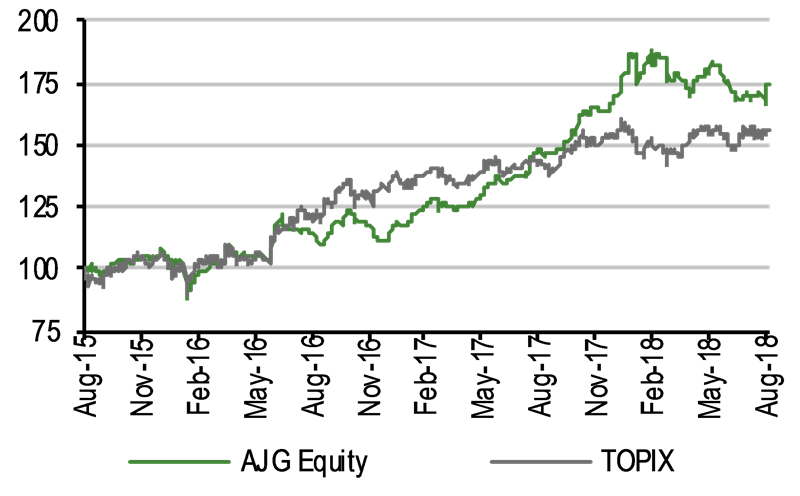
Atlantis Japan Growth Fund (AJG) is advised by Atlantis Investment Research Corporation (AIRC). Lead portfolio adviser Taeko Setaishi aims to generate long-term capital growth from a portfolio of primarily smaller-capitalisation Japanese equities. AIRC’s philosophy is that over the long term, a company’s share price performance is driven by its earnings growth, especially for smaller companies. Setaishi notes that Japanese equities have experienced negative investor fund flows in 2018, which has had a large impact on the Japanese stock market. However, while overall economic growth in the country remains modest, the adviser is continuing to find companies with attractive fundamentals that are trading on reasonable valuations, particularly in small and mid-caps. While recent performance has been more challenging, AJG has outperformed its benchmark TOPIX index over the last one, three, five and 10 years.
Atlantis Japan Growth Fund |
Continuing to find attractive growth opportunities |
Investment companies |
5 September 2018 |
Share price/discount performance
Three-year performance vs index
Gearing
Analysts
|
|||||||||||||||||||||||||||||||||||||||||||||||||||||||||||||||||||||||||||||||||||
Atlantis Japan Growth Fund (AJG) is advised by Atlantis Investment Research Corporation (AIRC). Lead portfolio adviser Taeko Setaishi aims to generate long-term capital growth from a portfolio of primarily smaller-capitalisation Japanese equities. AIRC’s philosophy is that over the long term, a company’s share price performance is driven by its earnings growth, especially for smaller companies. Setaishi notes that Japanese equities have experienced negative investor fund flows in 2018, which has had a large impact on the Japanese stock market. However, while overall economic growth in the country remains modest, the adviser is continuing to find companies with attractive fundamentals that are trading on reasonable valuations, particularly in small and mid-caps. While recent performance has been more challenging, AJG has outperformed its benchmark TOPIX index over the last one, three, five and 10 years.
12 months ending |
Share price |
NAV |
TOPIX |
MSCI Japan |
MSCI AC |
FTSE All- |
31/08/14 |
5.8 |
13.0 |
3.7 |
9.8 |
13.3 |
10.3 |
31/08/15 |
8.4 |
12.2 |
13.4 |
11.7 |
1.7 |
(2.3) |
31/08/16 |
14.1 |
10.3 |
21.5 |
28.5 |
26.7 |
11.7 |
31/08/17 |
30.4 |
30.4 |
18.8 |
25.6 |
19.7 |
14.3 |
31/08/18 |
17.6 |
19.4 |
7.8 |
6.9 |
11.0 |
4.7 |
Source: Thomson Datastream. Note: All % on a total return basis in pounds sterling.
Investment strategy: Four-stage stock selection
Setaishi employs a largely unconstrained approach to individual stock selection, seeking companies with strong fundamentals and attractive valuations. She uses a four-stage investment process: periodic screening, company visits, in-depth fundamental research and the construction of a buy list. Sector allocations can vary markedly compared with the TOPIX index; for example, at end July, c 45% of the portfolio was invested in industrial stocks versus a benchmark weighting of c 8%. Gearing of up to 20% of NAV is permitted; net gearing was 4.2% at end July 2018.
Market outlook: Potential for rerating
Japanese equities look relatively attractively valued compared with other developed stock markets and may offer the opportunity for a rerating. While overall Japanese economic activity remains modest, there are pockets of higher growth driven by secular trends, such as increased automation, and growth in the Japanese service sector. This provides opportunities for investors employing a disciplined approach to stock selection.
Valuation: Discount has widened in 2018
In February 2018, AJG briefly traded at a small premium. However, its shares are once again trading at a discount, its 10.0% share price discount to NAV is modestly wider than the averages of the last one, three, five and 10 years (a range of 8.3% to 9.9%). The company’s board operates an active discount control mechanism, including a continuation vote if the discount regularly exceeds 10% (see page 7). AJG focuses on long-term capital growth rather than income and does not pay a dividend.
Exhibit 1: Fund at a glance
Investment objective and fund background |
Recent developments |
|||||||||||||||||||||||||||||||||||||||||||||||||||||||||
AJG aims to achieve long-term capital growth through investing wholly or mainly in listed Japanese equities. Currently all investments are in Japanese equities with a bias to smaller- and mid-sized companies. |
■ 24 August 2018: Confirmation of next redemption point (28 September 2018). ■ 9 July 2018: 12-month results ending 30 April 2018 in £ terms. NAV TR +38.8% versus benchmark TR +13.5%. Share price TR +36.0%. ■ 6 April 2018: the board approved payments for redeemed shares – 2.3424p/share for basic entitlements and 2.2965p/share for excess entitlements. ■ 3 April 2018: investment manager Tiburon Partners changed its name to Quaero Capital following the merger of the two companies. ■ 3 April 2018: 24% of shares lodged for redemption (scaled back to 5%). |
|||||||||||||||||||||||||||||||||||||||||||||||||||||||||
Forthcoming |
Capital structure |
Fund details |
||||||||||||||||||||||||||||||||||||||||||||||||||||||||
AGM |
October 2018 |
Ongoing charges |
1.57% (FY18) |
Group |
Atlantis Investment Research Corp |
|||||||||||||||||||||||||||||||||||||||||||||||||||||
Interim results |
December 2018 |
Net gearing |
4.2% |
Manager |
Quaero Capital |
|||||||||||||||||||||||||||||||||||||||||||||||||||||
Year end |
30 April |
Annual mgmt fee |
1.0% |
Address |
2-4 King Street, |
|||||||||||||||||||||||||||||||||||||||||||||||||||||
Dividend paid |
Irregular (see page 7) |
Performance fee |
None |
|||||||||||||||||||||||||||||||||||||||||||||||||||||||
Launch date |
10 May 1996 |
Company life |
Indefinite subject to cont. vote |
Phone |
+44 (0)207 747 5770 |
|||||||||||||||||||||||||||||||||||||||||||||||||||||
Continuation vote |
Conditional on discount |
Loan facilities |
¥1.5bn |
Website |
||||||||||||||||||||||||||||||||||||||||||||||||||||||
Dividend policy and history (financial years) |
Share buyback policy and history (financial years) |
|||||||||||||||||||||||||||||||||||||||||||||||||||||||||
Dividend payments are irregular and paid in US cents. No dividends have been paid since FY12 and there is currently no intention to make distributions. |
Renewed annually, the board has authority to repurchase up to 14.99% of outstanding shares. Repurchases shown below include redeemed shares. Allotments are exercises of subscription rights. |
|||||||||||||||||||||||||||||||||||||||||||||||||||||||||
|
|
|||||||||||||||||||||||||||||||||||||||||||||||||||||||||
Shareholder base (as at 31 July 2018) |
Portfolio exposure by market cap (rebased for gearing as at 31 July 2018) |
|||||||||||||||||||||||||||||||||||||||||||||||||||||||||
|
|
|||||||||||||||||||||||||||||||||||||||||||||||||||||||||
Top 10 holdings (as at 31 July 2018) |
||||||||||||||||||||||||||||||||||||||||||||||||||||||||||
|
||||||||||||||||||||||||||||||||||||||||||||||||||||||||||
Source: Atlantis Japan Growth Fund, Edison Investment Research, Bloomberg, Morningstar. Note: *N/A where not in July 2017 top 10.
Market outlook: Valuations remain relatively attractive
Exhibit 2 (left-hand side) shows how share prices have performed in sterling terms over the last five years; small-cap Japanese equities have outperformed both the broader Japanese stock market and global equities over this period. While there are constraints on Japanese economic growth due to factors such as a lack of inflation and an ageing population, there are companies that are able to harness demographic trends at home as well as tap into higher-growth overseas economies. In terms of valuation, using Datastream indices (Exhibit 2, right-hand side), Japanese stocks are trading on a forward P/E multiple of 13.5x, which is a c 9% discount to world equities and is appreciably wider than the c 3% average discount over the last five years. Exhibit 3 highlights Japanese equity valuations compared with other developed markets. The average forward P/E multiple is broadly in line with those in the UK and Europe, but at a significant more than 20% discount to the US. In addition, Japan’s current forward earnings multiple is at a discount to its 10-year average, unlike in the US, UK and Europe. This suggests there may be potential for a relative rerating of Japanese equities.
|
Exhibit 2: Market performance and valuation |
|
Performance of indices (last five years, in £ terms) |
Japan forward P/E multiple and discount to World index |
|
|
|
Source: Thomson Datastream, Edison Investment Research. Note: Data at 31 August 2018. |
|
Exhibit 3: Forward P/E multiples (x) of Datastream indices (last 10 years)
Last |
High |
Low |
10-year average |
Last as % of average |
|
Japan |
13.5 |
23.6 |
10.5 |
14.4 |
93 |
US |
17.3 |
18.9 |
9.4 |
14.9 |
116 |
UK |
13.0 |
15.8 |
7.4 |
12.4 |
105 |
Europe |
13.4 |
15.6 |
7.6 |
12.0 |
111 |
World |
14.8 |
16.3 |
4.7 |
12.4 |
120 |
Source: Thomson Datastream, Edison Investment Research. Note: Data at 31 August 2018.
Fund profile: Primary focus on smaller companies
AJG was launched on 10 May 1996, is incorporated in Guernsey and is listed on the Main Market of the London Stock Exchange. Tiburon Partners was appointed its investment manager in 2012, with AIRC acting as investment adviser. (Tiburon recently changed its name the Quaero Capital following the merger of the two companies.) AIRC was established in 1996 and is an independent boutique fund adviser based in Tokyo, employing four investment professionals with an average of more than 30 years’ investment experience. Since 1 May 2016, AJG’s lead portfolio adviser has been Taeko Setaishi, who had been the company’s deputy portfolio adviser since 1996. She aims to generate long-term growth in capital from a diversified portfolio of 60–70 Japanese equities (including REITs) benchmarked against the TOPIX index. Up to 100% of gross assets may be invested in companies quoted on any Japanese stock exchange; up to 20% of NAV, at the time of investment, is permitted in companies traded on other stock exchanges, that are either controlled and managed in Japan or have material Japanese operations; and up to 10% of NAV, at the time of investment, may be in unlisted companies. Up to 20% of NAV may be invested in equity warrants and convertible debt, and no more than 10% of the portfolio is permitted in a single company. Gearing of up to 20% of NAV, at the time of borrowing, is allowed (net gearing was 4.2% at end July). From the fund’s inception on 10 May 1996 to end FY18 (April), AJG’s NAV total return in sterling terms is +271.9%, which is meaningfully ahead of the benchmark’s +57.5% total return.
The fund’s lead portfolio adviser: Taeko Setaishi
The adviser’s view: Still finding attractive opportunities
Setaishi explains there has been no fundamental change in her view about the macro environment in Japan (see our February 2018 initiation note). While there was some economic weakness in Q118 as a result of extraordinary factors, since then economic data have been more favourable. There is strong capex in the domestic private sector and while consumption has been a little disappointing given higher wages and tightness in the labour market, exports remain robust. The adviser believes that over the medium term, the Japanese economy can grow at c 1% pa. However, although overall economic growth remains modest compared with other developed economies, Setaishi is continuing to find attractive investment opportunities due to significant structural changes in Japan. This is represented within AJG’s portfolio in a variety of themes such as: companies benefiting from an ageing population; Japan’s market leadership in robotics; a trend towards outsourcing due to a tight labour market; strong global demand for semiconductors; and a shift within the Japanese economy away from manufacturing and towards services. Given the very strong 15–20% Japanese corporate earnings growth in 2017, Setaishi believes growth will be more modest in 2018. For the year, she is expecting corporate sales growth of c 3%, with slightly higher growth in earnings per share. However, the adviser notes there is much higher earnings growth in aggregate at small- and mid-cap companies, which she believes should translate into outperformance by smaller companies compared with the broader Japanese market.
Setaishi suggests the Japanese stock market has been ignored by international investors, who have focused on concerns about disruptions to global trade as a result of US protectionist policies. She notes consistent negative international fund flows in Japanese equities during 2018 and, unusually, there has been a lack of domestic retail demand. The adviser believes that if corporate earnings come through and the Japanese yen remains strong, there should be a tapering of the selling pressure from overseas investors. She notes the relatively attractive valuations of Japanese compared with other developed market equities and says that in absolute terms, Japanese equities are trading towards the low end of their historical ranges on both a P/E and price-to-book basis. Setaishi believes that, given time, international investors will take note of the relatively attractive valuations of Japanese equities and the available investment opportunities in the country.
Asset allocation
Investment process: Stock prices driven by earnings growth
AIRC’s investment process is founded on the belief that a company’s long-term share price performance is driven by its earnings growth, and portfolio investments are made following a diligent individual stock selection approach. There are four steps to the process:
■
Periodic screening of a universe of c 2,000 companies, seeking firms with above-average growth and improving fundamentals, which are trading on reasonable valuations.
■
Company visits to understand a firm’s business model and its competitive position.
■
In-depth fundamental research, including the construction of an earnings model, a determination of a stock’s appropriate valuation and a consideration of its technical factors.
■
Following discussions within the investment team, construction of a buy list that the portfolio adviser uses as a source to recommend new investments.
Portfolio holdings may be sold if there is a perceived unjustified change in a company’s business model; if there is a downturn in a firm’s operating environment or an earnings disappointment; or if a position becomes too large. The portfolio adviser’s investment approach is largely unconstrained, while adhering to the parameters detailed in the Fund profile section (page 3). This means that sector allocations can vary markedly compared with the TOPIX index (see Exhibit 5). AJG’s portfolio has a high active share (97.7% at end July 2018). This is a measure of how a portfolio differs from its benchmark, with 0% representing full index replication and 100% being zero commonality with the benchmark.
Current portfolio positioning
AJG’s market cap exposure is shown in Exhibit 4. Over the last 12 months to the end of July there is a higher weighting to companies in the £500m to £2bn band (+22.5pp) at the expense of those in the smallest cap (<£500m, -13.0pp) and £2bn to £5bn (-10.1pp) bands.
Exhibit 4: Portfolio exposure by market cap (% unless stated)
Portfolio end-July 2018 |
Portfolio end-July 2017 |
Change (pp) |
|
>£10bn |
13.5 |
13.7 |
(0.2) |
£5bn to £10bn |
3.6 |
2.8 |
0.7 |
£2bn to £5bn |
8.7 |
18.8 |
(10.1) |
£500m to £2bn |
44.4 |
21.9 |
22.5 |
<£500m |
29.8 |
42.8 |
(13.0) |
100.0 |
100.0 |
Source: Atlantis Japan Growth Fund, Edison Investment Research. Note: Rebased for gearing.
In terms of sector exposure (using Global Industry Classification Standard rather than TOPIX classifications), over the last 12 months the largest changes are in technology (-14.1pp), real estate (+9.0pp) and industrials (+7.7pp), which remains the largest overweight sector in the portfolio by quite some margin.
Exhibit 5: Portfolio sector exposure vs benchmark (% unless stated)
Portfolio end- |
Portfolio end- |
Change |
Index |
Active weight |
Fund weight/ |
|
Industrials |
44.5 |
36.8 |
7.7 |
22.4 |
22.1 |
2.0 |
Information technology |
15.9 |
30.0 |
(14.1) |
12.2 |
3.7 |
1.3 |
Consumer discretionary |
14.4 |
12.0 |
2.4 |
19.5 |
(5.1) |
0.7 |
Real estate |
9.0 |
0.0 |
9.0 |
3.0 |
6.0 |
3.0 |
Healthcare |
7.2 |
4.6 |
2.6 |
7.3 |
(0.1) |
1.0 |
Materials |
3.9 |
7.9 |
(4.0) |
6.9 |
(3.0) |
0.6 |
Financials |
3.4 |
7.2 |
(3.9) |
11.6 |
(8.2) |
0.3 |
Telecommunications |
1.6 |
0.4 |
1.3 |
5.0 |
(3.4) |
0.3 |
Energy |
0.0 |
0.0 |
0.0 |
1.2 |
(1.2) |
N/A |
Utilities |
0.0 |
0.0 |
0.0 |
1.8 |
(1.8) |
N/A |
Consumer staples |
0.0 |
1.0 |
(1.0) |
9.0 |
(9.0) |
N/A |
100.0 |
100.0 |
100.0 |
Source: Atlantis Japan Growth Fund, Edison Investment Research, Bloomberg. Note: Rebased for gearing.
Performance: Outperformance in FY18
During FY18 (ending 30 April), AJG’s NAV and share price total returns of 38.8% and 36.0% were meaningfully ahead of the benchmark’s 13.5% total return. Positions contributing to the outperformance include Lasertec (semiconductor equipment), Daifuku (material handling and distribution systems) and Idec (electrical components).
|
Exhibit 6: Investment company performance to 31 August 2018 in sterling terms |
|
Price, NAV and benchmark total return performance, one-year rebased |
Price, NAV and benchmark total return performance (%) |
|
|
|
Source: Thomson Datastream, Edison Investment Research. Note: Three, five and 10-year performance figures annualised. |
|
While AJG’s more recent performance has generally trailed that of the benchmark, as small-cap indices have lagged the broader Japanese stock market due to particularly heavy negative fund flows, the company’s longer-term performance record remains intact. AJG has outperformed the TOPIX index over one, three, five and 10 years in both NAV and share-price terms, despite more than 10pp performance dilution from subscription share issuance over the period from October 2015 to October 2017. It is also interesting to note its meaningful outperformance of the FTSE All-Share index and the MSCI AC World index (which is dominated by outperforming US stocks) over these periods.
|
Exhibit 7: Share price and NAV total return performance, relative to indices (%) |
||||||||
|
One month |
Three months |
Six months |
One year |
Three years |
Five years |
10 years |
|
Price relative to TOPIX |
1.8 |
(3.3) |
(7.4) |
9.0 |
12.4 |
9.6 |
43.3 |
|
NAV relative to TOPIX |
1.8 |
(3.8) |
(4.1) |
10.7 |
10.4 |
18.9 |
46.9 |
|
Price relative to MSCI Japan Small Cap |
2.4 |
(1.3) |
(6.7) |
9.9 |
1.4 |
(5.2) |
2.8 |
|
NAV relative to MSCI Japan Small Cap |
2.4 |
(1.8) |
(3.3) |
11.7 |
(0.5) |
2.8 |
5.3 |
|
Price relative to MSCI AC World |
1.0 |
(8.7) |
(13.7) |
5.9 |
3.9 |
3.5 |
18.3 |
|
NAV relative to MSCI AC World |
1.0 |
(9.3) |
(10.6) |
7.6 |
2.1 |
12.3 |
21.2 |
|
Price relative to FTSE All-Share |
5.7 |
(1.8) |
(11.2) |
12.3 |
30.8 |
39.3 |
63.2 |
|
NAV relative to FTSE All-Share |
5.7 |
(2.3) |
(8.0) |
14.1 |
28.4 |
51.1 |
67.3 |
|
|
Source: Thomson Datastream, Edison Investment Research. Note: Data to end-August 2018. Geometric calculation. All data in GBP. |
||||||||
|
Exhibit 8: NAV total return performance relative to benchmark over three years |
||||||||
|
||||||||
|
Source: Thomson Datastream, Edison Investment Research |
||||||||
Discount: Modestly wider than historical averages
Having briefly moved to trading at a small premium in February 2018, AJG is again trading at a single-digit discount. The current 10.0% share price discount to NAV is modestly wider than the historical averages of 8.3%, 8.8%, 8.5% and 9.9% over the last one, three, five and 10 years respectively. The board operates a hard discount control mechanism, whereby a continuation vote is scheduled if AJG’s shares have traded, on average, at a greater than 10% discount to NAV during any rolling 90-day period, in normal market conditions. If the continuation vote is triggered it will occur no later than the next practical AGM. There is also a continuation vote scheduled for the October 2019 AGM. Renewed annually, the board has authority to repurchase up to 14.99% of outstanding shares; the recent buyback of 75,000 shares was the first since FY17.
|
Exhibit 9: Share price premium/discount to NAV (including income) over three years (%) |
|
|
Source: Thomson Datastream, Edison Investment Research |
Capital structure and fees
AJG is a Guernsey-incorporated investment company with one class of share outstanding. There are currently 48.9m ordinary shares in issue (and 3.9m shares held in treasury). The company has a ¥1.5bn (c £10.5m) credit facility with Royal Bank of Scotland International (RBSI), of which ¥1.0bn (c £7.0m) is drawn down, equivalent to net gearing of 4.2% at the end of July 2018. The loan covenants state that AJG’s portfolio must contain at least 60 holdings, with at least 50 quoted on the Tokyo Stock Exchange or any other equivalent exchange approved by RBSI. The amount of credit drawn down must not exceed 25% of the portfolio value and the company’s NAV must not fall below $58.8m (c £45m). There are currently 68 stocks in the portfolio and AJG’s NAV is c $150m (c £115m). The company’s subscription share mechanism was discontinued in November 2017, having successfully raised c £26m in the prior two financial years (c £11m in FY16 and c £15m in FY17). The board believes the simplified capital structure is more appealing to current and future shareholders. AJG has a facility, at the board’s discretion, to enable shareholders to sell all or part of their holdings via a regular six-monthly redemption of up to 5% of AJG’s outstanding shares. At each redemption point, the board may notionally allocate assets and liabilities into a redemption pool or use available cash to fund redemption requests. During FY18, 2.6% of AJG’s shares were lodged for redemption on 29 September 2017, with 24.0% lodged on 29 March 2018 (scaled back to 5%). Quaero Capital is paid an annual management fee of 1% of NAV. In FY18, ongoing charges were 1.57%, which was modestly higher than 1.52% in FY17. However, the current level of ongoing charges is meaningfully lower than 1.91% in FY16; this is primarily due to the company’s increased size, which spreads fixed costs over a larger asset base.
Dividend policy and record
AJG aims to generate long-term capital growth rather than focusing on income generation. The last time a dividend was paid was in FY12, and the board intends to continue a zero-distribution policy as portfolio income has tended to be more than offset by expenses.
Peer group comparison
Following the name change of Fidelity’s Japan Trust and its move to the AIC Japan sector, there are now just three funds in the AIC Japanese Smaller Companies sector. AJG’s NAV total returns are below the sector average over the periods shown. However, readers should be reminded that the trust’s performance has been diluted by more than 10pp over the two years of the subscription share issuance (October 2015 to October 2017). AJG has the highest ongoing charge of the three funds and the lowest level of gearing and none of the three peers pay a dividend. To enable a broader comparison, we also show the six trusts in the AIC Japan sector. AJG’s total returns are ahead of this sector’s average over one, three and 10 years, and broadly in line over five years.
Exhibit 10: Japanese peer groups as at 31 August 2018*
% unless stated |
Market cap £m |
NAV TR |
NAV TR |
NAV TR |
NAV TR |
Discount (ex-par) |
Ongoing charge |
Perf. |
Net gearing |
Dividend yield (%) |
Atlantis Japan Growth |
110.3 |
19.4 |
70.9 |
116.1 |
241.4 |
(10.1) |
1.6 |
No |
104 |
0.0 |
Baillie Gifford Shin Nippon |
527.3 |
32.6 |
142.8 |
243.8 |
679.4 |
4.6 |
0.9 |
No |
110 |
0.0 |
JPMorgan Japan Smaller Cos |
234.9 |
14.1 |
77.1 |
127.0 |
193.3 |
(10.7) |
1.1 |
No |
109 |
0.0 |
Average – Japanese Smaller Cos |
290.8 |
22.0 |
96.9 |
162.3 |
371.4 |
(5.4) |
1.2 |
108 |
0.0 |
|
AJG Rank |
3 |
2 |
3 |
3 |
2 |
2 |
1 |
3 |
||
Aberdeen Japan |
86.6 |
5.8 |
36.5 |
91.0 |
201.1 |
(12.6) |
1.2 |
No |
111 |
0.9 |
Baillie Gifford Japan |
773.4 |
21.7 |
91.8 |
155.3 |
359.9 |
2.7 |
0.8 |
No |
111 |
0.0 |
CC Japan Income & Growth |
205.5 |
16.1 |
|
|
|
5.2 |
1.3 |
No |
118 |
2.3 |
Fidelity Japan |
207.1 |
24.5 |
90.5 |
133.4 |
204.1 |
(16.0) |
1.3 |
No |
113 |
0.0 |
JPMorgan Japanese |
733.7 |
19.7 |
70.0 |
114.0 |
201.4 |
(9.3) |
0.7 |
No |
105 |
1.3 |
Schroder Japan Growth |
262.5 |
8.2 |
51.6 |
90.4 |
174.7 |
(8.8) |
1.0 |
No |
130 |
1.8 |
Average – Japan |
378.1 |
16.0 |
68.1 |
116.8 |
228.2 |
(6.5) |
1.0 |
115 |
1.1 |
Source: Morningstar, Edison Investment Research. Note: *Performance as at 30 August 2018. TR=total return. Net gearing is total assets less cash and equivalents as a percentage of net assets.
The board
There are four directors on AJG’s board; all are non-executive and independent of the manager. Chairman Noel Lamb was appointed to the board on 1 February 2011 and assumed his current role on 1 May 2014. The other three directors and dates of appointment are: Philip Ehrmann (25 October 2013), Richard Pavry (1 August 2016) and Michael Moule (5 February 2018). The directors have backgrounds in investment management, corporate finance and law. In April 2018, the board made its biennial visit to Japan to spend time with the investment adviser, and to gain a greater understanding of the structural issues within the Japanese economy and the available investment opportunities for AJG.
|
|
QEX’s revised sales turnover target indicates a robust business uptake and confirms the strong start in Q119 (despite weaker sales in Australia), with sales at NZ$15.4m (up 35% vs Q418) driven by dairy products and NZ’s international postage revenue. Importantly, management highlighted that the solid trend continued over the past two months. QEX’s ability to secure funding through its listing in February coupled with the recent NZ$2.5m placement, supports the company’s solid growth prospects.