Last close As at 05/08/2026
EUR2.93
▲ −0.02 (−0.81%)
Market capitalisation
EUR248m
Research: Healthcare
FY23 is shaping up to be a busy clinical year for Oryzon with readouts and trial initiations expected across its lead assets. The next major clinical milestone for iadademstat in oncology is the initiation of the Phase Ib FRIDA study in second-line FLT3+ relapsed/refractory (r/r) acute myeloid leukaemia (AML) patients with the trial expected to start imminently. Oryzon’s lead central nervous system (CNS) clinical asset, vafidemstat, is being assessed for the treatment of borderline personality disorder (BPD) in the Phase IIb PORTICO study. Interim data readouts are expected from the trial in Q123, which we view as the next major upcoming catalyst for investor attention. Our valuation of Oryzon remains largely unchanged at €869.0m or €15.6 per share (previously €846.7m or €15.5/share).
Written by
Oryzon Genomics |
Catalysts on the horizon in FY23 |
FY22 results |
Pharma and biotech |
6 March 2023 |
Share price performance
Business description
Next events
Analysts
Oryzon Genomics is a research client of Edison Investment Research Limited |
|||||||||||||||||||||||||||||||||||||||||||||||||||||||||
FY23 is shaping up to be a busy clinical year for Oryzon with readouts and trial initiations expected across its lead assets. The next major clinical milestone for iadademstat in oncology is the initiation of the Phase Ib FRIDA study in second-line FLT3+ relapsed/refractory (r/r) acute myeloid leukaemia (AML) patients with the trial expected to start imminently. Oryzon’s lead central nervous system (CNS) clinical asset, vafidemstat, is being assessed for the treatment of borderline personality disorder (BPD) in the Phase IIb PORTICO study. Interim data readouts are expected from the trial in Q123, which we view as the next major upcoming catalyst for investor attention. Our valuation of Oryzon remains largely unchanged at €869.0m or €15.6 per share (previously €846.7m or €15.5/share).
Year end |
Revenue |
PBT* |
EPS* |
DPS |
P/E |
Yield |
12/21 |
10.6 |
(7.2) |
(0.09) |
0.0 |
N/A |
N/A |
12/22 |
15.7 |
(6.6) |
(0.07) |
0.0 |
N/A |
N/A |
12/23e |
17.3 |
(4.2) |
(0.03) |
0.0 |
N/A |
N/A |
12/24e |
19.0 |
(10.0) |
(0.14) |
0.0 |
N/A |
N/A |
Note: *PBT and EPS is normalised, excluding amortisation of acquired intangibles, other income and exceptional items.
FRIDA and PORTICO in focus
While iadademstat is being investigated across multiple indications in oncology, management has stated that the Phase Ib FRIDA study is now central to the company’s overall strategy. Second-line AML represents a significantly underserved patient population that management believes could expedite iadademstat’s route to market. In CNS, the PORTICO study represents a potentially significant commercial opportunity for Oryzon as there are currently no FDA-approved treatments for BPD. In our view, the 2023 PORTICO interim and top-line readouts may play an important role in shaping management’s future development strategy for vafidemstat within its CNS portfolio.
Cash runway into FY24
At end FY22, Oryzon had a gross cash position of €21.3m with total outstanding debt of €17.3m. We estimate that the current annual burn rate of around €16m, excluding debt obligations, will provide a cash runway into H124. We estimate that the company will need to raise an additional c €50m through 2025 (€8m in FY23 considering potential debt repayments) to fund its operations.
Valuation: €869.0m or €15.6/share
We value Oryzon at €869.0m or €15.6/share (previously €846.7m or €15.5/share). The valuation has been affected slightly by rolling our model forward and updating our exchange rate assumptions to $1.07/€ (from $1.06/€), but our underlying long-term assumptions remain unchanged.
No let up on clinical progression
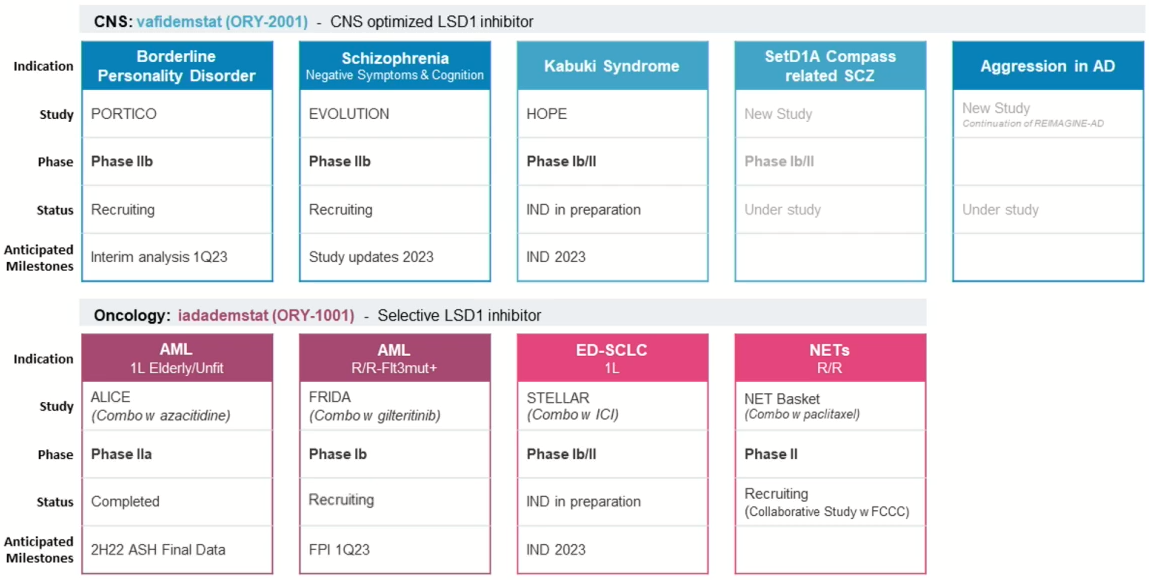
Following the completion of the ALICE trial, Oryzon’s clinical pipeline is continuing momentum with the next anticipated milestone coming in the form of the independent interim and top-line readouts from the PORTICO study. The independent analysis, based on the 90 patients enrolled within the study will provide futility assessment; top-line data are expected in Q423/H124. In oncology, Oryzon is strategically prioritising iadademstat in AML and now expects to initiate the Phase Ib FRIDA in Q123 (previously communicated in H222).
|
Exhibit 1: Oryzon clinical pipeline |
|
|
Source: Oryzon KOL event |
Positive AML results in ALICE turns attention to FRIDA
Oryzon finished 2022 on a positive note when it presented encouraging data readouts from the Phase IIa ALICE trial investigating its lead oncology asset iadademstat in combination with azacitidine, for the treatment of AML in newly diagnosed elderly/unfit patients. The study met its primary endpoints of safety and tolerability with no major non-haematological or organ-related toxicities. Notably, iadademstat displayed an encouraging efficacy profile, achieving an objective response rate (ORR) of 81% and median overall survival (mOS) of 11.1 months, significantly higher than previously reported values for azacitidine monotherapy (ORR: c 30%; mOS: c 7–8 months), although we note that comparison between trials must be undertaken with caution.
Oryzon intends to keep up the clinical pace of iadademstat in AML with the initiation of the Phase I FRIDA study in a subset of r/r AML patients (FLT3+), an indication that may represent a sizable opportunity in a market segment with less overall competition. The trial will investigate iadademstat in combination with Astella’s FDA-approved FLT3 inhibitor gilteritinib (Xospata) for patients with r/r FLT3+ AML in a second-line setting. In our view, a potentially noteworthy result from the ALICE study, and one that may provide insight into the upcoming Phase Ib FRIDA trial, was the observation that those evaluable AML patients (n=3) possessing an FLT3 mutation (FLT3+) all responded to iadademstat treatment. However, we acknowledge that the current data only represent a small number of patients so there may be limitations in extrapolating from this finding.
Additionally, the mOS for gilteritinib monotherapy in FLT3+ r/r AML patients is 9.3 months and, in our view, combinational treatments may provide scope for further improvements. In our recent Oncology ABCs report, we discussed combination therapies being critical for developing new efficacious treatment regimens in oncology and, should similar positive synergistic effects from iadademstat/gilteritinib be observed in patients enrolled in FRIDA, we believe this could represent a significant opportunity for Oryzon. Management had previously communicated that the FRIDA study would be initiated by end 2022, so we expect patient enrolment to start in Q123.
Oncology pipeline momentum continues in solid tumours
In January 2023 Oryzon announced it had enrolled the first patient into its collaborative Phase II trial investigating the use of iadademstat, in combination with paclitaxel for the treatment of r/r small cell lung cancer (SCLC) or high-grade (G3) neuroendocrine carcinomas (NECs). The trial is being conducted in collaboration with the Fox Chase Cancer Center, a leading investigational cancer institute in the US, with Oryzon providing funding, iadademstat and technical advice. In our view, the first patient enrolment marks a significant clinical milestone for the study, opening iadademstat’s potential expansion into additional indications.
The company is also looking to file an investigational new drug (IND) application to the FDA in 2023 for the Phase I/II (STELLAR) trial in first line metastatic SCLC (mSCLC), investigating the combination of iadademstat with immune checkpoint inhibitors (ICIs). The ICI atezolizumab (Tecentriq) has been approved as a first line treatment in mSCLC in combination with chemotherapy (carboplatin and etoposide). However, the treatment regime only offers modest improvements in overall survival (OS) compared to chemotherapy alone (median OS 12.3 vs 10.3 months) so an unmet need to achieve sustained disease control continues to exist. Additionally, preclinical studies suggest that LSD1 inhibitors may sensitise SCLC tumours to ICIs, offering potential synergistic benefits for the ICI/iadademstat combination, in our view. While management has communicated that it expects to submit an IND in 2023 for STELLAR, we might expect a slower trial initiation given the company’s strategic focus on FRIDA in AML.
Imago deal sets a precedent in LSD1
In Q422 Merck announced it would acquire the LSD1-focused biotech Imago Biosciences for $1.35bn ($36.00 per share in cash), news that saw Imago’s stock price jump by c 100% at the time. After completion of the deal in Q123, Oryzon has become one of the most advanced-stage independent LSD1 inhibitor players, as shown in Exhibit 2. Overall, we view the Merck/Imago deal as a highly encouraging precedent transaction in the LSD1 space. Additionally, with the global AML market expected to reach US$9.4bn by 2028 (EvaluatePharma) we see this as a potentially attractive opportunity that may trigger renewed interest from further big pharma players.
Exhibit 2: LSD1 targeting oncology pipeline
Company |
Drug |
Phase |
Indication/s |
Notes |
Oryzon |
Iadademstat |
First line AML r/r FLT3+ AML Neuroendocrine cancers |
Phase Ib FRIDA study in r/r FLT3+ AML expected to initiate in Q123 Phase II study in neuroendocrine cancers in combination with paclitaxel initiated in Q123 Preparing new Phase Ib/II trial (STELLAR) in mSCLC |
|
Imago Biosciences (Merck)* |
Bomedemstat |
Essential thrombocythemia myelofibrosis |
Trial readouts expected by end CY22. Merck announced acquisition of Imago for US$1.35bn |
|
Jubilant Therapeutics |
JB-802 |
Advanced solid tumours |
Targets both LSD1 and HDAC6 |
|
Salarius Pharmaceuticals |
Seclidemstat |
Ewing sarcoma |
Study currently on hold due to patient death classified as a suspected unexpected serious adverse reaction |
|
Bristol Myers Squibb / Celgene |
Pulrodemstat |
Solid tumours and non-Hodgkin lymphomas |
In combination with either an antibiotic (rifampin) or antifungal (itraconazole) |
|
Otsuka Pharmaceuticals (Astex Pharmaceuticals) |
TAS1440 |
r/r AML |
In combination with all-trans retinoic acid |
Source: EvaluatePharma Note: *Merck acquisition announced on 21 November 2022 and expected to close in Q1 CY23.
Catalyst approach for vafidemstat
Interim readouts in BPD in Q123
The most significant clinical news emerging from Oryzon’s ongoing CNS programmes came in the form of interim safety data from its Phase IIb randomised, double-blind PORTICO study, investigating the use of vafidemstat for the treatment of BPD. In September 2022 the company reported no serious adverse events from the first 43 patients enrolled in the trial and that approval for the study to continue had been granted by the PORTICO independent data-monitoring committee. The primary endpoints for the study are overall clinical BPD improvement and improvement in aggression. Interim analysis for 90 patients in PORTICO is anticipated in Q123, the results of which may dictate future patient enrolment (up to 156 are planned to be recruited), and final readouts expected in Q423. The current standard of care in BPD is often off-label prescribed anti-psychotic medications. These therapies act as a sedative; however, they do not treat the symptoms of psychosis observed in BPD patients. Additionally, anti-psychotics are associated with a significant side-effect burden such as weight gain, metabolic syndrome, cholesterol and sexual side effects. With no drugs specifically approved for the treatment of BPD, we see vafidemstat as a potential first to market drug within this indication and, with its observed safety profile to date, offering significant market differentiation against off-label anti-psychotics, provided it can demonstrate efficacy.
Valuation
We value Oryzon at €869m or €15.6/share, based on a risk-adjusted NPV analysis using a 12.5% discount rate and Q422 net cash of €4m. Our underlying long-term assumptions remain unchanged; however, we have rolled our model forward, updated our exchange rate assumption to $1.07/€ (from $1.06/€) and updated net cash. A breakdown of our rNPV valuation is shown in Exhibit 3, which includes five rNPV projects (for more details see our Outlook note). We have not yet included vafidemstat in Kabuki syndrome while we await trial initiation. We have also excluded iadademstat in G3-NECs pending further clinical data from the Phase II basket study to further define the target G3-NEC patient population.
Exhibit 3: Valuation of Oryzon
Product |
Indication |
Launch |
Peak sales ($m) |
Value |
Probability |
rNPV |
NPV/share (€/share) |
|
Iadademstat |
2L AML |
2026 |
500 |
777.8 |
30% |
229.1 |
4.1 |
|
1L SCLC |
2026 |
730 |
822.3 |
25% |
201.1 |
3.6 |
||
Vafidemstat |
BPD |
2027 |
1,610 |
1,284.0 |
20% |
247.7 |
4.5 |
|
Schizophrenia, negative symptoms |
2027 |
700 |
646.4 |
15% |
89.9 |
1.6 |
||
Aggression in Alzheimer’s disease |
2028 |
910 |
686.4 |
15% |
97.2 |
1.7 |
||
Net cash end FY22 |
4.0 |
100% |
4.0 |
0.1 |
||||
Valuation |
|
|
|
4,220.9 |
869.0 |
15.6 |
||
Source: Edison Investment Research
Financials
Oryzon’s total operational expenses (excluding COGS) stood at €21.0m in FY22, 23.1% (y-o-y) higher than €17.0m in FY21. R&D expenses (€13.7m) constituted c65% of operating expenses in FY22, increasing 40.4% (y-o-y) in FY22 compared to €9.5m in FY21. The higher external R&D expenses were mainly attributed to related CRO service fees for the clinical development of Phase Ib/II clinical trials for iadademstat and vafidemstat molecules, along with preclinical stage projects. Free cash flow (outflow) for the company was 5.0% higher to €16.1m in FY22 from €15.4m in FY21.
Following the FY22 results, we have updated our FY23 estimates and have now introduced FY24 estimates. We forecast FY23 total operating expenses of €20.6m (previously €16.4m), in line with FY22 (€21.0m); however, we expect expenses to grow further in FY24 to €24.0m. We estimate R&D expenses to increase to €17.0m and €24.0m in FY23 and FY24, respectively, as Oryzon continues to progress its assets into later stage clinical studies. We estimate an increase in net cash outflow from operations to €2.8m in FY23 and €7.0m in FY24, respectively, in line with current operational spending and increased R&D activity. In our model, we project that Oryzon will launch its first product into the market in FY26.
In FY22, the company announced that it has entered into a convertible bonds financing agreement with a Swiss institutional investor, Nice & Green, to raise up to €20m over 30 months. The raise is designed to help capitalise the company past key inflection points from ongoing clinical trials in FY22, FY23 and fund clinical development into H124. The financing agreement consists of four tranches, including an initial tranche of €8m, followed by three optional future tranches of €4m each, to be executed at Oryzon’s request, subject to customary conditions. By end-FY22, the company subscribed to €8m convertible bonds out of the total €20m plus additional €2m bonds subscription (for €1m arrangement fee and €1m contractual deposit amount) totalling to 100 bonds. Out of the 100 bonds (nominal value of 100k each) subscribed by end FY22, the company had converted 55 bonds into shares with 45 outstanding. We have modelled this as repayment of debt in our model.
Post the reporting period, the company drew a further €4m in a second tranche in January 2023 as part of the financing agreement against 40 convertible bonds. Additionally, we note that in January 2023 the company converted a further 19 bonds into shares. This results in a total of 66 bonds outstanding for conversion as of January 2023.
Based on our forecast cash burn rate and gross cash position (€21.3m) in FY22, we estimate that, excluding debt repayment obligations, Oryzon has a cash runway to H124. We note the company had bank borrowings of €14.0m by end FY22 and €3.3m of convertibles bonds, which are likely to be converted to common shares (similar to previous bonds under the same financing agreement). Considering debt repayments due in FY23, we estimate the need to raise €8m in FY23 and further €20m in FY24 and €22m in FY25. Out of the total €50m cash requirement (shown as illustrative debt), the company may raise €12m through the remaining convertible bond agreement using three optional tranches (€4m already raised through the agreement in January 2023). Alternatively, if the funding is realised through an equity issue instead (assuming at the current trading price of €2.11/share), Oryzon would have to issue 23.7m shares, resulting in our per-share valuation coming down to €11.0/share from $15.6 currently (shares outstanding would increase from 55.6m to 79.3m).
Exhibit 4: Financial summary
Accounts: Year end 31 December (€000s) |
2021 |
2022 |
2023e |
2024e |
INCOME STATEMENT |
|
|
|
|
Total revenues |
10,615 |
15,698 |
17,268 |
18,995 |
Cost of sales |
(746) |
(464) |
(487) |
(512) |
Gross profit |
9,869 |
15,234 |
16,781 |
18,483 |
Gross margin % |
93% |
97% |
97% |
97% |
SG&A (expenses) |
(3,782) |
(3,163) |
(3,479) |
(3,827) |
R&D costs |
(9,746) |
(13,681) |
(16,975) |
(23,975) |
Other income/(expense) |
(3,203) |
(3,714) |
0 |
0 |
Exceptionals and adjustments |
(4) |
0 |
0 |
0 |
Reported EBITDA |
(6,866) |
(5,323) |
(3,673) |
(9,318) |
Depreciation and amortisation |
144 |
167 |
149 |
131 |
Reported EBIT |
(7,011) |
(5,490) |
(3,822) |
(9,450) |
Finance income/(expense) |
(169) |
(871) |
(426) |
(579) |
Other income/(expense) |
0 |
(195) |
0 |
0 |
Reported PBT |
(7,180) |
(6,557) |
(4,248) |
(10,029) |
Income tax expense (includes exceptionals) |
2,493 |
2,325 |
2,409 |
2,367 |
Reported net income |
(4,687) |
(4,231) |
(1,839) |
(7,662) |
Basic average number of shares, m |
53.1 |
54.3 |
55.6 |
55.6 |
Basic EPS (p) |
(0.09) |
(0.08) |
(0.03) |
(0.14) |
|
|
|
|
|
Adjusted EBITDA |
(6,862) |
(5,323) |
(3,673) |
(9,318) |
Adjusted EBIT |
(7,007) |
(5,490) |
(3,822) |
(9,450) |
Adjusted PBT |
(7,176) |
(6,361) |
(4,248) |
(10,029) |
Adjusted EPS (€) |
(0.09) |
(0.07) |
(0.03) |
(0.14) |
Adjusted diluted EPS (€) |
(0.09) |
(0.07) |
(0.03) |
(0.14) |
|
|
|
|
|
BALANCE SHEET |
|
|
|
|
Property, plant and equipment |
682 |
611 |
538 |
482 |
Intangible assets |
60,254 |
75,843 |
87,460 |
99,926 |
Investments |
29 |
31 |
31 |
31 |
Deferred tax assets |
1,812 |
2,050 |
2,050 |
2,050 |
Total non-current assets |
62,778 |
78,535 |
90,078 |
102,489 |
Cash and equivalents |
28,725 |
21,317 |
5,152 |
496 |
Trade and other receivables |
3,645 |
3,709 |
3,677 |
3,693 |
Inventories |
104 |
10 |
10 |
10 |
Other current assets |
132 |
129 |
129 |
129 |
Total current assets |
32,606 |
25,165 |
8,968 |
4,328 |
Deferred tax liabilities |
1,812 |
2,050 |
2,050 |
2,050 |
Long term debt* |
13,354 |
10,346 |
14,486 |
31,877 |
Other non-current liabilities |
285 |
0 |
0 |
0 |
Total non-current liabilities |
15,451 |
12,396 |
16,536 |
33,927 |
Trade and other payables |
3,518 |
5,742 |
4,630 |
5,186 |
Short term debt |
4,306 |
12,920 |
7,077 |
4,562 |
Other current liabilities |
847 |
70 |
70 |
70 |
Total current liabilities |
8,672 |
18,732 |
11,777 |
9,818 |
Equity attributable to company |
71,262 |
72,572 |
70,733 |
63,071 |
|
0 |
0 |
0 |
0 |
CASH FLOW STATEMENT |
|
|
|
|
Profit before tax |
(7,180) |
(6,557) |
(4,248) |
(10,029) |
Cash from operations (CFO) |
(3,626) |
(1,848) |
(2,770) |
(6,991) |
Capex |
(175) |
(76) |
(76) |
(76) |
Acquisitions & disposals net |
0 |
0 |
0 |
0 |
Acquisition of intangible assets |
(11,586) |
(14,195) |
(11,617) |
(12,466) |
Other investing activities |
37 |
(1) |
0 |
0 |
Cash used in investing activities (CFIA) |
(11,724) |
(14,271) |
(11,693) |
(12,542) |
Net proceeds from issue of shares |
0 |
(932) |
0 |
0 |
Movements in debt |
4,123 |
9,642 |
(1,703) |
14,877 |
Other financing activities |
0 |
0 |
0 |
0 |
Cash from financing activities (CFF) |
4,123 |
8,710 |
(1,703) |
14,877 |
Increase/(decrease) in cash and equivalents |
(10,880) |
(7,408) |
(16,165) |
(4,656) |
Currency translation differences and other |
348 |
1 |
0 |
0 |
Cash and equivalents at start of period |
39,605 |
28,725 |
21,317 |
5,152 |
Cash and equivalents at end of period |
28,725 |
21,317 |
5,152 |
496 |
Net (debt) cash |
14,954 |
3,975 |
(3,094) |
(2,648) |
Source: Oryzon Genomics, Edison Investment Research. Note: Long-term and short debt also include derivatives and other financial liabilities. Oryzon reports in Spanish GAAP. *Includes cash outflows related to development costs that were capitalised.
|
|
Research: Investment Companies
European Opportunities Trust’s (EOT’s) manager, Alexander Darwall, invests in globally focused companies with unique technologies, comparative advantages and multiple growth channels, with the aim of constructing a resilient portfolio capable of generating capital growth in all economic climates. This strategy has delivered positive returns and outperformance over the long term; in the 10 years to end February 2023, the portfolio has made an average annualised return of 9.1% in NAV terms, compared to a benchmark return of 8.1% on the same basis. Nearer-term performance has been disappointing, and the share price discount has widened, despite the fact that most of EOT’s portfolio holdings are performing well. Manager Alexander Darwall expects positive news from several of his ‘special’ companies over the coming year, which should boost performance, and he is confident his strategy and patience will continue to pay off for shareholders over the longer term.