Last close As at 05/08/2026
GBP6.48
▲ 15.00 (2.37%)
Market capitalisation
GBP1,121m
Research: Investment Companies
Molten Ventures has recently faced pressure on tech valuations and muted deal activity from macroeconomic headwinds. That said, management reflected the lower public multiples in Molten’s H123 valuations, with greater stabilisation occurring in H223 (gross portfolio value was down 19% excluding FX in FY23 but only 2% in H223). Molten now offers exposure to a curated portfolio of 70+ assets at a significant discount to NAV. Management remains confident the portfolio is well funded, with 80% of the Core portfolio having a cash runway of more than 18 months on current projections, and expects weighted average top-line growth of over 65% in 2023 across the Core portfolio. Therefore, it still assumes a limited £20m funding requirement across the portfolio in FY24.
Molten Ventures |
Cash is king |
Investment trusts |
24 July 2023 |
Analysts
|
||||||||||||||||||||||||||||||||||||||||||||||||||||||||||||||||||||||||||||||||||||||||||||||||||||||||||||||||||||||
Molten Ventures has recently faced pressure on tech valuations and muted deal activity from macroeconomic headwinds. That said, management reflected the lower public multiples in Molten’s H123 valuations, with greater stabilisation occurring in H223 (gross portfolio value was down 19% excluding FX in FY23 but only 2% in H223). Molten now offers exposure to a curated portfolio of 70+ assets at a significant discount to NAV. Management remains confident the portfolio is well funded, with 80% of the Core portfolio having a cash runway of more than 18 months on current projections, and expects weighted average top-line growth of over 65% in 2023 across the Core portfolio. Therefore, it still assumes a limited £20m funding requirement across the portfolio in FY24.
|
Molten’s CEO discusses the company’s FY23 results |
|
|
Source: Edison Investment Research |
European VC an attractive way to gain tech exposure
European VC offers an expanding pool of opportunities, with deal values growing by 24% pa in 2018–22 (vs 11% for US VC). This makes it a compelling route to gaining exposure to the European tech sector, especially given the limited options in European public markets (eg in SaaS), companies staying private for longer and superior historical VC returns versus public markets. PitchBook highlights that the improved regulatory framework for startups has assisted deal activity and capital inflows from outside Europe, with US participation in European VC deals (by count) at 23.0% in 2022 (12.6% in 2018). That said, average European VC valuations are still below the US market, offering greater value discovery potential.
Why consider Molten Ventures now?
As a well-established listed VC player in Europe, Molten provides exposure to a diverse portfolio of high-growth technology companies across enterprise software, hardware and deeptech, as well as digital health and wellness, which are otherwise hard to access. We note that the impact of any further near-term market downturn on Molten’s share price may be at least partially cushioned by (1) direct investments largely made through preference shares; (2) its shares trading at a 66% discount to last reported NAV, with the latter already reflecting an average 35% discount to the last funding round applied to c 31% of its portfolio; and (3) a high portfolio weighting to enterprise software (52% at end-March 2023).
The Molten Ventures advantage
We believe several factors help to differentiate Molten Ventures from competing investment propositions, which we discuss below.
Rare pure tech exposure
The UK and European public markets offer only limited exposure to the technology sector, which in some areas is characterised by a shrinking pool of opportunities (see for example the recent takeovers of Aveva and Micro Focus in the software space). Software-as-a-service (SaaS) business models and digitalisation mean start-ups are far more capital efficient than they have been in the past. When coupled with better access to private capital in Europe, companies have not needed to list to access the capital required to drive growth. This means companies can stay private for longer, avoiding the cost, governance issues and short-termism that can be found on the public markets. This has allowed private company investors (and entrepreneurs) to retain far more of the value created by Europe’s successful start-ups. Molten Ventures was the first venture capital firm to list in London in 2016 and provides liquid exposure to this asset class through a diversified portfolio of high-growth, private technology businesses, which are otherwise hard to access.
Established reputation as a ‘go-to’ VC investor
As an early mover and market leader in the European venture capital (VC) sector (with 66 full-time employees based in offices in London and Dublin), Molten Ventures has cemented its reputation as an investor of choice. This creates a virtuous circle where, through its partnerships, relationships and track record, Molten can attract top-tier entrepreneurs and businesses, improving its chances of offering superior returns to investors. Molten Ventures sources investment opportunities through the following principal channels:
■
directly through the group’s market presence and established reputation;
■
through its membership of the international Draper Venture Network;
■
through investments in seed fund of funds (see below for details), which also drive brand/network benefits from supporting the ecosystem; and
■
through Earlybird Digital, a seed and Series A investor based in Germany (with offices in Berlin, Munich and Istanbul) and Molten’s co-investment partner and manager of seed funds, some of which Molten has invested in. The importance of Molten’s partnership with Earlybird is illustrated by the fact that two of Molten’s 17 core portfolio holdings at end-March 2023 and eight of its 53-strong emerging portfolio had emerged from Earlybird’s investment portfolio (see Exhibit 1).
|
Exhibit 1: The continued importance of Molten’s partnership with Earlybird by number of portfolio holdings |
|
|
Source: Molten Ventures |
Molten’s investment approach is more entrepreneur-friendly than the typical US VC model, which sifts potential winners from losers and can aggressively cut underperforming investments. Molten prioritises using resources on its more successful investments, but still devotes time and effort towards its lower-performing companies to help them achieve exits where possible and release value back to Molten’s portfolio. As a rule of thumb, Molten’s management expects 30% of its investments to deliver strong returns, 60% to deliver returns of 0.5–2.0x money invested and only 10% to be write-offs. Historically, around 43% of Molten’s full and partial exits since IPO (by invested capital) returned a multiple on invested capital (MOIC) of more than 3.0x, with a further 27% returning a MOIC of 1.0–3.0x. The remaining investments delivered a positive MOIC but were below 1.0x (18%) or were written off in full (12%).
A one-stop-shop, diversified by segment, investment stage and vintage
While Molten is focused exclusively on technology, it offers a diversified portfolio of c 70 direct investments across different vintages and stages of investment in four technology sectors (see Exhibit 2). Its core portfolio comprises its 17 largest holdings, representing 61.5% of its gross portfolio value at end-March 2023 (see Exhibit 3).
|
Exhibit 2: Molten’s portfolio by sector |
|
|
Source: Molten Ventures |
Exhibit 3: Summary of Molten’s portfolio at end-March 2023
Company name |
Sector |
Location |
Fair value |
Share in gross portfolio value |
||
ThoughtMachine |
Hardware and deeptech |
UK |
109.6 |
8.0% |
||
CoachHub |
Enterprise tech |
Germany |
96.6 |
7.0% |
||
Aiven |
Enterprise tech |
Finland |
94.5 |
6.9% |
||
Ledger |
Hardware and deeptech |
France |
71.8 |
5.2% |
||
Aircall |
Enterprise tech |
France |
58.6 |
4.3% |
||
Revolut |
Consumer tech |
UK |
54.5 |
4.0% |
||
Form3 |
Enterprise tech |
UK |
52.4 |
3.8% |
||
M-files |
Enterprise tech |
US |
44.9 |
3.3% |
||
RavenPack |
Enterprise tech |
Spain |
41.0 |
3.0% |
||
Graphcore |
Hardware and deeptech |
UK |
37.2 |
2.7% |
||
ICEYE |
Hardware and deeptech |
Finland |
35.7 |
2.6% |
||
Endomag |
Digital health and wellness |
UK |
34.0 |
2.5% |
||
FintechOS |
Enterprise tech |
UK |
28.3 |
2.1% |
||
ISAR Aerospace |
Hardware and deeptech |
Germany |
27.4 |
2.0% |
||
HiveMQ |
Hardware and deeptech |
Germany |
20.9 |
1.5% |
||
Schüttflix |
Enterprise tech |
Germany |
21.1 |
1.5% |
||
Primary Bid |
Consumer tech |
UK |
14.7 |
1.1% |
||
Core portfolio |
|
|
843.2 |
61.5% |
||
Remaining portfolio |
|
|
526.4 |
38.4% |
||
Total portfolio |
|
|
1,369.6 |
|
||
Co-invest |
|
|
1.1 |
|
||
Gross portfolio value |
|
|
1,370.7 |
|
||
Carry external |
|
|
(94.0) |
|
||
Portfolio deferred tax |
|
|
0.0 |
|
||
Trading carry and co-invest |
|
|
0.3 |
|
||
Non-investment cash movement |
|
|
0.0 |
|
||
Net portfolio value |
|
|
1,277.0 |
|
||
Source: Molten Ventures
Molten’s focus is on series A+ rounds, with its ‘sweet spot’ being investments in series B and C rounds, though it also invests directly in series A rounds (see Exhibit 4). This approach means that Molten can diversify its portfolio and ensure it has investee companies ready for realisation and investment through the economic cycle. Furthermore, through its fund-of-funds strategy (launched in October 2017), it has made an aggregate of £148m commitments to 75 specialist seed funds across the UK and Europe as of end-March 2023 (with 18 commitments into new seed funds in FY23 alone), which provide exposure to more than 1,800 companies. This exposure provides Molten with privileged access to a pipeline of attractive early-stage opportunities (including emerging investment trends) for potential follow-on investments. Molten requires that each of the seed managers in its programme is either a subject matter expert or geographical expert.
|
Exhibit 4: Overview of investment vehicles within the Molten group |
|
|
Source: Molten Ventures |
Generating income from managing third-party capital
Apart from investing from its own balance sheet, Molten also manages c £0.4bn in third-party capital through its tax-advantaged co-investment vehicles: Enterprise Investment Schemes (EIS) and its Venture Capital Trust (Molten Ventures VCTs), focused on early-stage VC investments (Series A in particular). Molten generated £23m in fee income (from management and director fees, see Exhibit 5) in FY23, which almost fully covered its operating expenses (the net expense ratio was below 0.1%, visibly below the targeted 1%).
|
Exhibit 5: Molten’s fee income and net expense ratio |
|
|
Source: Molten Ventures |
Over time, Molten intends to increase its fee income above its operating costs, though we assume that its earlier plan to launch a growth (ie Series B+) co-investment fund has been put on hold given the less favourable market environment. Molten’s management sees further opportunities to grow third-party assets arising from the increased political focus in the UK on attracting long-term capital into the venture ecosystem. Climate tech, AI and the emerging tech ecosystems in Central and Eastern Europe are considered areas with significant potential.
Growing importance of key European VC hubs
Molten Ventures offers high-quality exposure to the vibrant European VC sector, which has been growing dynamically in terms of deal volumes in recent years (see Exhibit 6). In part, this growth reflects the overall growth in the asset class globally, with assets under the management of VC funds expanding from €60bn in 2013 to €300bn in 2022, with one of the main drivers being non-traditional VC investors, according to PitchBook. At the same time, above-average growth in European VC has led to a gradual narrowing of the gap with the US VC market. Based on end-year US$/€ FX rates, we calculate European VC deal values represented 45% and 36% of US VC deal values in 2022 and 2021 respectively compared to c 20–25% in 2013–16 (based on PitchBook data).
|
Exhibit 6: European VC deal value in €bn |
Exhibit 7: US VC deal value in US$bn |
|
|
|
Source: PitchBook Q2 2023 European Venture Report. Note: *As at end-June 2023. |
Source: PitchBook-NVCA Venture Monitor Q223 First Look and Q123. Note: *As at end-June 2023. |
|
Exhibit 6: European VC deal value in €bn |
|
|
Source: PitchBook Q2 2023 European Venture Report. Note: *As at end-June 2023. |
|
Exhibit 7: US VC deal value in US$bn |
|
|
Source: PitchBook-NVCA Venture Monitor Q223 First Look and Q123. Note: *As at end-June 2023. |
PitchBook recently highlighted that key European VC hubs have improved their regulatory framework for startups in recent years. This has stimulated deal activity and capital inflows from outside of Europe, leading to an increase in European VC activity with US participation to 23.0% in 2022 and 19.0% in 2023 to date (as of end-June 2023) versus 12.6% in 2018 (see Exhibit 8). Continued growth in deals with US participation could help further narrow the valuation gap between US and European VC deals.
|
Exhibit 8: European VC deal count with US investor participation |
|
|
Source: PitchBook |
More recently, deteriorating macroeconomic conditions, coupled with a de-rating in public equity markets and a normalisation of monetary policy after the ultra-low interest rate environment of previous years, have had an impact on both deal volumes and valuations in the VC market, given that VC-backed companies are long-duration assets and therefore more sensitive to a changing rates environment. This has also triggered investor concerns over the pressure on cash runways of high-growth, unprofitable businesses backed by VC and growth equity funds. Nevertheless, we note that VC fund-raising remained solid in 2022 at €28.0bn (vs €28.8bn in 2021), according to PitchBook (see Exhibit 9). So far in 2023, VC funds have raised €8.9bn (as of end-June 2023). Coupled with a more cautious capital deployment of VC funds recently, this has kept VC dry powder (ie funds available to invest) at a relatively high €43bn as at end-May 2023. Once investor sentiment improves, the dry powder could prove supportive to deal volumes and valuations.
|
Exhibit 9: European VC fund-raising |
|
|
Source: PitchBook. Note: *As at end-June 2023. |
While the current challenges may weigh on VC returns in the near term, it is worth keeping in mind the superior returns this asset class has delivered over the long term. The horizon pooled return of the Cambridge Associates US Venture Capital Index over the 10 years to end-2022 stands at c 18.7% pa, ahead of the modified public market equivalent (mPME) of the US small-cap Index (as calculated by Cambridge Associates, CA) at 9.5% pa. CA’s VC index also outperformed the public markets over the 20 and 25 years to end-2022, with respective returns of c 12.2% and 25.4% pa versus the respective mPME US small-cap Index returns of c 9.7% and 7.9% pa. It also outperformed the mPME Nasdaq Composite Index over the 10-year and 25-year periods by c 300bp and 1,551bp respectively, while its performance over 20 years was broadly in line.
Initial signs of stabilisation in valuations in H223
Molten’s gross portfolio value declined by 16% in FY23 (to end-March 2023) or 19% excluding the FX impact, reversing some of the 37% gains posted in FY22. That said, most of the fall was recognised in the first half of the fiscal year, with an H223 decrease of just 2% excluding FX. The latter represents a £29m markdown, as £79m of uplifts were offset by £108m of reductions. Key contributors, accounting jointly for 7.7pp of the decline in gross portfolio fair value excluding FX in FY23, were Graphcore (a machine learning semiconductor company; its fair value was marked down close to 70% on the back of, among others, a cancelled deal with Microsoft in autumn last year) and Revolut (which was marked down by c 44% in FY23, mostly in H123). Molten’s net asset value (NAV) was down by close to 17% in FY23.
We note that the pressure on valuations (the enterprise values of Molten’s ‘Core’ holdings fell by c 37% in FY23) was partly cushioned by liquidation preferences, as 97% of its ‘Core’ investments are structured as preferred shares. Around 55% of the total portfolio (by latest fair value) was valued at levels triggering the preference stack protection at end-March 2023. Here, we note that Molten’s fair value of its emerging portfolio (£526m) is only marginally above the investment cost of c £500m.
The valuation markdowns were accompanied by a robust c 40% value-weighted revenue growth in the calendar year to end-December 2022 across Molten’s ‘Core’ portfolio (though below the expected 60–65%, partly due to the greater focus on cash preservation). The company expects continued high top-line growth of its ‘Core’ holdings in 2023 at over 65%, see Exhibit 10.
|
Exhibit 10: Expected ‘Core’ portfolio revenue growth in 2023 versus 2022 |
|
|
Source: Molten Ventures |
Molten has delivered an NAV TR since IPO of c 14% pa
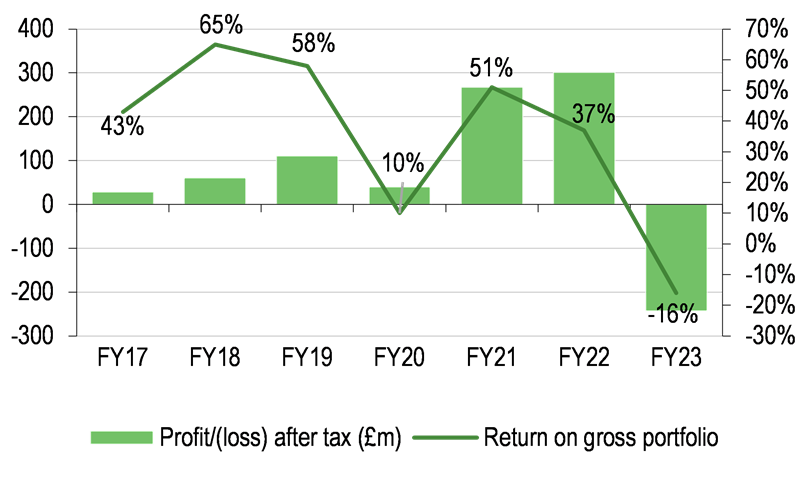
Between FY17 and FY23, Molten delivered a 35% average gross return (defined as profit after tax over gross portfolio value), versus its 20% target through the cycle (see Exhibit 11). Importantly, it has generated cash realisations of £487m since IPO (18% pa on opening portfolio on average, see below for details), compared to c £1bn of investments made by Molten in FY17–23. After accounting for the share issues carried out in recent years, we estimate that Molten has posted an NAV total return (TR) of c 14% per year since its IPO in FY17 (c 21% per year between the IPO date and end-March 2022, see Exhibit 12). This has not been accompanied by a similar share price TR, due to the c 40% sell-off over the last 12 months induced by investors’ anxiety over macroeconomic pressures on valuations and the cash runways of VC and growth-stage businesses.
|
Exhibit 11: Molten’s return on gross portfolio since IPO |
Exhibit 12: Molten’s NAV TR since IPO |
|
|
|
Source: Molten Ventures |
Source: Molten Ventures, Edison Investment Research |
|
Exhibit 11: Molten’s return on gross portfolio since IPO |
|
|
Source: Molten Ventures |
|
Exhibit 12: Molten’s NAV TR since IPO |
|
|
Source: Molten Ventures, Edison Investment Research |
The universe of listed investment companies focused on unquoted tech investments is quite diverse, so it is difficult to make a reliable comparison of Molten’s returns to these peers. On one side of the spectrum, there are listed private equity (PE) companies such as HgCapital Trust and Oakley Capital Investments, which delivered very strong returns in recent years, ahead of Molten’s NAV TR (see Exhibit 13). That said, we note that listed PE companies normally invest in more mature, profitable businesses (whose valuations were so far less affected by the recent market downturn) and there are certain differences in portfolio exposures between Molten and these two listed PE companies. HgCapital Trust focuses exclusively on software and services businesses (serving primarily SMEs), while Oakley’s focus is on trends such as migration to the cloud, the consumer shift to online and growing demand for quality, accessible learning. Therefore, they are less exposed to hardware and deeptech, which is Molten’s second-largest portfolio exposure and covers a diverse set of businesses offering proprietary innovation. These businesses are active in the fintech space (eg Thought Machine), digital asset custody (Ledger), processors for machine learning (Graphcore), spacetech (ICEYE, ISAR Aerospace, Satellite Vu), AI-powered software (automation hero, causaLens), operating systems for quantum computing (Riverlane), graphene applications (Paragraf), cybersecurity/fraud detection (Ravelin, Vaultree) and the metaverse (Hadean), among others. Consequently, some investors may consider Molten Ventures as a complement (or alternative) to their holdings in tech-focused listed PE players.
At the same time, the listed VC and growth equity peers include some companies that listed quite recently (eg Seraphim Space Investment Trust, Forward Partners) and as a result have a limited track record in terms of returns. Peers that can present at least five years of returns have delivered a wide range of outcomes so far (see below for details). We also note that Molten Ventures is one of the largest listed VC investment companies by market cap (despite its wide discount to NAV).
Exhibit 13: Selected peer group at 24 July 2023*
% unless stated |
Market cap |
NAV TR |
NAV TR |
NAV TR |
Discount |
Molten Ventures |
412.0 |
(16.8) |
40.5 |
87.4 |
(65.5) |
HgCapital Trust |
1,730.2 |
10.3 |
108.7 |
173.9 |
(19.7) |
Oakley Capital Investments |
785.1 |
17.8 |
99.9 |
190.1 |
(33.4) |
IP Group |
610.7 |
(19.7) |
25.7 |
8.0 |
(55.7) |
Seraphim Space Investment Trust |
90.6 |
1.0 |
N/A |
N/A |
(64.0) |
Augmentum Fintech |
185.3 |
2.4 |
36.8 |
N/A |
(31.7) |
Forward Partners Group |
33.0 |
(30.8) |
N/A |
N/A |
(66.0) |
TMT Investments |
74.8 |
(20.3) |
99.7 |
219.7 |
(52.4) |
VNV Global AB |
236.0 |
(68.0) |
(66.9) |
(67.4) |
(27.7) |
Simple average |
428.5 |
(10.6) |
45.4 |
90.2 |
(44.4) |
Source: Morningstar, Edison Investment Research. Note: *NAV performance in sterling terms based on end-March 2023 NAV, or latest earlier available NAV (end-December 2022 for IP Group, Forward Partners and TMT Investments).
Trading at a wide 66% discount to NAV
Molten adopts a relatively conservative approach to portfolio valuation. It predominantly relies on the last funding round (49% of the portfolio at end-March 2023, see Exhibit 14), which is calibrated to account for movements in the revenue multiples of public peers since the deal closure, as well as any subsequent technical or product milestones and the trading performance of the company compared to expectations at the time of the funding round. A further 34% of the private portfolio (eg Revolut, CoachHub) was valued relative to peers based on forward revenue multiples. Here, the weighted average revenue multiple was 8.4x at end-March 2023 vs 7.8x at end-March 2022, which may be at least partially due to the recovery in public tech stocks recently. The remaining 17% of the private portfolio represents Molten’s fund-of-fund investments, valued based on net asset values provided by general partners.
|
Exhibit 14: Molten’s portfolio by valuation method (end-March 2023) |
Exhibit 15: Molten’s portfolio by valuation method (end-March 2022) |
|
|
|
Source: Molten Ventures |
|
Exhibit 14: Molten’s portfolio by valuation method (end-March 2023) |
|
|
Source: Molten Ventures |
|
Exhibit 15: Molten’s portfolio by valuation method (end-March 2022) |
|
|
Source: Molten Ventures |
Molten’s aim is to reflect the revenue trajectory in its carrying values (rather than the full prospective growth path, which normally determines valuations of funding rounds), as it prefers to gradually recognise the ‘success story’ of its portfolio winners. As a result, Molten applied a valuation discount to 65% of the holdings valued based on last funding round (vs 52% at end-March 2022), ranging from 6% to 79%, with a weighted average discount of 35% (up from 25% at end-March 2022). We estimate that the overall discount applied to holdings valued using the last funding round implies a c 12% discount embedded within Molten’s NAV. In this context, we note that c 35% of Molten’s portfolio holdings (by fair value) completed the last funding round within the 12 months to end-March 2023 (41% across Molten’s Core portfolio).
The above-mentioned discount is on top of the 66% discount to reported NAV at which Molten’s shares currently trade (compared to a double-digit premium until around mid-2021). Some additional support to Molten’s valuations comes from the fact that over the last three financial years, Molten posted an average uplift to last fair value in the final year of holding a realised asset of c 10% (although this also covers 2021, when conditions were particularly buoyant). We also believe that the fundraising across the portfolio over the twelve months to end-March 2023 (see below) is a good validation of Molten’s fair values.
Sufficient liquidity, absent any major cash injections requirements and writedowns across the portfolio
VC investors such as Molten Ventures are operating against a backdrop of a very low realisation activity, with European exit value in Q223 at only €0.9bn vs €15.0bn in Q222, according to PitchBook (see Exhibit 16).
|
Exhibit 16: European VC exit value (€bn) |
|
|
Source: PitchBook. Note: *At end-June 2023 |
New credit facility and secondary sale of fund investments
In response to the weaker market environment, Molten improved its holding-level liquidity in FY23 by securing a new £150m credit facility (upsized from £60m previously) with JP Morgan Chase Bank and Silicon Valley Bank (SVB) to strengthen its balance sheet flexibility. The facility bears an interest rate of SONIA plus 5.5% per year on drawn amounts and has a three-year maturity, with the option to extend it twice by a year each. The facility has a maximum loan-to-value covenant at 10% on drawn amounts. We calculate that, based on the end-March 2023 gross portfolio value, this limits Molten’s available undrawn part of the facility to c £47m. Management highlighted that there was no impact on the facility from the change of ownership of SVB to HSBC UK Bank in March 2023.
Moreover, Molten syndicated part of its fund-of-funds programme, with Castlegate Investments acquiring a proportion of Molten’s existing seed portfolio for €15m (c £13m) and making another €15m of commitments for future investments. Together with £23m of cash and £10m in listed holdings, we calculate that Molten’s available liquidity was £80m at end-March 2023. This will be further assisted by the proceeds from the recently agreed secondary sale for 10% their Earlybird Fund VI investment, realising c £13m (the company did not disclose at what discount to NAV the transaction will be carried out), bringing Molten’s available resources to c 7% of gross portfolio value.
If the subdued exit environment persists in the coming quarters, the above-mentioned liquidity would have to largely cover (1) new primary and follow-on investments, including capital calls from the funds Molten has outstanding commitments to; (2) operating expenses (net of fee income); and (3) interest on the drawn part of its debt facility (Molten’s interest and other expenses on loans and borrowings stood at £7.1m in FY23).
Outstanding fund commitments of £70m, expected direct portfolio funding requirement of £20m in FY24
Molten’s outstanding commitments to seed and early-stage fund-of-funds programmes was £70m at end-March 2023, which management expects to be drawn over three to five years. On top of this, management reiterated its expectations of the funding requirement across its portfolio in FY24 at a moderate £20m. More than £1bn of capital was raised during 28 funding rounds across the portfolio over the last 12 months (to end-March 2023). Importantly, over 90% of these were up-rounds or flat rounds, which is ahead of the broader European VC market, where 85% and 81% of the rounds (by count) in 2022 and Q123 were up or flat rounds, according to PitchBook (see Exhibit 17). Major funding rounds completed by Molten’s core holdings so far in 2023 include Ledger (€62m Series C extension in March 2023), Isar Aerospace (€155m Series C in March 2023) and Schüttflix (€16m Series A extension in February 2023).
|
Exhibit 17: Share of VC deal count by up/down/flat rounds |
|
|
Source: PitchBook. Note: *At end-March 2023 |
Consequently, management believes the portfolio is well funded, with 80% of the Core portfolio having a cash runway of more than 18 months on current projections (although this excludes some companies with limited information rights, eg Revolut).
In terms of its direct VC investments, Molten has the flexibility to adjust capital deployment as it deems fit (subject to any deals it has agreed to but not yet closed). This has been reflected in its more cautious approach to new investments in H223 (see below). Finally, the company’s operating costs excluding financial expenses of £23.9m in FY23 (FY22: £26.6m) were largely covered by its £23m fee income (management and director fees) from managing third-party capital. Consequently, we believe the liquid resources available to Molten should be sufficient to cover its near-term liquidity needs, on the condition that the required cash injections into portfolio companies are not considerably above the £20m guided by the management and that its portfolio value does not deteriorate significantly (which would further limit Molten’s ability to draw down on the remaining part of its credit facility). At the same time, the above implies that, absent any major pick-up in realisations, Molten’s firepower for new investments is rather limited for now.
More cautious approach to new investments
Molten invested £138m in FY23 (vs the targeted £150m and £311m in FY22), mostly in H123 (£112m) with higher focus on capital preservation in H223. This includes eight primary investments (£61m), as well as follow-ons/secondaries into 17 companies. We note that Molten’s follow-on investments in existing holdings amounted to £44m in FY23, which equals 72% of the primary investments during the fiscal year – broadly in line with the c 50–120% range over the last five years and representing just 3% of opening NAV (see Exhibit 18). Consequently, it seems that there was no elevated liquidity pressure across the portfolio in FY23 that would require sizeable capital injections from Molten.
|
Exhibit 18: Molten’s investments by type (£m) |
|
|
Source: Molten Ventures |
We also note that 80% of the amount spent on primaries and follow-ons was invested in enterprise technology businesses, with some examples including:
■
Friday Finance (primary, Series A) – a finance management platform
■
Settlemint (primary, Series A) – a platform for building blockchain applications for enterprises
■
CoachHub (follow-on, Series B extension) – a provider of a global talent development platform
Molten’s new investments in FY23 were skewed towards early-stage VC (Series A) investments (70% of Molten’s FY23 investments vs c 10–30% in FY18–FY22), while its general investment approach is to make most direct investments into later-stage companies (Series B and later). We believe this reflects Molten’s cautiousness in terms of committing larger ticket sizes to investments whose valuations may be more sensitive to the recent de-rating in public markets. Molten’s EIS/VCTs invested a further £41m in FY23 (vs £45m in FY22).
Meanwhile, realisations amounted to £48m in FY23 (c 3% of portfolio value, see Exhibit 19), of which c £35m in H223 (ahead of H223 investments), mostly from selling down floated investments (UiPath, Trustpilot, Minit).
|
Exhibit 19: Molten’s cash realisations |
|
|
Source: Molten Ventures |
Molten’s approach to ESG
Molten highlights that it integrates ESG factors across all aspects of its business, including deal sourcing (screening potential portfolio companies against Molten’s ESG exclusion list), due diligence (with significant ESG risks flagged and escalated to Molten’s General Counsel), portfolio management and how the holding entity is operated.
Around 52% of Molten’s current portfolio companies had a 1:1 ESG onboarding with the company’s ESG Lead. Molten monitors the performance of portfolio companies through the annual distribution of its ESG framework. In FY23, 78% of portfolio companies completed the framework for at least one iteration (Molten has been distributing it for two consecutive years now). This provided Molten with data and insights into their ESG activity and performance, with key findings outlined below:
■
15 portfolio companies measure their carbon footprint, a further 10 intend to do so in the next 12 months
■
56% companies have energy-efficient measures implemented in their primary offices
■
49% of portfolio companies conduct equality, diversity and inclusion training for their staff
■
Average female board representation at 14%
■
Boards of portfolio companies held six meetings on average in the last 12 months
■
84% of portfolio companies reported no cybersecurity incidents in the last 12 months
Molten aims to produce a summary of the ESG progress of its portfolio companies by collecting historic ESG data through the lifetime of the investment. Moreover, Molten intends to deliver bespoke ESG events to help with integration of ESG strategies.
We also note that 63% of new investments made during FY23 were provided with Molten’s financial support towards their carbon footprint calculations or offsetting. At the holding level, the company offset 177 of CO2 tonnes equivalent, which represents 100% of Molten’s Scope 1 and 2 and select Scope 3 emissions (which are in Molten’s direct control) in the calendar year 2022. The offsets were executed through a collection of woodland restoration projects in the UK and a UK tree planting scheme coupled with an avoided deforestation project based in Brazil. We also note that 91% of Molten’s full-time equivalents (FTEs) who reported data used public transport, cycling or walking as their main mode of transport for their commute.
In terms of social aspects, it is worth noting that women represent 40% of Molten’s team. The company’s group-wide diversity, equality and inclusion recruitment policy was updated to include quantitative metrics in June 2022. Finally, all employees (FTEs during Q4 of FY23) completed a bullying and harassment training.
Molten’s management highlighted that it achieved all its FY23 ESG KPIs (see Molten’s FY23 annual report for details). In Exhibit 20, we summarise Molten’s ESG KPIs for FY24, achievement of which determines 10% of the bonus entitlement for all staff and executive directors.
Exhibit 20: Molten’s ESG KPIs
Portfolio level |
Holding level |
Climate Strategy |
Demonstrate the value of strong ESG performance at both the fund and portfolio level to help ensure ESG is fully supported by key internal stakeholders |
Effectively embed Molten’s Corporate |
Implement Molten’s Climate Strategy and take action both internally and across the portfolio to drive carbon reduction through education and opportunity realisation |
Demonstrate engagement with 75%+ directly held portfolio companies (held throughout the period) at Molten’s internal February 2024 Portfolio Strategy Day through the identification of at least one component aspect of ESG with each portfolio company that is understood to present an actionable commercial opportunity to help build business and accrue value in support of wider corporate targets |
All new investment opportunities assessed for alignment with Molten’s Corporate Purpose and Climate Strategy as part of the new investment case brought to Investment Committee |
Introduce internal carbon reduction |
Inclusion of an ESG agenda item and evidence of a material discussion of ESG topics in at least one board meeting during FY24 across 75%+ of directly held portfolio companies (held throughout the period) in which Molten has an appointed director |
All core portfolio companies assessed on their alignment to Molten’s Corporate Purpose and Climate Strategy |
Identify any material ‘carbon intensity hotspots’ within all of Molten’s directly held portfolio, and positively engage with 75%+ of the relevant management teams or appropriate dedicated personnel in those that have identified, to support them in their assessment/understanding of their carbon emissions and reduction pathway |
Deliver improved aggregated portfolio ESG performance across directly held portfolio companies for which an ESG framework assessment was carried out in FY22 and use data outputs to establish key champion areas that will be communicated to portfolio management teams at an annual ESG engagement and training event |
Source: Molten Ventures
Risk factors
■
Early-stage business risk: the early-stage nature of Molten’s portfolio businesses carries a high degree of risk, with Molten Ventures also exposed to risks related to non-controlling investments. Not all of the fund investments will achieve their hoped-for potential. To mitigate this risk, management invests in seed funds, as well as Series A and B stage companies, and is looking to launch a co-investment fund to allow the group to make follow-on investments and continue to support its later-stage (Series B+) companies.
■
Portfolio concentration: Molten Ventures holds a relatively concentrated portfolio of investments. Realisations and investor returns may be dominated by a limited number of investee companies.
■
Reputation and deal flow: Molten Ventures relies on the reputation of its senior investment team (with over 100 years of combined experience), its strategic contacts and ecosystem to source appropriate deal flow and deliver the quality of investment opportunity to drive attractive investment returns.
■
Technology sector: the company is subject to risks associated with developments in the technology sector, including the cyclicality of valuations in the sector and potential trade tensions between China and the US, as well as other unforeseen future developments. Molten Ventures seeks to mitigate this risk by investing across four discrete segments of the technology sector, which allows the group to be simultaneously investing in one sector (eg digital health and wellness) while realising investments from another (eg consumer technology).
■
Valuation risk: Molten’s investments are difficult to value accurately, with valuation methodologies that are inherently subjective. There can be no assurance that the reported values of the company’s investments will be realised. As a mitigation, it should be noted that the majority of Molten’s investments have been exited at a premium to holding value (a 10% uplift over the last three financial years), highlighting management’s conservative approach to valuation. In addition, exposure to private technology companies can otherwise be hard to identify in the public markets. The NAV returns on Molten’s portfolio have a relatively low correlation to listed equity markets, as valuations of private technology companies take time to adjust to public market valuations, supporting fund diversification and reducing portfolio volatility.
■
Liquidity events: exits are uncertain and difficult to predict and proceeds from trade sales/IPOs are likely to vary substantially from year to year, with the potential for liquidity events to slow if technology valuations fall.
|
|
Research: Industrials
We believe ArborGen Holdings is in prime position, not only to address increasing demands from clients for its seedlings, but also for its ongoing investment in genetic improvement to continue to drive the switch to sales of higher-value, higher-margin seedlings to all its key markets. While this process plays out, underlying EBIT is set to increase five-fold in the next two years as gross margins return to and then exceed historical levels. We determine a value of NZ$0.49/share, implying attractive upside.