Last close As at 05/08/2026
CHF50.70
▲ 0.20 (0.40%)
Market capitalisation
CHF681m
Research: Healthcare
Basilea reported good momentum in H120 as total revenues increased to CHF69.3m (+9.7%), highlighting ongoing growth in Cresemba (severe mould infections) sales. Basilea has retained FY20 guidance for revenue and its updated guidance for operating loss (CHF5–15m vs prior expected loss of CHF20–30m) reflects the one-time gain (c CHF15m) related to the sale of its headquarters. We expect H220 to be event-driven, with multiple R&D-related inflection points (derazantinib data in iCCA and urothelial cancer). Basilea plans to initiate a Phase I/II gastric cancer study shortly; adding in this indication increases our derazantinib peak sales estimate to $0.934bn. We value Basilea at CHF1.14bn.
Basilea Pharmaceutica |
A tale of two halves |
Half-year results |
Pharma & biotech |
19 August 2020 |
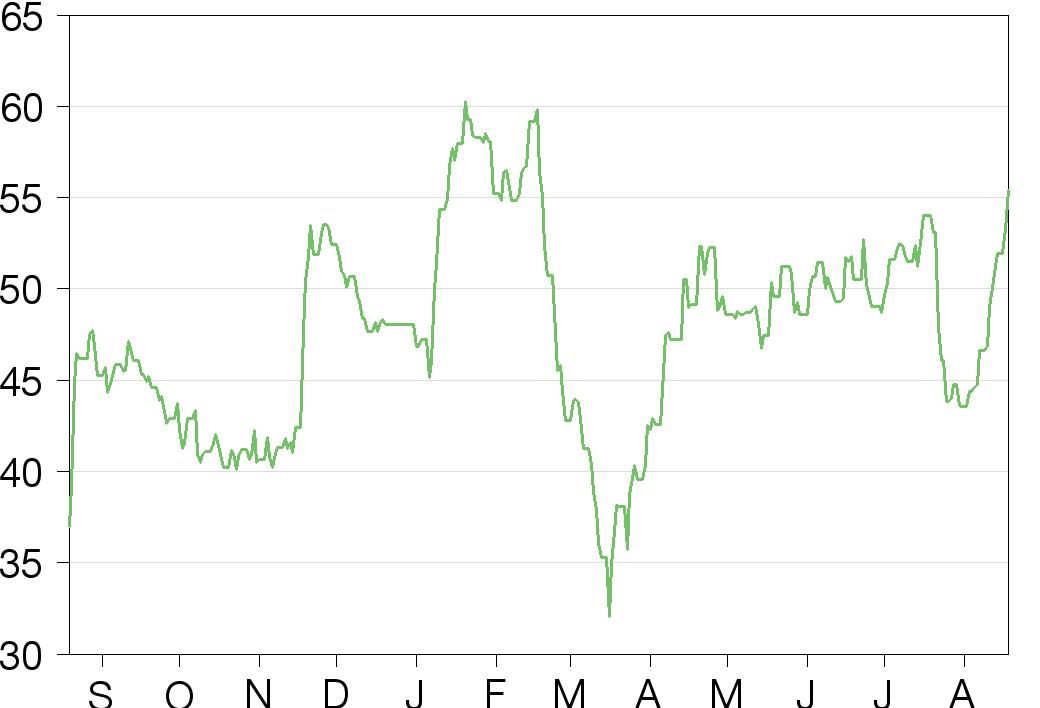
Share price performance
Business description
Next events
Analysts
Basilea Pharmaceutica is a research client of Edison Investment Research Limited |
|||||||||||||||||||||||||||||||||||||||||||||||||||
Basilea reported good momentum in H120 as total revenues increased to CHF69.3m (+9.7%), highlighting ongoing growth in Cresemba (severe mould infections) sales. Basilea has retained FY20 guidance for revenue and its updated guidance for operating loss (CHF5–15m vs prior expected loss of CHF20–30m) reflects the one-time gain (c CHF15m) related to the sale of its headquarters. We expect H220 to be event-driven, with multiple R&D-related inflection points (derazantinib data in iCCA and urothelial cancer). Basilea plans to initiate a Phase I/II gastric cancer study shortly; adding in this indication increases our derazantinib peak sales estimate to $0.934bn. We value Basilea at CHF1.14bn.
Year end |
Revenue (CHFm) |
PBT* |
EPS* |
DPS |
P/E |
Yield |
12/18 |
132.6 |
(31.0) |
(2.88) |
0.0 |
N/A |
N/A |
12/19 |
134.4 |
(22.2) |
(2.07) |
0.0 |
N/A |
N/A |
12/20e |
134.3 |
(30.4) |
(2.83) |
0.0 |
N/A |
N/A |
12/21e |
139.2 |
(30.8) |
(2.86) |
0.0 |
N/A |
N/A |
Note: *PBT and EPS are normalised, excluding amortisation of acquired intangibles, exceptional items and share-based payments.
Cresemba and financials dominate H120
Total in-market Cresemba sales reported by partners exceeded $220m (12 months to 31 March 2020). Zevtera sales remain lacklustre and the US is still the significant value driver for the product (potential launch in 2022/23). Basilea has successfully extended its debt maturity profile (from 2022 through to 2027) via the placement of a new senior convertible bond. The company remains well funded, with gross cash and investments of CHF144.7m (prior to the CHF50m net cash from the new bond issue) sufficient to fund operations beyond 2020 to R&D inflection points. We now forecast break-even at operating profit level in 2022 (vs 2021) as we have pushed out a likely US partnering deal until after ERADICATE top-line data in Q122.
Derazantinib hat trick of data expected in H220
We forecast derazantinib (FGFR inhibitor) approval in 2023 for iCCA (bile duct cancer). Multiple indications and combinations are key to unlocking value. In H220, three data points are expected: 1) top-line results from cohort 1 of the registrational Phase II study FIDES-01 in iCCA patients with FGFR2 gene fusions; 2) interim results from cohort 2 of FIDES-01 (patients with other FGFR2 gene aberrations); and 3) interim results from FIDES-02 monotherapy/combination with immunotherapy (PD-L1) in UC. We now forecast total derazantinib peak sales of $0.934bn (includes gastric cancer; FIDES-03 is scheduled to start in Q320). A Phase II biomarker-driven study for lisavanbulin, a microtubule-targeting tumour checkpoint controller, in recurrent glioblastoma (GBM) is planned for H220.
Valuation: rNPV of CHF1.14bn or CHF106/share
Our revised valuation is CHF1.14bn or CHF106/share versus CHF1.10bn or CHF102/share previously. We include the gastric cancer indication for derazantinib, which offsets a reduction in our Zevtera EU and RoW sales trajectory in 2020/21. Our valuation is based on an NPV analysis for marketed products, a risk-adjusted NPV for the pipeline and net debt of CHF53.5m at 30 June 2020.
2020 building towards R&D inflection points
As Basilea moves towards our expected break-even at operating profit level (2021), the top-line forecast for Cresemba/isavuconazole (for the treatment of severe mould infections) sales growth continues to be of relevance. Basilea has been successful at bringing two anti-infective drugs to market, the other being Zevtera/ceftobiprole (bacterial infections), although we note that its fortunes still rest on the outcome of the ongoing US Phase III (ERADICATE) trial and, on the basis of positive results, potential approval in the US, the key market for Zevtera. However, expectations for Basilea are rapidly focusing on longer-term value creation, which is dependent on crystallising value from its mid-stage oncology pipeline that consists of in-licensed asset derazantinib and in-house developed product lisavanbulin. The second half of 2020 is critical; we expect top-line and interim data to confirm derazantinib activity in a range of solid tumours including iCCA and whether its unique dual mechanism of action (FGFR inhibition plus CSF1R activity) creates synergies as part of immunomodulating targeted treatment strategies. While COVID-19 has not had a material impact on Basilea’s operations, enrolment in the Zevtera Phase III ERADICATE study in Staphylococcus aureus bacteraemia (SAB) bloodstream infections could potentially be delayed by up to one quarter. Completion of ERADICATE enrolment is still expected in H221, but top-line data are now expected in Q122. A potential US launch date of 2023 is feasible, with initial focus on SAB and ABSSSI. A partnering deal in the US is now likely in 2022 (vs 2021) as data from ERADICATE will be pivotal to negotiations. Exhibit 1 highlights the key catalysts ahead in 2020/21.
|
Exhibit 1: Key catalysts in 2020/21 |
|
|
Source: Basilea corporate presentation |
Cresemba ex-US increasing contribution to growth
Cresemba sales have continued to grow, benefiting from international launches by partners in new markets and growth in existing markets. Cresemba is a broad-spectrum antifungal for the treatment of severe, life-threatening fungal infections. It is available in the US and major European countries through regional partners including Astellas in the US and Pfizer in most of Europe. In-market sales of Cresemba increased to $220m in the 12 months ending 31 March 2020 (+30% y-o-y vs c $170m in the prior comparable period). Exhibit 2 highlights the steady growth in sales in the US and increasing contribution from the key EU-5/other markets to ~30% at Q120. Cresemba is currently available in 45 countries (although it is approved in 50), with the aim of increasing to 60 by end 2021. Further launches will aid growth in 2021 and beyond. We note that prior to loss of exclusivity, global sales of many best-in-class antifungals were split c 25% US and c 75% RoW, highlighting the opportunity ex-US for Cresemba.
|
Exhibit 2: Cresemba sales growth in key launched markets |
|
|
Source: Basilea corporate presentation. Note: In-market sales for 12 months to 31 March 2020 c $220m; LCD = US$ corrected for currency fluctuations; MAT = moving annual total. |
During H120, Basilea received c $6m milestone-related income from Pfizer (related to launch in Australia triggering $0.5m, launch in Taiwan triggering $0.5m and CHF5m related to marketing authorisation in the Russian Federation for oral Cresemba). Importantly, the China National Medical Products Administration (NMPA) has accepted the Cresemba marketing authorisation application (MAA) for mucormycosis for regulatory review and we expect the MAA for invasive aspergillosis to be submitted separately in the near future. Basilea estimates that China accounts for more than 15% of the global market for newer antifungals (launch in China expected in 2021).
Derazantinib: A data-driven second half
Derazantinib is an oral kinase inhibitor that targets FGFR1/2/3 and CSF1R kinases. It is a selective and potent FGFR inhibitor (FGFR1, FGFR2, FGFR3 and, to a lesser degree, FGFR4) anticipated to have efficacy in tumours that test positive for FGFR aberrations. Deregulation of the fibroblast growth factor (FGF) signalling axis has been implicated in oncogenesis, tumour progression and resistance to anticancer therapy across many solid tumours. Multiple indications and combinations are key to unlocking value. Beyond its ability to inhibit FGFRs, derazantinib’s immunomodulation activity through CSF1R inhibition could provide additional synergies in combination with a PD-(L)1 antibody or small molecule drug compared to other FGFR inhibitors in the clinic. This may be a critical differentiating factor vs other FGFR inhibitors in an arena where immunomodulatory drugs such as checkpoint inhibitors are being used in earlier lines of treatment. See our note 2020 vision on derazantinib in iCCA for details.
All eyes on FIDES-01 top-line data in iCCA
The initial indication of derazantinib targeted bile duct cancer. The asset is now in a Phase II (FIDES-01) potential registration study for intrahepatic cholangiocarcinoma (iCCA) in patients with FGFR2 gene fusion (cohort 1 completed patient enrolment in July), and iCCA patients with FGFR2 gene mutations or amplifications (cohort 2). Interim data from cohort 2, expected H220, will define derazantinib utility across FGFR2 gene mutations and amplifications (not just gene fusions). Importantly, the top-line data from cohort 1 are expected towards year-end 2020. We highlight that the interim analysis of cohort 1 of FIDES-01 (reported in January 2019), based on a subset of 29 patients (42 enrolled on the study) who had at least one post-baseline imaging assessment, showed an objective response rate (ORR) of 21% and disease control rate (partial response or stable disease) of 83%. Safety and tolerability were confirmed as seen in previous studies. We forecast $147.0m peak sales across the US and Europe (2028) in iCCA based on 75% peak penetration across all FGFR2 gene aberrations. Positive data from either cohort 1 or 2 could pave the way to registrational submission in 2021. We note that in April the FDA granted accelerated approval of Incyte’s Pemazyre (pemigatinib) for advanced cholangiocarcinoma with FGFR2 fusion or rearrangement based on Phase II data from the FIGHT-202 study (n=107, ORR was 36% and median duration of response was 7.5 months).
FIDES-03 marks a hat trick of studies
In August 2019, Basilea initiated a Phase I/II (FIDES-02) study in patients with advanced UC and is now planning a Phase I/II (FIDES-03) study in advanced gastric cancer, which is expected to initiate in Q320. FIDES-02 and 03 are exploring derazantinib utility as a monotherapy and in combination with Roche’s PD-(L)1 immunotherapy Tecentriq. FIDES-02 will enrol c 300 UC patients with FGFR-driven disease (first-line cisplatin-ineligible or second-line and above) in four cohorts. The first cohort to read out interim data is the combination with Tecentriq expected in H220. This will establish a recommended Phase II dose (RP2D) before expansion into Phase II, also expected in H220. Efficacy data are expected in 2021. Basilea highlights that one of the cohorts contains patients who have not responded to previous treatment with FGFR inhibitors, which could be a powerful differentiator versus the competition if derazantinib can prove utility in FGFR inhibitor-resistant tumours. With the momentum in cancer treatment algorithms shifting towards targeted therapies and immunoncology, we believe this is a comprehensive strategy for adding further value to derazantinib. CSF1R activity is very novel and potentially important for PD-(L)1 combinations, as there may be synergy (both act by activating the immune system against the cancer). Prudent trial execution will be key to crystallising value from derazantinib, as the emerging landscape in FGFR drug discovery is becoming increasingly competitive in the UC indication. We forecast peak sales in UC of $481.8m based on 10% peak penetration. We include the gastric cancer indication for the first time, although the Phase I/II (FIDES-03) study is still currently in planning and expected to initiate in Q320. This study will target patients with any FGFR aberrations with derazantinib monotherapy and in combination with Tecentriq. Interim results are expected in H221, with top-line data expected in 2022. We forecast $305.2m peak sales across the US and Europe (2030) in gastric cancer specifically and have assumed a target patient population with FGFR2 fusions, mutations and amplifications in line with iCCA. We note that the trial is expected to target patients with any FGFR aberrations initially and we will refine our forecasts as we get a deeper understanding of the exact FGFR aberrations that are oncogenic drivers in gastric cancer and are targeted by derazantinib. We note that unlike in iCCA and UC, there is not much FGFR competition in this space.
With three indications and potential immunotherapy combination data in hand, Basilea believes this strategy is optimal for seeking a development/commercial partner that will bring the financial resources to explore other opportunities in the space simultaneously. Molecular profiling data of FGFR-driven cancer patients revealed that FGFR aberrations were found in 7.1% of cancers in this patient population (4,853 tumours were analysed by next-generation sequencing, source: Helsten et al), with bladder/ ureter, breast, endometrial and ovarian cancer being the most common cancers affected.
Lisavanbulin: Phase II study to initiate in H220
Lisavanbulin (BAL101553), an internally developed microtubule-targeting tumour checkpoint controller, is being evaluated in Phase I/IIa clinical trials in advanced solid tumours. Lisavanbulin is a prodrug of BAL27862, a novel microtubule-destabilizing drug, which induces tumour cell death through activation of a checkpoint important for tumour cell division. At present, there are no approved drugs that target the BAL27862 binding site. Following confirmed efficacy signals from the Phase I and Phase IIa expansion study in GBM patients (NCT02490800 and NCT02895360), Basilea is planning a Phase II biomarker-driven study in patients with recurrent glioblastoma utilising EB1 (plus-end binding protein) expression that appears to be a predictive biomarker for a response. The study is expected to start in the next few months, with interim results in H121 and top-line results in H221.
Valuation
Our revised valuation is CHF1.14bn or CHF106/share versus CHF1.10bn or CHF102/share previously. The main source of valuation uplift is inclusion of the gastric cancer indication for derazantinib for the first time. This offsets changes to our forecasts for Zevtera. The US is a key market for Zevtera (expected launch 2023). Ex-US sales of the product are not disclosed by Basilea and hence we do not expect significant growth here. We have therefore reduced our Zevtera sales ramp-up in 2020/21. Our valuation is based on an NPV analysis for marketed products, a risk-adjusted NPV for the pipeline and net debt. We have rolled forward our DCF, updated for spot FX rates and reflect a net debt position of CHF53.5m at 30 June 2020. With forecast peak sales of $0.808bn, our Cresemba rNPV is CHF817m. The extension of the Cresemba supply agreement with Pfizer into 2021 has slightly reduced our NPV due to the expected higher cost of products sold and lower gross margin. The breakdown of our valuation is shown in Exhibit 3.
Exhibit 3: Basilea rNPV valuation
Product |
Indication |
Launch |
Peak sales (US$m) |
NPV |
Probability |
rNPV (CHFm) |
NPV/share (CHF/share) |
Cresemba (isavuconazole) |
Severe mould infections |
2015 (US); 2016 (EU); 2018 (RoW); 2022 Japan |
808 |
864.9 |
75–100%* |
816.6 |
75.6 |
Zevtera/Mabelio (ceftobiprole) |
Severe bacterial infections |
2015 (EU); 2018 (RoW); 2023 (US); 2023 (China) |
550 |
240.4 |
75–100%** |
195.1 |
18.1 |
Lisavanbulin (BAL101553) |
Glioblastoma |
2023 |
500 |
186.4 |
20% |
31.7 |
2.9 |
Derazantinib |
iCCA and UC and gastric |
2023 (iCCA); 2024 (UC); 2025 (gastric) |
934 |
378.3 |
40% |
151.3 |
14.0 |
Net debt at 30 June 2020 |
|
|
(53.5) |
100% |
(53.5) |
(4.9) |
|
Valuation |
|
|
1,614.4 |
1,141.4 |
105.7 |
Source: Edison Investment Research. Note: *100% probability for the US and EU, 75% for RoW and Japan. **100% probability for the EU, 75% probability for China, RoW and the US.
H1 financial results
Basilea reported growth of 9.7% in total revenues to CHF69.3m in H120 (H119: CHF63.2m), driven largely by the strong sales performance of antifungal drug Cresemba. Total revenues include CHF62.0m (+17.2%) contributions from Cresemba and Zevtera, which represent a mix of royalties on sales, product sales, contract revenues and milestones. Given that Zevtera still accounts for a minority of these combined revenues (we assume ≤9%), the performance reflects stronger than anticipated Cresemba revenues (≥91%). Non-deferred Cresemba and Zevtera (C&Z) revenue grew in H120 to CHF36.5m (from CHF30.1m) to contribute ~60% of C&Z-related revenue (CHF62.0m). from 38% previously. This trend is expected to continue into FY20, with Basilea forecasting that non-deferred revenue represents c 70% of total C&Z-related revenues (company forecasts CHF77–87m in FY20). Other revenue of CHF7.2m (H119: CHF10.1m) comprises mainly BARDA reimbursements related to the Phase III ceftobiprole trials required for a US registration. The BARDA payment declined y-o-y, reflecting the end of the TARGET Phase III trial in skin infections and the COVID-19 related delay to enrolment into ERADICATE in bacteraemia (phasing impact).
The company maintains total revenue guidance for FY20 of CHF128–138m, while its updated guidance for an operating loss of CHF5–15m (vs CHF20–30m previously) reflects the one-time gain from the sale of corporate HQ and a slightly higher cost of goods. Our forecasts now include the net CHF15m gain, and we have revised COGS upwards for 2020 and 2021 relating to the anticipated extension of the supply period of Cresemba to Pfizer. We forecast stable revenues in 2021; we have reduced our deferred income revenue contribution to CHF3m (from CHF21m), reduced our Zevtera EU and RoW forecasts and pushed back Zevtera US partnering expectations by one year. This means that we now forecast that break-even is achievable in 2022, with sustainable profitability (at operating profit level) from 2023 – the major swing factors to this being the timing (and amount) of milestones received, actual R&D expenses for the year and any potential in-licensing deals.
Basilea expects reported gross cash (including financial investments) of CHF150m at 31 December 2020, significantly higher than guidance of CHF100m given at the FY19 results, as cash benefits from the property sale and convertible bond issuance was partly offset by the increase in working capital. In July 2020, Basilea optimised its debt maturity profile by the placement of CHF97.0m in a new convertible bond issuance (maturity 2027) and the repurchase of CHF47m in existing convertible debt (maturity in 2022). This transaction extended the maturity of c 25% of its mid-term debt to 2027 and yielded net cash proceeds of c CHF50m. Basilea has stated that it has earmarked these funds to further reduce its mid-term debt in the future. We calculate net debt at 30 June 2020 of CHF53.5m based on CHF144.7m in cash and investments (excluding c CHF50m net cash proceeds from the July bond transaction) and CHF198.1m in unsecured convertible bonds.
Exhibit 4: Financial summary
CHF'000s |
|
2017 |
2018 |
2019 |
2020e |
2021e |
|
December |
US GAAP |
US GAAP |
US GAAP |
US GAAP |
US GAAP |
||
PROFIT & LOSS |
|||||||
Revenue |
|
|
101,521 |
132,555 |
134,381 |
134,304 |
139,214 |
Cost of Sales |
(9,025) |
(20,299) |
(18,868) |
(22,867) |
(26,473) |
||
Gross Profit |
92,496 |
112,256 |
115,513 |
111,436 |
112,741 |
||
Research and development (gross) |
(55,055) |
(104,942) |
(102,662) |
(103,500) |
(105,000) |
||
SG&A |
(54,491) |
(31,409) |
(30,051) |
(31,821) |
(31,842) |
||
EBITDA |
|
|
(15,150) |
(22,272) |
(15,560) |
(21,363) |
(21,444) |
Operating Profit (before amort. and except.) |
|
|
(16,950) |
(23,972) |
(17,060) |
(23,648) |
(23,856) |
Intangible Amortisation |
(100) |
(123) |
(140) |
(237) |
(245) |
||
Exceptionals |
0 |
0 |
0 |
14,959 |
0 |
||
Other |
0 |
0 |
0 |
0 |
0 |
||
Operating Profit |
(17,050) |
(24,095) |
(17,200) |
(8,926) |
(24,101) |
||
Net Interest |
(1,976) |
(7,065) |
(5,182) |
(6,792) |
(6,894) |
||
Profit Before Tax (norm) |
|
|
(18,926) |
(31,037) |
(22,242) |
(30,440) |
(30,750) |
Profit Before Tax (reported) |
|
|
(19,026) |
(31,160) |
(22,382) |
(17,418) |
(30,995) |
Tax |
(334) |
(192) |
(40) |
(26) |
(26) |
||
Profit After Tax (norm) |
(19,260) |
(31,229) |
(22,282) |
(30,467) |
(30,776) |
||
Profit After Tax (reported) |
(19,360) |
(31,352) |
(22,422) |
(17,444) |
(31,021) |
||
Average Number of Shares Outstanding (m) |
10.8 |
10.8 |
10.8 |
10.8 |
10.8 |
||
EPS - normalised (CHFc) |
|
|
(178.36) |
(288.15) |
(207.16) |
(282.93) |
(285.80) |
EPS - (reported) (CHFc) |
|
|
(179.28) |
(289.28) |
(208.47) |
(162.00) |
(288.08) |
Dividend per share (c) |
0.0 |
0.0 |
0.0 |
0.0 |
0.0 |
||
Gross Margin (%) |
91.1 |
84.7 |
86.0 |
83.0 |
81.0 |
||
EBITDA Margin (%) |
N/A |
N/A |
N/A |
N/A |
N/A |
||
Operating Margin (before GW and except.) (%) |
N/A |
N/A |
N/A |
N/A |
N/A |
||
BALANCE SHEET |
|||||||
Fixed Assets |
|
|
58,189 |
7,013 |
36,607 |
35,352 |
37,071 |
Intangible Assets |
326 |
372 |
372 |
572 |
772 |
||
Tangible Assets |
7,768 |
6,424 |
5,162 |
3,707 |
5,226 |
||
Investments |
50,095 |
217 |
31,073 |
31,073 |
31,073 |
||
Current Assets |
|
|
292,976 |
274,738 |
184,860 |
185,447 |
152,125 |
Stocks |
15,320 |
14,411 |
18,569 |
21,928 |
21,759 |
||
Debtors |
4,955 |
3,757 |
6,242 |
6,255 |
6,484 |
||
Cash |
260,724 |
223,908 |
131,044 |
128,259 |
94,878 |
||
Other |
11,977 |
32,662 |
29,005 |
29,005 |
29,005 |
||
Current Liabilities |
|
|
(79,491) |
(66,684) |
(75,494) |
(51,687) |
(48,109) |
Creditors |
(79,491) |
(66,684) |
(75,494) |
(51,687) |
(48,109) |
||
Short term borrowings |
0 |
0 |
0 |
0 |
0 |
||
Long Term Liabilities |
|
|
(313,114) |
(281,754) |
(238,933) |
(277,880) |
(277,830) |
Long term borrowings |
(196,224) |
(196,982) |
(197,740) |
(248,118) |
(248,118) |
||
Other long term liabilities |
(116,890) |
(84,772) |
(41,193) |
(29,762) |
(29,712) |
||
Net Assets |
|
|
(41,440) |
(66,687) |
(92,960) |
(108,769) |
(136,743) |
CASH FLOW |
|||||||
Operating Cash Flow |
|
|
19,014 |
(79,210) |
(63,836) |
(63,626) |
(22,084) |
Net Interest |
0 |
0 |
0 |
(6,792) |
(6,894) |
||
Tax |
0 |
0 |
0 |
(26) |
(26) |
||
Capex |
(711) |
(419) |
(294) |
(900) |
(4,176) |
||
Acquisitions/disposals |
0 |
0 |
0 |
0 |
0 |
||
Financing |
0 |
0 |
0 |
0 |
0 |
||
Other |
3,391 |
42,813 |
1,266 |
18,181 |
(200) |
||
Dividends |
0 |
0 |
0 |
0 |
0 |
||
Net Cash Flow |
21,694 |
(36,816) |
(62,864) |
(53,163) |
(33,381) |
||
Opening net debt/(cash) |
|
|
(43,564) |
(64,500) |
(26,926) |
36,696 |
89,859 |
HP finance leases initiated |
0 |
0 |
0 |
0 |
0 |
||
Other |
(758) |
(758) |
(758) |
0 |
0 |
||
Closing net debt/(cash) |
|
|
(64,500) |
(26,926) |
36,696 |
89,859 |
123,240 |
Source: Company accounts, Edison Investment research
|
|
Research: Industrials
Marshall Motor Holdings’ (MMH) H120 results were severely disrupted by the pandemic, as was the whole UK auto retail sector. Despite a strong Q120 and continued outperformance of the new car market, management had anticipated an H120 underlying loss before tax, which was duly recorded at £8.9m. FY20 management guidance for a near break-even performance is encouraging as recovery is already apparent in increased June and July activity levels. With a strong half-year cash position, MMH is positioned to pursue its growth strategy as the momentum of recovery builds into FY21.