Last close As at 05/08/2026
—
— 0.00 (0.00%)
Market capitalisation
—
Research: Financials
Cenkos has a record of successful fund-raising for clients and maintaining annual profitability since its inception in 2005. This reflects its focus on client outcomes, a well-established network of business relationships and flexibility in its cost base. Its client relationships should stand it in good stead when market conditions become more favourable. In the meantime, the company’s strong balance sheet, with substantial capital headroom, provides reassurance and Cenkos would not need to attain earlier levels of return on equity to warrant a materially higher valuation.
Written by
Cenkos Securities |
Resilient broker with a substantial track record |
Initiation of coverage |
Financial services |
7 November 2019 |
Share price performance
Business description
Next events
Analyst
Cenkos Securities is a research client of Edison Investment Research Limited |
|||||||||||||||||||||||||||||||||||||||||||||
Cenkos has a record of successful fund-raising for clients and maintaining annual profitability since its inception in 2005. This reflects its focus on client outcomes, a well-established network of business relationships and flexibility in its cost base. Its client relationships should stand it in good stead when market conditions become more favourable. In the meantime, the company’s strong balance sheet, with substantial capital headroom, provides reassurance and Cenkos would not need to attain earlier levels of return on equity to warrant a materially higher valuation.
Year end |
Revenue (£m) |
PBT* |
EPS* |
DPS |
P/E |
Yield |
12/17 |
59.5 |
10.0 |
13.2 |
9.0 |
3.8 |
17.9 |
12/18 |
45.0 |
3.2 |
4.2 |
4.5 |
11.9 |
8.9 |
12/19e |
32.5 |
1.0 |
1.0 |
4.0 |
48.2 |
7.9 |
12/20e |
37.5 |
3.5 |
5.0 |
4.5 |
10.0 |
8.9 |
Note: *PBT and EPS are reported with EPS on a fully diluted basis.
Independent broker with a flexible business model
Founded in 2004, Cenkos began trading in 2005 and from the outset adopted a model under which teams of experienced professionals joined the firm with rewards aligned to the company’s performance and achievement of objectives. This provided motivation and conferred a high degree of cost flexibility, which has moderated the impact of weak market conditions on profits, as currently. The recruitment of experienced staff provided the range of relationships required to build both the corporate and institutional client lists that have underpinned Cenkos’s track record in terms of equity fund-raising (nearly £20bn since 2005).
Trading background and outlook
The impact of domestic and global political uncertainty on UK equity issuance and corporate activity has been marked; London Stock Exchange Main Market money raised increased slightly in 9M19 but the number of new issues fell by 31%, while AIM new issues were down 59% and money raised 31% lower. Secondary trading was 19% lower over the same period and M&A activity has also slowed. Against this background, Cenkos did well to achieve near break-even in its first half, while on our estimates (subject to completion of transactions) it would be profitable in the full year. Our estimate for 2020 assumes some recovery in activity and hence revenues, but not a return to the levels seen in 2017 and 2018. Given the uncertainty over market conditions, we highlight the sensitivity analysis on page 8 which provides an indication of earnings outcomes under different revenue assumptions.
Valuation: Modest ROE assumptions implied
The number of UK peers is limited but within this list Cenkos trades in the range of P/E and price to book multiples, while offering an above average yield. The shares trade at 1x book value, a 10-year low, while an ROE/COE model (page 10) implies that the market is assuming an ROE of 10%, which appears modest in the context of five- and 10-year averages of 28% and 26% respectively.
Independent stockbroker with strong fund-raising record
Cenkos is an independent specialist institutional stockbroking company with offices in London and Edinburgh and c 115 employees. It acts as a nominated adviser, sponsor and financial advisor to 110 client companies diversified by sector and development stage. At its inception in 2005, it brought together a number of teams of experienced market professionals who provided the company with a strong network of institutional and corporate relationships, a characteristic that has been developed since then. This has enabled Cenkos to establish a strong track record for fund-raising including a number of larger transactions in addition to a flow of deals for smaller and midcap clients (see Exhibit 1).
|
Exhibit 1: Cenkos funds raised by year |
|
|
Source: Cenkos |
Cenkos itself was listed on the AIM market in 2006 and focuses on corporate clients seeking admission to or already listed on the London Stock Exchange Main or AIM markets. The group seeks to maintain long-term relationships with its clients through a focus on understanding their financing needs, maintaining continuity of key staff and delivering good outcomes for them. An indicator of the success of this approach is that nearly 50% of its current corporate clients have been with the firm for more than five years.
|
Exhibit 2: Cenkos revenue and profit record |
|
|
Source: Cenkos, Edison Investment Research |
A feature of the business since its formation has been a flexible remuneration structure that has rewarded and helped retain teams while containing costs in periods of weaker corporate activity. This has protected the profitability of the business through market fluctuations, as shown in the chart of revenue and pre-tax profit above. The regulatory environment has evolved and the group’s remuneration policy reflects this, with the aim being to align discretionary variable remuneration with the long-term success of Cenkos rather than simply tracking yearly performance. Nevertheless, the company has still demonstrated substantial flexibility of overall costs in response to revenue generation.
Our next table shows Cenkos’s revenue by segment over the last three years with corporate finance accounting for over 70% of the total on average. This income is subject to the timing and size of corporate transactions and variations in the level of these transactions largely explains the substantial moves in overall revenues shown in Exhibit 2, above. Nomad and broking fees have been relatively stable given their recurring nature subject to changes in the number and mix of clients. On a longer view, the client count expanded rapidly post inception with growth then moderating and a modest net erosion has been seen since 2015 (from 125 to 110). Research income has shown a significant fall since 2016 reflecting the impact of MiFID II implementation, together with pre-existing pressure on institutional commissions. Finally, execution income is affected by the impact of market moves on the value of shares held as a market maker and shares received in lieu of fees. Since this figure was first disclosed in 2015, annual revenue has averaged £5.1m.
Exhibit 3: Revenue analysis 2016–18
2016 |
2017 |
2018 |
% over three years |
|
Corporate finance |
29,720 |
44,030 |
32,734 |
72 |
Nomad and broking |
5,481 |
5,273 |
5,070 |
11 |
Research |
5,033 |
2,949 |
2,754 |
7 |
Execution |
3,509 |
7,252 |
4,395 |
10 |
Total revenue |
43,743 |
59,504 |
44,953 |
100 |
Source: Cenkos, Edison Investment Research
The group has straightforward strategic objectives, reflecting its role and the existing and prospective client base.
■
Grow revenues by retaining existing clients and winning new ones; to this end, Cenkos fosters a client-first culture to ensure good client outcomes.
■
Maintain a strong team culture to retain and recruit talented staff.
■
Disciplined approach to operational efficiency. An example of this is the use of enhanced regulatory monitoring technology that is set to support operational leverage as activity rises.
■
The strong balance sheet may be used to invest in the business where appropriate to support growth.
■
Use cash flow and earnings to underpin shareholder returns.
Historically, Cenkos has focused on the organic development of its business, probably reflecting the multiple risks inherent in combining people-based companies. Nevertheless, in 2018 it acquired the nomad and corporate broker business of Smith & Williamson. The relatively small size of this transaction and ability to transfer clients and key staff were attractive features. Cenkos agreed to pay Smith & Williamson a deferred consideration equivalent to 20% of all fees earned in the 12 months from completion (December 2018) from clients transferred. A team of six joined the corporate finance department and 12 nomad clients transferred to Cenkos.
Management and staff
Details of group board members are given on page 13. The group board currently comprises three non-executive directors and Jim Durkin. Julian Morse (head of growth companies) is set to join the board as an executive director once FCA approval has been received. The majority of the executive team joined the company at or around the time of its formation and have substantial experience in the securities industry, providing the business with continuity and a range of well-established business relationships.
In addition, across the whole of Cenkos, 51% of staff have been with the firm for more than five years. Naturally, there is a level of staff change for normal reasons and, as an example, in its August trading update the company noted that a number of individuals from the investment companies team would be leaving, although the head of the team remains in place and Cenkos remains committed to this area of the business.
In 2018 the segmental split of the 110 average employees was: corporate finance 22, corporate broking 47 and support services 41.
H119 results review
In this section we provide a brief summary and commentary on Cenkos’s first-half figures, announced in September. Exhibit 4 shows the half yearly progression of the profit and loss account from 2017.
Exhibit 4: Half yearly P&L summary
£000s unless shown |
H117 |
H217 |
H118 |
H218 |
H119 |
Change y-o-y |
Sequential change |
Corporate finance |
21,209 |
22,821 |
11,925 |
20,809 |
6,245 |
(48%) |
(70%) |
Nomad and broking |
2,610 |
2,663 |
2,552 |
2,518 |
2,521 |
(1%) |
0% |
Research |
1,741 |
1,208 |
1,538 |
1,216 |
938 |
(39%) |
(23%) |
Execution |
3,689 |
3,563 |
2,085 |
2,310 |
921 |
(56%) |
(60%) |
Total revenue |
29,249 |
30,255 |
18,100 |
26,853 |
10,625 |
(41%) |
(60%) |
Administration expenses |
(25,032) |
(24,496) |
(17,674) |
(24,228) |
(10,876) |
(38%) |
(55%) |
Operating profit/loss |
4,217 |
5,759 |
426 |
2,625 |
(251) |
N/A |
N/A |
Investment income |
8 |
15 |
38 |
65 |
65 |
71% |
0% |
Finance cost |
0 |
0 |
0 |
0 |
(10) |
N/A |
N/A |
Pre-tax profit |
4,225 |
5,774 |
464 |
2,690 |
(196) |
N/A |
N/A |
Tax |
(904) |
(911) |
(123) |
(682) |
(5) |
N/A |
N/A |
Attributable profit |
3,321 |
4,863 |
341 |
2,008 |
(201) |
N/A |
N/A |
EPS (p) |
6.1 |
0.0 |
0.6 |
0.0 |
(0.6) |
N/A |
N/A |
DPS (p) |
4.5 |
4.5 |
2.0 |
2.5 |
2.0 |
0% |
N/A |
Source: Cenkos, Edison Investment Research
We would highlight the following points:
In the period shown, total revenue has varied substantially, between c £30m and below £11m, with corporate finance revenue accounting for much of this variation, as would be expected. For H119, overall revenue fell by 41% y-o-y, with corporate finance down by 48% reflecting the particularly subdued level of corporate activity, with funds raised on behalf of clients also 48% lower at £343m versus £666m. There were also sharp reductions in research and execution revenues as MiFID II effects and market levels continued to affect these areas. The recurring fees earned by the nomad and broking segment allowed it to maintain its record of relative stability.
Administration expenses were reduced by 38%, almost matching the percentage revenue decline, with almost all of the £6.8m reduction being in staff costs (which halved to £6.5m), reflecting flexibility in variable compensation, some reductions in headcount across the business and the absence of some one-off costs relating to the period during which FCA approval of the CEO appointment was pending.
This left a marginal loss at the operating and pre-tax profit levels, but the group notes that, prospectively, there should be an annualised saving of £2.0m in staff costs as one-off staff costs fall away and the reduction in headcount takes full effect.
There was an unchanged dividend of 2p. Cenkos reiterated its dividend policy, which is to use earnings and cash flow to underpin shareholder returns using a combination of dividends and share buybacks. The company seeks to pay stable dividends and, after allowing for investment in the firm, satisfying capital requirements and taking into account market conditions and outlook, to return excess cash to shareholders.
Market background and outlook
We start by summarising the trends in primary activity and secondary trading on the London Stock Exchange Main and AIM markets.
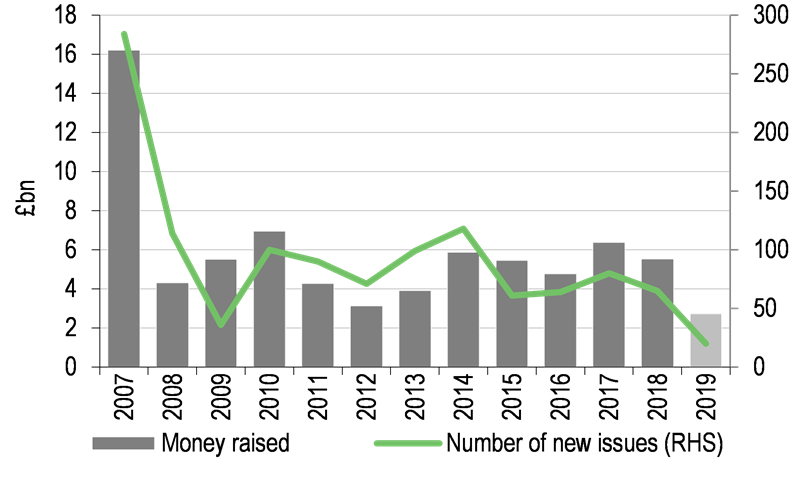
The two charts below show the value of new and further issuance for the London Stock Exchange markets since 2007, highlighting how issuance peaked following and prior to the financial crisis for the Main and AIM markets respectively. The high levels of issuance on the Main Market in 2008–09 were boosted by capital raising required by banks to strengthen their balance sheets. Subsequent issuance has been low in the context of those years but has fluctuated, declining in 2018 and being mixed in 2019 year to date. For the nine months to end September this year, the total value of Main Market issuance was 3% ahead of the prior year period, but this was much more concentrated in fewer names and the number of new issues fell by 31%. On AIM, the picture has been significantly weaker with the value of total issuance down by 31% and the number of new issues 59% lower.
|
Exhibit 5: LSE Main Market money raised |
Exhibit 6: LSE AIM money raised & no. of new issues |
|
|
|
Source: London Stock Exchange. Note: 2019 to end September |
|
Exhibit 5: LSE Main Market money raised |
|
|
Source: London Stock Exchange. Note: 2019 to end September |
|
Exhibit 6: LSE AIM money raised & no. of new issues |
|
|
Source: London Stock Exchange. Note: 2019 to end September |
Exhibit 7 illustrates recent equity market performance highlighting the relative weakness of the FTSE All-Share AIM index (-6% over 12 months), which is likely to have fed into the weakness in issuance shown above. In comparison, the FTSE All-Share and Small Cap indices were up by 9% and 4% over 12 months (all total return indices). The second chart shows a more subdued level of recent trading on the London Stock Exchange order book; in the nine months to end September, the average daily value traded was 19% below the prior year.
|
Exhibit 7: FTSE AIM, All-Share and Small Cap indices |
Exhibit 8: LSE order book, average daily value traded |
|
|
|
Source: Refinitiv. Note: Total return indices. |
Source: London Stock Exchange (Main Market) |
|
Exhibit 7: FTSE AIM, All-Share and Small Cap indices |
|
|
Source: Refinitiv. Note: Total return indices. |
|
Exhibit 8: LSE order book, average daily value traded |
|
|
Source: London Stock Exchange (Main Market) |
The London Stock Exchange data therefore confirm the dampening impact of sustained political uncertainty on both issuance-related and trading activities.
We now turn to the level of M&A activity in the UK and the next two charts use ONS data to illustrate recent trends. Exhibit 9 shows the volatility of the value of transactions over time, primarily reflecting the incidence of large transactions although, even with these fluctuations, it is clear there has been a decline in the value of M&A transactions over the last year. This is also evident in the shorter time period included in Exhibit 10; the number of transactions in H119 was 15% lower than the prior year period and the value of transactions was 37% lower.
|
Exhibit 9 UK M&A value 2015–19 |
Exhibit 10: UK M&A value and volume 2018 and H119 |
|
|
|
Source: ONS, Edison Investment Research |
|
Exhibit 9 UK M&A value 2015–19 |
|
|
Source: ONS, Edison Investment Research |
|
Exhibit 10: UK M&A value and volume 2018 and H119 |
|
|
Source: ONS, Edison Investment Research |
The weakness in new issuance in particular and also M&A mirrors the experience of Cenkos and other quoted stockbrokers, with political uncertainty and a consequent reduction in investor appetite constricting the opportunities for equity fund-raising. Nevertheless, the pipeline of potential corporate transactions remains promising according to Cenkos’s outlook comments with the H119 results and this is in line with statements made by finnCap and Arden regarding this part of their business. A possible resolution of political uncertainty following the forthcoming general election could be a catalyst for a bounce back in corporate and investor activity, although continued difficulties surrounding Brexit may yet prolong the period of subdued activity.
To put these comments in context, Exhibit 11 lists selected completed transactions in which Cenkos has been involved in 2018 and 2019 to September. This illustrates the range of client companies served and transaction sizes carried out. The number of selected transactions reported for 2019 to end September was lower and, as noted earlier, the total raised for clients in H119 was 48% lower at £343m versus £666m. Cenkos has acted as advisor for two of the seven AIM IPOs that took place to end September in an indication that it is maintaining its position even in lacklustre market conditions. As we will illustrate in the financial section below, a potential pick-up in the number and/ or size of transactions in subsequent months could have a material impact on profitability.
Exhibit 11: Selected completed acquisitions (consideration in £m unless shown)
2018 |
Company |
Transaction |
Consideration |
2019 |
Company |
Transaction |
Consideration |
||
January |
Bango |
Placing |
5.0 |
February |
Kromek |
Placing |
21.0 |
||
Seeing Machines |
Placing |
A$53.0 |
March |
Diaceutics |
IPO |
17.0 |
|||
February |
Fulcrum Utility Services |
Placing |
10.4 |
April |
Seeing Machines |
Placing |
27.5 |
||
March |
Safeharbour |
IPO |
22.7 |
Tasty |
Placing |
3.3 |
|||
Jaywing |
Placing |
1.3 |
May |
Landlore Resources |
Placing |
1.0 |
|||
Chariot Oil & Gas |
Placing |
12.5 |
Falcon Oil & Gas |
Placing |
US$9.0 |
||||
ICG Longbow |
Placing |
4.3 |
June |
GCP Asset Backed Inc. |
Placing |
63.3 |
|||
Landlore Resources |
Placing |
3.2 |
Collagen Solutions |
Placing |
6.0 |
||||
April |
Breedon |
Placing |
170.0 |
Marlowe |
Placing & acqn |
20.0 |
|||
Corero Network Security |
Placing |
4.0 |
July |
Dods |
Placing |
13.2 |
|||
May |
Restore |
Placing |
51.5 |
August |
Brickability |
IPO |
56.7 |
||
88 Energy |
Placing |
A$17.0 |
Intelligent Ultrasound |
Placing |
6.3 |
||||
June |
Rosenblatt |
IPO |
43.0 |
Rotala |
Placing |
1.1 |
|||
RA International |
IPO |
18.8 |
September |
Inspiration Healthcare |
Placing |
4.3 |
|||
Eddie Stobart Logistics |
Placing |
30.0 |
Equals |
Placing |
14.3 |
||||
Trinity Exploration & Production |
Placing |
US$20.0 |
|||||||
Marlowe |
Placing |
20.0 |
|||||||
August |
Creo Medical |
Placing |
51.0 |
||||||
Duke Royalty |
Placing |
44.0 |
|||||||
Venture Life |
Placing |
18.8 |
|||||||
September |
Arena Events |
Placing |
20.0 |
||||||
IG Design |
Placing |
50.0 |
|||||||
GCP Asset Backed Inc. Fund |
C sh.issue |
51.1 |
|||||||
Aberdeen Div. Inc. & Growth |
Placing |
1.6 |
|||||||
October |
Shearwater |
Placing |
16.7 |
||||||
November |
Angling Direct |
Placing |
20.0 |
||||||
88 Energy |
Placing |
A$10.0 |
|||||||
December |
GCP Asset Backed Inc. Fund |
Placing |
13.0 |
||||||
Mercantile Ports & Logistics |
Placing |
29.8 |
|||||||
Medaphor |
Placing |
5.1 |
|||||||
Filta |
Placing |
3.0 |
|||||||
Esure (adviser to Bain Capital) |
Acquisition |
1,200.0 |
|||||||
Marlowe |
Placing |
7.0 |
|||||||
Total |
1,989.0 |
Total |
262.1 |
||||||
Source: Cenkos
Financials
We have already highlighted the substantial historical variation in Cenkos’s corporate finance revenues that is also a characteristic of the industry. This means that forecasts should be viewed in light of the lumpiness and cyclicality that lie behind these fluctuations.
For the current year, we have assumed total revenue of £32.5m, down 28% compared 2018 but still implying a significant second-half improvement compared with H119. This reflects Cenkos’s positive comments on the start of H219, but is contingent on completion of a number of deals prior to the year end so remains subject to considerable uncertainty.
For 2020, any estimate has to be even less certain, a situation exacerbated by the political background. We have used an assumption of total revenues of £37.5m including an improvement of 22% in corporate finance revenue although, as shown in Exhibit 12, both this and total revenue would still be significantly below the level seen in 2018.
Exhibit 12: Revenue estimates
December year end (£000s) |
2018 |
2019e |
2020e |
Corporate finance |
32,734 |
23,460 |
28,560 |
Nomad and broking |
5,070 |
5,040 |
5,040 |
Research |
2,754 |
1,880 |
1,900 |
Execution |
4,395 |
2,120 |
2,000 |
Total revenue |
44,953 |
32,500 |
37,500 |
Source: Edison Investment Research
Given the uncertainty of potential revenues and the importance of Cenkos’s flexible cost base, we have prepared a scenario analysis around our central assumptions for 2020 (Exhibit 13). This assumes non-staff costs are held constant between the scenarios at c £9.6m, although in practice there could be some change here. We have assumed that variable staff costs account for approximately 65% of total staff costs. For code staff1 this ratio was 87% in 2017 and 2018, but we assume the variable element will be significantly lower across the company as a whole given that fixed remuneration is at a relatively low level for senior staff included in this category (at an average of c £100,000 compared with Numis c £180,000 in FY18 and Shore Capital c £166,000 in FY17). Flexing of assumed variable staff costs in these scenarios means that the staff cost to revenue ratio shows limited movement, while the impact on profits of a £2.5m variance in revenue is limited to £1m at the pre-tax level.
Those deemed to have a material impact on the firm’s risk profile
Exhibit 13: P&L scenario analysis for 2020e
£000 unless stated |
Low |
Central |
High |
Revenues |
35,000 |
37,500 |
40,000 |
Non staff costs |
(9,550) |
(9,550) |
(9,550) |
Staff costs |
(23,060) |
(24,560) |
(26,060) |
Operating profit |
2,390 |
3,390 |
4,390 |
Investment income |
130 |
130 |
130 |
Finance income |
(20) |
(20) |
(20) |
Pre-tax profit |
2,500 |
3,500 |
4,500 |
Tax |
(475) |
(665) |
(855) |
Net profit |
2,025 |
2,835 |
3,645 |
C/I ratio |
93.2% |
91.0% |
89.0% |
Staff costs/revenue |
65.9% |
65.5% |
65.2% |
EPS (p) |
3.5 |
5.0 |
6.5 |
Source: Edison Investment Research
Turning to the balance sheet, Cenkos had cash and cash equivalents at the end of H119 of £14.7m. This was £7m lower than the H118 level with the outflow resulting primarily from a £3m operating cash outflow (including a £5.9m working capital outflow) and a total cost of £3.7m for dividends and share repurchases. The regulatory capital position remains strong with an end-H119 capital resources surplus of £15.9m above the Pillar 1 requirement.
As noted earlier, Cenkos’s policy is to pay stable dividends and, after satisfying capital requirements and taking account of investment requirements and the market background, to return excess cash to shareholders. This policy appears well-suited to the nature of the business where profits can vary significantly, and provides shareholders with the potential for a degree of consistency in dividend payments while also having surplus cash returned in periods of stronger profitability. Reflecting the policy, from flotation to end H119, Cenkos paid out dividends of £87.6m and spent £25.4m repurchasing shares.
Sensitivities
We would highlight the following as important sensitivities for Cenkos’s business.
■
As highlighted in the discussion of the company’s longer-term revenue and profit record and the scenarios shown in the Financials section, Cenkos’s results are dependent on market conditions. Arguably, from current levels there is greater upside risk in terms of market activity, but this does not exclude a further worsening before the trading background improves. Although Cenkos reported a small loss at the interim stage it has traded profitably since flotation and, on our estimates, would return to profitability with its full year results for 2019.
■
The risk of losing key staff is a consideration for Cenkos, as for its peers, and while it has a remuneration structure that rewards successful teams well when trading is good, there is still a risk when a competitor decides to make a strategic investment in staff to secure market position (Panmure Gordon being a recent example of a firm which has been clear that it was following this approach).
■
Reputational risk is important for all stockbroking businesses and Cenkos seeks to mitigate this through encouraging the right culture and the operation of a multi-disciplinary new business committee. Since incurring a £0.53m fine from the FCA in 2016 in relation to an abortive attempt to transfer a client (Quindell) from AIM to a Premium Listing, Cenkos implemented a remedial plan in 2017/18 to address the shortcomings identified in its oversight processes. It remains sensitive to the need to ensure that its approach and systems mitigate such risks.
■
Regulatory change is a continuing feature for capital markets businesses, which entails additional costs associated with adapting IT systems and, in some cases, employing additional staff. The most significant recent change, the implementation of MiFID II, took place at the beginning of 2018 so the major part of the financial impact has probably been seen, but most commentary suggests that downward pressure on institutional payments for research/sales remains under pressure given the trend for a contraction in asset managers’ own fees.
Valuation
We start by showing a comparative valuation table that includes quoted UK stockbrokers and, as an additional reference, a selection of US and European investment banks and advisers (Exhibit 15). While the UK quoted peers address the same market as Cenkos, the businesses are differentiated and there is a lack of available estimates to support a broad comparison. Nevertheless, the last reported P/E multiples are within a relatively narrow range and, where available, the prospective (current year multiples) are markedly higher with earnings depressed by reduced market activity. Cenkos trades within the range on its price to book ratio, but offers a premium yield of 7.8% (here we have used 4p, our assumed 2019 payment as the dividend rather than the 4.5p paid for FY18).
The investment banks and advisers are much larger businesses in most cases and exposed to different markets. On consensus estimates, they are, in most cases, not expected to see the degree of earnings reduction expected for UK stockbrokers. The average last-reported P/E is not somewhat lower than the UK stockbroker average while, given more resilient earnings, most prospective multiples are markedly lower. ROEs and with them price to book ratios for this group are generally higher than for the UK brokers.
Exhibit 14: Peer comparison
Price |
Market cap |
Last reported |
Current year P/E (x) |
Yield |
ROE |
Price to book |
|
UK brokers |
|||||||
Cenkos |
50 |
26 |
11.9 |
48.2 |
7.9 |
8.0 |
1.0 |
Arden Partners |
18 |
5 |
Loss |
N/A |
5.6 |
N/A |
0.7 |
FinnCap |
24 |
41 |
13.0 |
28.4 |
5.8 |
11.1 |
1.9 |
Numis |
232 |
243 |
10.0 |
25.2 |
5.2 |
8.1 |
1.8 |
Shore Capital |
223 |
48 |
17.8 |
N/A |
4.5 |
4.8 |
0.8 |
WH Ireland |
49 |
21 |
Loss |
N/A |
0.0 |
N/A |
1.4 |
UK average |
13.6 |
N/A |
4.2 |
8.0 |
1.3 |
||
US, European IB and advisory |
|||||||
Bank of America |
32.8 |
295,219 |
12.5 |
12.1 |
1.6 |
10.5 |
1.2 |
Evercore |
77.9 |
3,546 |
8.6 |
9.9 |
2.4 |
69.7 |
4.1 |
Goldman Sachs |
218.6 |
77,418 |
8.7 |
10.0 |
1.4 |
12.3 |
1.1 |
Greenhill |
17.5 |
356 |
12.3 |
N/A |
1.1 |
29.7 |
5.7 |
JP Morgan |
129.1 |
404,920 |
14.3 |
12.3 |
1.9 |
13.0 |
1.6 |
Moelis |
35.9 |
2,147 |
12.0 |
15.2 |
5.2 |
60.4 |
5.0 |
Morgan Stanley |
48.8 |
80,572 |
10.3 |
9.8 |
2.3 |
11.8 |
1.2 |
Stifel Financial |
60.4 |
4,200 |
11.4 |
10.5 |
0.8 |
14.2 |
1.4 |
Credit Suisse |
13.0 |
33,374 |
12.0 |
10.7 |
2.0 |
7.8 |
0.8 |
Deutsche Bank |
6.9 |
14,401 |
15.9 |
Loss |
1.6 |
N/A |
0.2 |
UBS |
12.4 |
47,718 |
9.6 |
10.4 |
5.7 |
9.5 |
0.9 |
US, European IB and advisory average |
11.6 |
11.2 |
2.4 |
23.9 |
2.1 |
Source: Refinitiv, Edison Investment Research. Note: Priced at 6 November 2019. P/Es are for financial years therefore not all the same period end.
Exhibit 15 shows the 10-year history for Cenkos’s price to book value, which is a useful measure to monitor for brokers when earnings are depressed or negative. As can be seen, Cenkos’s current rating at 1x book represents a low point over this period reflecting the difficult market background, but also suggesting an opportunity on a medium to longer view given the potential for a substantial recovery in earnings and return on equity.
|
Exhibit 15: Ten-year history of the price to book value ratio for Cenkos |
|
|
Source: Refinitiv, Edison Investment Research |
Using an ROE/COE valuation model, we can calculate the ROE assumed by the market as being 10%, based on a cost of equity of 10%, growth of 4% and the H119 book value of 50.9p. This compares with our estimate of 3% for the current year, 10% for 2020 and the historical averages over five and 10 years of 28% and 26%, respectively.
Finally, to provide further context, we include a table of recent share price performance for the peers shown above. For most of the UK stocks there are significant negative movements over one year, year to date and from 12-month highs, which is unsurprising given the prolongation of political uncertainty and the resulting market background. In line with the more stable earnings expectations noted above for the investment bank and adviser group, share prices on average have been more stable, although in some instances reduced expectations have also driven marked share price weakness. As with the price to book history, Cenkos’s share price performance may suggest an opportunity for those prepared to look ahead to a period of more favourable market conditions that would allow the company to demonstrate its ability to execute transactions for clients and generate attractive returns on equity and cash returns to shareholders.
Exhibit 16: Recent share price performance for peer group
One month |
Three months |
One year |
Ytd |
From 12-month high |
|
UK brokers |
|||||
Cenkos |
11.7 |
12.9 |
-29.1 |
-27.1 |
-34.4 |
Arden Partners |
-2.7 |
9.1 |
-41.0 |
-36.8 |
-41.9 |
FinnCap |
-5.9 |
-7.7 |
N/A |
-15.0 |
-19.7 |
Numis |
9.2 |
-1.9 |
-21.7 |
-3.3 |
-25.3 |
Shore Capital |
61.8 |
8.0 |
-12.7 |
3.5 |
-14.4 |
WH Ireland |
-2.0 |
-1.0 |
-36.8 |
-27.4 |
-39.5 |
UK average |
12.1 |
1.3 |
-28.0 |
-15.8 |
-28.2 |
US, European IB and advisory |
|||||
Bank of America |
15.7 |
16.9 |
17.0 |
33.2 |
-0.8 |
Evercore |
2.9 |
-0.1 |
-5.5 |
8.9 |
-21.2 |
Goldman Sachs |
8.9 |
8.4 |
-4.4 |
30.9 |
-6.6 |
Greenhill |
33.9 |
21.4 |
-17.7 |
-28.4 |
-43.8 |
JP Morgan |
12.6 |
17.8 |
18.3 |
32.2 |
-0.9 |
Moelis |
16.6 |
8.1 |
-10.4 |
7.4 |
-24.1 |
Morgan Stanley |
19.5 |
20.4 |
6.4 |
23.0 |
-2.3 |
Stifel Financial |
16.6 |
12.3 |
27.4 |
45.7 |
-2.6 |
Credit Suisse |
13.9 |
15.7 |
0.9 |
20.3 |
-8.1 |
Deutsche Bank |
7.0 |
0.7 |
-24.4 |
-0.5 |
-26.0 |
UBS |
15.7 |
14.1 |
-13.7 |
0.3 |
-16.1 |
US, European IB and advisory average |
14.9 |
12.3 |
-0.6 |
15.7 |
-13.9 |
Source: Refinitiv
Exhibit 17: Financial summary
£000s |
2015 |
2016 |
2017 |
2018 |
2019e |
2020e |
|
Year end 31 December |
|||||||
PROFIT & LOSS |
|
|
|
|
|
|
|
Revenue |
76,513 |
43,743 |
59,504 |
44,953 |
32,500 |
37,500 |
|
Administration expenses (excluding depreciation) |
(56,510) |
(38,581) |
(49,286) |
(41,655) |
(30,962) |
(33,820) |
|
EBITDA |
20,003 |
5,162 |
10,218 |
3,298 |
1,538 |
3,680 |
|
Depreciation |
(241) |
(182) |
(242) |
(247) |
(648) |
(290) |
|
Operating profit |
19,762 |
4,980 |
9,976 |
3,051 |
890 |
3,390 |
|
Non-recurring items |
0 |
0 |
0 |
0 |
0 |
0 |
|
Investment revenues |
134 |
83 |
23 |
103 |
110 |
110 |
|
Profit before tax |
19,896 |
5,063 |
9,999 |
3,154 |
1,000 |
3,500 |
|
Tax |
(4,525) |
(1,858) |
(1,815) |
(805) |
(232) |
(665) |
|
Profit after tax, continuing operations |
15,371 |
3,205 |
8,184 |
2,349 |
768 |
2,835 |
|
Discontinued operations |
0 |
(661) |
(973) |
0 |
0 |
0 |
|
Profit after tax |
15,371 |
2,544 |
7,211 |
2,349 |
768 |
2,835 |
|
Average number of shares outstanding (m) |
56.5 |
54.7 |
54.7 |
51.8 |
51.0 |
51.0 |
|
EPS continuing operations (p) |
27.2 |
5.9 |
15.0 |
4.2 |
1.0 |
5.0 |
|
Fully diluted EPS (p) |
26.8 |
4.6 |
13.2 |
4.2 |
1.0 |
5.0 |
|
Dividend per share (p) |
14.00 |
6.00 |
9.00 |
4.50 |
4.00 |
4.50 |
|
NAV per share (p) |
0.53 |
0.50 |
0.56 |
0.54 |
0.52 |
0.57 |
|
ROE (%) |
43% |
10% |
25% |
8% |
3% |
10% |
|
Cost/income ratio |
74.2% |
88.6% |
83.2% |
93.2% |
97.3% |
91.0% |
|
Staff costs/Revenue |
60.1% |
68.3% |
63.7% |
64.4% |
70.1% |
65.5% |
|
BALANCE SHEET |
|
|
|
|
|
|
|
Non-current assets |
1,626 |
625 |
1,263 |
1,178 |
6,538 |
5,868 |
|
Property, plant and equipment |
296 |
389 |
525 |
558 |
591 |
601 |
|
Other non-current assets |
1,330 |
236 |
738 |
620 |
5,947 |
5,267 |
|
Current assets |
64,725 |
62,692 |
68,492 |
65,334 |
54,793 |
57,178 |
|
Other current assets inc Investments - long positions |
12,706 |
13,811 |
10,615 |
12,648 |
10,168 |
10,168 |
|
Cash |
33,106 |
23,795 |
36,829 |
33,635 |
26,091 |
28,476 |
|
Debtors and other |
18,913 |
25,086 |
21,048 |
19,051 |
18,534 |
18,534 |
|
Current liabilities |
(37,432) |
(35,254) |
(39,641) |
(38,658) |
(34,507) |
(33,827) |
|
Other current liabilities inc short positions |
(2,551) |
(2,694) |
(3,341) |
(6,018) |
(9,007) |
(8,327) |
|
Other current liabilities |
(34,881) |
(32,560) |
(36,300) |
(32,640) |
(25,500) |
(25,500) |
|
Non-current liabilities |
(351) |
(880) |
(366) |
(263) |
(171) |
(171) |
|
Net assets |
28,568 |
27,183 |
29,748 |
27,591 |
26,653 |
29,048 |
|
CASH FLOW |
|
|
|
|
|
|
|
Operating cash flow |
15,538 |
(465) |
6,917 |
3,180 |
3,000 |
5,960 |
|
Working capital and other items |
16,184 |
(1,387) |
13,490 |
1,444 |
(6,134) |
0 |
|
Tax paid |
(5,049) |
(2,533) |
(1,334) |
(1,664) |
(427) |
(665) |
|
Net cash from operating items |
26,673 |
(4,385) |
19,073 |
2,960 |
(3,561) |
5,295 |
|
Fixed asset investment |
(174) |
(272) |
(378) |
(280) |
(307) |
(300) |
|
Acquisitions/disposals |
0 |
0 |
0 |
(100) |
0 |
0 |
|
Other investing activities |
191 |
93 |
23 |
90 |
104 |
110 |
|
Share (purchase)/issuance |
(16,823) |
(438) |
(549) |
(2,353) |
(678) |
0 |
|
Ordinary dividends |
(9,740) |
(4,367) |
(5,201) |
(3,573) |
(2,418) |
(2,040) |
|
Other financing |
47 |
58 |
66 |
62 |
(684) |
(680) |
|
Other |
0 |
0 |
0 |
0 |
0 |
0 |
|
Net cash flow |
174 |
(9,311) |
13,034 |
(3,194) |
(7,544) |
2,385 |
|
Opening net (debt)/cash |
32,932 |
33,106 |
23,795 |
36,829 |
33,635 |
26,091 |
|
FX |
0 |
0 |
0 |
0 |
0 |
0 |
|
Closing net (debt)/cash |
33,106 |
23,795 |
36,829 |
33,635 |
26,091 |
28,476 |
|
Source: Cenkos Securities accounts, Edison Investment Research
|
||||||||||||||||||||||||||||||||||||||||
|
|
Research: Investment Companies
Canadian General Investments (CGI) is a well-established company with a long-term track record of outperformance. Manager Greg Eckel is ‘sticking to his knitting’, seeking companies with strong fundamentals and well-respected management teams, that are trading on reasonable valuations and can be held for the long term. While there are economic headwinds, including the ongoing US-China trade dispute, the manager says that ‘Canada remains an island of stability’, and suggests investors may benefit from Canadian exposure as part of a global portfolio. Eckel is continuing to find what he considers to be interesting investment opportunities in a variety of sectors, in both Canada and the US.