Last close As at 05/08/2026
EUR2.92
▲ −0.01 (−0.41%)
Market capitalisation
EUR247m
Research: Healthcare
Recently, Oryzon has published a flurry of fresh preclinical data backing its products ORY-2001 and ORY-3001. Latest data from ORY-2001 expanded the understanding about its diverse effects on Alzheimer’s disease (AD) patients, potentially including a disease modifying effect. At ASH in December 2017 Oryzon revealed first preclinical data with ORY-3001 showing that the drug could be effective in sickle cell disease. The company also introduced its plans to continue the development of ORY-1001, its lead oncology asset, once it gets the rights back in early Q118, after Roche completes a dose-finding study with small cell lung cancer patients. Our valuation is €305m or €8.9/share (vs €8.6/share).
Written by
Oryzon Genomics |
New data support holistic effects of ORY-2001 |
Company update |
Pharma & biotech |
14 December 2017 |
Share price performance
Business description
Next events
Analysts
Oryzon Genomics is a research client of Edison Investment Research Limited |
||||||||||||||||||||||||||||||||||||||||||||||||||||||
Recently, Oryzon has published a flurry of fresh preclinical data backing its products ORY-2001 and ORY-3001. Latest data from ORY-2001 expanded the understanding about its diverse effects on Alzheimer's disease (AD) patients, potentially including a disease modifying effect. At ASH in December 2017 Oryzon revealed first preclinical data with ORY-3001 showing that the drug could be effective in sickle cell disease. The company also introduced its plans to continue the development of ORY-1001, its lead oncology asset, once it gets the rights back in early Q118, after Roche completes a dose-finding study with small cell lung cancer patients. Our valuation is €305m or €8.9/share (vs €8.6/share).
Year end |
Revenue (€m) |
PBT* |
EPS* |
DPS |
P/E |
Yield |
12/15 |
7.2 |
(0.1) |
(0.01) |
0.0 |
N/A |
N/A |
12/16 |
5.0 |
(4.7) |
(0.17) |
0.0 |
N/A |
N/A |
12/17e |
4.7 |
(5.4) |
(0.17) |
0.0 |
N/A |
N/A |
12/18e |
7.0 |
(5.6) |
(0.16) |
0.0 |
N/A |
N/A |
Note: *PBT and EPS are normalised, excluding amortisation of acquired intangibles, exceptional items and share-based payments.
New preclinical data show multiple ORY-2001 effects
New preclinical data on ORY-2001 (Oryzon’s lead CNS asset) were presented at two separate conferences in October and November 2017. The first set demonstrated that in the well-established experimental autoimmune encephalomyelitis model for multiple sclerosis (MS), ORY-2001 performed as well as or better than fingolimod (Gilenya, Novartis) in reducing immune cell infiltration of CNS tissues, providing neuroprotection and thereby reducing demyelination. The next Phase IIa trial in MS patients is expected to start around end-2017. The second set of data from an AD animal model showed that ORY-2001 improved behavioural symptoms of AD patients such as aggression and social isolation, which is in addition to improving cognitive decline as reported in earlier studies. This indicates a wide holistic effect on AD. A Phase IIa in AD is expected to start in early Q118.
ORY-3001 for SCD; next trials for ORY-1001 revealed
The first published preclinical in vivo data on ORY-3001, Oryzon’s third asset, revealed it could be effective in sickle cell disease, which currently has no cure and has an adverse prognosis. This is in line with Oryzon’s intention to continue the development of ORY-3001 in certain orphan diseases. Finally, more details about the R&D plans for the lead oncology asset ORY-1001 include two clinical studies in both current indications – acute leukaemias and small cell lung cancer (SCLC) – with trials to start in early 2018.
Valuation: Multiple catalysts likely in early 2019
Our valuation is up slightly to €305m or €8.9/share, from €295m or €8.6/share. Oryzon’s Q317 financial results presented no surprises; the main effect on our valuation came from rolling our model forward, which was slightly offset by the lower net cash position. Preliminary data readouts from all four new trials are expected in early 2019 and all are key catalysts reachable with the current cash position.
ORY-2001 vs fingolimod in MS mouse model
While ORY-2001 has already established Phase I safety/tolerability data and now is progressing to two Phase IIa clinical trials for AD and MS, Oryzon has recently published new in vivo data supporting the development of the drug for these indications. The first set of data includes further preclinical findings about ORY-2001 in MS compared against fingolimod (Gilenya, Novartis) in the experimental autoimmune encephalomyelitis (EAE) mouse model. A more detailed analysis of ORY-2001’s previous preclinical PoC data can be found in our May 2017 Outlook. The new data was presented at MSParis2017 on 26 October 2017, a conference for both the European and Americas Committees for Treatment and Research in Multiple Sclerosis (ECTRIMS, ACTRIMS).
ORY-2001 was studied against Novartis’s MS drug fingolimod in the EAE mouse model in order to compare the effects of the two drugs in the effector phase of EAE. EAE is an accepted model for MS. The pathological CNS changes in mice that resemble MS are induced by the administration of myelin (fatty sheet that covers axon of nerve cells, essential for proper nerve functioning) proteins or peptides. This induces the production of myelin-specific CD4+ T cells, which ultimately leads to autoimmune reaction and demyelination. Immunized mice develop the disease within nine to 14 days (effector phase). A gradual demyelination leads to the development of different degrees of paralysis, mimicking the natural course of MS. Mice were either treated orally with ORY-2001 (n=10), fingolimod (n=10) or with vehicle (n=10). The treatment started from day 12 for five days (after the first clinical symptoms emerged until the time of sacrifice). The key findings of the study were:
■
Treatment with ORY-2001 reduced the severity of the disease and reduced mean clinical score significantly (which indicates a positive clinical effect), which was not the case in the fingolimod treated group (Exhibit 1).
■
Treatment with ORY-2001 and fingolimod similarly reduced CD4+ T cell infiltration in the spinal cord. Both drugs reduced the number of demyelination plaques in the cervical section of the spinal cord. Mice in the fingolimod arm did not have reduced demyelination plaques in the lumbar region.
■
Treatment with ORY-2001 and fingolimod resulted in a significant increase in the number of immune cells retained in lymph nodes but not in spleen in the case of fingolimod. Retention suggests a reduced egress of lymphocytes from immune tissues, which is usually associated with an inflammatory response.
■
Gene expression analysis of the spinal cord and brain samples showed similar gene changes after treatment with ORY-2001 vs fingolimod. Both drugs upregulated genes involved in neuroprotection and downregulated genes involved in inflammation and demyelination.
■
Treatment with ORY-2001 also caused a reduction of various pro-inflammatory cytokines.
|
Exhibit 1: Comparison of the mean clinical score of ORY-2001 and fingolimod (FTY720) |
|
|
Source: Oryzon Genomics poster presentation. Note: Clinical score reflects the extent of the paralysis – 0 = no signs; 5.0 = hind and foreleg paralysis. |
These new data show that in the well-established EAE model for MS, ORY-2001 performed as good as or better than fingolimod in the effector phase. These effects include reducing immune cell infiltration of CNS tissues, providing neuroprotection and thereby reducing demyelination. The therapeutic effect was achieved at clinically feasible dosages.
Fingolimod is a sphingosine-1-phosphate (S1P) antagonist currently marketed by Novartis for patients with relapsing-remitting MS. Its primary mechanism of action is via S1P receptors to reduce T cell infiltration to the CNS. However, there are additional therapeutic effects on the CNS; for example it was recently discovered that fingolimod is also involved in histone modification. Since its first launch in 2010, fingolimod (Gilenya) has performed well in the MS market (Exhibit 2).
|
Exhibit 2: MS market worldwide – Gilenya was the third best-seller in 2016 |
|
|
Source: Evaluate Pharma |
Next steps with ORY-2001 in MS
At the end of October 2017, Oryzon received approval to start its next Phase IIa with ORY-2001 in the SATEEN study, “SAfety, Tolerability and Efficacy in an EpigeNetic approach to treat MS”. The trial is expected to recruit the first patient before the end of 2017. This will be a randomised, double-blind, placebo-controlled, three-arm, 36-week parallel-group study. The aim of the study is to evaluate the safety and tolerability of ORY-2001 in patients with relapsing-remitting MS and secondary progressive multiple sclerosis. In total 24 patients are expected to be enrolled and the preliminary readout is planned in early 2019.
ORY-2001 may improve behavioural symptoms in AD
In addition to ORY-2001 compared to fingolimod, Oryzon recently presented new preclinical data with ORY-2001 for AD suggesting that the drug could help to treat the behavioural symptoms. This follows previously reported data showing rescue of profound memory impairment; an analysis can be found in our May 2017 Outlook. The new data was presented at the Society for Neuroscience 47th annual meeting, Washington DC, on 11-15 November 2017.
The experiments were conducted with SAMP8 mice, which is a non-transgenic model for accelerated ageing and AD. The SAMP8 mice were treated with a range of clinically feasible doses of ORY-2001 or a vehicle. SAMR1 mice were treated with a vehicle only and acted as a normal control. The new data demonstrate ORY-2001’s effects on behavioural symptoms after six weeks of treatment using a so-called resident intruder (RI) test, which is an established test for aggression and evaluates the response of the test mouse to a new animal introduced in its environment. Gene expression analysis was then carried out on the mice’s prefrontal cortices. The main findings were:
■
ORY-2001-treated SAMP8 mice showed reduced aggression in the RI test measured by number of attacks and number of clinch attacks compared with SAMP8 control mice, to a similar level to the SAMR1 control mice (Exhibit 3).
■
ORY-2001 normalised pathological gene expression changes observed in SAMP8 mice (resembling those in AD) compared with SAMR1 mice, measured by a genome-wide microarray-based survey.
|
Exhibit 3: RI test showing reduced attacks and clinch attacks by ORY-2001-treated mice |
|
|
Source: Oryzon Genomics poster presentation |
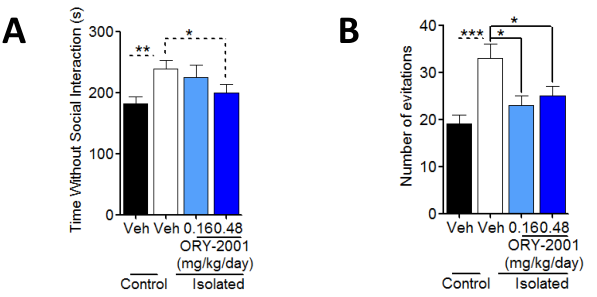
The RI test was also conducted in the rat isolation model with ORY-2001. Rats are very social rodents and do not tolerate isolation. Rat isolation therefore was used as a model for social avoidance seen in AD patients. Rats were divided into control arm (three to four animals per cage) or isolated (one animal per cage). Isolated animal were treated with vehicle or ORY-2001 for five weeks; control animals were given vehicle. After that all animals were tested in the RI test. The findings were:
■
No aggressive behaviour was observed in the rats in either group, confirming the social nature of the animals.
■
Social avoidance measured by time without social interaction and number of evitations was significantly increased in isolated rats treated with vehicle, indicating the socially detrimental effect of the isolation. However, the treatment with ORY-2001 significantly improved both parameters.
|
Exhibit 4: RI test demonstrates ORY-2001’s efficacy in rat isolation model |
|
|
Source: Oryzon Genomics poster presentation |
These results suggest that ORY-2001 could have an effect on both cognitive decline and behavioural symptoms of AD. Specific treatments for behavioural symptoms such as aggression and social isolation are lacking and so tackling these could help to make ORY-2001 more competitive in the market. A large proportion of AD patients (20-50%) exhibit clinically significant aggression as a neuropsychological symptom. Currently this is managed by non-pharmacological as well as pharmacological means. There is no FDA approved specific medication for the treatment of aggression in AD. Memantine is the only drug approved for AD that has also been shown to reduce symptoms of agitation and aggression, whereas other drugs used are more general antipsychotics, antidepressants or anxiolytic drugs and often have unfavourable safety profiles.
Next steps with ORY-2001 in AD
The next step in the development of ORY-2001 for the treatment of AD is the Phase IIa study ETHERAL, “Epigenetic THERapy in ALzheimer’s Disease”. It will be a randomised, double-blind, placebo-controlled trial and will include 90 patients with mild to moderate AD. The study will consist of a screening period and a 26-week treatment period with open-label extension of another 26 weeks. The aim is to evaluate safety, tolerability and clinical effects. This trial is due to start in Q118 and due to end in Q419, but preliminary readout is planned in early 2019.
ORY-3001’s first preclinical data revealed
Another notable recent revelation was the first published preclinical data from preclinical studies with ORY-3001 (specific LSD1 inhibitor), Oryzon’s third lead product. The data showing ORY-3001’s efficacy in animal models of sickle cell disease (SCD) were presented at the American Society of Hematology (ASH) 59th annual meeting on 9-12 December 2017 in Atlanta, GA. This is in line with Oryzon’s intention to continue the development of ORY-3001 in certain orphan diseases.
There two types of haemoglobin: foetal (HbF) and adult. While HbF represents most of haemoglobin in foetal life, it drops to <1% in normal adults and is found in a few “F-cells”. The purpose of this study was to investigate whether ORY-3001 has the potential to increase HbF, which could replace the function of the mutated adult Hb. The results showed that oral administration of ORY-3001 increased HbF 10-fold in SCD transgenic mice. So called F reticulocytes (young red blood cells containing HbF) increased 300%. In baboons, F-reticulocytes increased 8-fold. As a next step Oryzon indicated that it will continue the development of ORY-3001 for SCD, although no specific details were announced.
SCD is a genetic disease where an adult gene for haemoglobin (a protein responsible for oxygen transport in red blood cells) is mutated resulting in abnormal shaped red blood cells, which resemble a sickle. This leads to anaemia and red blood cells being not able to pass through the smallest blood vessels, capillaries. This results in vaso-occlusive crisis, acute or chronic pain, and decreased supply of oxygen to organs, which causes damage and many other symptoms. Currently there is no cure and only symptomatic treatment is used. Hydroxyurea therapy is the only drug approved in the US for SCD to treat frequent and severe pain; however, it is not effective in a significant portion of patients. SCD is the most common inherited blood disorder with around 100k patients (emedicine.com) in the US alone and especially prevalent among African Americans, with up to 30% of people in some parts in Africa being heterozygotes for sickle cell mutated gene (carriers). The prognosis is rather adverse with median age of death being 42-48 years (emedicne.com).
Multiple key catalysts likely in early 2019
Oryzon is about to get back the rights from Roche for ORY-1001 (discussed in our previous report), once Roche finalises the dose-finding study in small cell lung cancer patients. Oryzon previously indicated that it planned to continue the development of ORY-1001 in both clinical-stage indications (Phase I dose finding data for SCLC; Phase I/IIa data for acute leukaemias). According to new details, the company plans to initiate a new Phase I/IIa study in SCLC and a follow on Phase IIa in acute myeloid leukaemia (AML), which could both start in Q218. This means that preliminary data readouts from all four trials with ORY-1001 and ORY-2001 are expected in early 2019 and all are key catalysts reachable with the current cash position.
Financials and valuation
Oryzon’s 9M17 financial update came in with no surprises. 9M17 R&D costs were €4.3m compared to €3.4m a year ago, while total operating costs were €7.1m versus €7.0m last year. We have somewhat fine-tuned our estimates for 2017 (mainly increasing the capitalisation of expenses via the revenue line [Oryzon follows local GAAP] and lowering other costs). 2018 estimates were affected due to revision of our R&D costs downwards as Oryzon indicated that the two new studies related to ORY-1001 could be smaller and aimed at generating a dataset that would be beneficial during the licensing negotiations (no further details have been provided so far). As previously, we still expect an increase in R&D costs next year related to the initiation of the new clinical trials.
Exhibit 5: Key changes to our financial forecasts
€m |
2016 |
2017e |
2018e |
||||
Actual |
Old |
New |
Change (%) |
Old |
New |
Change (%) |
|
Revenue |
5.009 |
4.381 |
4.742 |
+8% |
7.906 |
7.014 |
-11% |
Gross profit |
5.009 |
4.381 |
4.742 |
+8% |
7.906 |
7.014 |
-11% |
R&D costs |
(5.210) |
(5.774) |
(5.774) |
0% |
(13.577) |
(8.502) |
-37% |
Operating profit (rep) |
(4.578) |
(6.061) |
(4.883) |
-19% |
(10.875) |
(5.005) |
-54% |
Profit before tax (rep) |
(5.480) |
(7.330) |
(6.152) |
-16% |
(12.090) |
(5.799) |
-52% |
Profit after tax (rep) |
(5.448) |
(7.330) |
(6.152) |
-16% |
(12.090) |
(5.799) |
-52% |
EPS reported (€) |
(0.20) |
(0.23) |
(0.20) |
-16% |
(0.35) |
(0.17) |
-52% |
Source: Oryzon Genomics accounts, Edison Investment Research
As Oryzon is on track to develop its assets in all the indications we currently include in our valuation, we maintain all our assumptions unchanged. Our new valuation is €305m or €8.9/share, marginally up from €294.9m or €8.6/share due to rolling our model forward, which was partially offset by a lower net cash position.
Exhibit 6: Oryzon rNPV valuation
Product |
Indication |
Launch |
Peak sales* |
Value |
Probability |
rNPV |
rNPV/share |
ORY-1001 |
AML |
2023 |
930 |
244.4 |
15% |
44.3 |
1.3 |
ORY-1001 |
SCLC |
2026 |
570 |
119.3 |
8% |
20.3 |
0.6 |
ORY-2001 |
AD |
2026 |
4,510 |
891.1 |
15% |
135.9 |
4.0 |
ORY-2001 |
MS |
2027 |
1,940 |
395.5 |
20% |
93.8 |
2.7 |
Net cash (FY17e) |
11.0 |
100% |
11.0 |
0.3 |
|||
Valuation |
|
|
1,661.3 |
305.4 |
8.9 |
Source: Edison Investment Research. Note: *Peak sales are rounded to the nearest US$10m, shown in US dollars. SCLC = small cell lung cancer; AML = acute myeloid leukaemia; AD = Alzheimer’s disease; MS = multiple sclerosis. Net cash includes term deposits.
Exhibit 7: Financial summary
€000s |
2013 |
2014 |
2015 |
2016 |
2017e |
2018e |
||
December |
Local GAAP |
Local GAAP |
Local GAAP |
Local GAAP |
Local GAAP |
Local GAAP |
||
PROFIT & LOSS |
||||||||
Revenue |
|
|
2,360 |
15,536 |
7,185 |
5,009 |
4,742 |
7,014 |
Cost of Sales |
0 |
0 |
0 |
0 |
0 |
0 |
||
Gross Profit |
2,360 |
15,536 |
7,185 |
5,009 |
4,742 |
7,014 |
||
Research and development |
(873) |
(1,108) |
(3,191) |
(5,210) |
(5,774) |
(8,502) |
||
EBITDA |
|
|
(94) |
11,659 |
688 |
(3,721) |
(4,047) |
(4,695) |
Operating Profit (before amort. and except.) |
(370) |
11,398 |
448 |
(3,879) |
(4,144) |
(4,791) |
||
Intangible Amortisation |
(657) |
(657) |
(657) |
(695) |
(739) |
(214) |
||
Exceptionals |
(186) |
(4,617) |
(24) |
(4) |
0 |
0 |
||
Other |
0 |
0 |
0 |
0 |
0 |
0 |
||
Operating Profit |
(1,213) |
6,124 |
(233) |
(4,578) |
(4,883) |
(5,005) |
||
Exceptionals |
0 |
667 |
(169) |
(58) |
0 |
0 |
||
Net Interest |
(672) |
(52) |
(553) |
(844) |
(1,269) |
(793) |
||
Profit Before Tax (norm) |
|
|
(1,042) |
11,346 |
(105) |
(4,724) |
(5,413) |
(5,584) |
Profit Before Tax (reported) |
|
|
(1,885) |
6,739 |
(955) |
(5,480) |
(6,152) |
(5,799) |
Tax |
89 |
(88) |
(37) |
32 |
0 |
0 |
||
Profit After Tax (norm) |
(953) |
11,258 |
(142) |
(4,692) |
(5,413) |
(5,584) |
||
Profit After Tax (reported) |
(1,796) |
6,651 |
(992) |
(5,448) |
(6,152) |
(5,799) |
||
Average Number of Shares Outstanding (m) |
23.0 |
23.3 |
24.7 |
27.6 |
31.3 |
34.2 |
||
EPS - normalised (€) |
|
|
(0.04) |
0.48 |
(0.01) |
(0.17) |
(0.17) |
(0.16) |
EPS - reported (€) |
|
|
(0.08) |
0.29 |
(0.04) |
(0.20) |
(0.20) |
(0.17) |
Dividend per share (€) |
0.0 |
0.0 |
0.0 |
0.0 |
0.0 |
0.0 |
||
Gross Margin (%) |
100.0 |
100.0 |
100.0 |
100.0 |
100.0 |
100.0 |
||
EBITDA Margin (%) |
N/A |
75.0 |
9.6 |
N/A |
N/A |
N/A |
||
Operating Margin (before GW and except.) (%) |
N/A |
73.4 |
6.2 |
N/A |
N/A |
N/A |
||
BALANCE SHEET |
||||||||
Fixed Assets |
|
|
20,128 |
16,059 |
18,050 |
21,269 |
25,175 |
31,879 |
Intangible Assets |
15,825 |
12,928 |
15,188 |
18,810 |
22,813 |
29,613 |
||
Tangible Assets |
1,159 |
981 |
854 |
696 |
600 |
503 |
||
Investments |
3,145 |
2,150 |
2,008 |
1,763 |
1,763 |
1,763 |
||
Current Assets |
|
|
2,851 |
9,999 |
22,681 |
28,475 |
32,082 |
19,599 |
Stocks |
2 |
9 |
4 |
8 |
6 |
7 |
||
Debtors |
663 |
704 |
940 |
978 |
859 |
519 |
||
Cash |
2,033 |
3,633 |
19,467 |
22,028 |
31,076 |
19,074 |
||
Other* |
153 |
5,654 |
2,270 |
5,461 |
141 |
0 |
||
Current Liabilities |
|
|
(2,724) |
(3,969) |
(5,296) |
(7,597) |
(8,726) |
(8,746) |
Creditors |
(1,005) |
(1,299) |
(2,401) |
(2,119) |
(2,080) |
(2,100) |
||
Short term borrowings |
(1,719) |
(2,670) |
(2,895) |
(5,477) |
(6,646) |
(6,646) |
||
Long Term Liabilities |
|
|
(11,251) |
(8,196) |
(7,841) |
(19,419) |
(15,102) |
(15,102) |
Long term borrowings |
(9,117) |
(6,420) |
(6,177) |
(17,723) |
(13,406) |
(13,406) |
||
Other long term liabilities |
(2,134) |
(1,776) |
(1,664) |
(1,696) |
(1,696) |
(1,696) |
||
Net Assets |
|
|
9,004 |
13,893 |
27,594 |
22,729 |
33,429 |
27,631 |
CASH FLOW |
||||||||
Operating Cash Flow |
|
|
(113) |
12,178 |
1,076 |
(4,536) |
(5,235) |
(5,129) |
Net Interest |
(672) |
(52) |
(553) |
(471) |
(1,269) |
(793) |
||
Tax |
0 |
0 |
0 |
0 |
0 |
0 |
||
Capex |
0 |
0 |
0 |
(28) |
0 |
0 |
||
Acquisitions/disposals |
(677) |
798 |
0 |
0 |
0 |
0 |
||
Financing |
0 |
0 |
14,725 |
287 |
16,853 |
0 |
||
Other** |
(161) |
(9,579) |
605 |
(6,819) |
1,847 |
(6,080) |
||
Dividends |
0 |
0 |
0 |
0 |
0 |
0 |
||
Net Cash Flow |
(1,623) |
3,345 |
15,853 |
(11,567) |
12,196 |
(12,002) |
||
Opening net debt/(cash) |
|
|
7,180 |
8,803 |
5,458 |
(10,395) |
1,172 |
(11,024) |
HP finance leases initiated |
0 |
0 |
0 |
0 |
0 |
0 |
||
Other |
0 |
0 |
0 |
0 |
0 |
0 |
||
Closing net debt/(cash) |
|
|
8,803 |
5,458 |
(10,395) |
1,172 |
(11,024) |
979 |
Source: Oryzon Genomics accounts, Edison Investment Research
|
|
Research: Industrials
John Laing Group’s (JLG) trading update and recent disposal of a wind farm provided year-to-date figures for investment commitments and realisations. The figures confirmed the strength of the underlying infrastructure project market and highlighted the increased level of activity within the business. We have revised our forecasts and now expect a special dividend payment of 5.3p/share (6.5% of £299m), offering a yield on the final and special payments combined, of c 3.3%. We expect further NAV growth in FY17 and beyond, and believe JLG’s rating is undemanding.